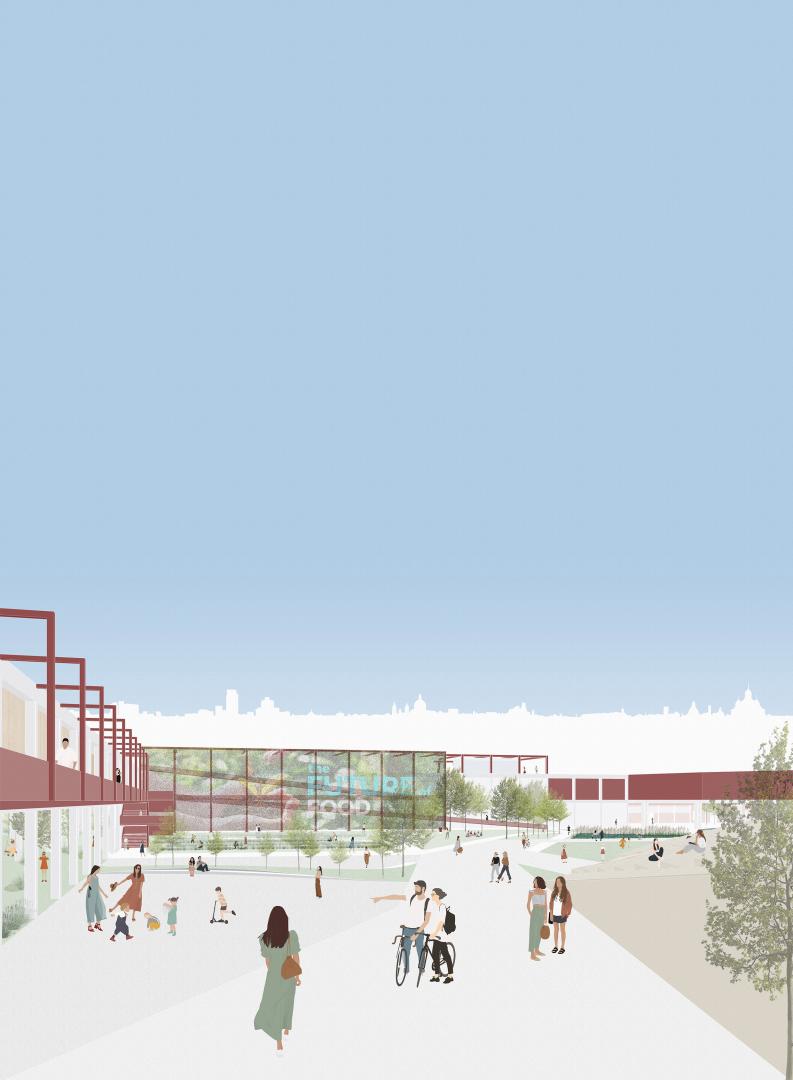
Madrid 2030: Future Hybrid Factory
Basic information
Project Title
Full project title
Category
Project Description
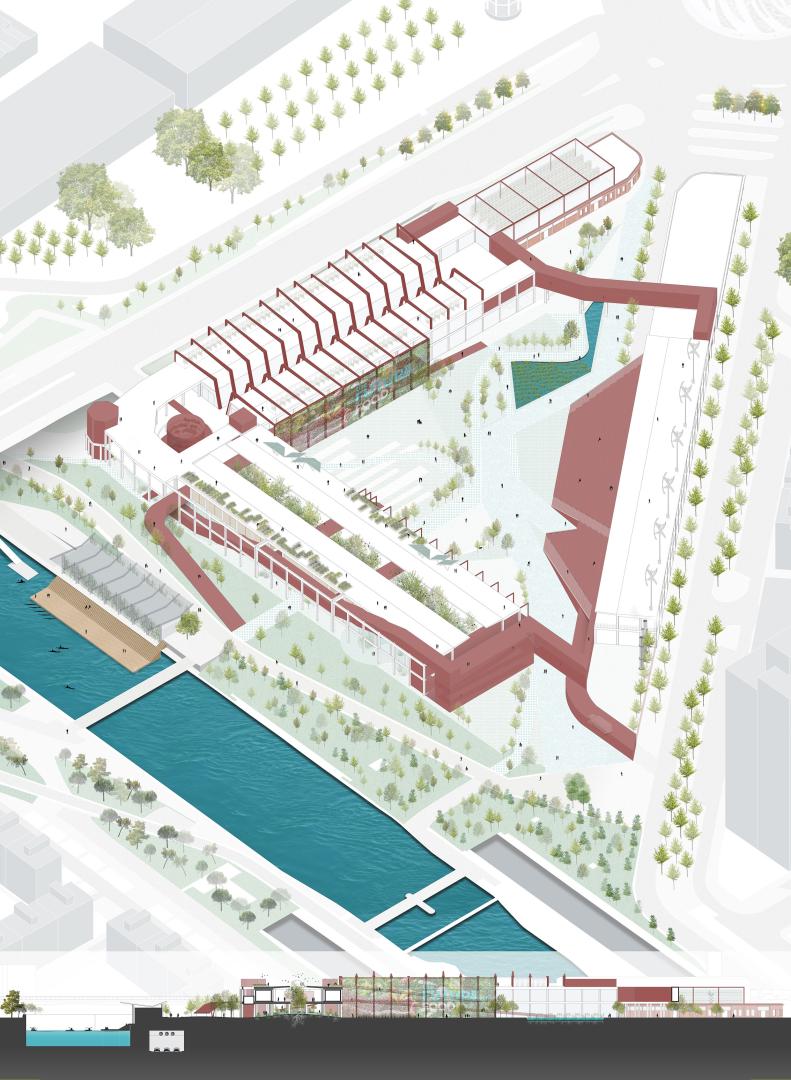
The project aims to recycle Madrid's Mercado de Frutas e Verduras, a building disused in 1983 located south of the city in a strategic position between the two linear parks that line the Manzanarre: the Madrid Río and the Parque Lineal del Manzanares. The recycling of the building will contribute to the creation of a self-sufficient and sustainable city.
Project Region
EU Programme or fund
Description of the project
Summary
Madrid, thanks to its experiments in urban gardens, seems to be fertile ground for experiments in the field of urban agriculture and it is for this reason that it is possible to imagine, precisely in Madrid, projects that can make a contribution in facing global crises, entering the European framework of the Green Deal.
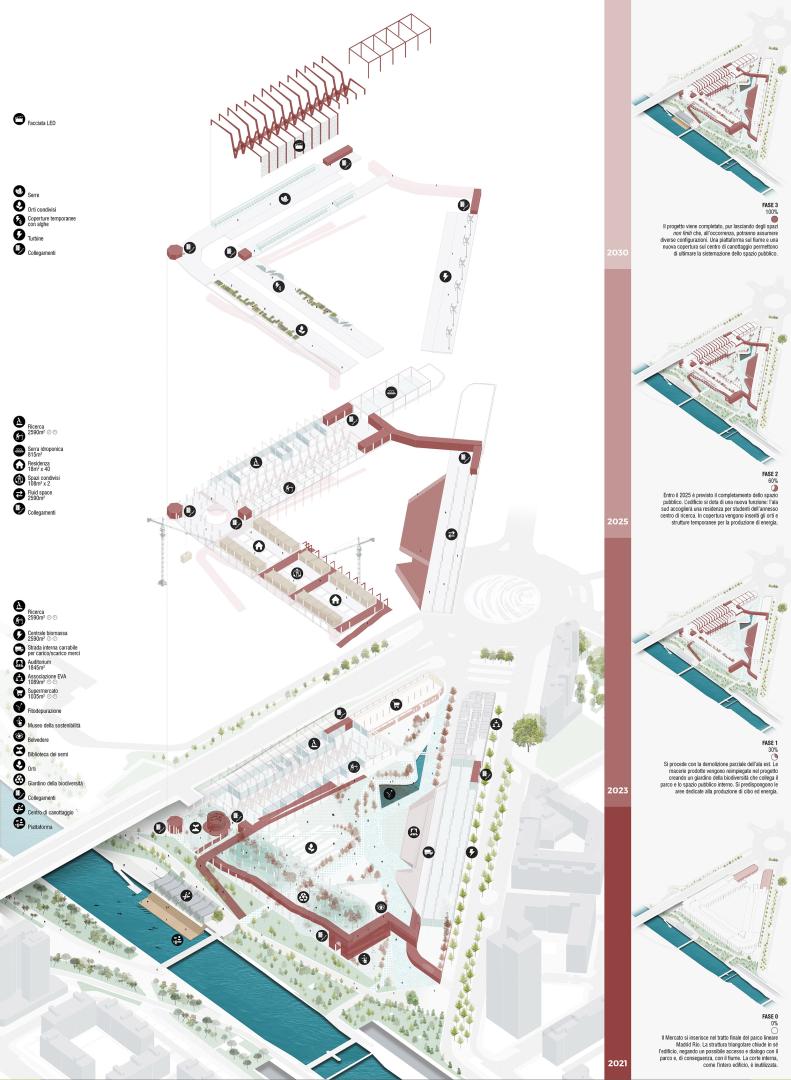
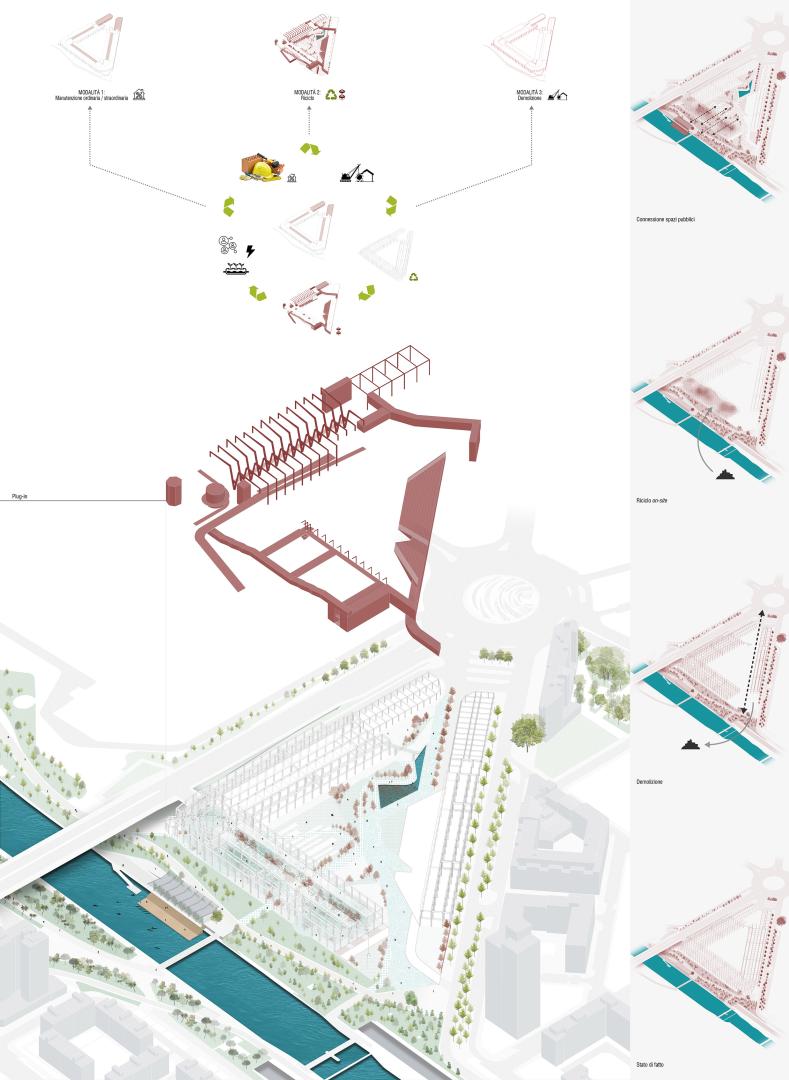
The project aims to recycle Madrid's Mercado de Frutas e Verduras, a building disused in 1983 located south of the city in a strategic position between the two linear parks that line the Manzanarre: the Madrid Río and the Parque Lineal del Manzanares. The recycling of the building will contribute to the creation of a self-sufficient and sustainable city: it will be a productive and highly technological building, in which different types of agriculture will be used for the production of food and the waste will find a second life in energy production, thus creating a closed circle in which everything is transformed.
The development of this infrastructure is the key to enhancing proximity between producers and consumers, improving access to different, safe and nutritious foods, strengthening emergency preparedness and reducing the distance traveled by food. From this point of view, the recycling of the Market could positively contribute to food and environmental sustainability by not weighing heavily on the resources of the planet, which is already in serious suffering.
Key objectives for sustainability
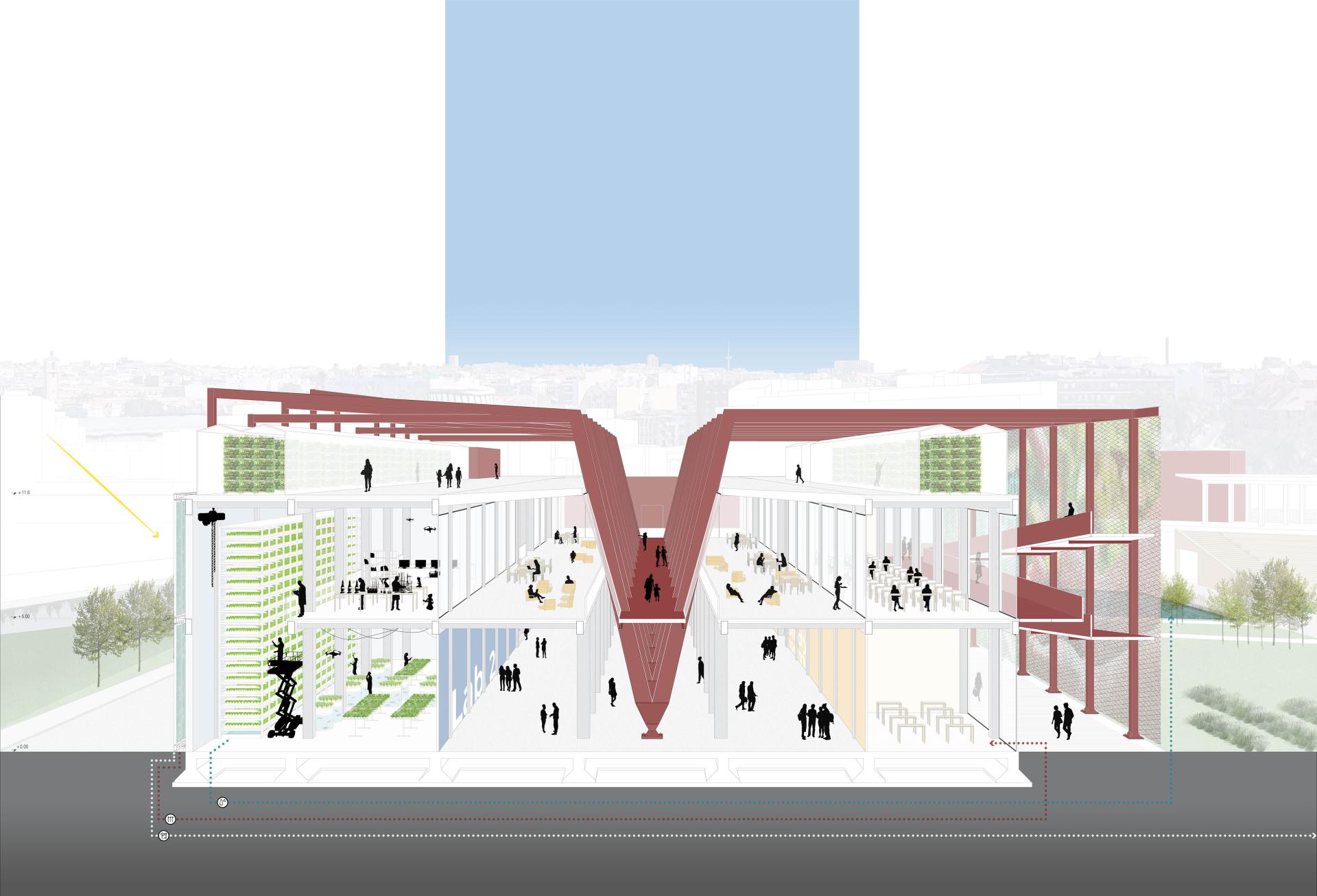
The pandemic crisis has highlighted the fragility and vulnerability of the systems in which we live, but at the same time it offers us the opportunity to start from scratch, think about new paradigms, new strategies for new development models. The values of the reversibility and adaptability of architecture make room for themselves on a crowded, overheated, sick planet and allow the creation of a city that is no longer static, but capable of regenerating itself from its own waste. The vision of a continuous productive landscape5 lays the foundations for what can be called a productive city: a city that reconnects with the countryside, generates new agricultural paradigms and is based on the revaluation of food. Agriculture then becomes the means by which it is possible to recycle abandoned buildings and is declined in its various forms: from urban gardens to agriculture 2.0 (hydroponics, aeroponics, aquaponics). These systems, integrated with a phytoremediation plant and a biomass plant, will allow the creation of closed cycles. In addition, one of the facades is covered with flat screen bioreactors made up of microalgae, a system designed and patented by ARUP, SSC Strategic Science Consult and Colt International. It is a real living facade in which compressed air is introduced at regular intervals to stimulate the algae to absorb CO2 and sunlight, producing heat and biomass, then heating and energy that will be reused in the building.
Key objectives for aesthetics and quality
Recycling makes it possible to see existing architecture as a resource to be able to create a "new" architecture that «has a multiple, multifaceted functionality, and therefore a certain versatility of spaces, as only [...] versatility makes this possible that characterizes the city, namely the overlapping of uses. the recycling operation translates into its urban dimension through the recycling of public space, and into its architectural dimension through the recycling of the market, reaching a final hybrid image that will be the synthesis of the complex dynamics that characterize the physical and theoretical context in which the project is inserted into.
The project is divided into three areas: research (on urban agriculture issues), housing and biomass power plant.
The model of residence as a "closed container-building" put in crisis by the pandemic here makes room for another vision: that of a skeleton in which it is possible to insert, remove, move prefabricated housing capsules, referring to the imagery of the Ville Spatiale and the subsequent Plug-in City. These capsules will in fact find their place on the first floor of the building, leaving the public space on the ground floor: the garden of biodiversity. The presence of this garden will contribute to the CO2 - O2 exchange, ensuring a natural exchange of air for the guests of the residence.
Key objectives for inclusion
All the spaces described try to establish a relationship with the surrounding environment and in particular with the internal public space which was conceived as an extension of the linear park: a place of connection, exchange and sociality that seeks to encourage interaction between the physical and digital environment.
Innovative character
Urban agriculture, with a view to recycling, becomes the engine through which it is possible to reactivate the building both in its social and technological dimension: the crops included, as well as the building, will not consume soil and will contribute to environmental sustainability.
The Future Hybrid Factory can be seen as a virtuous model that can be replicated not in its form, but in its concepts, extending its effects beyond the scale of the intervention, towards a scale of the city. It is also a valid response to the need to "reconcile our food system with the needs of the planet and respond positively to the desire of Europeans for healthy, fair and environmentally friendly food products."