Boekentoren
Basic information
Project Title
Full project title
Category
Project Description
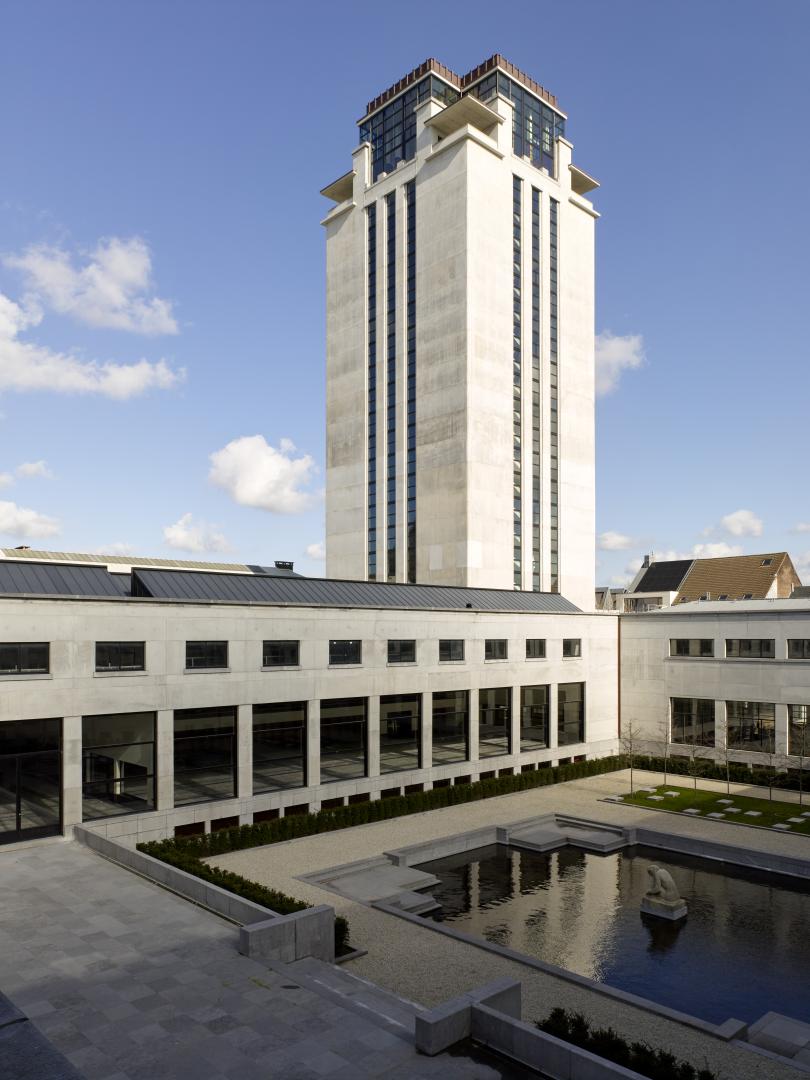
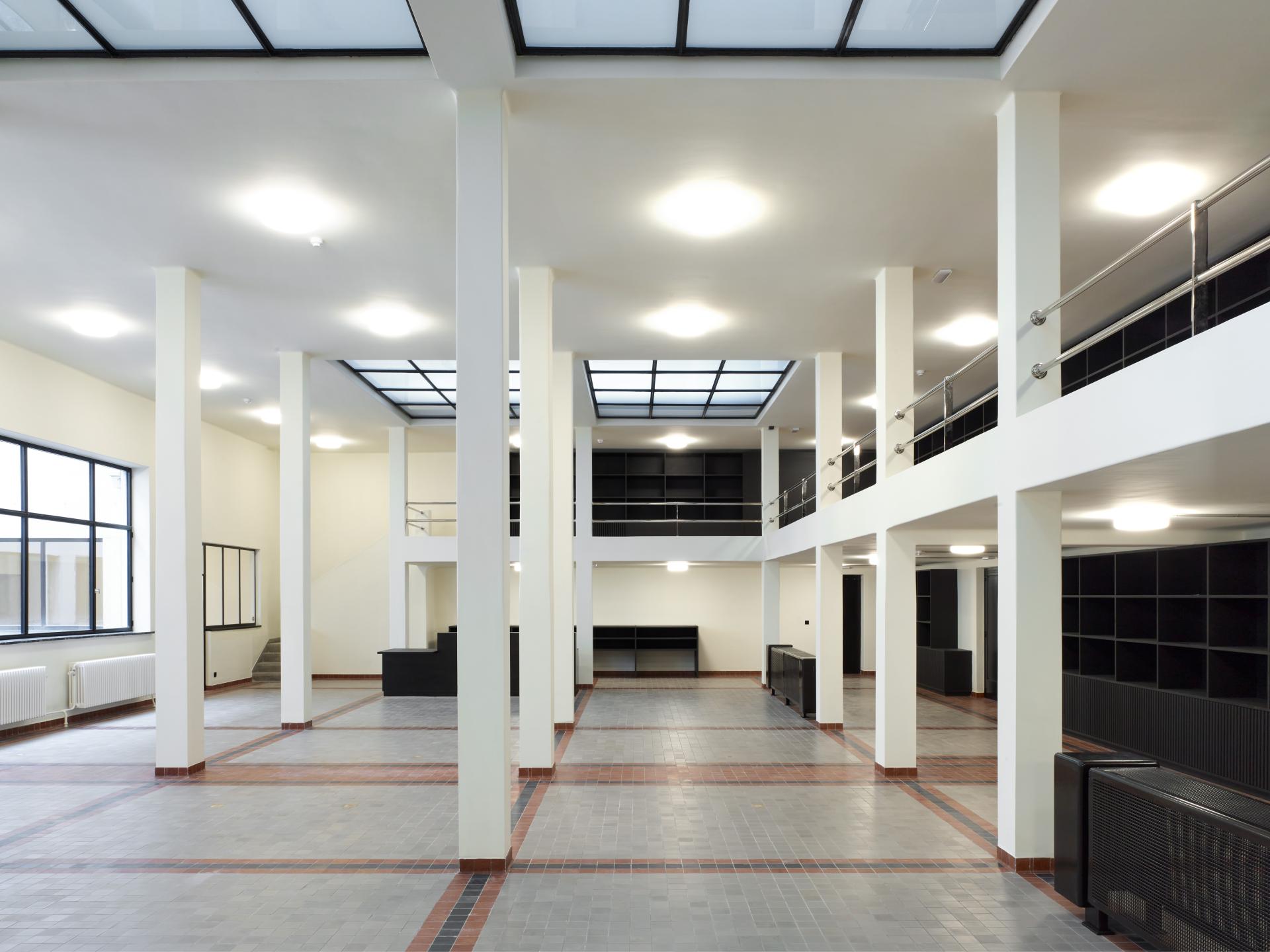
The Boekentoren, a modernist masterpiece designed by Henry van de Velde in the 1930s, has been restored and geared to the current requirements of library use and conservation. To this end, a new entrance pavilion generates a new sequence of spaces around the inner garden. Including a reading café, a canopied terrace and workspaces for handling digital data. Together with the necessary technical modifications, this clear-up restores the building’s dignity as a place for study and reading.
Project Region
EU Programme or fund
Which funds
Other Funds
OpenAIRE
Description of the project
Summary
The Central Library of Ghent University, a modernist masterpiece designed by Henry van de Velde in the 1930s, has been restored and adapted to the current requirements of library use and conservation. This project – also known as the Boekentoren or Book Tower — was the final monumental realisation of the Art Nouveau architect and ranks as one of the most important public buildings that he built in his native country, Belgium. The plan to add a tower to the city of Ghent and in doing so, to mark the presence of the university, was ambitious from the start.
With 64 meters in height, the Boekentoren adds a fourth major tower to the silhouette of Ghent. The project displays Van de Velde’s pioneering library concept: contrary to 19th century library layouts, Van de Velde separates collection storage from consultation space, stacking the collection efficiently on several tower levels, thus allowing for brightly lit and spacious reading rooms. The brutal fair-faced concrete skin — unusual for the time of building — and the elegant exterior framework in steel accentuated Van de Velde’s volumetric game of horizontal versus vertical.
Restored and renovated by Robbrecht en Daem architecten in collaboration with BARO, SumProject and Barbara Van der Wee architects (2007-2021), this conservation project aimed at restoring the historical site of the University Library, meanwhile advertising it as a library for the 21st Century. The design unites the ambitions of the University to respectfully repair the monumental site to its original condition, but also to render it a contemporary house for a great diversity of users and for the valuable library collections. Among the major interventions: a new underground depository for over 40 kilometers of books, a insulating box-in-box layout, the restoration of the tower’s famous concrete skin, a new entrance pavilion and future reading café, a new climatic systems for the Main Wing as well as new skylights and a new visitors’ centre.
Key objectives for sustainability
One of the most important interventions that has contributed to the transformation of the Boekentoren to a future-oriented, sustainable monument is the interior insulating box-in-box layout that was designed for the book storage levels in the entire tower. This layout allows the library to store precious collection objects in bettered climate conditions at limited energy cost, without interfering with the concrete façade in order to provide insulation. Another crucial intervention was the realisation of a new underground book depository beneath the historical courtyard. These two newly added levels not only ensure optimal climate conditions for the future, but made it possible that not one object of the precious collection originally stocked in the tower had to leave the site during the restoration. This was an advantage in terms of heritage and sustainability as the transportation of the entire collective memory of the tower was spared.
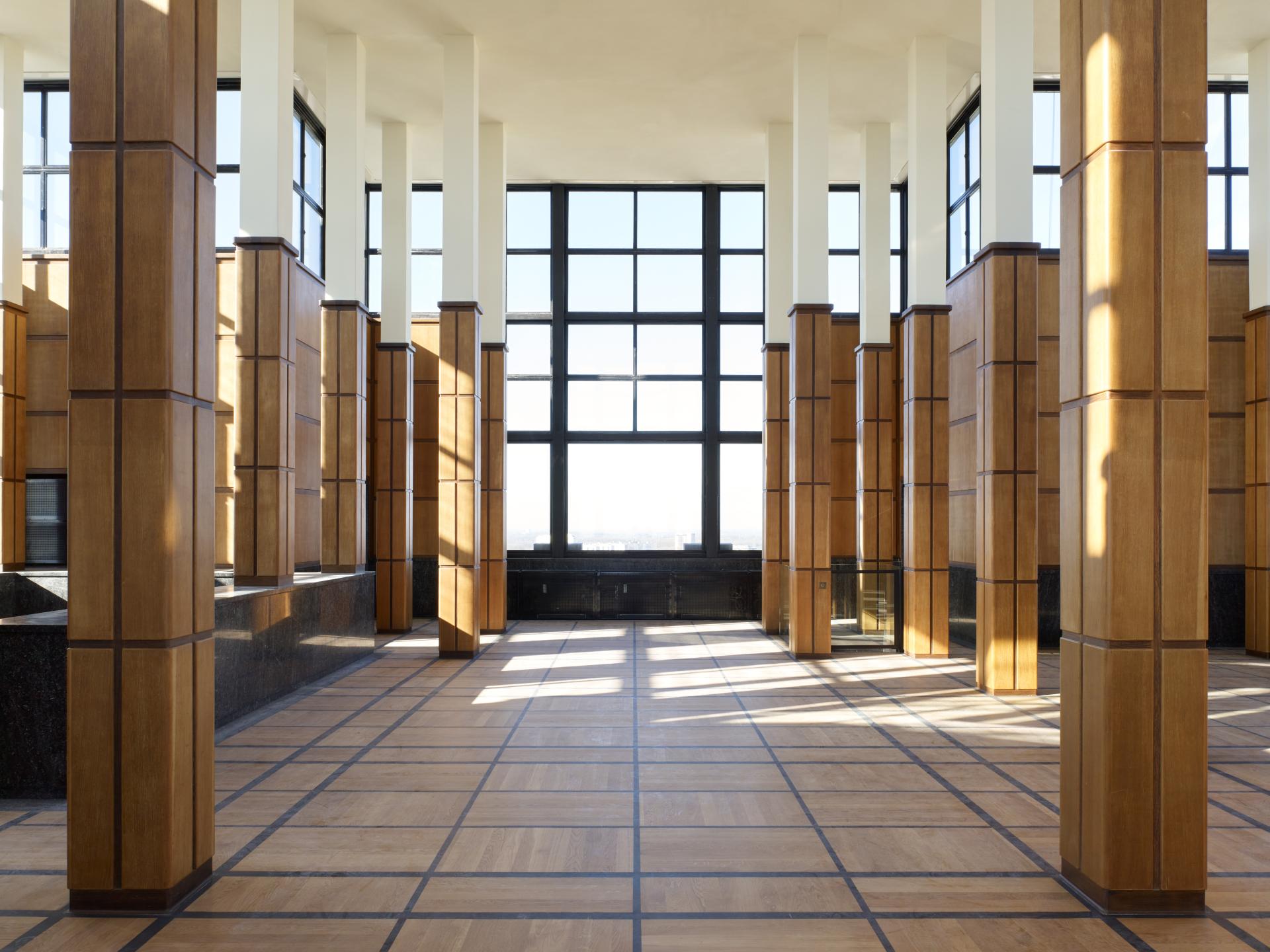
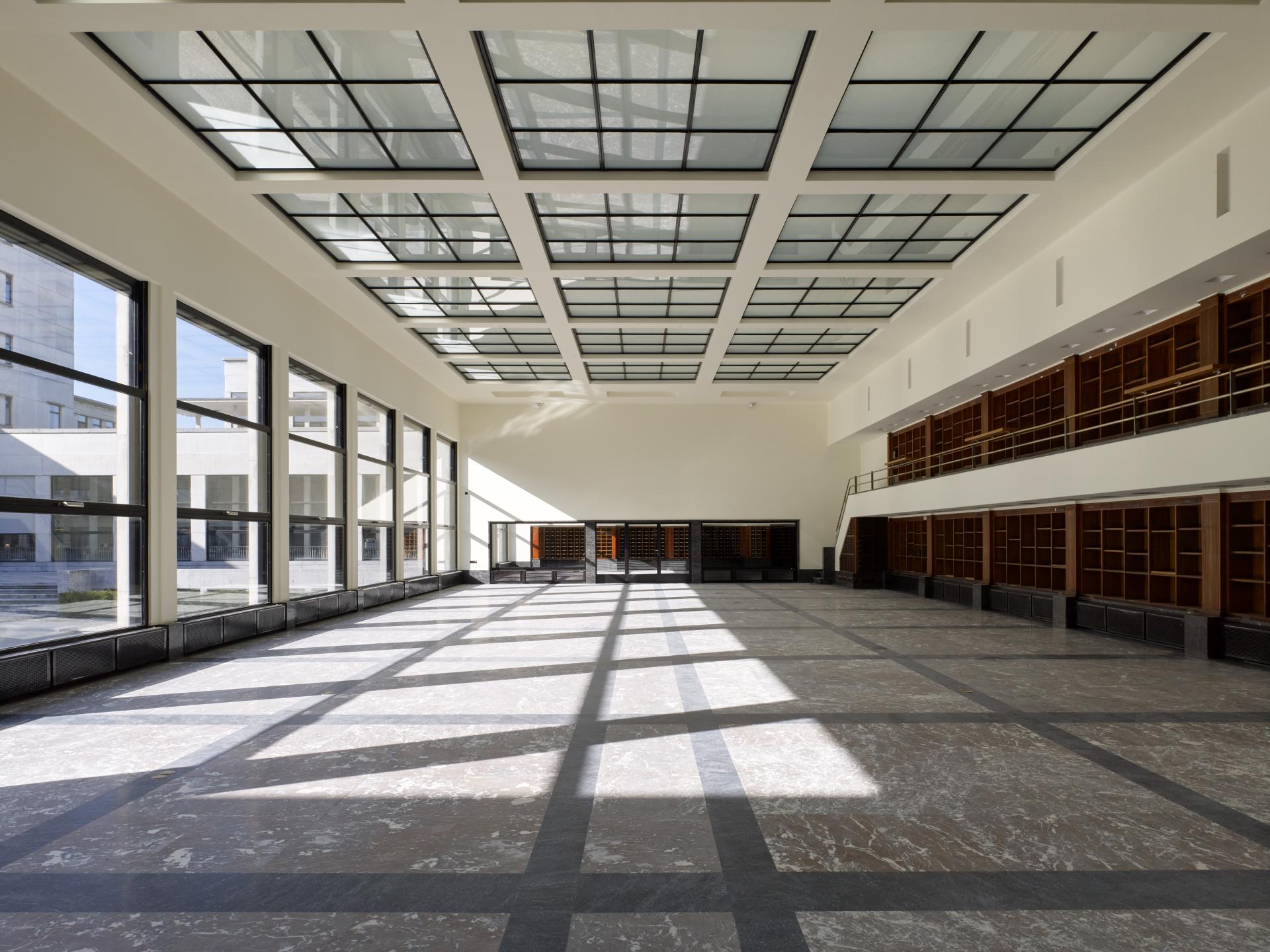
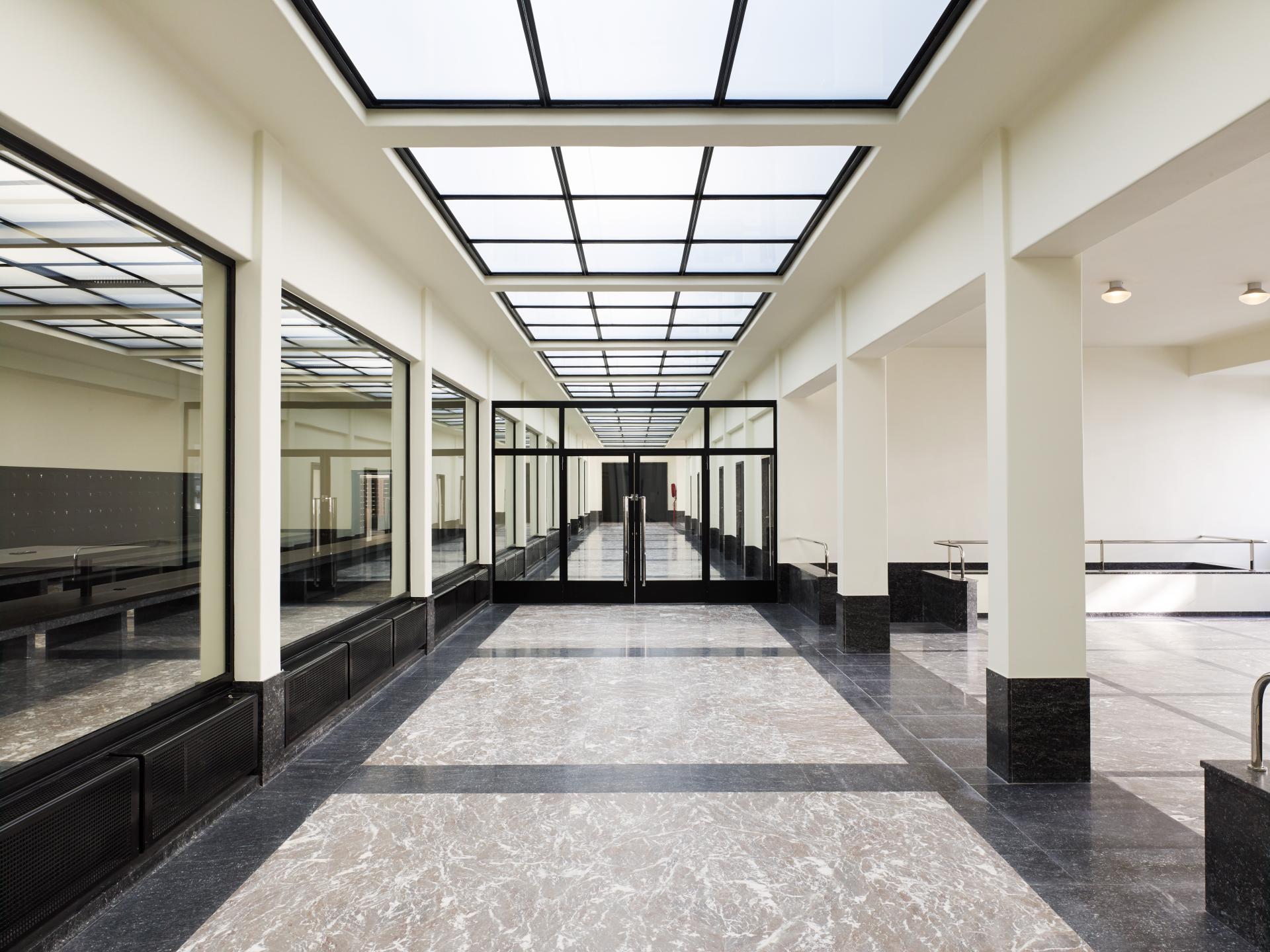
Having a closer look at the Main Wing, this part of the site received a contemporary climate installation, fully integrated into the architecture, as well as new roof lights to prevent excessive summer heating without obstructing the characteristic daylight infiltration into the spaces. Whereas the roof used to let in light from different directions, it is now fully orientated to the north. In addition, sunscreens have been added to the windows surrounding the inner main courtyard and to the observation room in the tower.
Although a highly complex process, the original floor tiles were reused, which fits with both the heritage and sustainability ambitions of the project. Excess stones from the roof were not removed from the site, but were used as stepping stones in the courtyard. The new joinery not only focused on bringing back the original slender steel profiles and subdivision, but intensive research was conducted on high performing ultra-transparent glazing. Trees and greenery were added to the courtyards and inner streets.
Key objectives for aesthetics and quality
As this tower was constructed at the end of Henry van de Velde’s career, it is emblematic of the confrontation of contradictory elements that can be found in many of his designs. Moving from Art Nouveau to a Pre-Modern sensitivity, the library incorporates this fascinating duality from masterplan to detail: straight versus curved lines, functional rigor versus ornate dynamism, tradition versus modernity. Van de Velde made a total design of the building. He designed the wall racks in the reading room, the wooden cabinets in the periodicals room, the card index furniture in the catalogue room and every possible detail for the interior: floor patterns, door knobs, radiator hoods, as well as the black iron window profiles. The low partition windows beautifully contrast with the double-height space.
Walking through the public and private spaces of the library, this ‘gesamtkunstwerk’ can be experienced today in its original splendour. “We’ve changed a lot to change nothing at all,” state the architects, as all building parts have been freed of non-original layers and additions, bringing the complex back to Van de Velde’s spirit, but with the latest technologies hidden inside. It results in a remarkable moment for architecture, the history of the arts and the oeuvre of Henry Van de Velde, who along with Belgian architect Victor Horta, was one of the most important figures of his time.
Key objectives for inclusion
The restoration of the Boekentoren aimed at a few crucial interventions and functional reshuffles to increase their meaning and use for a diverse range of users, from students, to researchers, honourable guests, city residents and even tourists. Prior to the restoration, intense thought was given to the meaning of a library and archive today. With the rise of new media, a library has changed as a place and as a service provider. The actual place where one can read and study is in fact part of the reading experience. Therefore, the Main Wing retrieved its originally studious character by regrouping and reinforcing a few student facilities in the west wing (HIKO): a new side entrance pavilion allows direct access to a multimedia centre with increased capacity, two new classrooms and a future reading café. Besides a study area the building now holds meeting places as well, adding an extra social purpose to the monument. This student hub will form a hinge between the main reading rooms and the adjacent Faculty of Arts and Literature. On the other end of the horizontal complex, the ‘belly’ of the Tower will house a new visitors’ centre with exhibition and meeting facilities. From this foyer the public will be able to visit the most emblematic space of the project, the Belvedère. It’s the building’s apotheosis that will be more accessible in general through guided tours from now on. Concerning accessibility in circulation, we can highlight that two new entrances were added to the monument. Where the building had no wheelchair-accessible entrance before, it now does, fully integrated in the original architecture. In the past, inside the tower wheelchair users only had access to the penultimate floor. A platform has now been added to make the Belvedère entirely inclusive. The addition of a second staircase in the tower (resulting in safe access for twice as many people to the Belvedère) and a priority lift further contribute to increasing the accessibility of the monument.
Results in relation to category
The Boekentoren was the final monumental realization of Van de Velde and ranks highly in Belgium’s cultural heritage. In order to preserve this heritage in its intended function, interventions in the spirit of Van de Velde were made to expand the meaning and use of the building. These modifications include: the realisation of a new underground book depository; the restoration of the tower’s famous concrete skin; the tower’s insulating box-in-box layout; the restoration of interior finishes and furniture; the careful study of original plan layouts to re-establish lost spatial situations; a new entrance pavilion and reading café; the planting of trees originally drawn by Van de Velde; the restoration of the terrace’s canopy, once demolished, to its former glory… All these interventions contribute to improving the functioning heart of the building and the university library’s mission to enhance public access to the impressive collections and to facilitate open knowledge creation online and in the reading rooms. Besides the architectural interventions, two new works of art (by Berlinde De Bruyckere and Dirk Braeckman) are integrated into the monument and in their own way, add an extra layer of cultural meaning.
Concentrating the library collection in one site, with storage facilities both in the tower and in the underground depository and digitization facilities on site, allows for efficient and sustainable on demand scanning by the library. Since the start of the renovation project, any UGent registered student and researcher can request a quick scan of a journal article or book chapter directly from the website, delivered as PDF to their inbox on the next day. This service has proven to be invaluable during the Covid-19 pandemic. Scanning of the heritage collections is a routine process in the library, where requests for high resolution reproductions and preservation-driven digital surrogates are made available online with open licenses, free for everyone to use.
How Citizens benefit
The restoration of the Boekentoren increases the building’s meaning and use for a diverse range of users, from students, to researchers, to the citizens of Ghent. At the time of the initial construction works, the Boekentoren was already a statement. Up to that point, the city's tallest buildings were all religious landmarks. Suddenly, a tower of books and knowledge rose in between church towers. In 2007, a televised challenge mobilized thousands of citizens and alumni and raised awareness of the need for renovation of the monument itself. The University rose to the occasion and an overall masterplan was drafted. Today, the renovated tower only reinforces its position as a landmark of knowledge for Ghent, both as a university and as a city. Van de Velde’s tower is not seen as outdated, on the contrary, it makes even more sense today. As an orientation point in the city and explanation mark against the skyline, it is a great pleasure for citizens to recognize their monument again, after decades of decayed concrete and years of scaffolding.
Besides a renewed house for study and reading, citizens find another experience that was not accessible before. From now on, Ghent University opens up the Belvedère — the stunning observation room on the top floor of the tower that offers a panoramic view of the city through four glass facades — to the public through guided tours. Prior to the restoration, this room was reserved for employees and privileged moments. A hidden gem that without a doubt, once visited, will hold a special place in every citizen’s heart.
Innovative character
We would like to highlight two major innovative milestones within the restoration of the Central Library of Ghent University. One is the unseen restoration of the concrete skin. With his austere concrete facades, Van de Velde was radically modern and embraced innovative concrete construction techniques. During the last years before the restoration, the concrete skin had become a yellow epoxy patchwork — an artificial protection layer that only prevented the old concrete from falling down. This layer hid the original skin entirely and was far from what Van de Velde had in mind for the tower’s facade. It required scraping off 6 centimetres from the facade through hydrodemolition right down to the concrete reinforcement, and then pouring back a new thin concrete membrane on top. It was an enormous and complex process, but one that respected Van de Velde’s design as much as possible.
A second highlight concerning the innovative character of the project is the meticulous update that was given to the monument in order to answer to today and tomorrow’s needs of a library and archive (the insulating box-in-box layout, new underground depository, new rooflights, a reading café…). The integration of the physical demands of contemporary building within a conservation logic was a constant challenge and ambition within the study of this project. As a result, the “book machine” that Van de Velde designed, can resume operations, with access to physical collections on site supplemented with full support for open science practice in Ghent and beyond.