Regional Ecosystem Bregenzerwald
Basic information
Project Title
Full project title
Category
Project Description
The project “Regional Ecosystem Bregenzerwald” explores the hinterlands of our food consumption and production by the example of the Bregenzerwald region in Austria.
A concept was developed to cultivate the landscape of Andelsbuch to people’s needs and to close the spatial and emotional gap of production & consumption. Preceiving building stock as a crucial resource for sustainable urban development, a proposal was implemented to enable a symbiotic programme of craft & community.
Project Region
EU Programme or fund
Description of the project
Summary
The studio project “Regional Ecosystem Bregenzerwald” therefore explores the hinterlands of our food consumption and production by the example of the Bregenzerwald region in Austria. We play with the perception of the countryside, its landscape and spatial potentials to form visionary concepts & architectural projects.
The basis for this project are two 19th-century buildings near the village centre of Andelsbuch, which, like many of their kind, have significant vacancies. To address the following question, we have encountered different professions in the field of agriculture all the way to food production and consumption:
How can we deal existing building stock in the village of Andelsbuch in the Bregenzerwald to prevent the loss of fertile land, in order to revive, conceptually transform and architecturally enhance existing buildings, so that the implementation of a workshop where knowledge & craft about gardening and processing of locally grown greens can be passed on to other people is enabled?
Prior, the buildings were analysed and documented, to understand the buildings and their character. To generate an added value to the existing context with this proposal, it was important to understand the building’s characteristics, deficits and most importantly its potentials. Their transformation includes a definition of an adequate way of dealing with the existing structure.
A concept was developed to cultivate the landscape of Andelsbuch to people’s needs and to close the spatial and emotional gap of production & consumption. In the sense of the principle to perceive building stock as a crucial resource for sustainable urban development, a proposal was implemented to enable a revitalisation of two buildings for a symbiotic programme of knowledge & craft sharing, business & community.
Key objectives for sustainability
Now we are noticing that rural development was neglected in the process of designing cities. With the ongoing COVID-19 pandemic, highly urbanised areas are at risks on multiple levels that haven’t been considered at this scale before, raising awareness for the relationship with the rural countryside. Survival essentials such as medical support & supply of food suddenly couldn’t be taken for granted anymore, limiting and making us reconsider our own consumer behaviour.
Empty shelves & panic buys but also a comeback to more homemade foods & general awareness of the importance of food safety have shaped our relationship to food & its production radically. Resulting in increasing consciousness about the importance of the rural countryside & its influence on ecosystems. Especially when thinking about food production & agriculture.
What can we learn from the on-going COVID-19 pandemic? It taught us to think about the things that we take for granted. For most, the value of local resources and consciousness for regional ecosystems. What is needed for farmers to be able to act more sustainable and to change old systems? What enables enclosed systems/circular systems? Sustainability in farming needs to be implemented and also be communicated to the consumer.
Key objectives for aesthetics and quality
Residential house, agricultural facilities and stable under one roof. A house for multiple generations.
However, society in the Bregenzerwald has changed, families have become smaller and people no longer focus on agriculture. What to do with the oversized old houses? Around 1,000 of the wooden buildings, between 60 and 200 years old, are empty for an average of 13 years or are only used by individuals. This was the result of a survey carried out in 2007 on behalf of the Bregenzerwald regional development department (Regio Bregenzerwald).
The typical farmhouses of the Bregenzerwald are a huge part of the cultural landscape of the region. Why is there a need for change? Those huge volumes that used to be built for agricultural/economic use in combination with accommodation for multiple generations are nowadays often not used efficiently anymore. A loss of value for the structure, the user and the surrounding community. Vacancy is a diverse, social, cultural and economic problem. Land is limited and the demand for space is getting higher and higher.
The “Bregenzerwälderhaus” is a building typology that was constantly undergoing change, therefore converting such a structure is a challenge. To bring the existing substance up to the current standards, the main challenges of dealing with those structures can be clearly defined: low ceiling heights of the old living spaces, low thermic quality of outer walls and poor natural lighting in the middle part of the building. How much transformation can a house like this tolerate? When does adaption make sense and where is the crossing line?
For the conversion of such a building, the characterising features need to be looked at, but in general, while working with such structures it is safe to say that compromises need to be taken into consideration, in order bring the building up to today’s standard. Odd and crooked elements are normal. Perfection does not exist or at least is defined differently while working with old struct
Key objectives for inclusion
A network of land and people
Food: we grow it, we buy it, we eat it, and we throw it away. Food is a unifying language that connects people and helps people to find a new way of living & see spaces around them differently. When it comes to food production, it needs to be seen as an entry point as a part of a solution rather than a problem. On this note, raising interest in agriculture and gardening needs is fundamentally important. Providing locally grown greens for the community needs to be part of our everyday life, in order to achieve some sort of independence from wholesale. The gap of, where does my food come from, is a complex spatial and emotional issue.
While living in the Bregenzerwald, you are surrounded by grassland & beautiful green fields, but what some don’t see is the overproduction of dairy that determines the region & the loss of farmers, who would not continue the families’ tradition. What happens with the land? We need to motivate people to make use of the land they are surrounded with in a sustainable way, and not just one single farmer that manages all the land. To produce local greens to please regional needs is an important step for a sustainable future. The region of Vorarlberg definitely has to catch up on that note. At this time Vorarlberg only grows 10% of the consumed greens.
This concept is based on multiple levels: The chosen location acts as a spatial point of intervention. The location is going to enable the production of fresh greens, like veggies but also both herbs for culinary & cosmetical use. In addition, the processing of those is what makes the concept interesting. Preserving produce & herbs with methods the younger generation forgot about. Preservation & fermentation of seasonal vegetables for all year round supply of locally grown greens. “Food without kilometres“. Cultivation of herbs and their processing into various tea mixtures, balms, tinctures, herbal salts, pestos. Also, the extraction of he
Innovative character
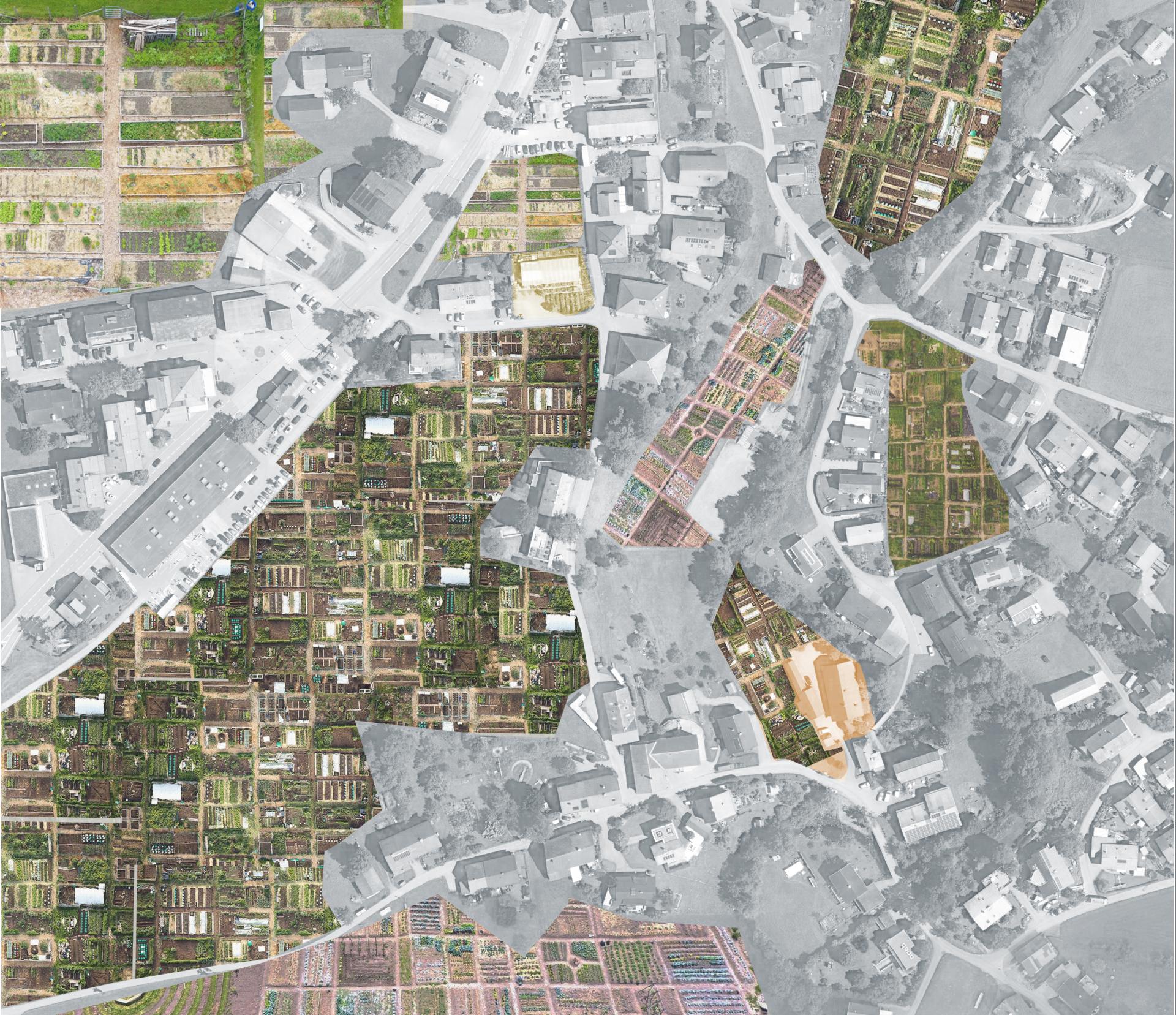
The Green Route of Andelsbuch - As a part of the project, a green route of communal gardens through Andelsbuch will take people past sites, cafes & shops across the village. If we change people’s footpath, to take them every day past the food that they eat, we can change their thinking and actions. And it might even become a touristic thing to experience in the Bregenzerwald, if the same sense of pride for dairy farming, would also be created for local agriculture & produce production. As a starting point of the green route, the chosen site with its buildings will show people what grows, how it grows, how you harvest it & what you can do with it.
It’s a story about craft & sharing knowledge about growing & processing local veggies, herbs and flowers. How we can make the existing manmade landscape into an edible landscape & cultivate it to local needs. A project that increases the awareness for the value of soil & land as a fundamental resource of great importance. (Re)-activating the local culture of gardening & processing. A hands-on process, where everybody plays a role.
Customer journey: People can stroll along the path through the village of Andelsbuch which runs along cultural sites, cafes, shops and much more. By taking food production in the heart of the village, the people can walk along to the food that they eat. Reconnect with the environment, seasonality & food production.
Which impressions will the customer / user get in the space? The impression should leave the people a sense of purpose & personal responsibility towards local resources. Bring people to believe in their own capabilities & power of small actions back again. We see what we have sort of forgotten about: What grows, how it grows, how to harvest it & what you do with it. From cultivation to consumption, it’s a hands-on process. The dried herbs and flowers with their wonderful smell leave the user with a long-lasting impression. Herbs which a