A new identity for Porto di Mare
Basic information
Project Title
Full project title
Category
Project Description
The main intent of the project is to re-form this portion of the city, integrating it with the Milanese context, thus creating a new polarity for the community. The project intends to maintain an active relationship with the historical memory of the place and at the same time define new spaces that can be used by the community. Water is used as a design element, which allows you to work on three very specific levels of redevelopment: urban, social and environmental.
Project Region
EU Programme or fund
Description of the project
Summary
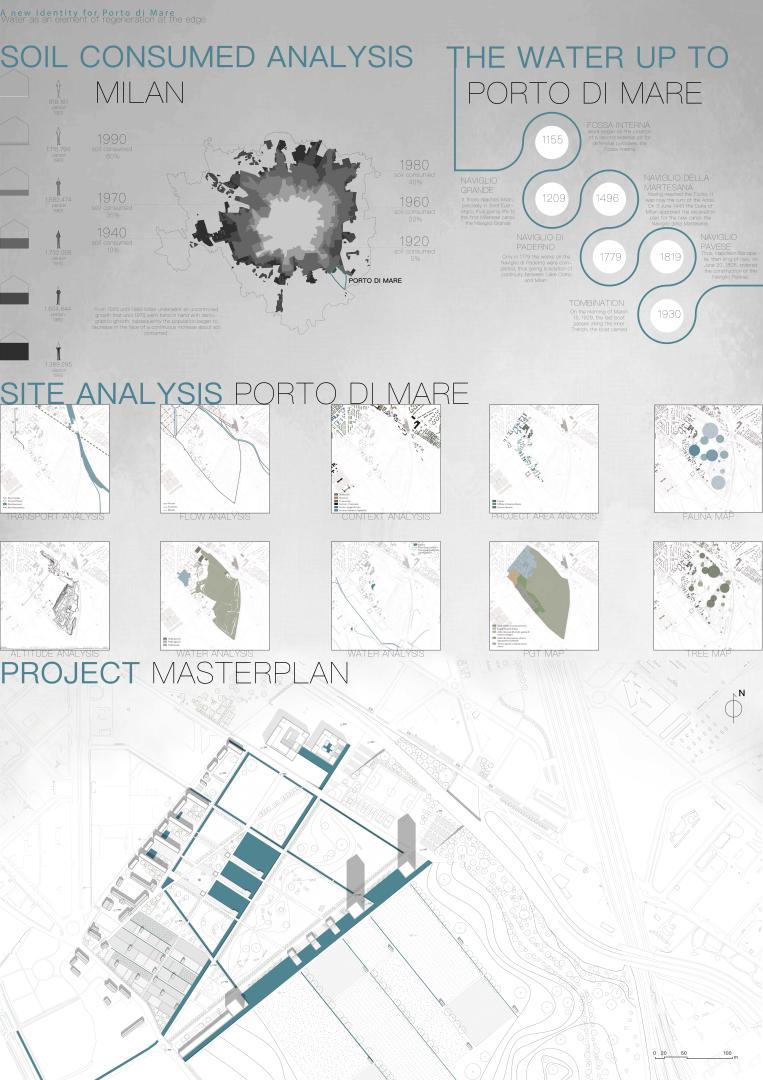
The project was born following the studies carried out in the laboratory concerning the theme of re-forming Milan, more precisely regarding the Porto di Mare area, which appears as a fragmented peripheral margin, a border between the urban fabric and a vast system of green areas, placing clear boundaries between nature and artifice. The main intent of the project is to re-form this portion of the city, integrating it with the Milanese context, thus creating a new polarity for the community. The project intends to maintain an active relationship with the historical memory of the place and at the same time define new spaces that are increasingly vital, usable by the community. This connection with memory is strengthened thanks to the use of water as a design element, which allows you to work on three very specific levels of redevelopment: urban, social and environmental. The first level uses water as an element of reconnection of the city fabric, allowing for the reconstitution of strong relationships with the context adjacent to the intervention area, which have now disappeared, thus defining new urban centralities. The second level involves the use of water as an element of socio-cultural requalification, through the design of two buildings, one for thermal use and the other for cultural use. The thermal buildings, historically closely related to the cultural ones, characterized by the presence of water inside them, are an architectural response to the presence of water in the city. The third level identifies water as an environmental resource and highlights the problem of waste associated with it. In addition, the masterplan envisages the design of large green areas for both agricultural and urban park use, with the aim of regenerating the land that is now “consumed” and deprived of its ability to manage rainwater and store CO2 .
Key objectives for sustainability
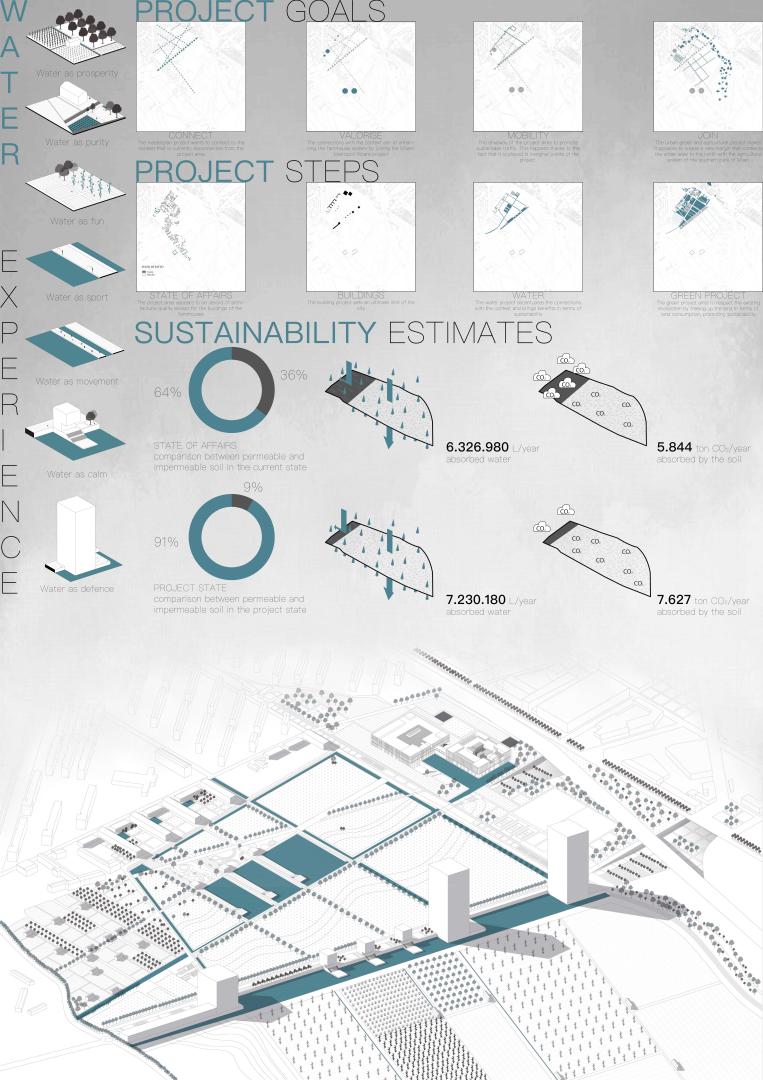
The project has broader objectives than the simple urban redevelopment of the project area. It has the will to be a starting point for a redevelopment model that must be adopted for Milan, changing what has been the development model of the city from 1920 to the present day which is based on land consumption. With the project, the area is cleared of cemented soil, improving the performance linked to the absorption of rainwater and the storage of CO2 . In addition, there is an urban and agricultural park project that will bring the city closer and closer to the objectives linked to the more sustainable Milan 2030 (to be precise, Milano Metropoli Rurale and ForestaMI).
Key objectives for aesthetics and quality
The project uses water as an element of regeneration of an area that is currently underestimated. In addition to being an aesthetic element, the water develops within the area creating situations that allow you to live different experiences related to it. In some places, water becomes a source of life by irrigating agricultural fields and urban gardens (water as prosperity). In the central area of the Masterplan, the presence of three pools of water allow the practice of water sports (water as a sport). Furthermore, in various points inside the Materplan the water is used for recreational purposes thanks to the presence of fountains (water as a game). Furthermore, water is also psychophysical well-being: its mere presence, thanks to the sounds produced by its flow and thanks to the freshness it brings into the environment, is capable of improving the quality of life in this place (water as calm and peace).
Key objectives for inclusion
The project aims to regenerate the Porto di Mare area which turns out to be an urban fragment detached from the surrounding context. Mainly, 4 objectives are bridged: to connect, to solve the problem of marginalization of the area, to enhance and access. The project axes have the purpose of defining spaces and connecting with the existing surrounding context. These axes are arranged in such a way as to enhance some historic farmhouses in the area, currently devoid of value and importance. Internal mobility is a more sustainable mobility: therefore, mainly cycle-pedestrian ateriors are created , thus limiting the carriageway as much as possible. Finally, with the urban and agricultural green project, an area that appears fragmented between nature and artifice is marginalized.
Innovative character
The new project for Porto di Mare aims to design in contrast to the various expansion plans of the city of Milan, which were based on land consumption. In this case, the project is based on the creation of large green areas such as urban parks, urban gardens and agricultural spaces, as well as mixed and uncultivated greenery. The aim is to go and regenerate that soil by now I feel its functions. Furthermore, the design of the area takes into account the presence of biodiversity, both plant and animal, by designing respecting the aforementioned biodiversity. the use of blue infrastructures, such as streams and water basins, help mitigate the climate and therefore overheating, and also help convey water in the event of heavy floods. cemented soil is drastically reduced compared to green and blue soil: respectively 10% for conumant soil and 90% for green soil.