Piazza Minniti and Piazzale Loreto
Basic information
Project Title
Full project title
Category
Project Description
Piazza Minniti and Piazzale Loreto transformation is an unprecedented experiment where Urban Mobility meets Participatory Public Art. Realized in 2020 during the emergency, the project merges tactical urbanism techniques with visual, relational and public arts; sustainable urban mobility goals with a fully inclusive citizen engagement process; an unprecedented administrative procedure with the culture of a Design City. Through quick, light, reversible, unexpensive and transferrable actions.
Project Region
EU Programme or fund
Which funds
Other Funds
Funded by EIT Urban Mobility KIC programme
Description of the project
Summary
Piazza Minniti and Piazzale Loreto tactical transformation is a specific case belonging to the wider municipal programme “Piazze Aperte”, active in the City of Milan since 2018 and dedicated to realize tactical urbanism experiments in all the city, with the inclusion of citizens participation in each step of the implementation, from decision to realization. But, thanks to the cross-funding by “CLEAR - City Liveability by Redesign” project (EIT Urban Mobility), this specific intervention, realized in the unprecedented year 2020, is different from all the others.
In 2020, due to the necessity to keep social distancing and the consequent impossibility to organize gatherings in public space with citizens for the usual co-realization of paintings, a mediated participation was activated through the involvement of visual artists in the process. In an unprecedented procedure, the City issued a call addressed to designers, muralists, painters, illustrators, relational and visual artists, open to solos or collectives, asking for proposals containing both a draft design for the two spaces and a methodology of involvement of citizens within the ideation and production process.
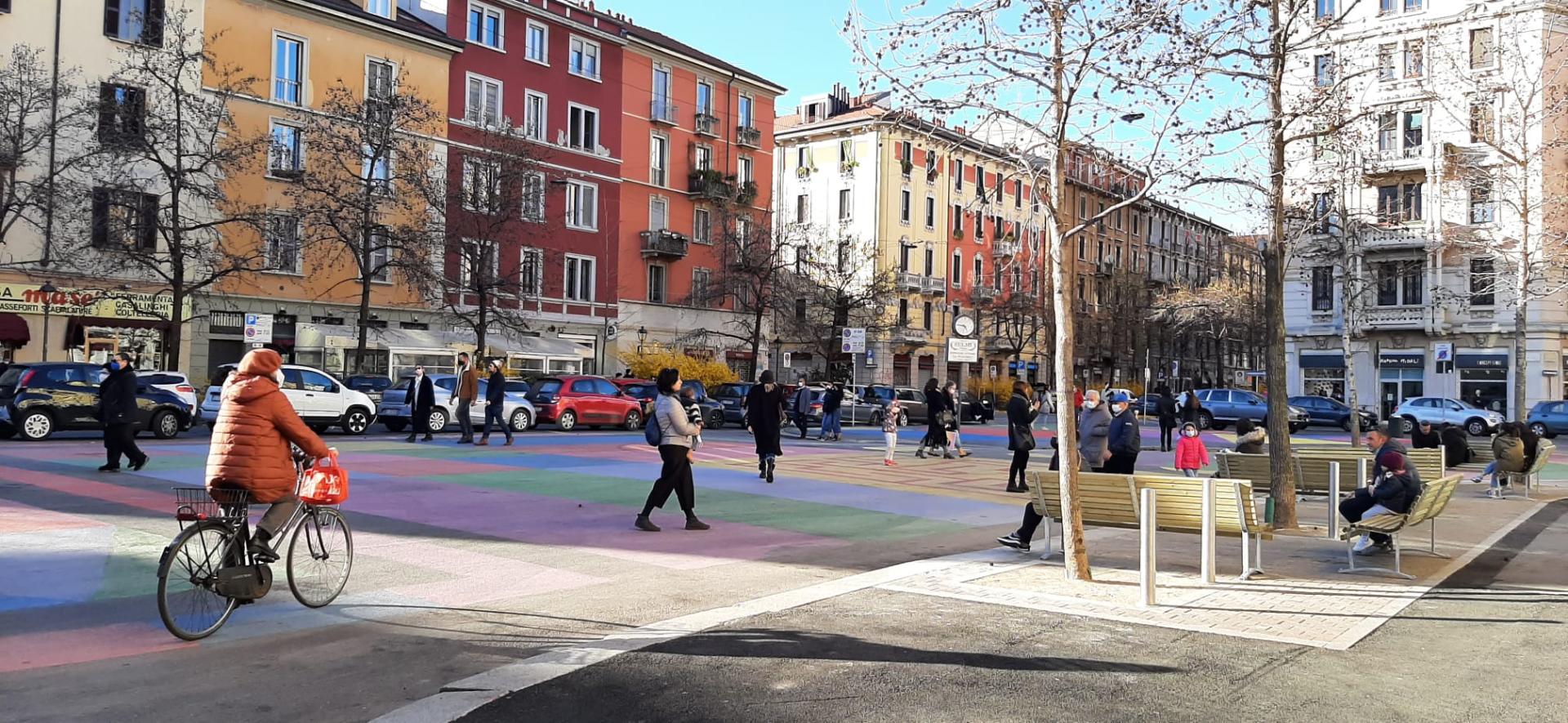
The results of this multi-layered experimentation are not only two newly pedestrianized public spaces in strategic areas of the city, with the neigbhorhood life reactivated and the citizen reappropriating the sites and fostering more sustainable lifestyles; they are also the production of two pieces of original public art co-designed with the neighborhoods, two megaillustrations at the urban scale of uncommon visual impact and aesthetic appeal, creating an essential precedent to the whole discipline of urban design in Italy.
Key objectives for sustainability
Regardless its efficient public transport network, Milan still presents a strong redundancy of street spaces, dedicated to private vehicular mobility and superabundant parking slots, and relevant problems of air pollution (dramatically high levels of PM10 and PM2.5), directly related with severe car traffic.
Since 2018, Milan has been working to the realization of a municipal programme (“Piazze Aperte”, Open Squares) dedicated to the conversion of former street and parking areas into public spaces through tactical urbanism techniques. A large number of reversible, unexpensive and publicly co-designed experimental transformations have then been activated throughout all the city in extremely short time compared to classical public works: few weeks for programming, few days for implementing.
Such a quickly realized pedestrianization of many small to large spaces in every neighbourhood, supported and connected by a growing network of pop-up bike lanes, acts as an unprecedented bottom-up transformation of Milan into a place where the pedestrian experience becomes more and more attractive, while active mobility expands as the favourite means of transportation. Each street space transformed then acts towards sustainability in three steps.
1 short term: instantly lowering local air pollution, PM10 and 2.5 values, resulting in an unquestionable advantage for the neigborhoods in terms of health safety.
2 mid term: creating healthier, traffic-safer and more pleasant environments, it triggers positive habits in the citizens, progressively more willing to move by feet and bikes through the city, in turn lowering car usage in the surroundings.
3 long term: tactical urbanism interventions are progressively developed as permanent transformations where structural action of greening, micro-forestation and soil naturalization are possible, solving “urban heat islands” issues and lowering the necessity of air conditioning in buildings (also responsible of PM10 emissions).
Key objectives for aesthetics and quality
In 2020, the City issued a call for visual and relational artists and designers to mediate the participatory process in the pandemic year. By doing so, we collected 43 proposals from all Italy and abroad, beautiful site-specific graphic artworks that will be exhibited soon. The winning proposal merged the artistic work of roman muralist and illustrator Camilla Falsini with the citizen engagement abilities by Jungle collective, resident in the neighborhood.
During the co-design phase (see following sections) the design draft was modified to better adapt it within the urban context and the strong cultural identity of the two areas. Although originally conceived to realize an urban transformation within the framework of urban design and sustainable mobility, the process ended with the realization of two original works of superscale graphic art, freely accessible to the public and dedicated to the identity of two neighborhoods in tumultuous evolution. These original, site specific super-illustrations characterize the spaces and help growing interest and curiosity to reinterpret the new areas as fully public squares, consolidating the sense of belonging and fostering different uses, from kids playground to pure contemplation.
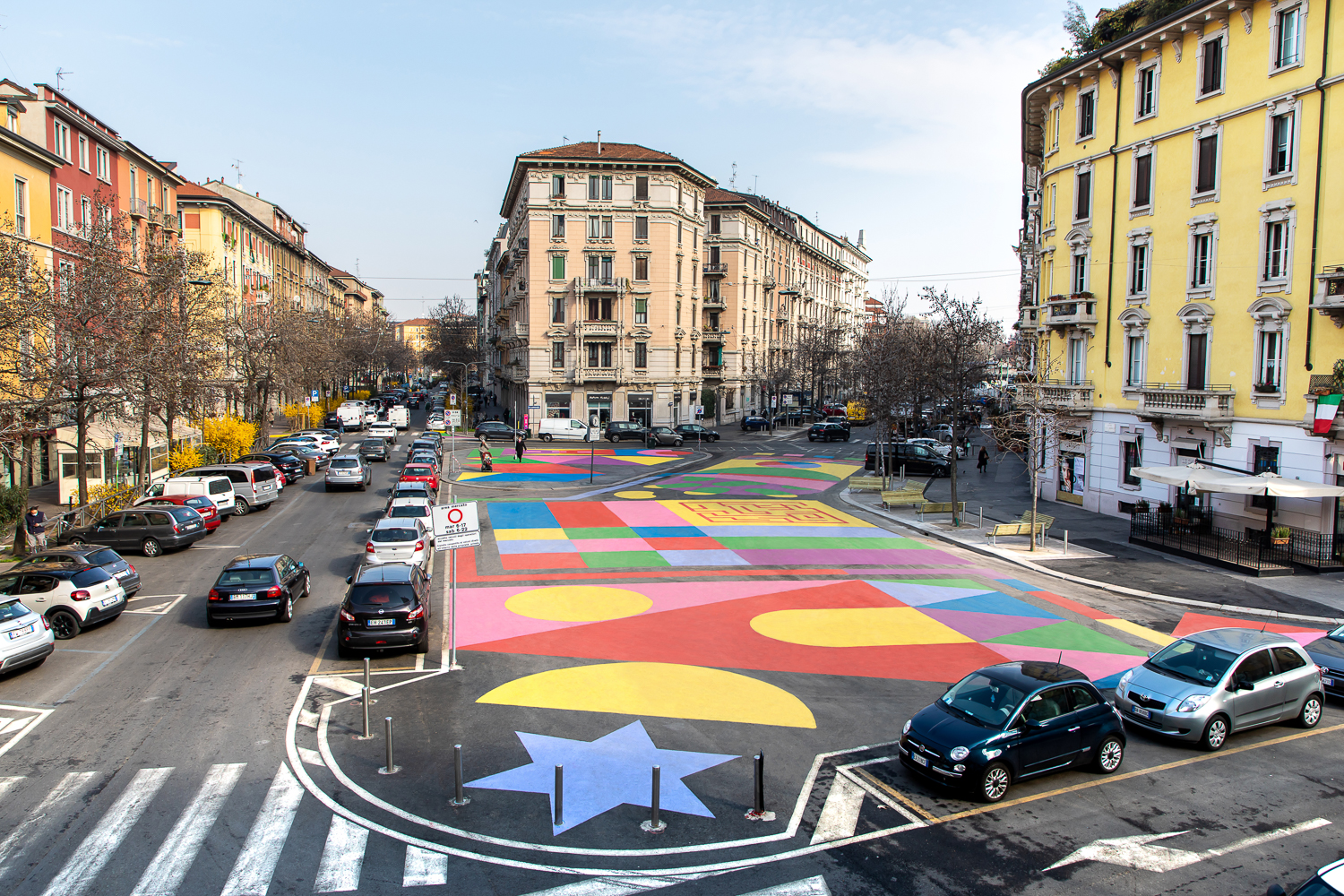
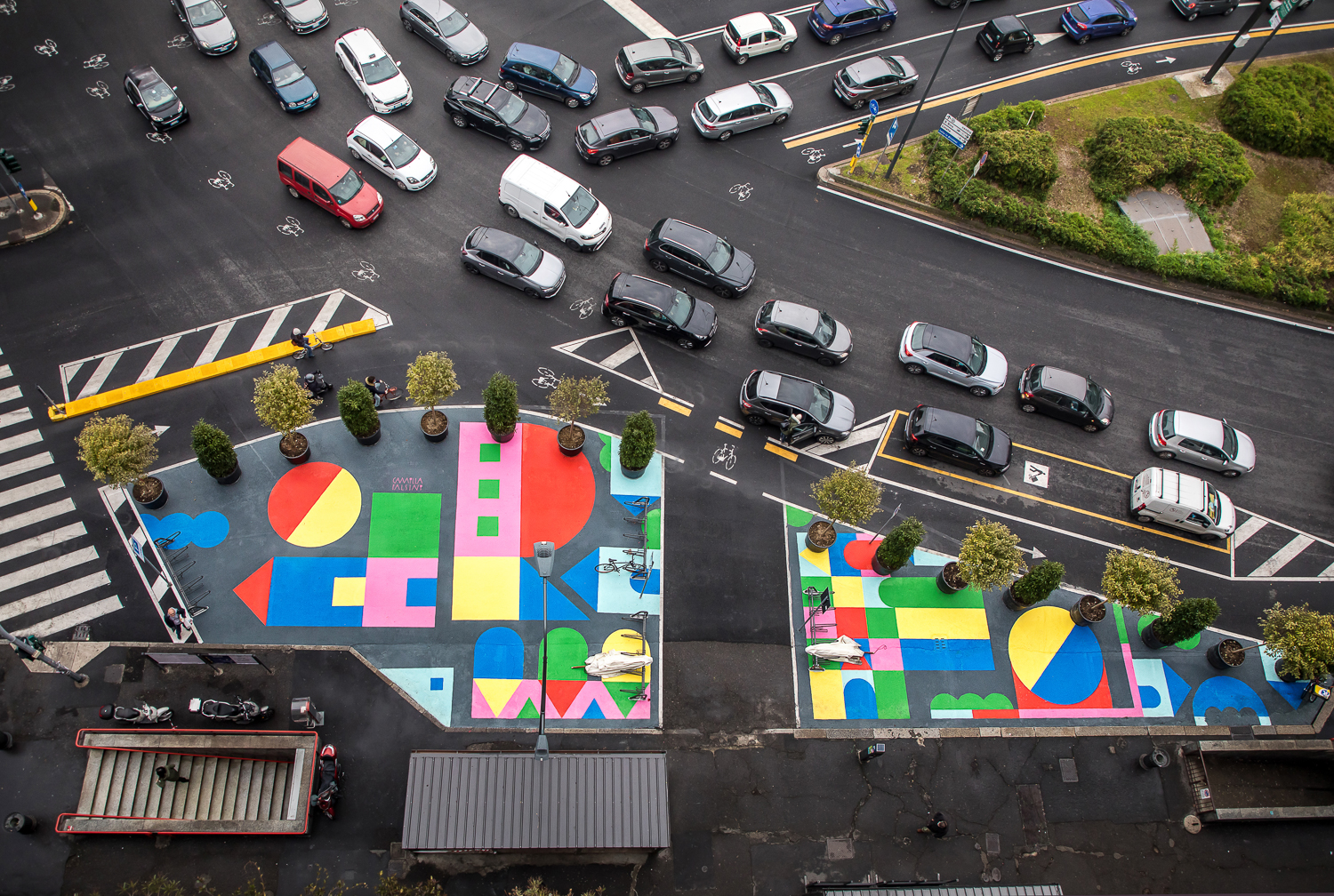
While belonging to the same aesthetical language, the two artworks differ slightly. In Piazzale Loreto, the small area is colored with a composition of shapes that evokes a bi-dimensional ideal city influenced by the tradition of classical Milanese design masters of the Memphis era. In the much larger Piazza Minniti, the design gets more abstract but the scale of the squares allows the graphic artwork to host a small maze, and the shapes are more clearly dedicated to kids as they can be subtly interpreted as playground for open air games.
Both the artworks contain a final hidden gift for residents: looked from above, the graphic composition of shapes reveal they are, in fact, readable: one hides the word “Loreto”, and the other “Isola”.
Key objectives for inclusion
The project is the outcome of a strategic municipal program started in 2018 and still ongoing, progressively consolidating methodologies for both realization and citizen engagement. After its first cycles, where the realizations were actively participated by citizens, but still on areas selected by the municipality, since 2019 the programme evolved in “Piazze Aperte in Ogni Quartiere” and the involvement of citizens extended to every step of the process.
1) Selection: the City issued a call open to free citizens, informal groups and associations, to propose urban transformations realizable within the tactical urbanism framework. Applicants are provided a kit of admissible interventions (typically paintings, urban furniture and potted plants) and a list of 52 urban areas available for a transformation (with the possibility to candidate further ones);
2) Proposal: citizens are asked to propose the transformation: function, aesthetics, furniture. All proposals are accepted (unless evidently incoherent with the intervention kit);
3) Co-design: citizens are involved in a co-design process to refine their proposals and fit them inside the urban safety regulations and traffic management;
4) Realization: citizens are welcome to actively contribute into the realization of the interventions. Collective painting living-labs are activated with adults and kids thanks to the use of non-toxic paints and materials.
Currently, the City is in the process of progressively realizing all proposals. The involvement process exceeded expectations, reaching more than 200 actors and collecting at least one proposal on each of the 52 originally available sites, plus an addition of 11 further areas, all currently under co-design phase.
Piazzale Loreto and Piazza Minniti are two specific cases out of these areas. Except for the realization phase (implemented in 2020, without the possibility of physical gathering of citizen groups), the process for the two sites fully followed the process.
Results in relation to category
Piazza Minniti and Piazzale Loreto transformation is part of a wider strategy towards the goal of a “15 minutes city”. This indicates the complex urban programming behind the transition towards a more equal city, where each neighborhood is equipped with services and spaces for high quality living, ideally within a 15-minutes-walk range. In march 2020, the City of Milan issued an open document called “Milano Strategia di Adattamento” (Adaptation Strategy) where the availability of high quality and quantity of public space was explicitly put in relation with the new urban needs of climate and health equality emerging from the Covid catastrophe.
The two areas assumed a decisive impact under this point of view.
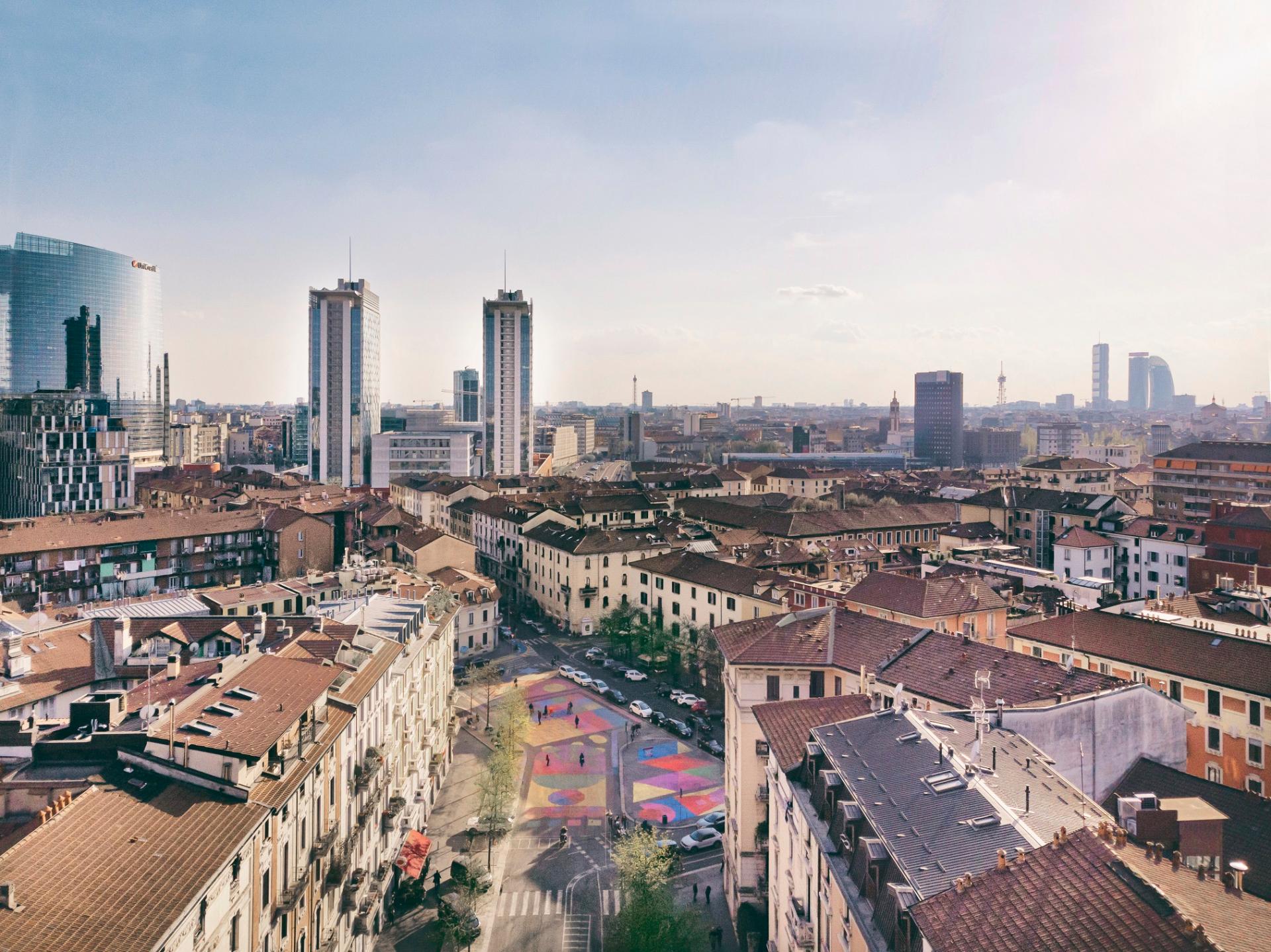
Piazza Minniti is a large square in a neighborhood undergoing drastic transformations in the last 10 years. From a small scale, compact and historical area, Isola is now populated by skyscrapers and large-scale global attractions, lacking intimate but airy spaces for residents, kids and elderlies. Piazza Minniti is a large square working at the superlocal scale, re-enabling proximity relationships altered by the violent urban transformations of the glamour district. It also hosts an important local market twice a week, and is therefore always lively and central in the neighborhood life, in its brightly colored beauty matching the liberty façades surrounding.
Piazzale Loreto is instead the most chaotic traffic ganglion of the whole city. A gigantic roundabout with heavy traumatic memories from WWII, currently under a freshly started process of requalification. The intervention works on a very little portion of it, extending the existing pedestrian path towards a new pop-up bike lane that, as David against Goliath, crosses the gargantuan site from side to side. Even in its small dimension, the intervention achieves the crucial impact of defending both bikers and pedestrians from accidents often occurred in the past, enabling a more peaceful neighborhoodlife
How Citizens benefit
The structure of the complex involvement process of “Piazze Aperte in Ogni Quartiere” is partially described in the former sections. Further specifical details may be added for the exceptional case of Piazzale Loreto and Piazza Minniti, realized in 2020 also in convergence within the EIT Urban Mobility European project “CLEAR - City Liveability by Redesign”.
As partially anticipated, the participatory process for these two squares followed the “Piazze Aperte in Ogni Quartiere” procedure: the areas were publicly selected by citizens and their reuse as pedestrianized spaces proposed and functionally co-designed.
As the pandemic emergency forced citizens home and impeded the realization of participatory painting living labs, the City took the opportunity to select an artist through a public call and engage her into leading remote co-design workshops with proponent groups for each areas.
Camilla Falsini and the Jungle team, then, met the residents and the associations of the neighbourhoods in digital encounters, presenting her work as illustrator and muralist and a draft idea of design for both the spaces. Through the meetings, residents interacted with the artist providing insights on the profound neighbourhoods identity and suggested changes in the graphic proposals accordingly. Specifically: the original colour palette was modified to adapt it with the context; a maze for kids was added in Piazza Minniti and both the designs were hybridized with lettering techniques, composing the name of the neighborhoods readable from above, as a sign of deeper connection with the local community of inhabitants.
Innovative character
The project implies several levels of innovation.
1) Tactical urbanism: itself an innovative approach to urban design, particularly when used by municipal administrations, able to learn from grassroots movements how to act quickly and inexpensively to realize test transformations that can be easily reverted or adjusted if their effects are not completely satisfactory. This flexibility allows much more freedom in urban experimentation as it does not involve classical public works procedures.
2) Total engagement: even among tactical urbanism literature, Piazze Aperte in Ogni Quartiere has been able to involve citizens in every single aspect of the process: each intervention is in fact co-decided, co-programmed, co-designed and co-realized and, when the case allows it, co-managed with local groups and residents.
3) Administrative innovation: the specific case of Piazza Minniti and Piazzale Loreto has a further level of innovation. It was cross-funded by EIT Urban Mobility (under “CLEAR” project) and, as it involved the selection of an artist proposal, it put together the Mobility and the Culture Departments of the Municipality of Milan in an unprecedented cross-disciplinary collaboration creating a relevant, replicable procedural precedent.
4) Aesthetic quality of results: unlike average tactical urbanism interventions, thanks to the involvement of professional artists, Piazza Minniti and Piazzale Loreto were able to reach unprecedented levels of aesthetic value, creating a new standard for a city with the most structured and ambitious design culture. But, besides the beauty of the artifacts themself, this methodology was also aimed at consolidating the role of such transformations, inherently temporary, into a meaningful process of symbolic rebirth of these spaces, putting, within the credibility of beauty, the seeds for future identity and permanence.