Multi:::Space
Basic information
Project Title
Full project title
Category
Project Description
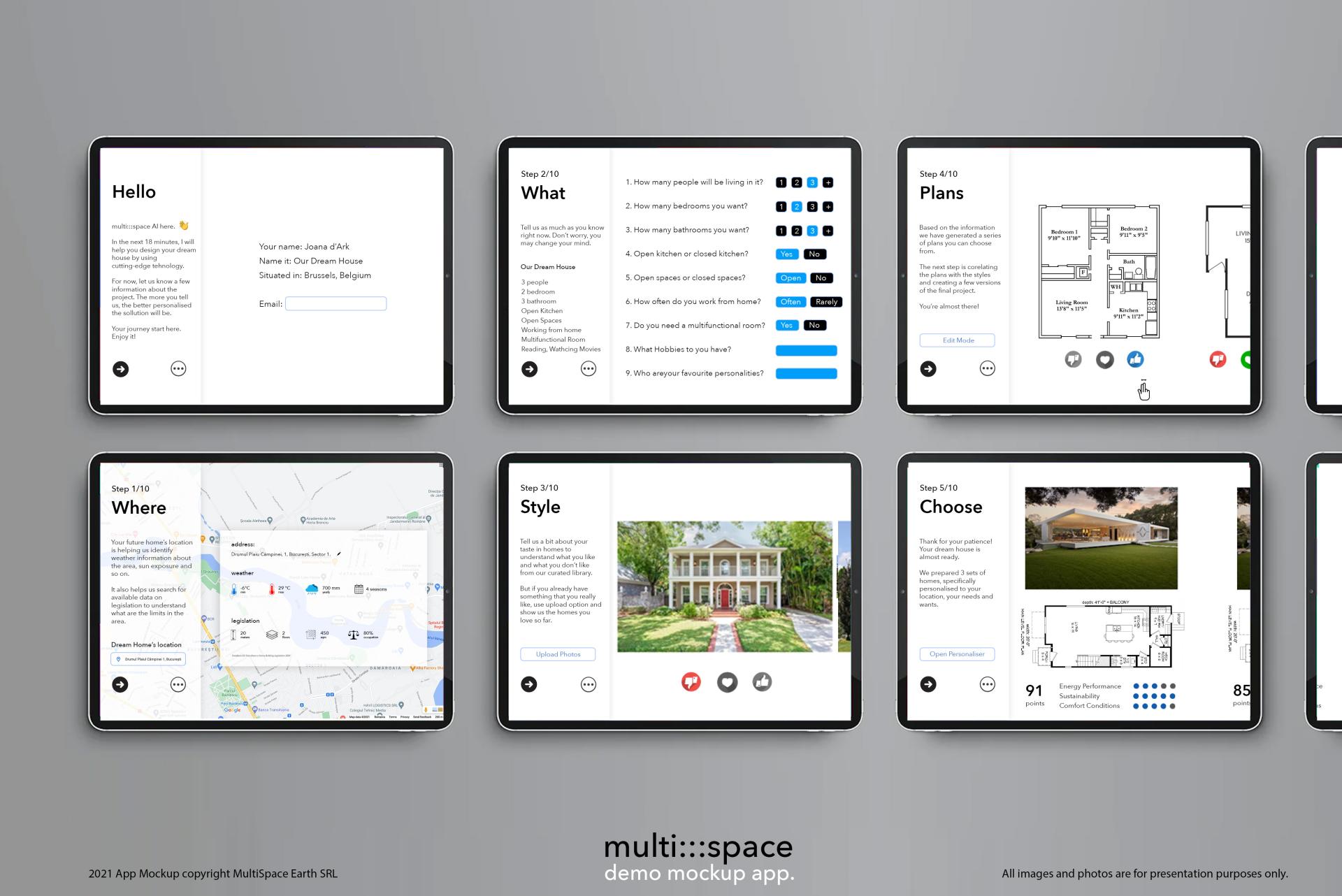
MultiSpace will help future home-owners conceptualize and design sustainable, personalised, affordable homes, in under 18 minutes. Based on data about the home location, on user’s needs and wants, using in-house developed algorithms and AI, it automatically generates styles, plans, 3Ds and simulations.
Architects and engineers can intervene in the process to better translate the digital dream into a physical reality, from idea to documentation, permitting, building and final inspection.
Project Region
EU Programme or fund
Description of the project
Summary
Architects and Engineers have today tremendous challenges in delivering homes to people. They have to aggregate and coordonate more knowledge and skills than ever to create a house, the place where people used to spend more than half of their lives.
Projects that successfully provide the necessary level of quality, sustainability, inclusivity and aesthetics, need a large number of specialised people which generates three major problems: insufficient specialised workforce, long time and increased total cost.
AI can generate and analyse thousands of solutions, based on a variety of indicators, in a fraction of the time, with fewer resources, having a cost of less than 10%, while being accessible everywhere there’s internet and a smart device.
MultiSpace is currently developing a web&app solution to help average people have access to the up-to-date knowledge & technologies 24/7 to help design their dream home. It also helps architects and engineers create the physical constructs faster, more efficiently and better than ever before. It combines the magic of bespoke homes with the advantages of prefabricated standardised construction.
MultiSpace App works in 4 automated stages. Users and professionals can intervene in any stage if they want to:
- Understanding (place, legislation & user)
- Designing (multiple designs and plans to choose from)
- Analysing (based on various parameters, from environmental to health, comfort and economical aspects)
- Documentation (for permitting and building, including materials and technologies)
The app has a freemium business model. It is free to play with, so it can work as a free source of inspiration both for people and professionals. To create revenue, to continuously improve the app, it has a credits and subscription system. People can buy credits starting from 50 euro and have access to simulations and details and Professionals can buy subscriptions and use the app in-house to provide their services.
Key objectives for sustainability
Due to multiple factors, people usually make various concessions with their future homes. MultiSpace’s goal is to create non-compromise solutions: affordable, safe and healthy homes with a positive environmental impact. Based on decades of research, more than 11 years experience, world’s top sustainability certifications (BREEAM, LEED, LBC, WELL, SOLAR DECATHLON), a massive Passive Strategies library and tons of analysis and studies, AI can deliver compelling projects, so people won’t sacrifice comfort, health, environment, time, peace of mind or money.
The current working framework has 6 areas and 40 indicators.
- LOCATION (improve, produce no harm)
Using Google Maps, public information, laws and permitting library and photos from the site. To double check the accuracy of public information, freelancers can become verifiers.
- WATER (targeting zero water, improve water quality on site)
User’s needs are analysed based on statistics. People can chose a variety of sollution for capturing and filtering to help them achieve this goal.
- ENERGY (targeting zero carbon footprint, 100% local renewable sources)
HVAC, Lighting and Home Appliances simulations will provide an hourly energy consumption. Based on client’s budget, multiple technological solutions are analysed, from producing solar energy to buying renewable energy or other options as CO2 credits.
- MATERIALS AND CIRCULARITY (local, natural, biodegradable, easy to recycle, no waste, low carbon footprint)
We analyse 3 stages: Construction Phase, Living Cycle and End of life. In the first app version, we’ll target only Construction phase and End of life. In a second stage, we’ll develop the home assistant who will help inhabitants during the Living Cycle. The 3rd major stage will create a marketplace for sustainable cleaning and maintenance solutions.
- AESTHETICS (UX, UI, integrate, foster relationships)
- PEOPLE (inclusion, accessibility, affordability)
Key objectives for aesthetics and quality
AESTHETICS 1/7 areas MultiSpace is focusing on and probably the hardest, because it is the most subjective. Not only based on client’s taste, but also because a house it’s not an isolated product, it lives in a context (historical, cultural and geographical), so that context dramatically influences the aesthetics. But it is also the most interesting area for us, as most of the homes today lack soul, craftsmanship, or higher meaning, most homes are just mere construction and architecture kind of lost its enriching and higher purpose.
Can a machine create more beautiful, more inspiring homes than humans can? On a large scale we are sure it can, because it does not have the time constraint most architects have today. It can learn, understand, play, analyze, provide new design in a fraction of the time most architects around the world afford to spend. Can it beat the world's best architects? Probably not but that’s ok, not everyone has access to word’s best.
FUNCTIONALITY, USER EXPERIENCE & USER INTERACTION
During the last decades, technology drove a lot of research on UX and UI, mostly in the digital space. MultiSpace is adapting what we have learned in the last decades from a website, with its continuous iterations and AB testing and product design, to a larger scale. The way we design, build and operate homes.
Starting from the works of Ernst Neufert, Don Norman, Steve Krug, Nir Eyal and William Lidwell, we created a map of UX & UI rules for homes that is working like a cornerstone for the other algorithms.
The hardest part to overcome is user testing because monitoring people in their home is not a feasible solution. To address that, by having a digital home, we can simulate human behaviour in a SIMS like game to better understand the dynamics. And we don’t have to wait a year to gather results and insights.
For the aesthetics, the AI uses lots of curated projects from award winning projects from the last millennium, The Bauhaus Diagram and more.
Key objectives for inclusion
The PEOPLE area includes: Inclusivity, Accessibility and Affordability. A house should aim, at any moment, to fill all the necessary requirements and recommendations for all 3 of them as, due to its life-span, inhabitants will change, people will get older or sick, and the climate will change as well.
Psychological factors largely influence home living, but these factors are rarely embedded in the house project.
There are a lot of guidelines and practices in the domain of inclusiveness and accessibility. Unfortunately, the law still lags behind in most of the places, which determined the architects and engineers to ignore these features when the client does not specifically ask for them.
INCLUSIVITY
Inclusive design will work both ways. Inclusivity is key for the wellbeing of individuals, wider society and healthy identity formation. Our sub-framework for inclusivity, includes 5 zones:
- HEALTH
- COMFORT & SENSES
- BELOGING & RELATIONSHIP
- OWNERSHIP
- PRIVACY
Some of the higher level factors we are working towards, include:
- Foster Relationships & Reduce Micro Aggression
- Non-segregated activities
- Hands On Experiential Home Education
- Increase visiting, co-working and creating communities
ACCESIBILITY (Physical, Mental Problems and Older people)
We are starting from the UN Habitat Accessibility of Housing Report, ISO 21542:2011 and other freely available guides are used as a baseline for the systems. Accessibility in most of the cases can easily be translated into algorithms.
AFFORDABILITY
The world has already seen amazing sustainable homes. The challenge is scaling. Our solution can make the design of a home cost 5-10% of a only-humans created house, while offering a higher level of quality and sustainability. Beyond that, the home being energy and water efficient, it is not only way more affordable to buy or rent, but also to live in, having lower monthly expenses than a traditional home. Even insurance and waste disposal will cost less
Innovative character
I started to ask myself how the world would look if everyone could afford the world's best architect? How would people feel? Will they become more emphatic, happier, healthier, more connected and prosperous? And I believe they will. So the problem is how can you make such a world possible.
I have been working for 11 years with architects and engineers in multiple residential projects and I know their strengths and weaknesses, their pains, their aspirations and their realities. I believe that we are now living in a time where we can fundamentally change the way we design with technology AI. This concept will enhance the contribution architects and engineers can bring to a future home, will help them do their job better, just as they also dream to do.
In the last decade, the landscape of Artificial Intelligence really gained momentum with Machine Learning, Computer Vision and Robotics. We have self-driving cars, we create medicine, create vaccines and monitor health with AI, improve cities and logistics. The Construction Sector is the slowest in terms of innovation and this is due to the smallest % invested in R&D.
MultiSpace is using existing technology (even if at its infancy, it works) but in a new way, helping both home-owners, architects and engineers and developers streamlining both the creative process and the designing process. CAD was a fundamental milestone in the construction industry. AI is the next one, where people and machines will work closer than ever before. MultiSpace will democratise sustainable homes, making them globally available at an extremely affordable price.
The potential of AI based solutions is tremendous and one day such solutions will become norm. Today there’s only one similar solution work-in-progress in the US, but it does not tackle sustainability and engineering. As a European, I would love to be able to create this solution here, in Europe, because one way or another, the MultiSpace AI App will become reality.