Circular Economy goes BIM
Basic information
Project Title
Full project title
Category
Project Description
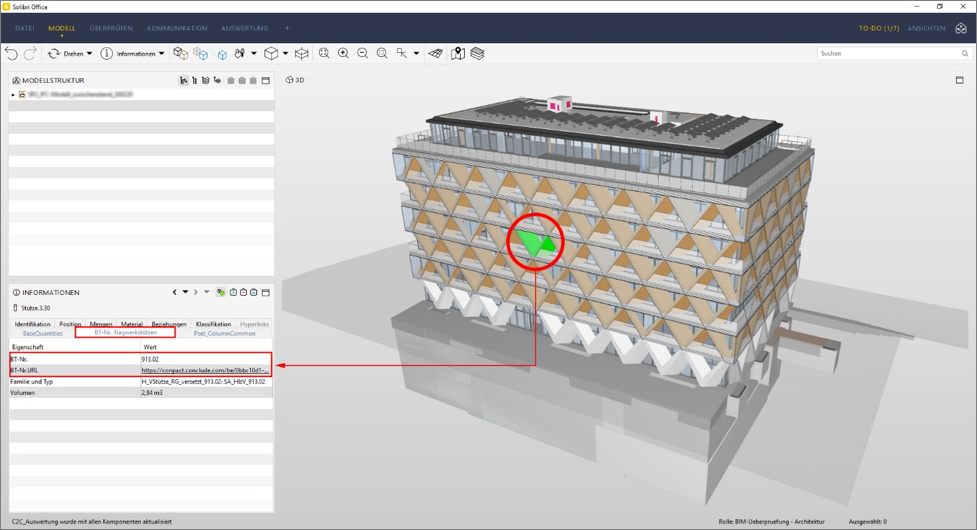
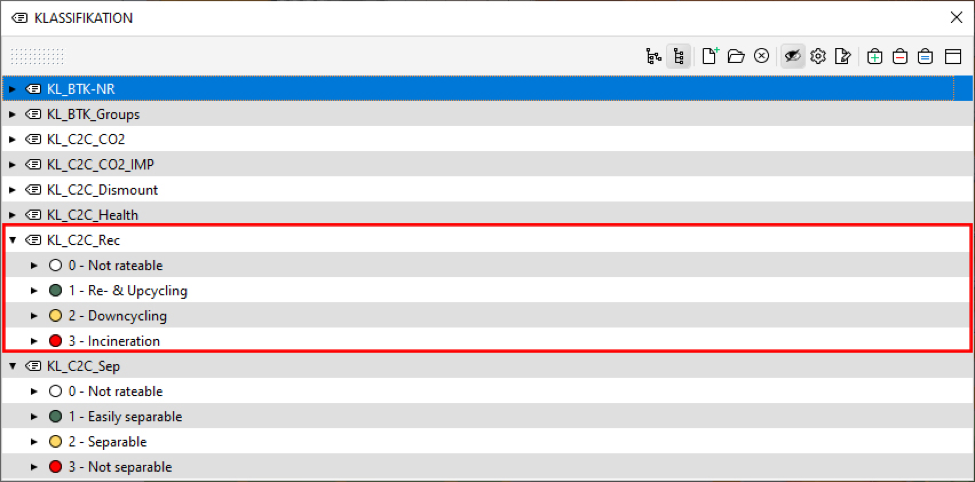
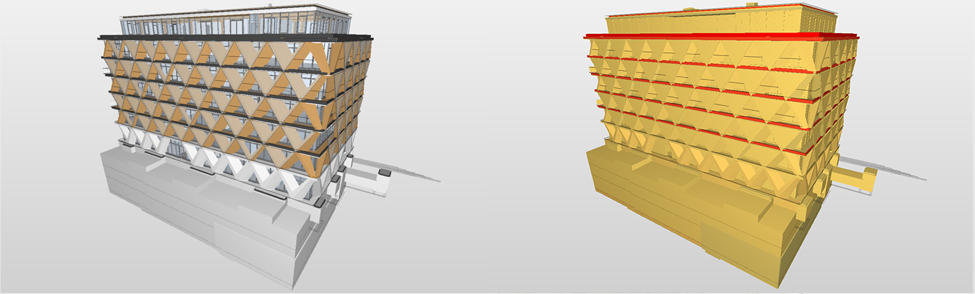
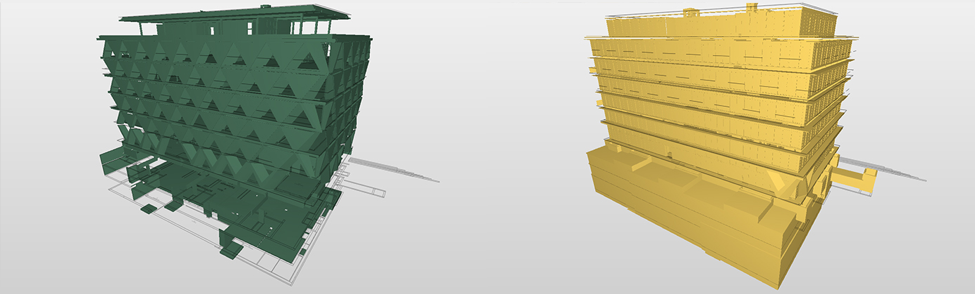
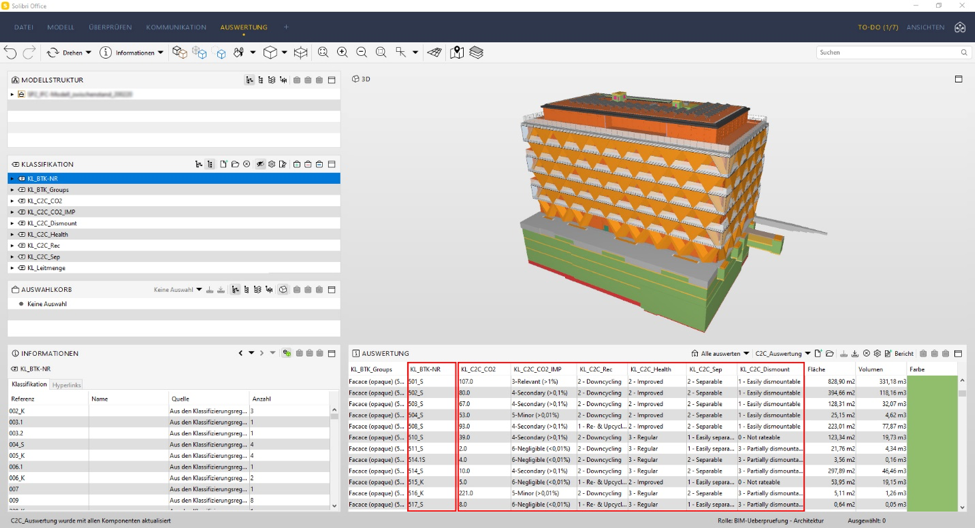
Global warming potentials, health aspects, recyclability, separability and flexibility are the main sustainability factors in the future building process. EPEA made it possible to connect these aspects based on the Cradle to Cradle principle with BIM. This complex interrelationship for a consistent circular economy is overcome using a combination of different software. Thereby, the BIM model is able to depict the c2c parameters using clear colouring to indicate the elements' quality.
Project Region
EU Programme or fund
Description of the project
Summary
The main objective of this tool, which has already been used in different projects, is to disclose the challenges in terms of the factors describing the sustainability and circularity of the planned structures. Through this tool the relevant criteria are assessed on the basis of the used materials. On the one hand the data can be used in the planning process to optimize relevant parts of the planned structure. On the other hand the data can be used to create a builing material/circularity passport, comprising all materials including their connectors as well as the LCA data.
Key objectives for sustainability
Cradle to Cradle is a design principle developed in the 1990s by Prof. Dr. Michael Braungart, William McDonough and EPEA Hamburg. It describes the safe and potentially infinite circulation of materials and nutrients in two cycles. In the biological cycle, consumables, such as natural fibers, circulate and can be safely returned into the cycle after use. In the technical cycle, consumer goods circulate, such as electronic items or floors and are being reused all over again. These products are optimized in the design and manufacturing process as resources for the next phase of use. All ingredients are chemically harmless and recyclable according to Cradle to Cradle. Thereby the design tool definitely has a positive influence on the quality of stay. The tool enables a precise monitoring in terms of health aspects of the used materials. As the health aspects of the products are known to be safe to use, it is now possible to identify the share of positive materials, which have a positive impact on the users health and the quality of stay. At the same time, it is made easily understandable, in which parts of the construction an improvement potential exists. This leads to a relevant improvement of the quality of stay in the building, an improvement of the users' health and a lower impact on the environment.
Key objectives for aesthetics and quality
The tool is a complex construction, merging the information of different programs into a BIM model. Through this work, relevant environmental data is made accessible and available to a broad group of planners. For them it is easy to analyse and use the information for the further planning. Changes can be made based on the environmental impact, or the reusability of a construction.
Key objectives for inclusion
Considering Buildings as raw material banks is seeing them as repositories or stockpiles of valuable, high qualitaty materials that can easily be taken apart and recovered. By harvesting materials and parts during deconstruction and renovation of buildings, these materials can be reused in the construction, operation or refurbishment of other buildings, thus reducing the need for primary resource mining.
Moreover, it also refers to a materialised investment. It is more than investing money in property funds. The building itself is considered as a materialised savings account for material resources, through which building materials, products and components are temporarily ‘deposited’ into a functional element or part of the building. When socio-economic conditions are favourable, (a part of) the materials, products and components may be retrieved for another investment: another building or another high quality application. Seeing material resources as a temporary way of materialising investments opens the door to a wide range of circular business models, in which economic and environmental value is conserved and created through reuse of materials, products, components and buildings, while (performance based) services are provided to support the daily life of (end) users.
Change of design culture:
Most current buildings are still designed from a linear perspective, neglecting future change and creating construction and demolition (C&D) waste during and at the end of their service life. The conception and design stages are crucial to ensure that buildings can support planned and unpredictable changes, in order to increase or maintain their quality of use.
designers: supporting technical designs for future retrofits;
contractors: more construction and deconstruction projects within a shorter timeframe;
facility managers: smooth maintenance and repair actions with no or restricted time delays.
Results in relation to category
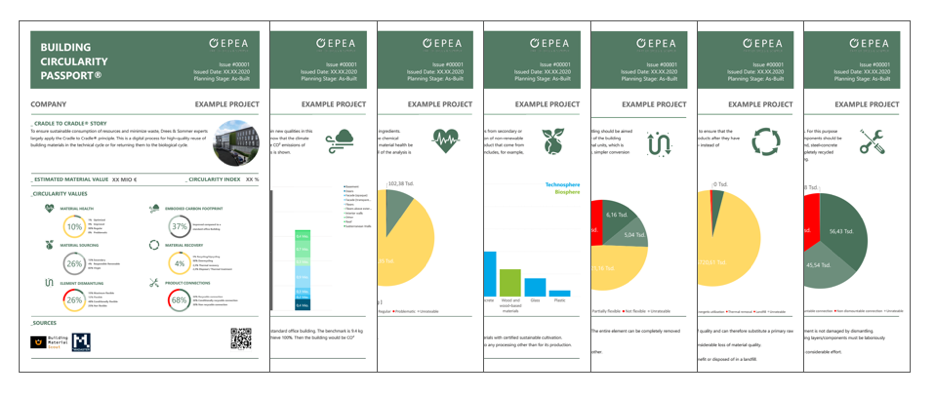
With this tool we are able to create a new identity for building: a Building Circularity Passport which is directly linked to BIM and the planning process. So it serves as a planning and documentation tool, for enabling the circulation of a building in collaboration with architects, all planning disciplines as well as the construction firms. For completed construction projects, the Building Circularity Passport additionally provides detailed information on which of the used materials can be easily separated, as well as on the chemical composition of the products used in the building. It is also possible to determine the monetary value of the structures used in the buildings. This information on the building provides you with considerable added value for financing, through aspects of risk assessment, value determination as well as the operation of the building.
How Citizens benefit
Our growing cities are constantly facing new needs for qualitative housing, work, logistics and mobility. Still, buildings are often created with only one function in mind. When societal needs or user preferences change, these mono-functional buildings usually become out-dated or even obsolete, resulting in a high rate of building vacancy and premature demolition.
Innovative character
The transition towards a circular and dynamic built environment will require a holistic and transdisciplinary approach.
The first step in changing a system is understanding it. The elements of a sound system description include a determination of the relevant key system functions and indicators. A path to a more sustainable society or system is initiated mainly by an appealing and inspiring vision, a clear visual or non-visual “image ”of a desired system based on shared principles (of a sustainable development).
From an inspiring and clear vision, we need to find a way to make things understandable, visual and compareable. Therefor new benchmarks for circular economy solutions need to be defined and easliy described.
Just like a life cycle assessment, circularity must also be made comprehensible in the future. This can be done for the very first time with this tool and its evaluation.
It also will make significant advances in the uptake of the circular economy in the building industry through the development of innovative circular reverse logistics’ tools and high-value secondary raw materials production technologies to establish market confidence and acceptability of recycled End-of-Life building materials.