Flexi-Podium
Basic information
Project Title
Full project title
Category
Project Description
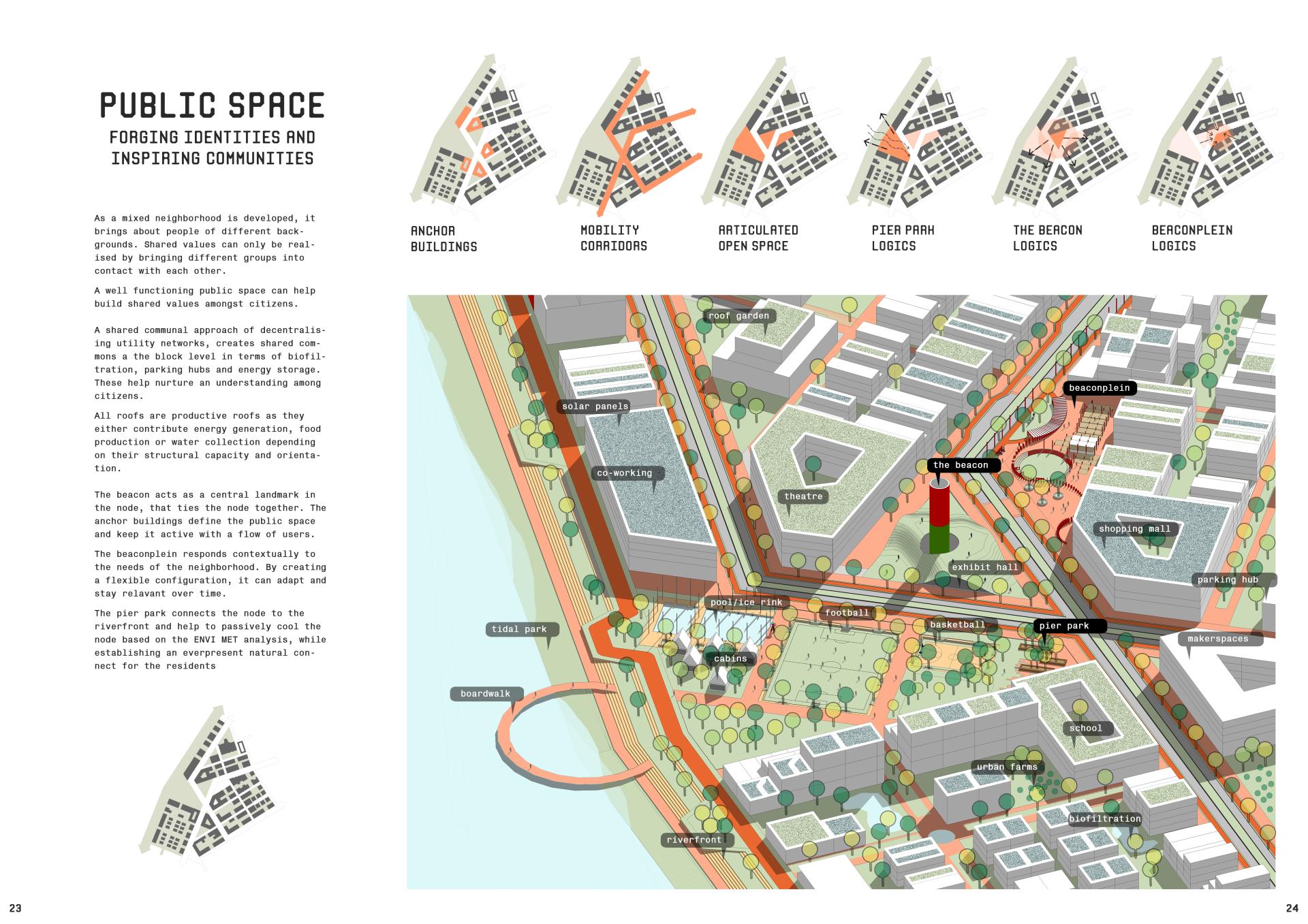
Spaces are socially produced (Lefebvre & Nicholson-Smith, 2009) and are not only a conception of architects and urbanists. By allowing citizens to be part of the city building process, the multiplicity of the ‘natural city’ can be allowed to emerge through appropriation. The flexi-podium is a user-controlled installation. Community members could reserves spaces, modify it to their needs and invite others in the community extending the Dutch tradition of legibility in public realm design.
Project Region
EU Programme or fund
Description of the project
Summary
“Affordances are the qualities of an object or environment that allow or afford an individual to perform an action or series of actions. For example, a bowl can afford eating for an adult, but it may also be perceived as a drum or hat by a child, thereby affording other uses. Applications of this theory of affordances today relate not only to analyzing the physical environments of inhabitation, but also in efforts opposing environmental degradation, as the question shifts from the narrow industrial perspective of what the environment can do for us to a more sustainable understanding of environmental affordances” (Gieseking, Mangold, Katz, Low, & Saegert, 2014).
This when extended to the public realm means its ability to ‘afford’ multiple interpretations and multiple uses by people. Spaces are socially produced (Lefebvre & Nicholson-Smith, 2009) and are not only a conception of architects and urbanists. By allowing citizens to be part of the city building process, the multiplicity of the ‘natural city’ can be allowed to emerge through appropriation.
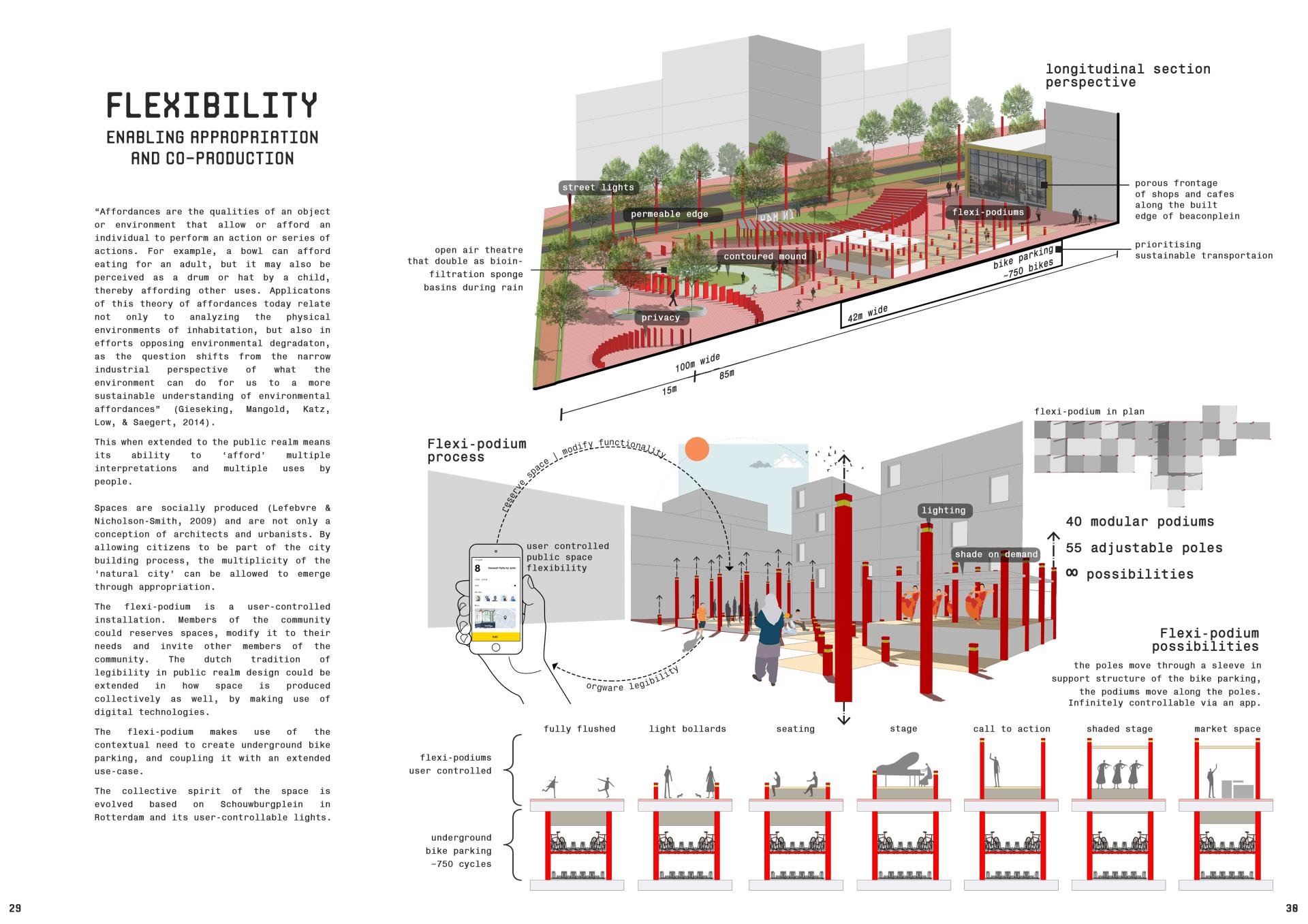
The Flexi-podium is a user-controlled installation. Members of the community could reserves spaces, modify it to their needs and invite other members of the community. The Dutch tradition of legibility in public realm design could be extended in how space is produced collectively as well, by making use of digital technologies.
The Flexi-podium is a bike parking solution on one level and an interactive urban installation on the street level that affords the public plaza as part of the Merwe-Vierhavens redevelopment in Rotterdam to take multiple roles along its lifetime. The affordance of the space is especially important in a brown-field regeneration project such as this as the neighbourhood and the public realm find their identity and ethos over time in a shared and collective process.
Key objectives for sustainability
1. The Flexi-podium is a combination of two infrastructural systems in one.
a. An underground bicycle parking
b. A ground-level urban installation.
Through the intensification of functionality, the proposal puts scarce urban space into better use.
2. The proposal by virtue of its modularity and reconfigurability, makes it extremely versatile. From a material perspective, it reduces the use of different types of single-use arrangements towards setting up markets or other temporal arrangements. From a spatial perspective, it introduces higher degrees of multi-purpose potentiality to the space owing to its ability to afford various configurations and thus various functions, truly reflecting the ethos of a public square.
3.
Key objectives for aesthetics and quality
The 40 modular podiums with 55 adjustable poles are arranged in a grid that reflects the underground parking. Theoretically, they could be arranged in an infinite number of ways to reflect new compositions at the ground level. In the example of the Merwe-Vierhavens, it takes up the shape of a regular grid, with few irregularities towards one end to introduce tension in the composition.
The Poles when fully contracted, reveal a clean surface. They could be configured to be bollards, seating, stage or a market booth. Thus enabling citizens to experience the space in multiple forms. The municipality or the neighbourhood organisations could experiment with this versatility towards creating new kind of experiences every day in the public space, bringing people to see something new every day.
The poles are designed to look industrial, reflecting the industrial past of the Merwe-vierhavens. While the materiality reflects the past, its spatial configuration is a subject of constant change reflecting the needs and demands of the present, while staying relevant for the future as well.
Key objectives for inclusion
The Flexi-podium is designed to be controlled by the community through the interface of a mobile app. Members of the community can reserve sections of the podium for specific periods of time in a day and it is reflected in a shared calendar for other community members to know. The app also enables citizens to choose the configuration of podium they would like to have.
The notion of configurable public spaces extends ideas of democracy, ownership and control to the physical public space. Public spaces are political in nature with only those with the know-how or in positions of power having the say to adapt it to reflect their needs. However, through a simple tool like that of a mobile app, the control of public space is democratised.
This is especially important in the re-development of Merwe-Vierhavens, which is expected to bring a lot of new residents to this part of the city. A shared ethos with mutual respect is important to ensure an inclusive neighbourhood for all.
Innovative character
There are two fundamental innovations in this idea.
1. Configurable public space.
Affordance in public space improves the experience of using it as it allows citizens to exert their personality into the physical space as well. That is why plazas with movable chairs are more enjoyable than those with fixed ones since you can move it to fit your needs. This idea is extended and explored in the Flexi-Podiums where the surface of the public plaza has a set of flexible podiums that could be converted to become bollards, seating, stage, a market booth or anything inbetween.
2. Digital interface with public space.
The ability to configure the public space is not locked within bureaucratic red tapes, but a democratised, citizen-centric app that allows everyday citizens to configure the space to reflect their needs. This makes the process transparent and accessible for a wide variety of everyday stakeholders who are traditionally not part of the process.