Parco Forlanini becomes “Grande”
Basic information
Project Title
Full project title
Category
Project Description
Parco Forlanini is becoming “Grande”, it is growing tree by tree, community by community, path by path. Its story is long and kept alive by small/big actions implemented by different communities, each giving its own energies, ideas, contributions. Its sustainability is its frugality to regenerate nature; its beauty is the un-expected agricultural meadows extended as far as the eye can see; its inclusivity is the plurality of the leadership creating opportunities for the park to become “Grande”.
Project Region
EU Programme or fund
Which funds
Other Funds
ERASMUS+ Programme (January2015 - February2017) “Community Participation in Planning” (CPiP, 2015-2017), an Erasmus+ project aimed at experimenting new educational models to drive students in urban planning and design towards inclusive planning practices. During the 2 years project students have worked within and for local communities towards a common vision of the Grande Parco Forlanini.
International Partners: University of Aveiro (Portugal), University of Belfast (Northern Ireland), Community Places (Belfast, Northern Ireland) (https://www.communityplaces.info/)
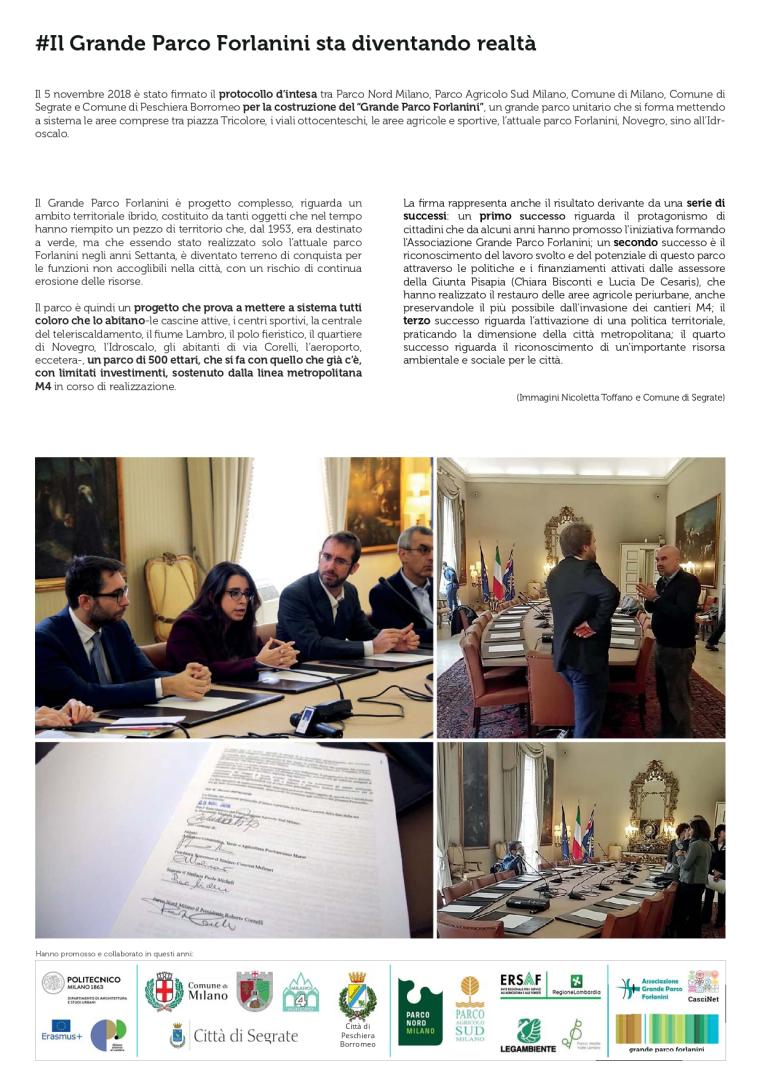
Throughout the implementation of the project and together with 80 international students, the team of the Politecnico di Milano (with prof. Antonio Longo a protagonist of the Grande Parco Forlanini initiative and planners of the Re-Lambro study), activated a local ecosystem of actors in collaboration with Associazione Grande parco Forlanini (http://www.grandeparcoforlanini.org/), made of citizens and activists, ERSAF (Regione Lombardia) and the Municipality of Milano. Additional actors of the activated ecosystem:
- Cascinet (https://cascinet.it/), an association of citizens and activists
- Milano Sport (https://www.milanosport.it/, managing the Saini Sport Centre in the area)
- Junior tennis (http://www.juniortennismilano.it/)
- Urban Golf Milano (https://www.golfinmilano.it/WP/)
- Scarioni Calcio (https://www.scarionicalcio.it/)
- Parco Esposizioni di Novegro (https://parcoesposizioninovegro.it/)
- the residents of the refugees centre in the area
The activated ecosystem is growing since then. Recently other associations of citizens and activists have joint the Grande Parco Forlanini network: Parco Nord Milano, Milano Bicycle Coalition, Ambiente Acqua Onlus, Gallab.
Description of the project
Summary
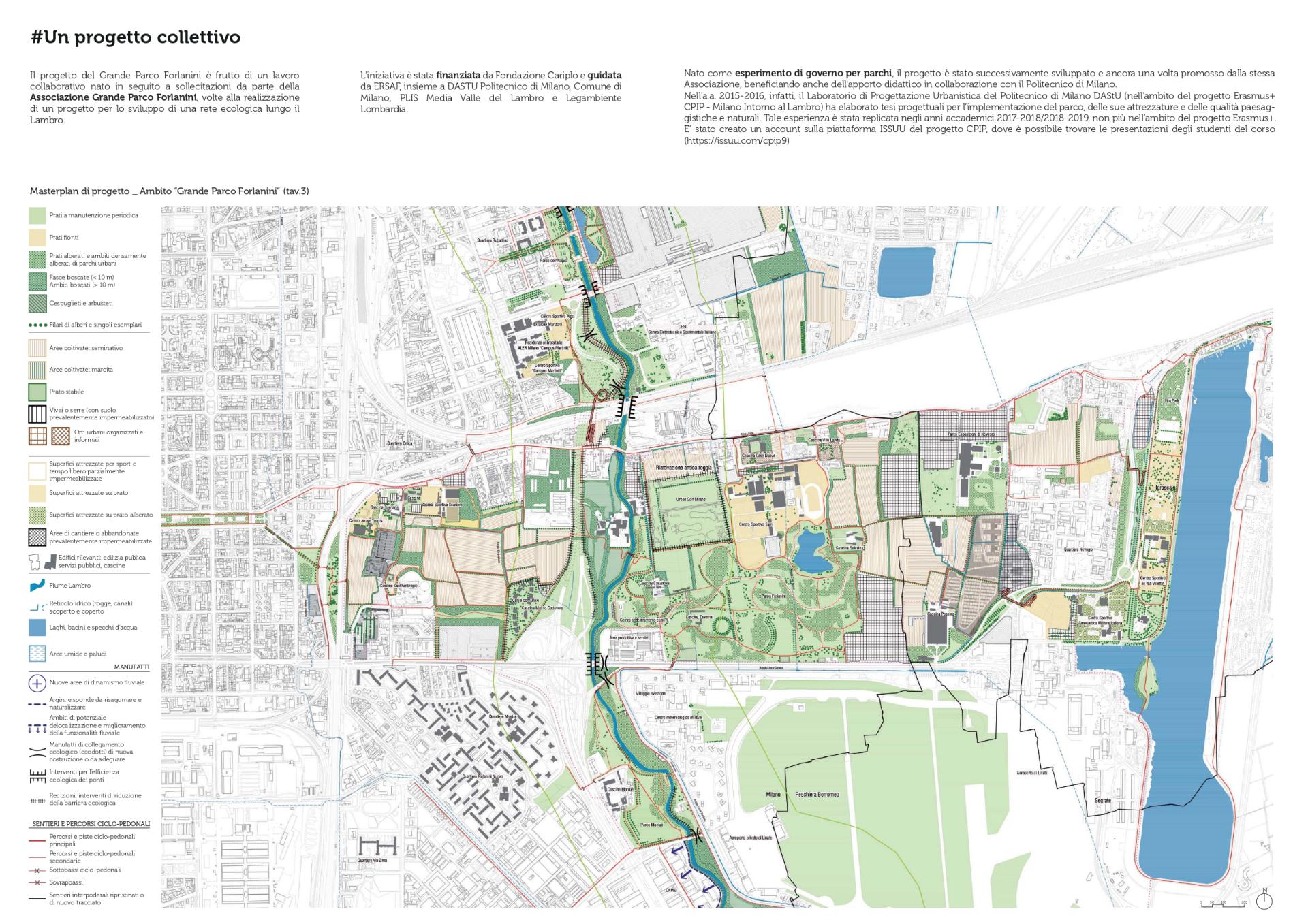
400 hectares. 400 hectares of land saved or still to be saved from speculation; of land conquested by citizens in collaboration with different institutions that no speculation is paying; of opportunities for the Lambro river to recover from its condition of ecological invisibility. 400 hectares of Milano urban future.
The park for the river: This park is one of the breathing areas of the Lambro river, its ancient flooding space; the park making is making the river its conservative resource which will benefit now of the park growth: the river is the ecological spine of several metropolitan parks and Grande Parco Forlanini represents an option to its ecological continuity, to its rehabilitation. The river is now hidden to users by flood security banks and by its pollution; the park's growth is its opportunity to go back to nature.
Making Parco Forlanini “Grande”. Making Parco Forlanini “Grande” has been, and still is, not a process of regeneration of an abandoned area. It is rather the collective identification of an opportunity embedded in this portion of the territory that was a chaotic pot of different not synergising fragments that are now coming together to grow with the park. Making Parco Forlanini “Grande” has been, and still is, a process of identity creation: getting familiar with its name; developing the sense of belonging to, and responsibility for, a transformation process out of any bureaucratic procedure; sharing a vision that is making the park a reality. Ours is not a completed project, it is many, several completed projects that have contributed and are still contributing to its growth.
A design in progress. The park is the output of a design in progress activity of several communities, actors, institutions; it is a project producing a plurality of values throughout the transformation of spaces; not the output of a blue-print, rather the output of a collective generated green strategy. It is an evolving plan, adaptive, responsible, and sustainable
Key objectives for sustainability
Rethinking the role of a forgotten, peripheral river (Lambro), and putting it back at the center of the Milano urban policies in a metropolitan perspective by improving the quality of water, soil and ecological connectivity, and regenerating the landscape along the river, through the city, is the pilot action put in place by the Grande Parco Forlanini initiative, which brings together elements and resources that are otherwise separate and distant, giving citizens a vital, healthy space, a space to be back to nature. Over the course of 10 years of action, the GPF has experimented and developed many sustainability objectives promoted by the United Nations SDG: today the sustainability of the project takes place as a balance of what has already been done in the past decade and what it can still be in the future . Specifically, some already met objectives are
Good health and well being: the GPF is inhabited and animated by dozens of sports associations, every day during the lock-down period it was the space for thousands of runners, athletes and young people to vent.
Green education: the city overlooks the park, the park connects parts of the city, it is landscape in the city, a space for nature care and culture
Jobs and economic growth: the park includes spaces for work, volunteering, services and mobility. Post covid forces us to conceive a new quality of work spaces and the Park is the most suitable environment to represent them.
Reduced inequalities: the park is a political device, it is a landscape and a common space, it is inclusive and open to differences.
Responsible consumption and production: the park is also an agricultural economy, innovative and sustainable
Life on land: the Milanese Lambro System and the Park are a new green and blue infrastructure, the backbone of the city's ecological redevelopment.
Strong institutions: a park to be built for partial works, over time, in a choral way, is a field of institutional innovation
Key objectives for aesthetics and quality
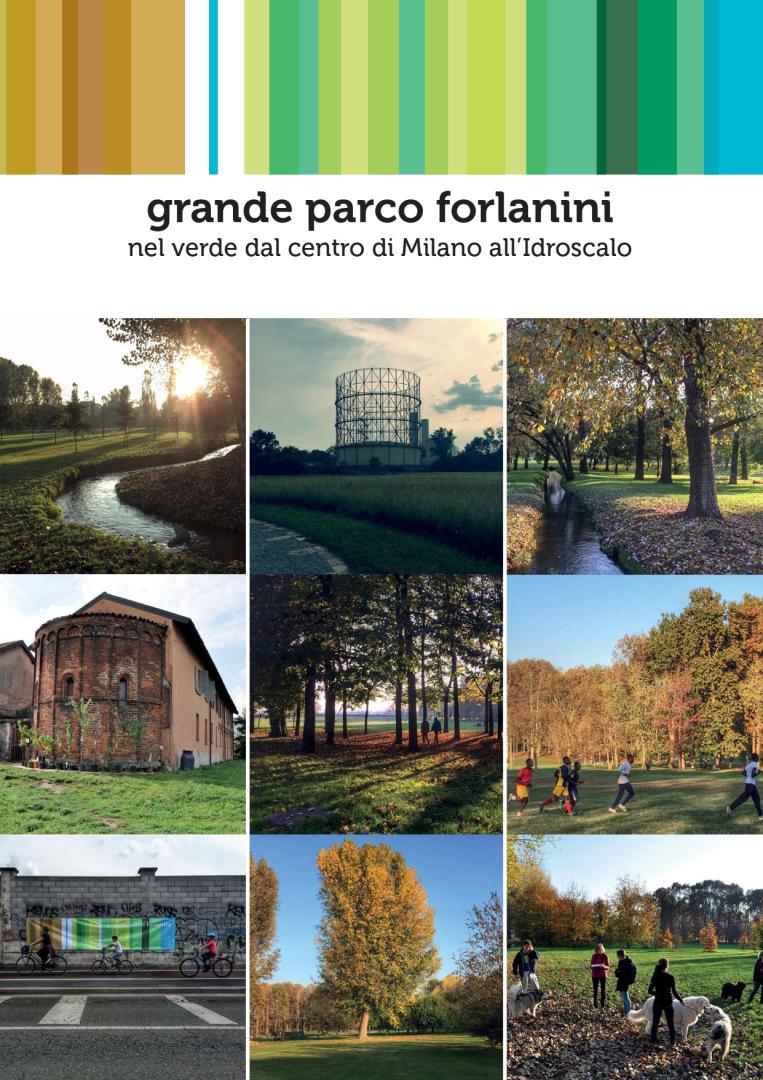
Milan is an unusual city for Italy: dense, with a discreet quality, barely visible. The ancient unity between city and countryside is now a separation and recent building projects have chosen the path of global aesthetics of buildings without place, generic. The Forlanini Park includes differentiated landscapes that have remained included and unknown, such as a large secret garden: the cultivated fields in the part closest to the center, ancient medieval farmhouses, the Lambro river, the woods grown on the sides of the park also due to long abandonment. The aesthetic value of these places consists in their unexpected beauty, in the sense of astonishment it generates in people when they discover that inside the city meadows are extended as far as the eye can see; in the instinct for care and protection they ignite.
The park is becoming the green infrastructure of routes connecting the city center with the large water shed near the Linate airport, Idroscalo; a sequence of different landscapes offering those alienating, relaxing, enjoying experiences, always new, diverse, surprising, comfortable, incredible along the hours of the day, along the seasons.
Milan, a city without landscape, finds a new landscape in the Grande Parco Forlanini: unusual, inhabited, surprising. This beauty, this aesthetic value is neither the output, nor the objective of a traditional project. It is the result of more than a decade of initiatives, events, actions that have made such value exist in the communities eye and in their actions: tree by tree, community by community, path by path. The park aesthetic value is its own designing capacity and the implementation of such a project achieved its goal when citizens started acting for its conservation and protection. Its aesthetic value is therefore made of two components: a hardware (the changing landscape) and a software (the active commitment of citizens and institutions).
Key objectives for inclusion
Parco Forlanini is growing tree by tree, community by community, path by path. Its story is long and kept alive by small/big actions implemented by different communities, each giving its own energies, ideas, contributions. The growing number of users, actors, uses, resources, dreams, opportunities to make it "Grande" is the evidence of its inclusivity. Not one unique leader, rather several; not one unique community, rather many; not one municipality, rather three (Milano, Segrate and Peschiera Borromeo). This richness of actions/forces is neither the output nor the objective of a project; it is the design fuel and not the design goal of this park. This is evident from the number of active groups, citizens organizations, local service providers. Some community leaders have an ephemeral role and with them also the related communities; some others have a more permanent nature and act and igniters of the attention on the park making: the team at Politecnico di Milano, the ERSAF unit of Regione Lombardia, Grande Parco Forlanini and Cascinet associations, Parco Nord Milano.
Grande Parco Forlanini is created by:
Communities of practice: runners, bikers, sport teams and organizations, urban agriculture activists that seasonally, yearly, monthly organizes events, initiatives in the area challenging the still existing fragmentation and that work as drivers for the engagement of additional communities and citizens
Communities of interest: ornithologists, activists for the protection of the Milano rivers, experts of history and architecture (due to the high concentration of traditional farms, some of them being ancient rural villages), hydrologists, and urban ecology activists.
Community of place: related to the different urban services being offered in the area: typical restaurants, exhibition centres, refugees centres, amusement park, sport centres, all of them creating citizens ecosystems developing strong relation with the places, the park and the offered opportunity
Results in relation to category
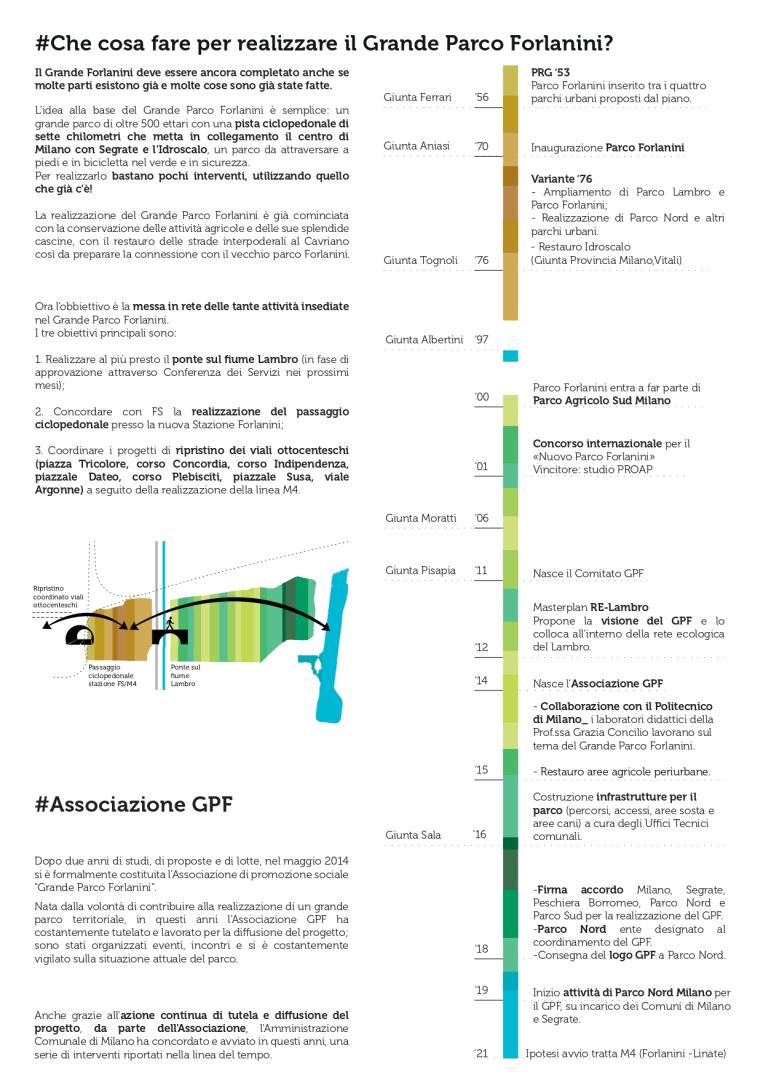
One of the key events that gave the birth to Grande Parco Forlanini was the 2001 international competition launched by the Municipality of Milan for the "redevelopment of Parco Forlanini". The competition saw as winner (2002) the Portuguese Gonçalo Byrne but his project has never been implemented due to lack of funds. From that moment until 2012, the Forlanini and its ambition to become “Grande” somehow remained a silent actor of the Milanese urban scene and together with it the Lambro river.
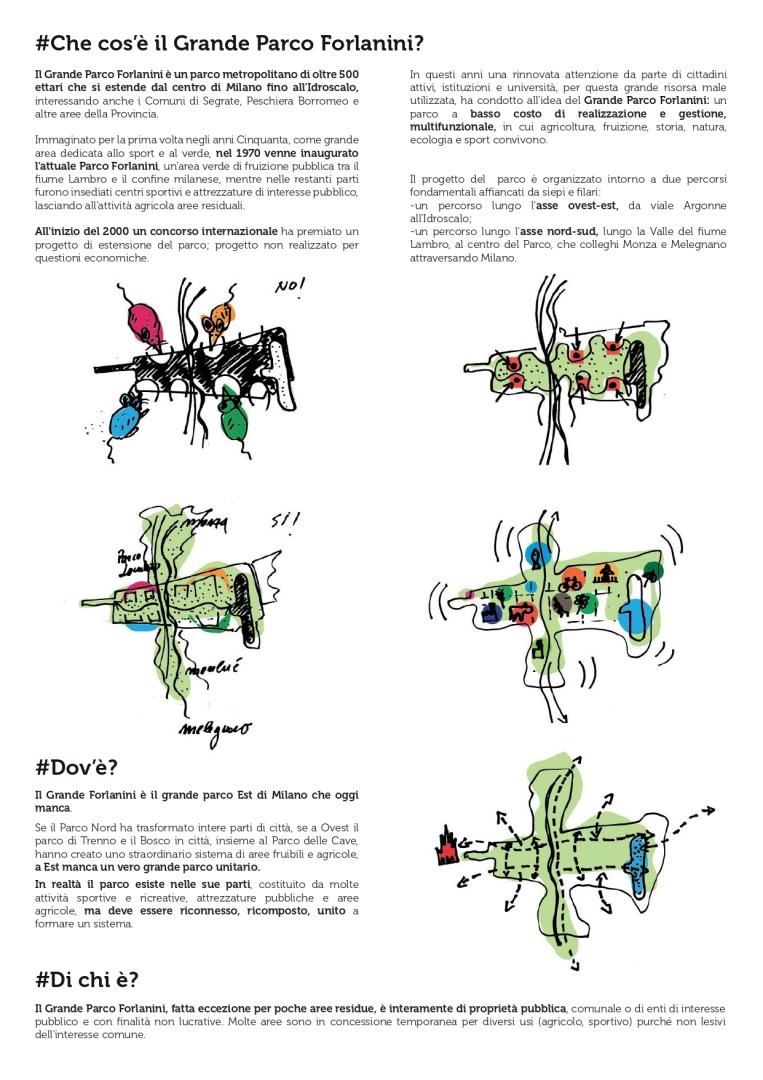
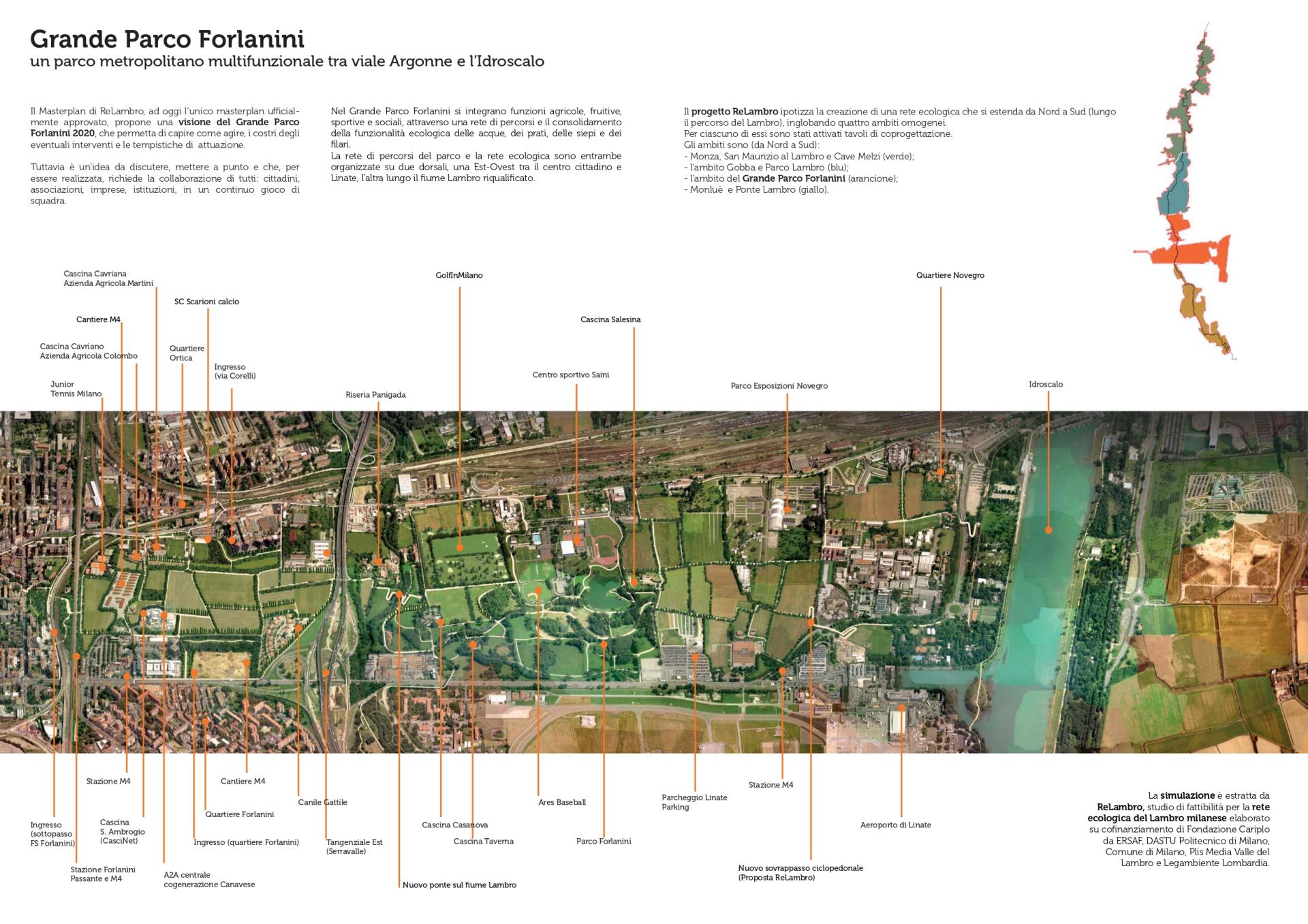
In 2012, however, the Parco Forlanini came back by the Re-Lambro Project, a project for the creation of the Lambro ecological network co-financed by Fondazione Cariplo and led by ERSAF, together with the Department of Architecture and Urban Studies of Politecnico di Milano, Municipality of Milan, PLIS Media Valle Lambro and Legambiente Lombardia. The so-called "ReLambro Masterplan" represented a trigger for the Parco Forlanini to become “Great”.
Following the ReLambro study, Parco Forlanini grew (2015) thanks to the effort put in place by citizens associations (mainly Grande Parco Forlanini Association), university, and the institutional action of the Park and Gardens unit of the Municipality of Milano: 40 hectares of agricultural areas were transformed into enjoyable land made accessible by 3 km of cycle and pedestrian paths allowing the public agricultural experience in the park were developed so making that vision to become a step forward into a new reality.
While the park was growing the CPiP project (Erasmus+) was supporting important community engagement activities to make the GPF association be known and share its goals and visions. A logo was developed, officially registered by Politecnico di Milano and largely used to promote the park and activate the creation of the Park identity. The logo was adopted by the citizens for a petition, and many actors used it in official communications as a declaration of identity. The park grew in intentions, perspectives.
How Citizens benefit
Grande Parco Forlanini is not yet as “Grande” as in the vision “from the Milano Dome to the Idroscalo in a greenway”: two bridges and a relevant underground connection can make it as “Grande” as in the visions of the different engaged and active communities. Nevertheless it is “Grande” enough to welcome a growing number of citizens: the evidence provided during the COVID-19 restrictions period. The pre-existing park (Parco Forlanini) represented the drivers for the new part to be discovered by a larger number of citizens: the new added western side of the park, being closer to the city center with respect to the old portion represented a surprise and a relief from the restriction imposed by the regional and national lock-down. This made the park, a new park of the city, to be experienced as an opportunity for a new collective way of spending time together staying in the city and at the same time in security. A growing park in the urban reality, that was known by some local communities, acquired the value of a park for the entire city. The eastern area of Milano needs it, needs its green provision and it is there, ready to use, easy to grow.
The role citizens have played has been fundamental for the growth steps that the park has already done: pushing the public authority to implement some initial transformations, adopting spaces and infrastructures which are abandoned and bringing them back to life, organising initiatives and events; their growing number is now the key to strengthen and orient the new coming interventions of the three public authorities (Milano, Segrate and Peschiera Borromeo) towards new steps towards it. Citizens are activists and makers at the same time, their commitment is growing as the benefits generated by the park growth are evident.
The main impact of the project is that the park is there although not yet as "Grande" as it could be, rather "Grande" anyway. The park is there with its present and its future.
Innovative character
One park, many visions. A park for the metropolitan area of Milano. The eastern gateway to the city. One surviving space of the Lambro river. The green cradle for 7km bike lane from the Dome to Idroscalo (the sea of Milano). The farms village park. The sport making park. The art making park. The park from above. The ecology-lab for Milano metropolitan area. Many visions synergising very different communities and competences making the park a reality already in its becoming and at the same time a growing opportunity. Each vision generated by one community. It is a value production project that is challenging the lack of fundings by recognising the frugality of its making, its relevance, its opportunity, its permanence in the citizens vision/s.
Not all the visions will be implementable. Some of them have already started to be: important meetings among the sport clubs and organizations took place under the guidance of Parco Nord: the challenging idea of a Sport Park is attractive and not easy to implement; the involvement of many universities in the activities of the different actors and associations in the area are implementing the park as an eco-lab, a lab to experiment operational solutions for the green transition; many farms are being rehabilitated and changing their functions to respond to societal needs towards the creation of small villages in the park.
The park is becoming but it already is, exists in its frugality. None of the implemented interventions is tremendously expensive, none of the visions implies irreversible transformations. Irreversible is its growing to become “Grande”. This is the innovative character of the candidate proposed initiative. Not the creation of a park as a public investment, rather its creation made by citizens who are not users rather city makers.