iLAND Silent Science
Basic information
Project Title
Full project title
Category
Project Description
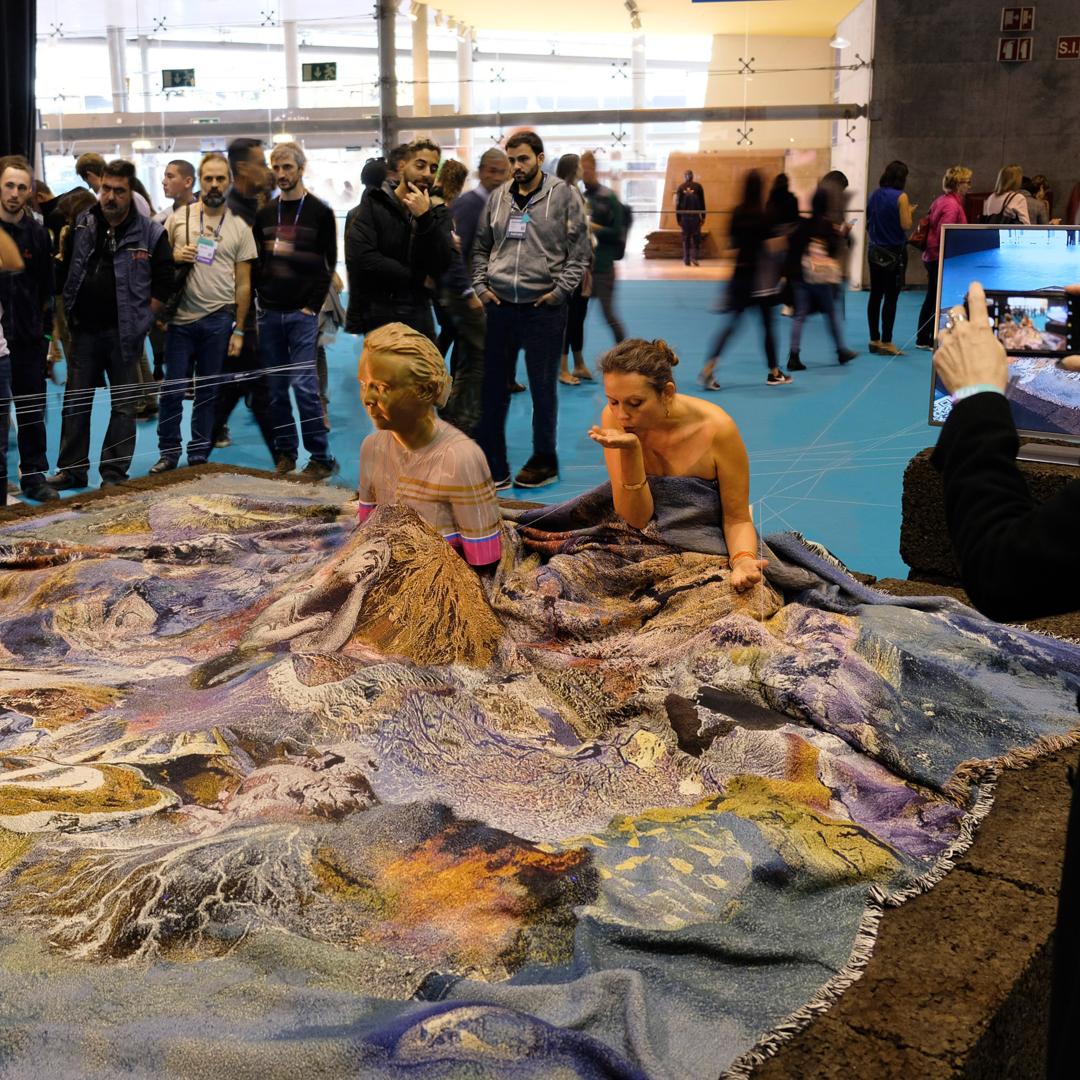
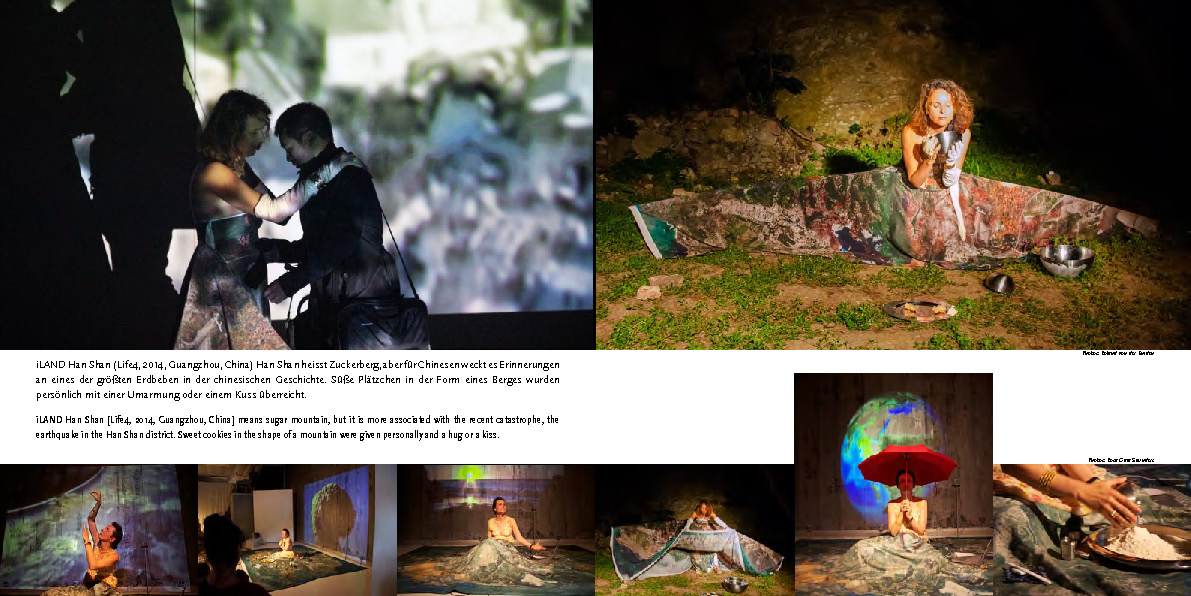
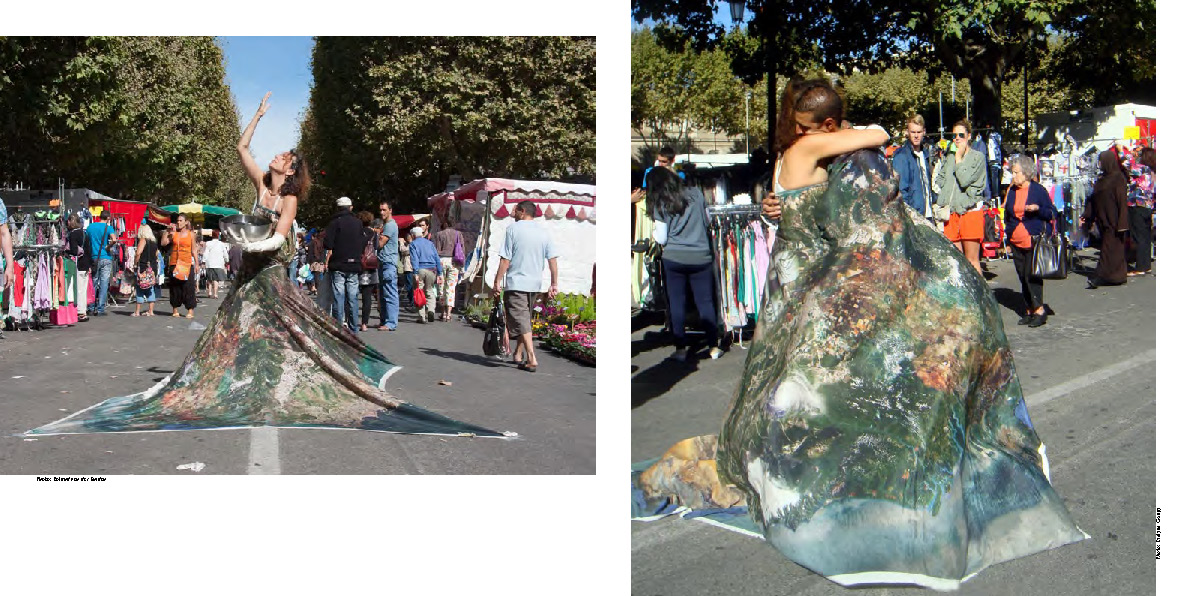
iLAND features the most pressing environmental issues on one large dress. Regina Frank performed with iLAND for a decade in 28 cities in silence, moving so slowly that you only understand her movement when you see it in time-lapse. Just like we don’t see the effect of our actions unless we look to the future. QR codes and panic buttons lead to websites informing on the issues and suggestions how each of us can make a change. The installation is an incentive for vibrant discussion and exchange.
Project Region
EU Programme or fund
Description of the project
Summary
iLand Silent Science
After 3 years of extensive research, collecting data and images from NASA, EDR, CDC, and the German Environmental Agency: UBA as well as other NGO’s and newspaper clippings Regina Frank brought together several hundreds of images as a collage featuring the most pressing issues on an island-like dress.
All of this data is readily available but it doesn’t really touch us, because it seems far away in space or time. iLAND is trying to touch us with these issues and inspire us to rethink our actions.
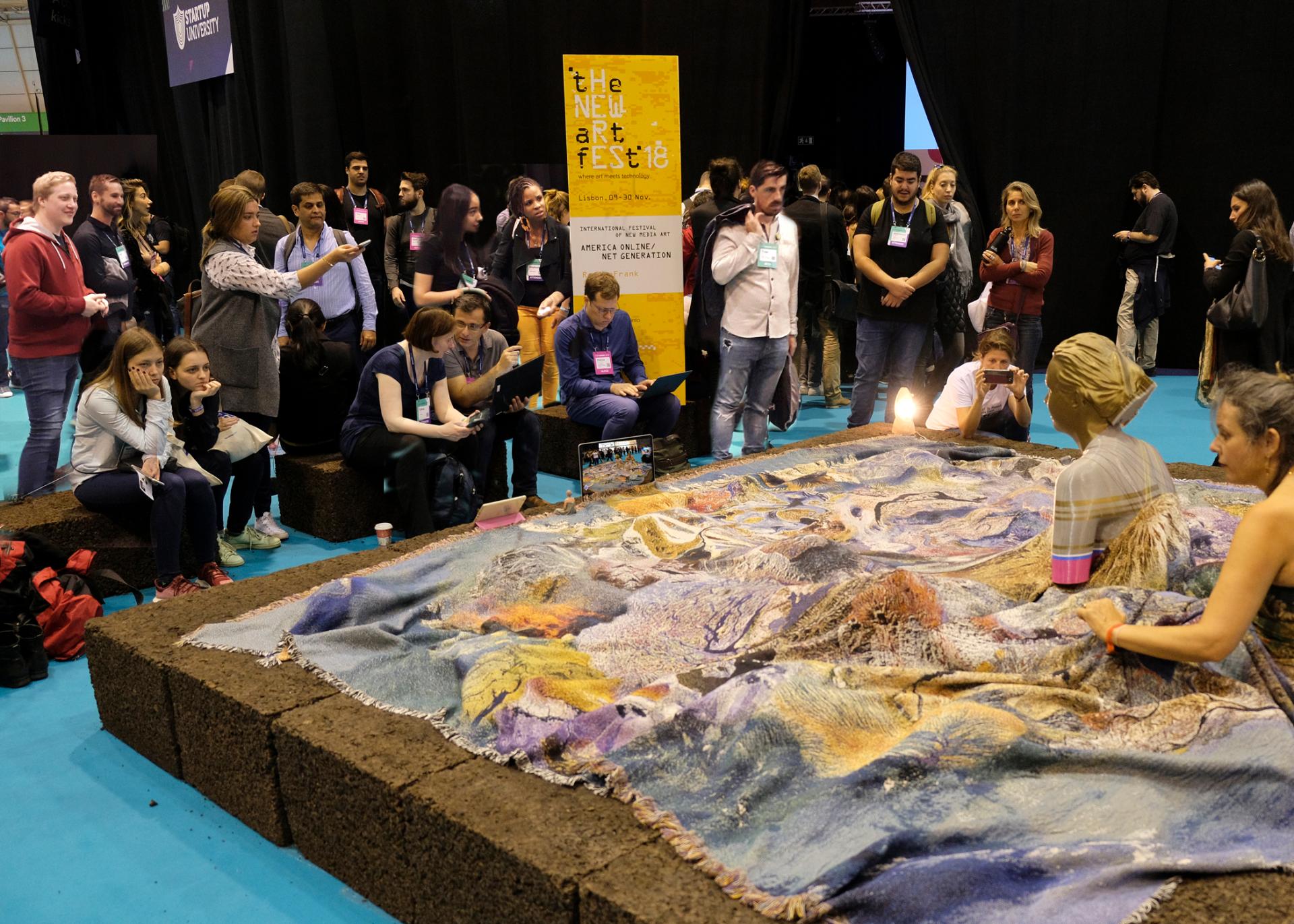
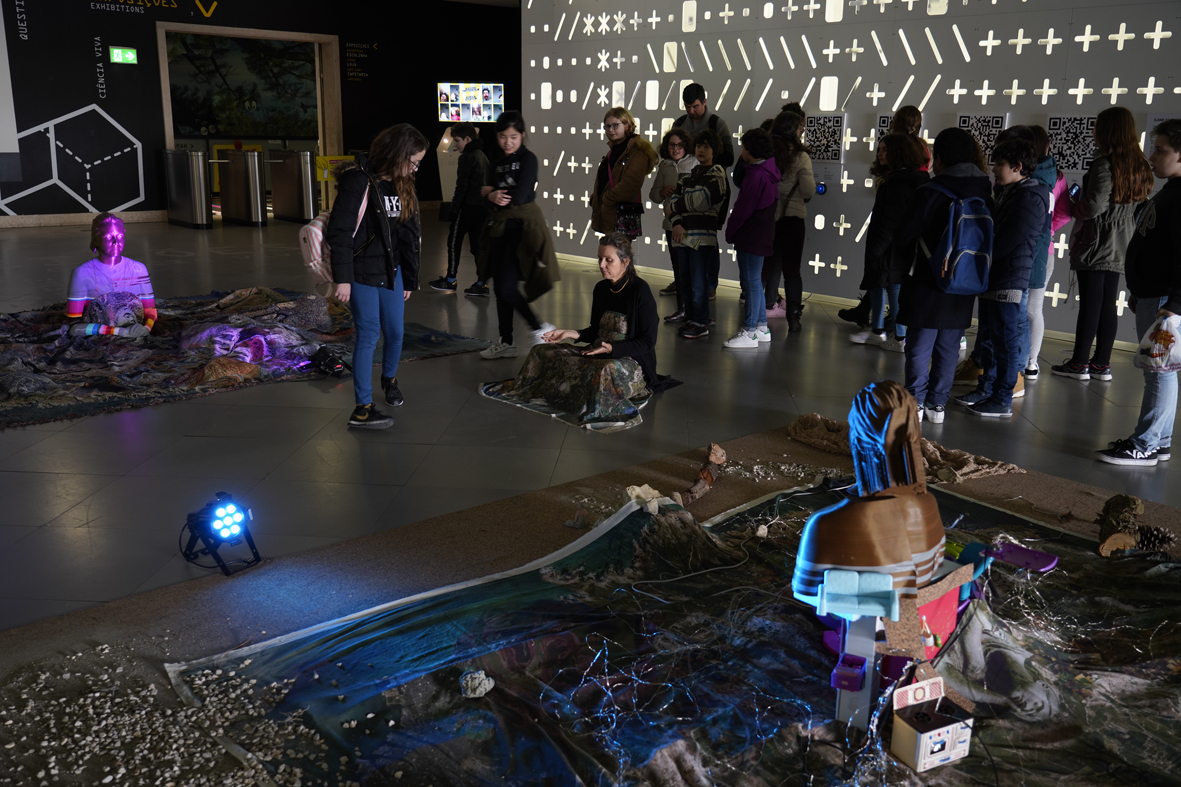
Regina Frank has performed in different 28 cities in public space, among them at the Websummit, at the MAAT (Museum of Art Architecture and Technology), at the Museum of Natural History in Lisbon, and around the world, including China, Japan, USA and Europe during seven years from 2013-2020.
With her ilAND Dress she is sitting in silence and moving so slowly in reality that you only can understand what kind of movement she is making when you see a time-lapse movie later. Just like we don’t really see the effect of our actions unless we speed up and look to the future.
Through QR codes the viewers learn about the environmental background information and the artist’s comprehensive research in the field; featuring suggestions for changes in our own behaviour. How each of us plays a valuable role in achieving change, as well as effective environmental projects that were implemented to solve some of the problems and ideas that are not yet realised. All issues are structured in three categories: soil, air, water and when a visitor pressed a panic button the area most effected by the issue would light up, thus showing the effect of the problem on the picture of the landscape.
The installation is an incentive for a vibrant discussion and exchange and will continue to travel. At the Websummit and Natural histThrough an AR (augmented reality) feature people can see sustainable air purification and highly nutritious plants growing virtually on the iLand.
Key objectives for sustainability
The key objectives of the project are to inform people about the urgency of the environmental issues we face and to inspire them to make proactive changes in their daily lives.
These objectives are made clear through performances, talks and silences, videos, social media, as well as through personal interaction in workshops giving sustainable fashion, food and travel advice. Together with the previously mentioned website and QR codes as a take-home message, the viewer can continue to implement some of these changes at home. The site also informs about other important environmental projects that can be supported.
All plastics (sculpture) are made from corn-oil and are biodegradable.
The dress travels in a suitcase and installs within minutes, and when deinstalled leaves no trace.
All materials can be reused in the next performance or installation.
All electricity (very low consumption since it is lit by LED) can be generated by solar modules.
Key objectives for aesthetics and quality
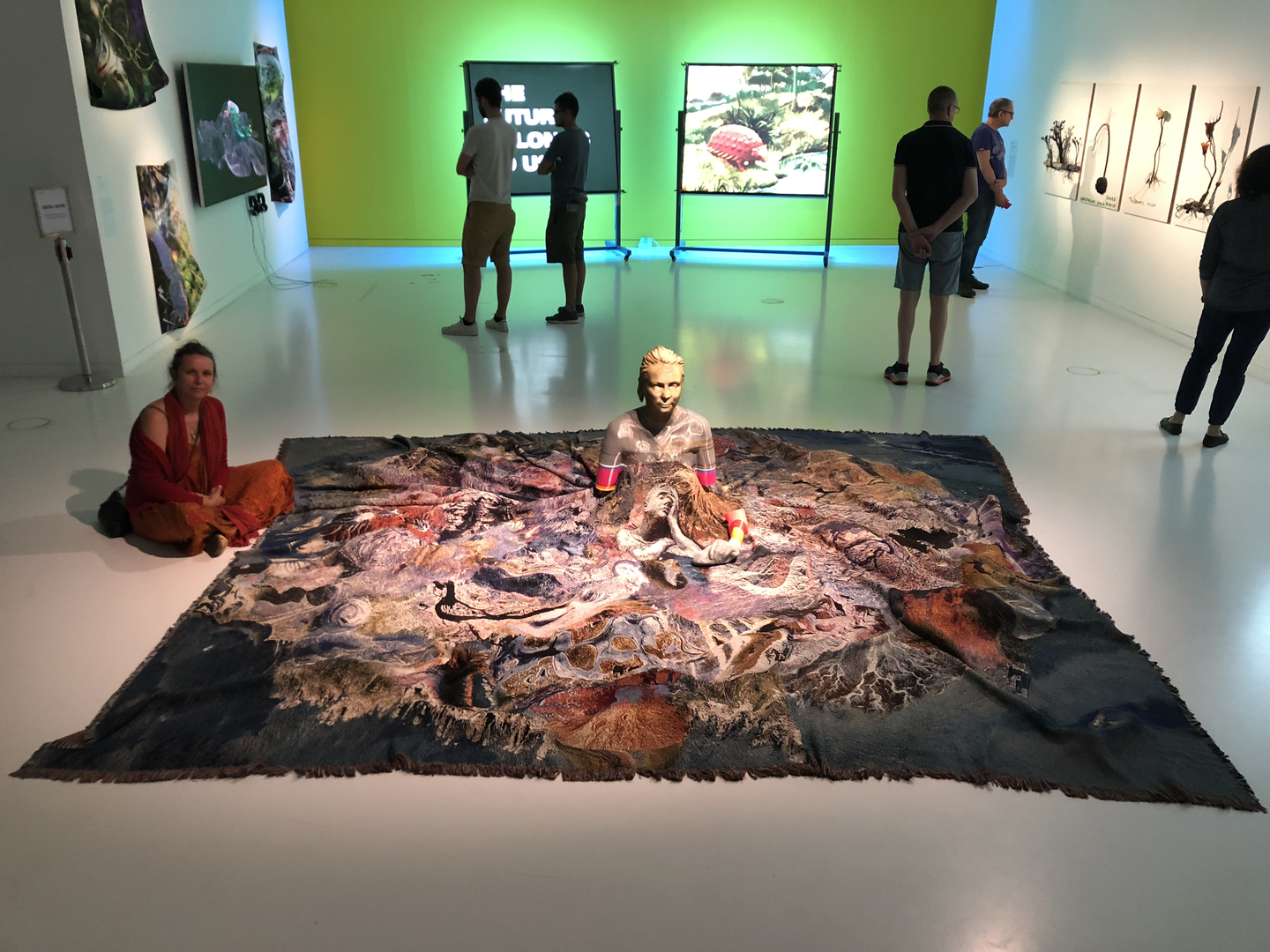
There are two iLAND pieces. A silk version that was first used for the Venice Biennale in 2011, and last used at the Pavilhao do Conhecimento in Lisbon in 2020. It was used for many performances around the world, in markets, harbors, museums etc. This fits in a carry-on or a handbag. This earthy coloured iLAND uses aerial images from various environmental organisations and Google Earth and is made from 100% natural silk.
The soft-weave iLAND (that was first used at the MAAT and at the 2018 WebSummit) with its vibrant colours in the 100% sustainable cotton tapestry uses infrared images that clearly show the progress of destruction or regeneration.
Both iLands can be formed into any type of landscape with clothing underneath to add volume, and thus look like mountains and valleys. The sculpture in the center is made from sustainable corn oil or clay and picks up on traditions of meditative reminders from Buddhist cultures. Children respond to the different-colored panic buttons relating to issues of soil (brownish yellow), water (green), air (blue), and a general emergency button in red.
This adds a play-full element to the installation but also highlights the issues on the tapestry and silk dress according to the aerial image where the problem is featured. Through the AR (augmented reality) feature people can see sustainable air purification and highly nutritious plants growing virtually on the iLand. This playfully informs people about a small simple solution to improve air quality at home, and introduces them to some easy- to-grow superfoods, and their benefits, to include into their daily diet.
Children could learn in brief workshops in a fun way how they can make a difference and feel empowered. Adults get inspired by the children interacting with the installation. In the Pavilhão do Conhecimento there were 8000 children during the time of the exhibition, and many tours of adults (around 5000). At the WebSummit countless young people interacted.
Key objectives for inclusion
All age groups respond to iLAND because of its inviting beauty and content. Many people who are normally not very interested in environmental issues or who haven't been informed of specific issues, start to give it more thought. The project empowers the viewer to make a difference and it also gives hope. It appeals to children because of the panic buttons as an interactive element, but also because of its dream-like appeal. It is like a large playground or a miniature landscape that includes toys in some of the presentation. For example, a toy airplane represents pollution through air traffic, but also plastic pollution and our complacency with traveling (one flight from Berlin to New York generates the same pollution as driving a car for one year).
The websites can be studied there and then with the help of explainers, and also later at home. The slow-motion performances that are shown as projections and on social media make it very clear how little we can see the effect of our actions unless we fast forward. The vegan food workshops teaching traditional local dishes in their vegan version, the program on how to make your own lipstick, shampoo, natural cleaner, etc is a side activity that involves the viewer with hands-on practice and fosters collaboration as well as offering a platform to meet and discuss further ideas. A vegan buffet at the opening sets an example for delicious food without animal products. The collaboration with various organisations opens up immense potential for the sharing of knowledge and creating further ideas.
Results in relation to category
I noticed that still there is very little at science museums on environmental issues, and even at conventions like the WebSummit and the various art museums. The Pavilhão do Conhecimento had no environmental issues installation, and neither did the Natural History Museum in Lisbon. It is important that installations like this are brought into our museums. But also touching people in the streets just with a silent performance to raise questions is extremely effective. I ask people to imagine that the world is an island and that all the environmental problems are on your doorstep, what would you do?
Even if it is just one person that changes some aspects in their live because they are inspired, it is already something gained. If we cook vegan meals once a week, produce less garbage, are mindful of fast fashion, fast food, and water consumption, as well as the real cost of things in terms of water, oil and other resources, (like the production of a t-shirt costing 2700 liters of water) we might consume less and treasure things more for their real value. We can buy things cheaply and the environmental costs are hidden, but if we create awareness we also become inspired to consume less and live more.
iLAND helps to recognise that resources are finite by bringing the relevant data together and showing the real cost of our consumption.
How Citizens benefit
All around the iLAND, people have conversations with me and with each other. Thousands of people have been inspired in many different cities. They participated in courses learning how to make vegan food, their own lipstick, shampoo, cleaner, and learned about the footprint of their actions. They became part of the performance and stumbled into me when they were not nescessarily interested in environmental issues. It is easy to bring like- minded people together for lectures and on the internet, but I see myself more as doing grassroots work, sharing with communities in the market, the museum, and in circumstances where people least expect it.
Innovative character
—The performance with its slow motion in reality that is later shown as a time-lapse movie, and only then you realize what kind of movement I am making (thus only being recognisable/ visible as a fast-forward film) is so far unique.
—The collage of infrared images from different environmental organisations which is woven into a tapestry historically relates to the tapestries depicting important historical events such as coronations or won battles (victories). The environmental problems of our times are our contemporary battles and the projects helping to resolve or ameliorate the condition of our planet are our victories.
—The structure of the site dividing the issues into the main themes of air, water and soil give us a much better overview. Even though the issues overlap in many ways, there are specific solutions to each aspect. For example: The air pollution from one containership is equivalent to that of 320 000 cars running for an entire year. Water is polluted through oil spills, the cheap, low-quality fuel being used to move such a vessel, and the garbage that is being dumped into the water. Soil pollution is caused through the polluted water ending up in our fields.
— The use of led lights to shed light on the problem and thus “enlighten” the audience. The interactive experience of pushing the buttons that turn on the lights on the installation, the scanning of the QR codes containing take- home messages, and the accessible informative workshops lasting 5-50 minutes provide more opportunity to interact.
—The food and self-made cosmetics that people can take home, try out, and make again is a fun reminder of the project at home.