Paradise Now
Basic information
Project Title
Full project title
Category
Project Description
¿If we could start from zero - but taking into account the current technology and knowledge - how would we affect nature?
Distancing itself from the primitive, Paradise Now is a look towards our origins from a technological perspective. The purpose is to create an alternative way of living based on a symbiosis with the environment. In order to provide hope, it is a seed for change, fighting the misconception that things are the way they are and that they cannot be changed.
Project Region
EU Programme or fund
Description of the project
Summary
The health crisis caused by Covid-19 forces us to position ourselves and react in a brave and creative way. The current context highlights the fragility of our living system, a system that characterizes by the disrespect upon our planet Earth. These are difficult and uncertain times, but also intense and exciting moments in which we measure ourselves as designers and as people.
Therefore, Paradise Now emerges from this context by getting back a broken relationship with nature. This project is about symbiosis with the natural ecosystem and a new way of living.
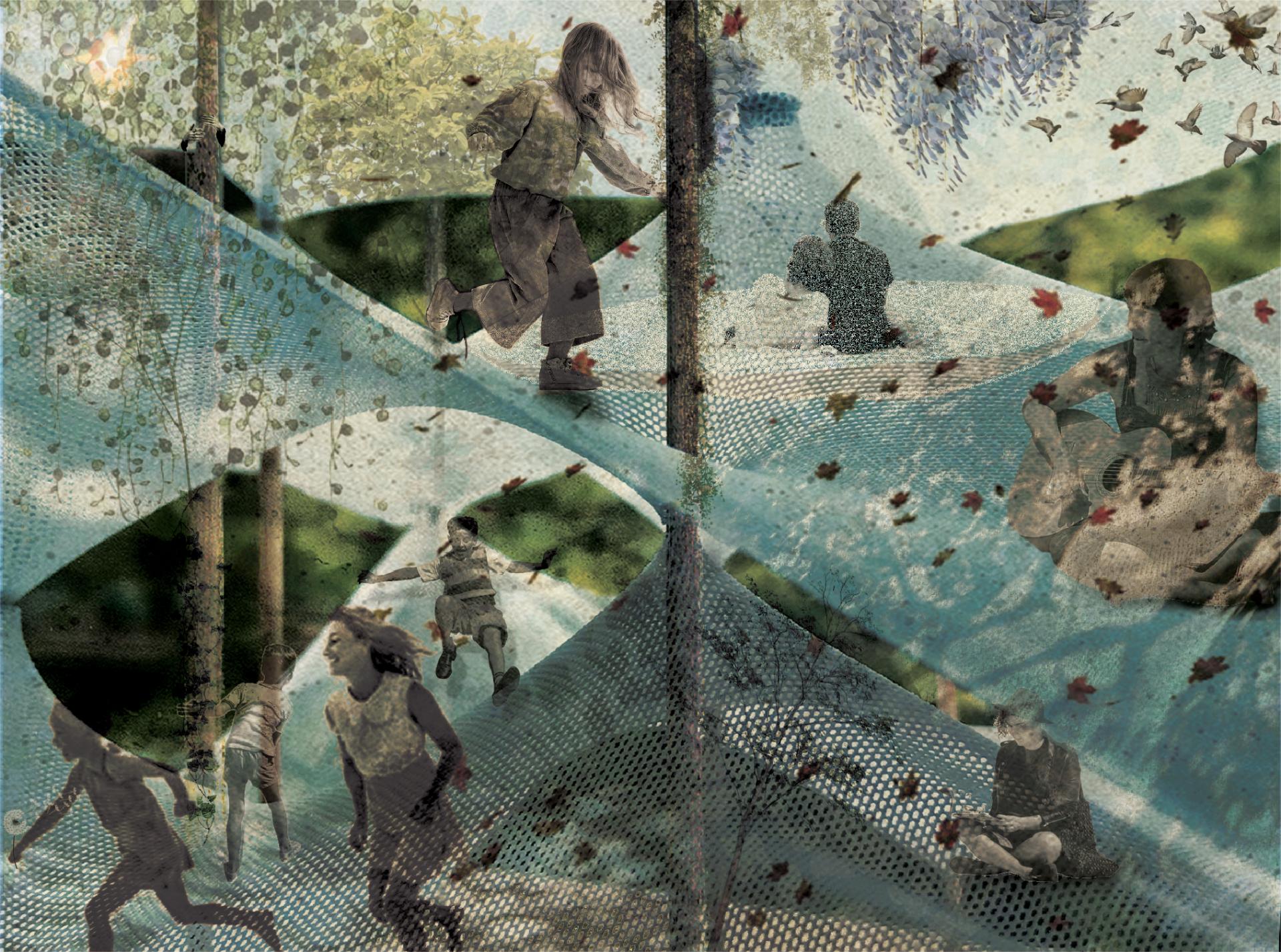
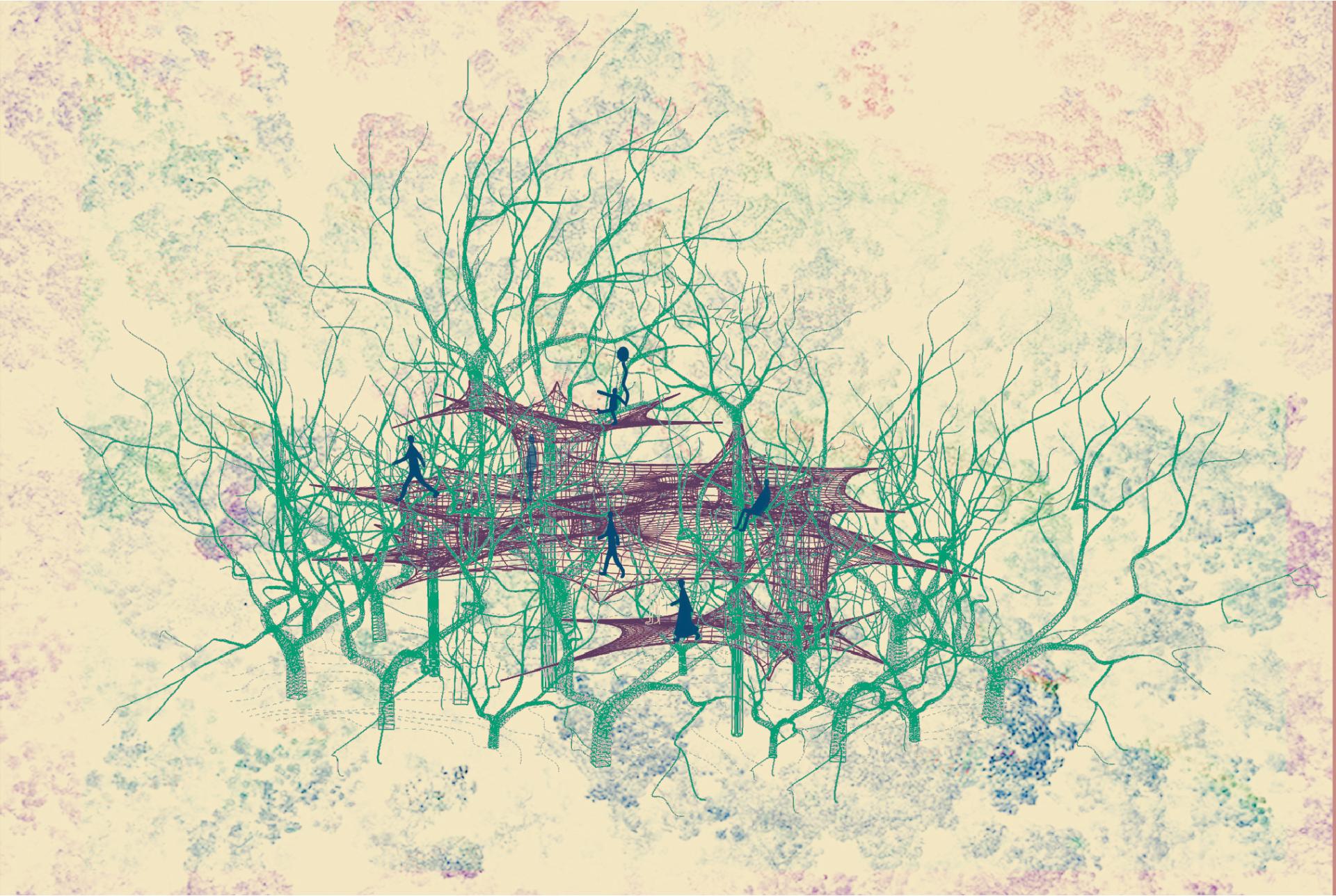
The project is based on speculative design, not located somewhere and adaptable everywhere. It is about creating a germ with the purpose to design a paradise. It's about dreaming, climbing trees, and generating architecture in the air.
The 6 key aspects of the project are: Paradise now is…
1. A new lifestyle: a symbiosis between dwelling and environment. There is no inside and outside space.
2. A new housing typology: the program is spreaded and dissolved. It is flexible, unanchored and mobile. For respectful, dynamic, nomadic and people that enjoy co-living.
3. An experience in the air, based on living in treetops. It is the willingness that man will conquer space, the antigravity and visceral idea of the childish desire to fly.
4. A respect for the environment: establish a protection around trees and neither practice earthmoving nor foundations (first stage in construction that implies damage).
5. A shelter for protection and comfort: waterproofed, insulated from the outdoor conditions and detached from the ground to achieve safety.
6. An ode to technology. Which facilitates: 1. Air architecture: the construction process done by drones. 2. Comfort: innovative natural materials that will ensure protection against external conditions.3. Structural adaptability in the natural environment. Architecture without walls, ceilings or floors. It is about using Tensile technology from Frei Otto's architecture
Key objectives for sustainability
1.Paradise Now uses natural materials with low impact and large live cycle. These materials are nets and threads made from natural fibres which can respond positively to a mechanical effort, such as jute.
2. The project refuses traditional ways of constructing: logging, earthmoving, foundations and concrete. It is an ode to nature, with a deep respect for the planet Earth.
3. Paradise Now is a system feed by the sources provided by the landscape. For instance, trees are a filter to regulate temperature and provide shade, the open area ensures ventilation, rain water can be stored, energy can be generated from sunlight, waste can be reused for compost.
Key objectives for aesthetics and quality
1. Paradise Now is a symbiosis with nature. It generates a permeable landscape made from a net that interlaces with the existing elements that the Earth provides (vegetation). Symbiosis means the art of living together, it comes from two Greek words that mean "with" and "living." It describes an ecological relationship between two organisms from different species, in this case humankind and vegetation.
2. Life competes for all kinds of natural resources, whether they be food, light, water or shelter. But competition is only a part of the picture. Cooperation and mutual benefit are also a foundation of countless interactions in nature and this is a key aspect in the project.
3. Paradise Now is an intuitive way of doing architecture, by Tensile structures. This type of construction is called the architecture of the air which was covered in depth by Frei Otto in his studies of non-rigid structures (Pneumatic Structures and Cables, Nets, and Membranes). Pneumatic Structures deals for the most part with surfaces loaded by tractive forces. Special membranes, of high tensile strength, are made semi-rigid by means of differences of enclosed air or fluid pressure and can serve as roofing, halls, silos, dams, or for any other application where ease and rapidity of construction and transportation are essential. In Cables, Nets, and Membranes the subject of non-rigid architectural structures is continued with a detailed investigation of structures under tensile loads, of which suspension bridges and tents are the most commonly known examples. Tensile structures have the advantages of mobility, light weight, ease, speed of erection, and low cost.
4. In Paradise Now the user experience is dynamic, in the air, based on living in the treetops. It is the willingness that man will conquer space, the antigravity and visceral idea of the childish desire to fly.
Key objectives for inclusion
Paradise Now is made form affordable materials, low cost construction (based on Tensile architecture) in comparison with a traditional building. The project is about an inclusive space: it is not closed or private, it is permeable and collaborative. The project aims to weave new relationships between inhabitants, no matter their origin, social class, studies or interests. The only need for the people to live in such a place is the love and respect for the environment and planet Earth. Therefore, people in our social context that for some reason are separated, segregated, marginalized or ignored by the political and social structure underlying urban organization and management are no longer marginalized in this new utopy where everyone lives the same way, surrounded by nature and in nature.
Marginalised groups know the realities they inhabit in a profound way. For this reason, they manage to highlight situations that, due to their burden of indefiniteness and diversity, have a high degree of potential for renewing our reality. Confronting new points of view allow designers and collectives to jointly generate alternative views of our world.
It is important that, thanks to the dialectic with the other, we learn to observe our reality with the ability to capture the manifestation of new housing epiphanies (men, nature, etc.). This new look makes it possible to detect a constellation of interstitial places, fragmented and diffuse margins, seen not only on the periphery but also inside the more consolidated urban system. In this sense, these places assume within the consolidated urban reality the role of active subject: they are proposed as pioneering spaces in which, on the one hand we can to propose new scenarios of coexistence and, on the other hand, they allow us to experience new ways of projecting capable, in turn, of rethinking the relationship between man and territory, between natural and artificial, between vegetable and built, between urban and rural.
Innovative character
Paradise Now is about a new housing typology and a new lifestyle: the program is no longer stacked in rooms. Contrary to tradition, in this project the program is completely spreaded and dissolved along the net. It is flexible, unanchored and mobile. In line with the future: it is for respectful, dynamic, nomadic and people that enjoy co-living.