Active Landscape
Basic information
Project Title
Full project title
Category
Project Description
The concept of “Active Landscape” focuses on starting from the existing resources and activating them in order to generate new methods of living within the landscape. In a time where our ecosystems are in crisis, we tried to apply this concept in the territory of Marine di Lecce, Italy. Having a long history of illegal constructions and abandonments, we have tried to reassign a lost value for the land, safeguard threatened public and turn poorly infrastructured settlements into more safe ones.
Project Region
EU Programme or fund
Description of the project
Summary
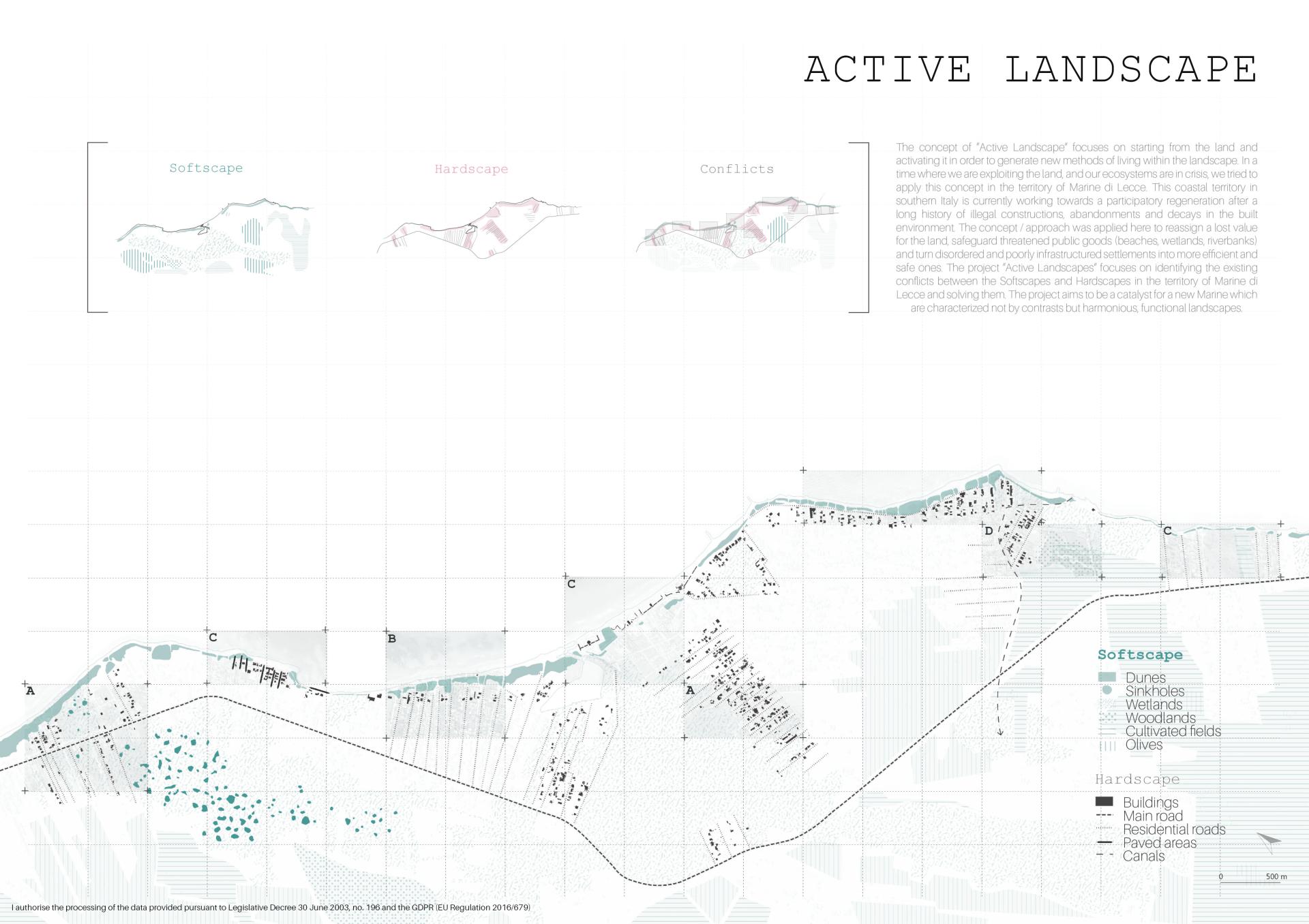
The concept of “Active Landscape” focuses on starting from the land and activating it in order to generate new methods of living within the landscape. In a time where we are exploiting the land, and our ecosystems are in crisis, we tried to apply this concept in the territory of Marine di Lecce, in Apulia region (Italy). This coastal territory in southern Italy is currently working towards a participatory regeneration after a long history of illegal constructions, abandonments and decays in the built environment. The concept / approach was applied here to reassign a lost value for the land, safeguard threatened public goods (beaches, wetlands, riverbanks) and turn disordered and poorly infrastructured settlements into more efficient and safe ones.
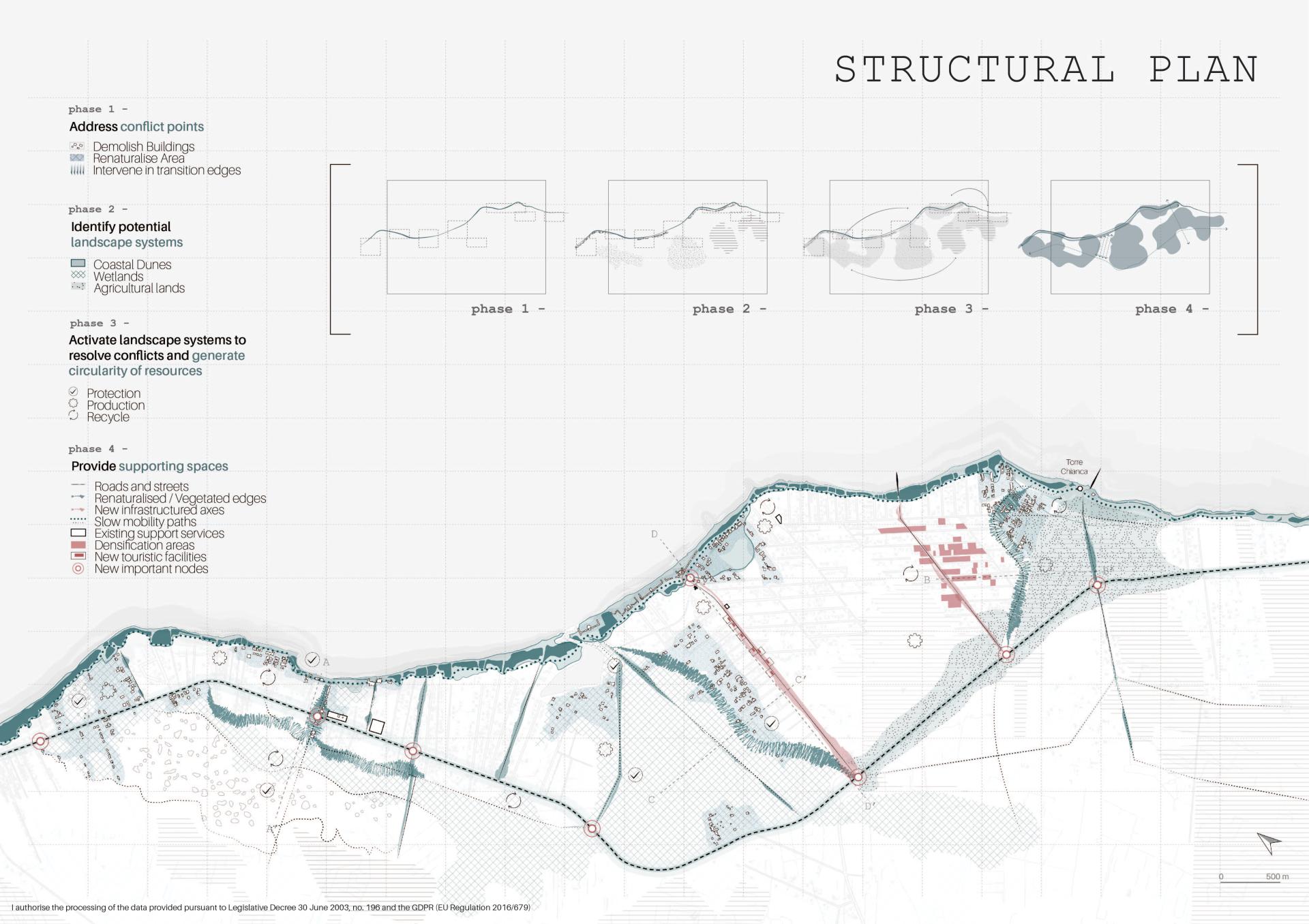
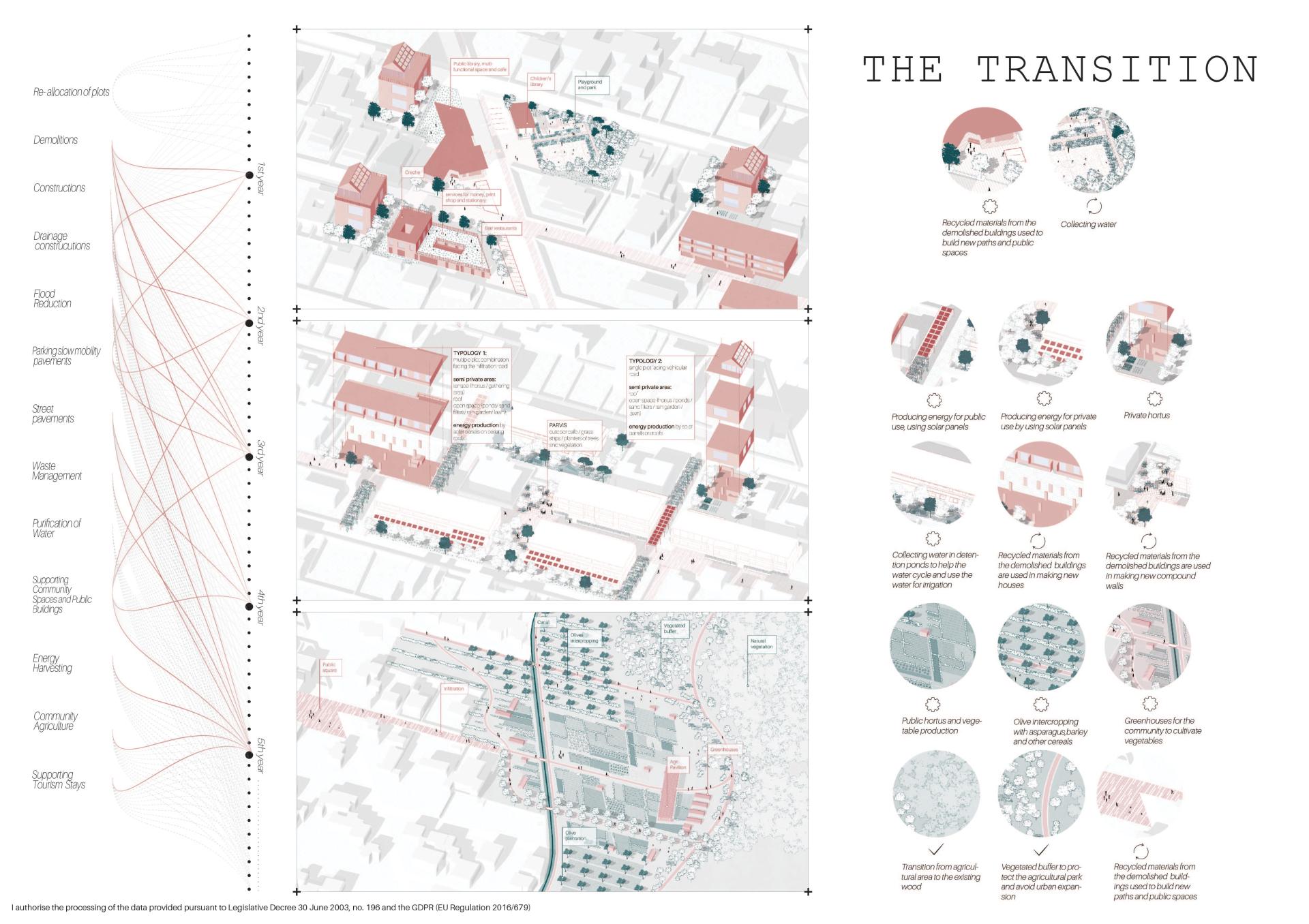
The project “Active Landscapes” focuses on identifying the existing conflicts between the Softscapes and Hardscapes in the territory of Marine di Lecce and solving them. The project aims to be a catalyst for a new Marine which are characterized not by contrasts but harmonious, functional landscapes. To overcome these conflicts, the project has four phases. The first focuses on the area of conflicts which include demolishing buildings, re-naturalizing areas and intervening in transition edges. The second highlights potentials of experiencing the landscape systems which are the dunes, wetlands and agriculture areas. The third proposes protection, production and recycling in the natural and technological cycles to activate the landscape and generate circularity of resources. And finally, the last provides new infrastructures and improves the existing ones, proposing new axes with supporting services, residential displacement areas and new categories of touristic facilities.
The project was developed within the “Built environment and landscape design studio” at the Politecnico di Milano, focused on the study of complex coastal territories characterised by unauthorised urbanisation in Southern Italy.
Key objectives for sustainability
The key objective of the concept is to provide for a sustainable systemic regeneration of the Marine at every phase.
- In PHASE 1 – We demolish and re - naturalise the areas for better resilience and intervene in the transition edges between the two dichotomies.
- In PHASE 2 - Landscape elements such as dunes and wetlands are considered as resources for the project, dynamic and synergetic elements within a system.
- In PHASE 3 – We activate and generate circularity of resources under 3 main strategies which are
- Protection – Conservation and active enhancement of the areas of the systems by enlarging and stabilizing them, to resolve ecological issues especially related to flood reduction.
- Production - Encourage strategies for social economic security by community agriculture and harvesting of renewable energy.
- Recycle – We consider water and construction waste the biggest resources here. Water is recycled through constant runoff -purification as it passes through various systems. Second, debris waste is reused in the construction of the new residences/ infrastructures.
- In PHASE 4 - We design new typologies of residences/ stays/ services keeping in public-private partnerships in mind to create more collective gains for the residents. E.g., Community or neighbourhood needs that could make the Marine less dependent on Lecce. Foundations such as the “Fondazione con il Sud” and “Comunità del Salento” provide funds for larger housing projects and innovative social service models. Another example could be for resource management and new economies. These gains help to reduce housing and livelihood costs. The design of the structures is based on local climate keeping enough shade from the sun and letting in breeze.
Key objectives for aesthetics and quality
Walking along the coast, close to the dunes and the wetlands, close to green plantations of olive trees and golden wheat, to private gardens full of peculiar species, the beauty of the place is overwhelming. The project aims to enhance this unique beauty already characteristic of the Lecce marinas without modifying what already exists, but rather protecting what is precious (through renaturation and agroecology) and giving residents and visitors the opportunity to enter the area through the introduction of slow mobility paths.
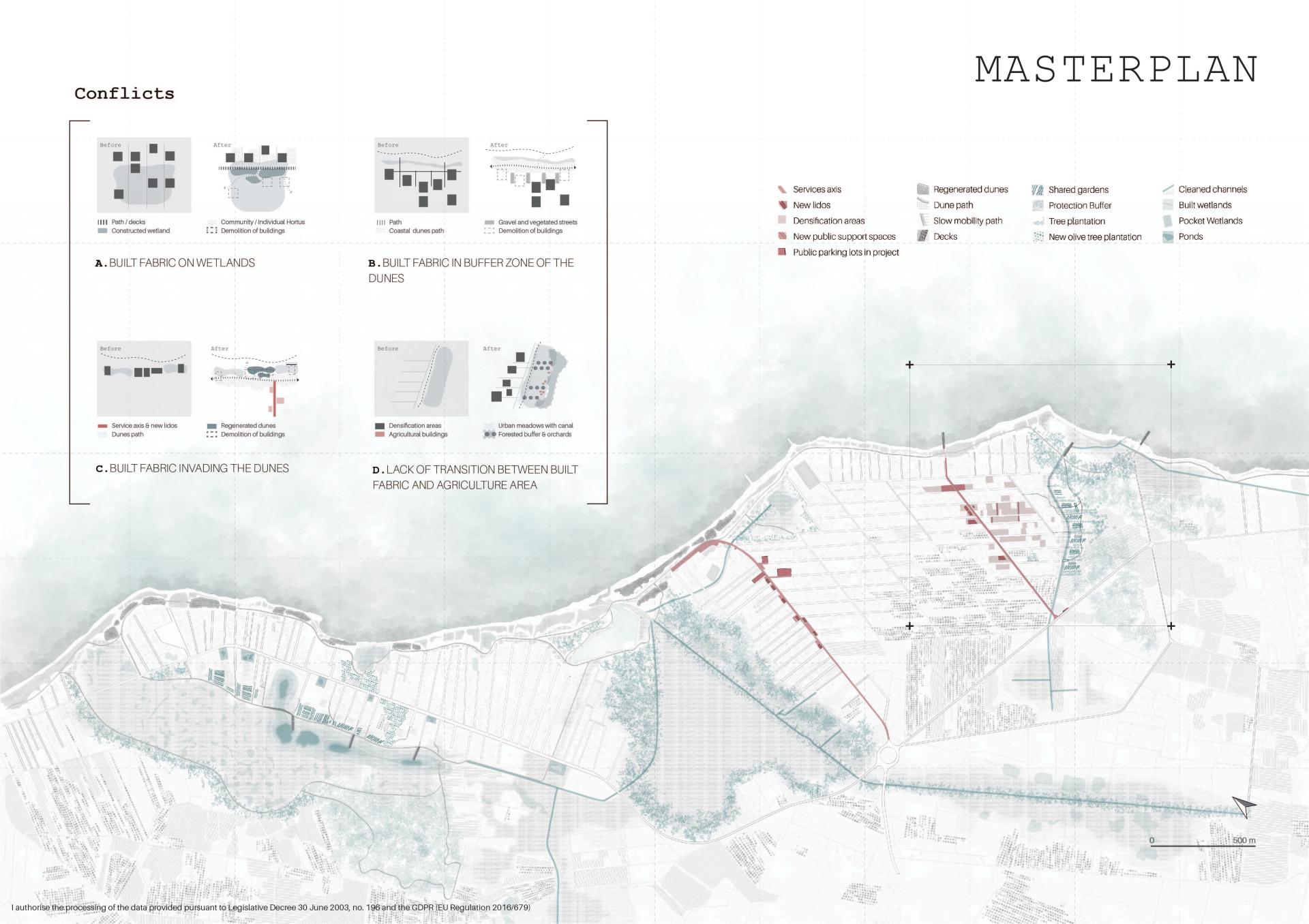
- Where we have the built fabric on wetlands and on unstable terrains, we built a wood path and we demolished the houses in danger, creating new hortus and vegetable gardens to prevent urbanization expansion and enhance the experience of the walking along the wetlands.
- Where built fabric is invading the dunes, we created a coastal dune path, interrupting the roads too close to the beach, to allow fruition of the natural beach landscape.
- For the vegetation we followed three main principles:
- Small-scale reproduction of local ecosystems with attention to species matching
- Attention to spatial perception due to the difference in heights and light/shade created by the density of the vegetation
- Attention to the contrast between different textures and colours
In terms of aesthetics and experience in our proposed built environment, we worked on blurring the lines between the soft and hardscapes. In our proposal, we paid attention to this transition between public and private space, in order to guide people through the continuity of use of materials and vegetation. The idea of the parvis comes from the firm conviction that Marine need more community spots developed over the whole territory in order to make this place less dependent on Lecce functionally, but also to improve the living experience for its locals and reduce the stress of tourism in concentrated areas, by diffusing the experience all along the territory.
Key objectives for inclusion
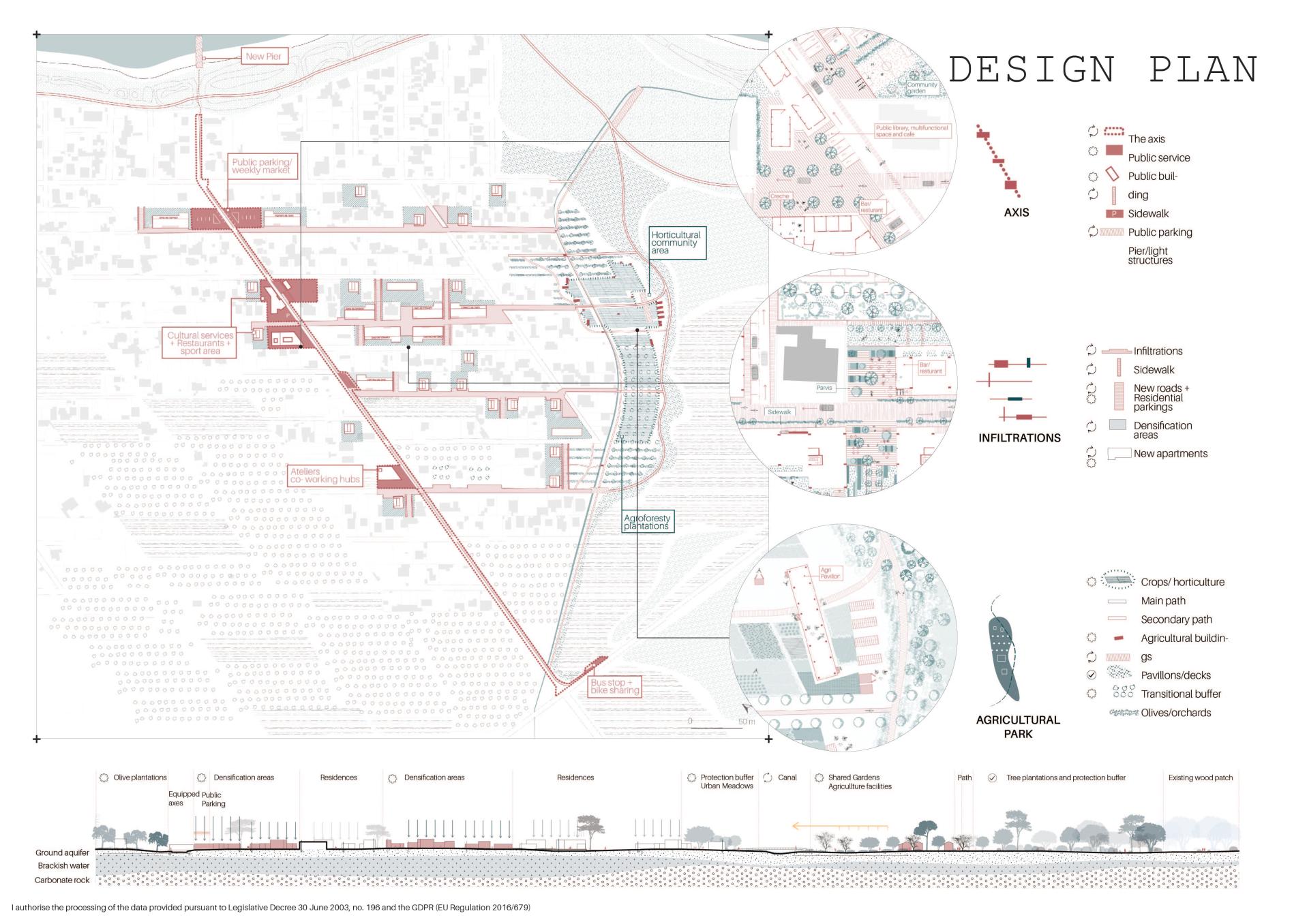
Starting from the service axis, we asked ourselves what kind of services do the inhabitants need. So, we tried to reinterpret the relationship between the street and the pedestrian space, creating integration and avoiding segregation. Our goal was to create a liveable neighbourhood so people don’t need to rely on Lecce for their needs: that’s why the new services are mostly concerning the residents of the community. The empty and abandoned plots along the axis have been used in order to create openings and provide new areas for people to gather. A new creche and libraries are provided for both young people, immigrants and families and they serves also as landmarks along this new axis.
The services and the new activities can be a source of income for the residents: for example, the new greenhouses and vegetable gardens can be managed by citizens or by the community through various co-operatives, providing jobs for unemployed people who cannot find any kind of work.
As for the built environment, we have introduced two new housing typologies: one for single plots, which is a four-storey building and one for plots that are joining together, which is a two-storey building. The new typologies are raised from the ground level, providing a semi private space that can be a parking or any other activity that can be shared by the residents. The different typologies are designed both to accommodate families who have been displaced from their demolished homes and to accommodate new inhabitants such as students, immigrants or young couples with a purpose to include different people in the already existing community.
Innovative character
The absence of efficient urban planning regulations and the continuous unauthorised self-construction of dwellings along the southern Italian coast (since the 1960s) leads us today to reflect on the future of an uncertain, borderline territory. A territory, we might say, not yet defined.
- Marine di Lecce has a strong tourist vocation due to its location near Lecce and the uniqueness of its landscape.
- Marine di Lecce is a place mainly characterised by residential housing, an absence of services, poor accessibility by public transport and precarious infrastructure conditions.
From this dichotomous definition of the Marine of Lecce it is possible to deduce the relevant problems to which the project tries to give an answer through a strategic approach based on the "activation of the landscape":
- The first innovative aspect of the project is the design approach itself: here, the landscape planning is the guiding tool for the definition of a strategic system. A system in which human needs are not in opposition to the needs of nature. The first step was therefore to understand the synergies between criticalities and potentials simultaneously, to understand the flows of knowledge and material that can be activated and to establish the connections between them.
- The second aspect we consider innovative concerns the circularity introduced, which is the fundamental basis of communication in the strategic system. Three key actions (phase 3 of the project): protection, production and recycling of resources.
- Social integration is at the very foundation of the project: a great emphasis has been placed on the needs of residents and tourists through the introduction of spaces for interaction.
- Last but not least, the project is highly flexible. The proposed strategies can be adapted and integrated with each other in different parts of the territory. In fact, the project foresees an implementation developed over a short, medium and long term period.