Social Housing in Vienna
Basic information
Project Title
Full project title
Category
Project Description
My Master Diploma Project focuses on the regeneration of an important though neglected area located at the crossing plot of four districts in Vienna. The main goal was to design a building based on pro-ecological systems, providing private housing space and multi-functional public services while ensuring the sustainable revival of the area by calming the traffic, designing green and resilient space. Proposed variety of functions and nature-based solutions may improve the quality of life around.
Project Region
EU Programme or fund
Description of the project
Summary
This Master Diploma Project presents the concept of wide rehabilitation of the area in the crossing of four districts in Vienna: Mariahilf, Margareten, Meidling and Rudolfsheim-Fünfhaus. The idea was to implement the latest technological and sustainable solutions that can ensure an ideal place to live and being a member of local community. The 21st century is a time of fundamental challenges in housing construction. The climate crisis, conflicts of views, globalization and the growing need for mobility are key factors driving the continual changes in the standard of living of the world's population. The visible demographic boom in urban centers forces the city authorities to implement many social programs that help stop the spread of homelessness or poverty, while ensuring the best quality of life. This concept is an example of the way how to introduce a rehabilitation process on urban and architectural ground in the abandoned and unfriendly to life or work places.
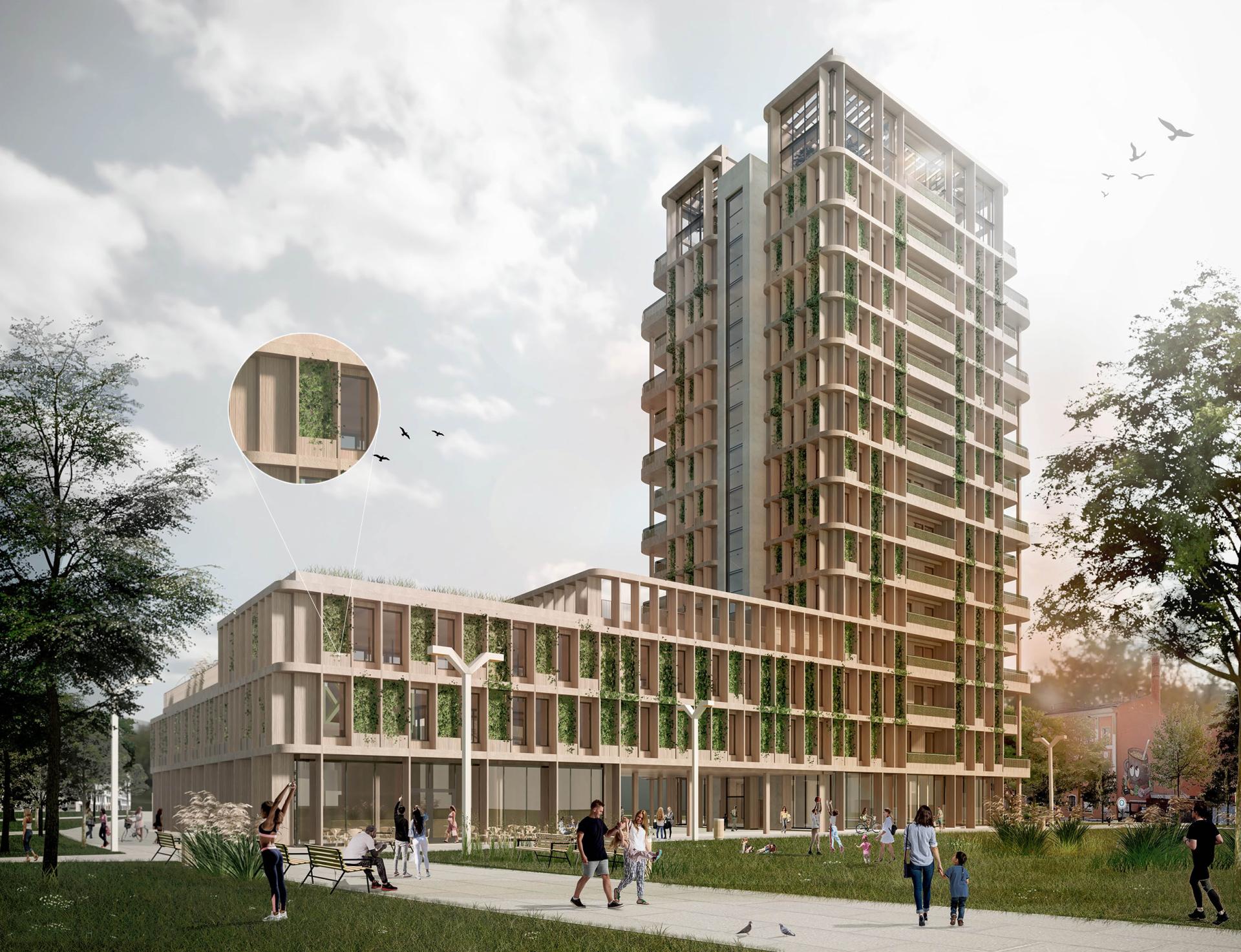
The primary factors taken into consideration were an integration of people of every kind and regeneration of the site and its surrounding by respectful treatment of tradition of Viennese social housing programs. Introducing social housing development with a great diversification of public services could provide better quality of living in this specific area for every resident who would be interested in an active participation of taking care of shared space which is proposed to be transformed into a green park with a high priority of soft mobility. Replacement of the neglected greenery and miles of concrete roads with a wooden high-rise building covered with vertical greenery on facade proposing the best quality place to live surrounded by a green enclave full of flora and fauna could be a great change to improve the status of current developments around, generate new initiative or investments on the local ground and ensure the new place to live, work and evolve.
Key objectives for sustainability
In order to emphasize the complexity of the subject matter, a project area was selected on the south-western outskirts of Vienna's city center, known as the Stadtwildnis Gaudenzdorfer Gürtel. In the past, this place was the site of the Gaudenzdorfer gas plant, so the area is now ruderal and deserted. Due to the low social commitment and high unemployment rate, there are no prospective investments in the area aimed at promoting this area.
The starting point for the project were the changes made to the transport system. In order to optimize the traffic of cars, an underground tunnel was proposed. It replaces the original Gaudenzdorfer Gürtel causing that the greatest generator of pollution and noise was removed from the site. In consequence, the plot was connected in a large green public space intended mainly for soft mobility where new plants and trees could be planted. As a consequence, the assumptions of the Smart City, in which the residents give up cars in favor of public transport, can be easily implemented because of direct accessibility to metro and tram stations. Existing development would be replaced with new pro ecological residential building introducing spatial order harmonized with the town planning of the area. An important aspect of the architectural design that has been paid attention to are building materials that enable the creation of non-standard solutions and their implementation in accordance with the principles of sustainable development. Therefore, the vast majority of the building have been designed with the use of wooden CLT elements, which are as durable as a reinforced concrete or steel structure. The vertical greenery on the walls and irrigation using rainwater provide a passive systems that ensure saving in energy consumption. As a consequence, new development in form of residential labs is an example of how to combat poor housing quality, unsafety abandoned spaces, unemployment among residents and social segregation.
Key objectives for aesthetics and quality
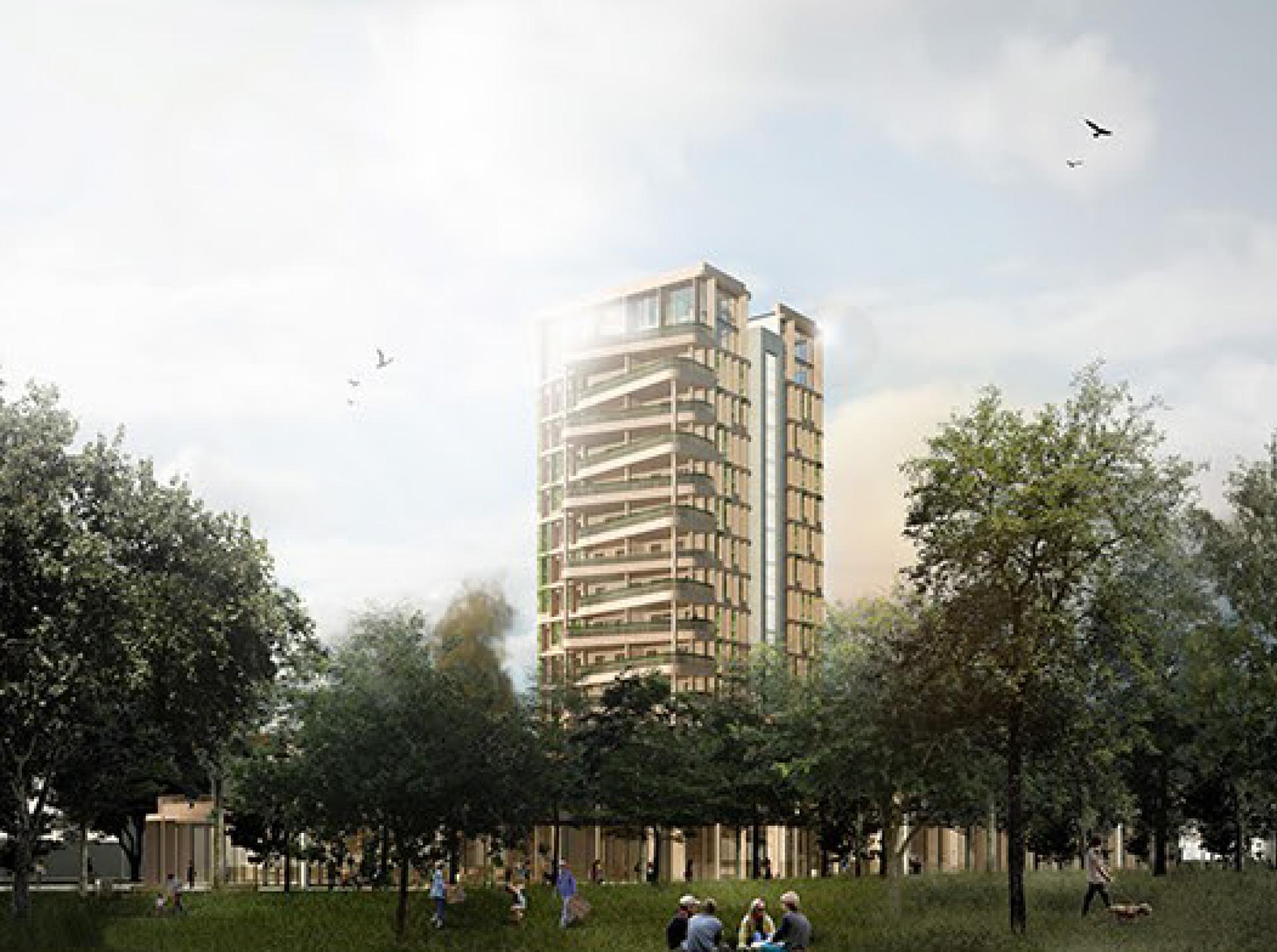
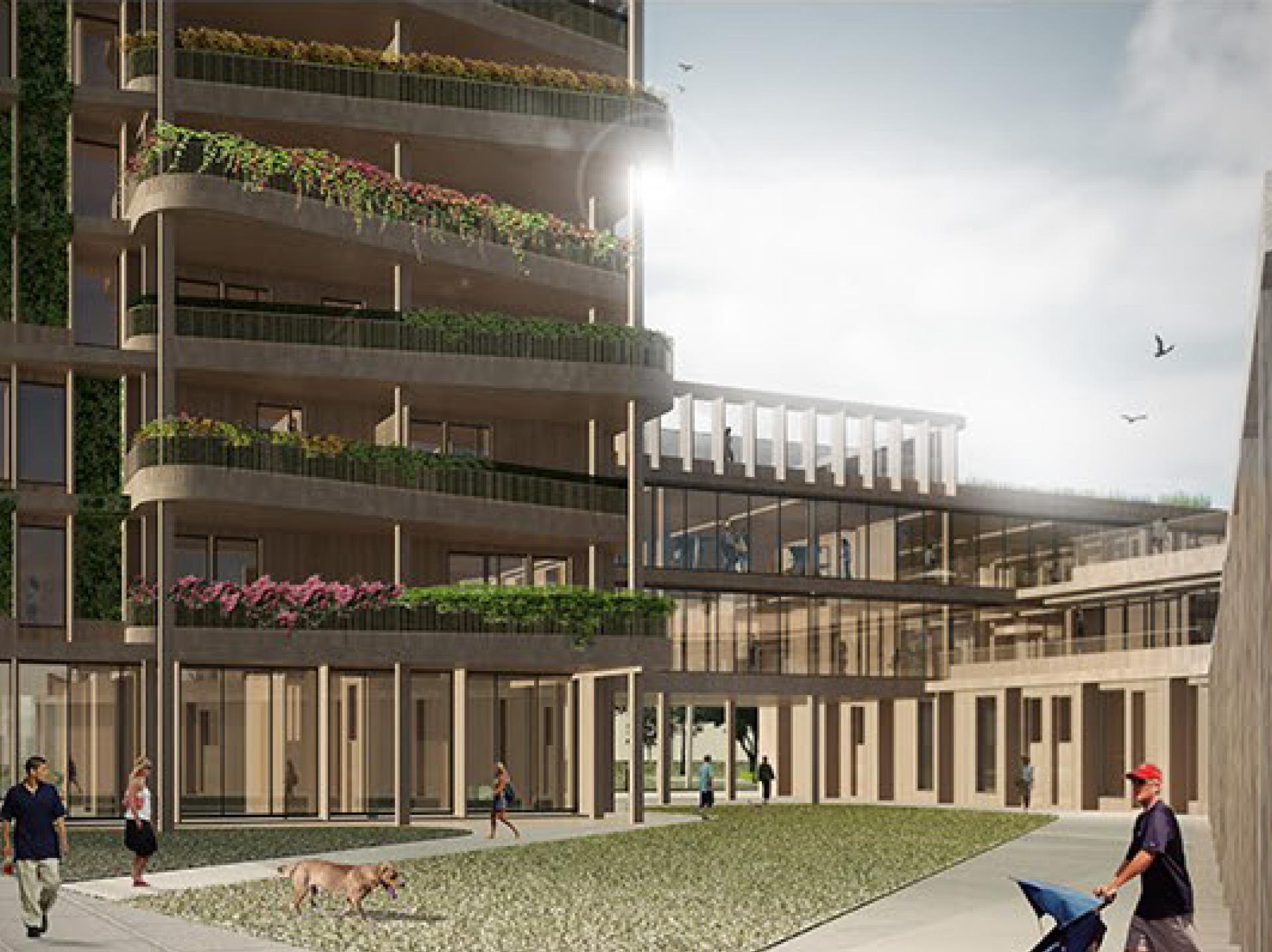
The project presents high quality design in terms of aesthetics due to a combination of the building material - wooden structural elements such as walls, slabs and finishing - with the natural environment of the green enclave. This makes a bit of contrast with an existing tenement development, an edifice of school or the Otto's Wagner Bridge. The last one was a significant factor that influenced the final position of new housing development. The urban context also played a major role while creating the highest quality experience. The exact location of the residential tower was defined on the crossing of two urban axes. The first one opens the view in the West-East direction and goes along the Wien Canal that is partially hidden. The other one creates a view from the North direction while driving through Gaudenzdorfer Gürtel. Worth noticing is the fact that looking from far away the residential tower raises up from behind the trees. It requires to get inside the plot to discover the bottom part of the building surrounded by various outdoor activities. This brings the aesthetics value to the project which creates the opportunity to gain the interest of passersby because of the new technological solutions of woodwork emerging from behind the trees. Moreover, the vertical greenery occuring on the wooden grid facade brings back the nature to the city complementing the whole of the green enclave created by the park. The last benefit regarding quality of experience and aesthetics is the rehabilitation of the places full of signs of vandalism and negligence on the part of residents and local authorities. This is clearly visible in the arched facilities under the Otto Wagner’s bridge. That’s why in this concept this place was regenerated and given to the public use as a free of charge space for workshops or local services. These small steps towards rehabilitation should encourage the community to feel full responsibility for the place and get involved in its improvement.
Key objectives for inclusion
The main idea is to create the space for locals who can easily contribute at every stage of the project or even after its completion and define what they expect from this place. It is the idea taken from the Urban Living Labs, where strong bond of the community is based on involving people in common creation of their place of living. In order to enhance them to take care for the environment and feel responsible, they can take the initiative and adapt the project to their vision. As it was mentioned, the project aims to open up to every group of people regardless of age, gender, origin, religious or political views, race or preferences. There is no limit or segragation that could influence the exclusion of any kind of human. Moreover, it encourages people to establish relationships with others. The key assumption was to divide a function of the building in a way to separate apartments as a private zone, but at the same time create a semi-public space where all residents could spend time together, share common passions or help each other. The aim of the zones is to enhance the community relationships and integrate them through different activities. Considering urban living labs approach to the supplementary facilities in social housing, this project contains for instance space that can be used for parties, movie nights or just as a canteen. Furthermore, the few rooms for interest clubs were appointed. This space is totally free and open for initiative of the residents who can make small hobby hubs that they join with the others. At the end of the first floor, the zone for daycare plays a role of the environmental community center for kids and teenagers. Other feature that should mentioned is the fact that gradually formed building allowed to create terraces on the roofs of the offshoot. Due to that there is plenty of space dedicated for residents as an extension of the park moved to the top of the complementary part.
Innovative character
Focusing on the topic of social housing, this master diploma project brought closer the phenomenon of quality adequate to the needs in Viennese social housing. The analysis of the case studies focus on expanding the base of measures applied by various architects. Reference to the real-life examples helped to point out the difficulties while struggling with design for a group of people with different origins, interests, needs and perception or to understand the true value of non-obvious solutions that may sometimes turn out to be excessive or redundant. Therefore, the main aim of the concept was the transformation of scattered and abandoned space to the ideal place of living within the community. This project should be an example of how to improve the quality of the environment and at the same time standard of living. The idea was to create an example of housing that would serve the city, the neighborhood and inhabitants whereas involve them into every stage of design. They can decide what they need in the park, what kind of workshop spaces they need or how their apartment would fit the best. There were plenty of innovative solutions that helped to create a space diversified in such a way to become a sustainable design. Focusing on the extraordinary benefit which is the location at the intersection of the districts of the world's capital of social housing enabled the transformation of the place into an ecosystem-rich enclave where the most modern technology of erecting high-rise buildings made of CLT wood elements was applied. Proposing not only the high quality design based on the materiality and technological solutions but also leaving room for action for people who would like to create an ideal place to live by identifying with the local society and actively deciding how it should function is unusual approach to design where the user has a causative power as well as an architect or an urban planner.