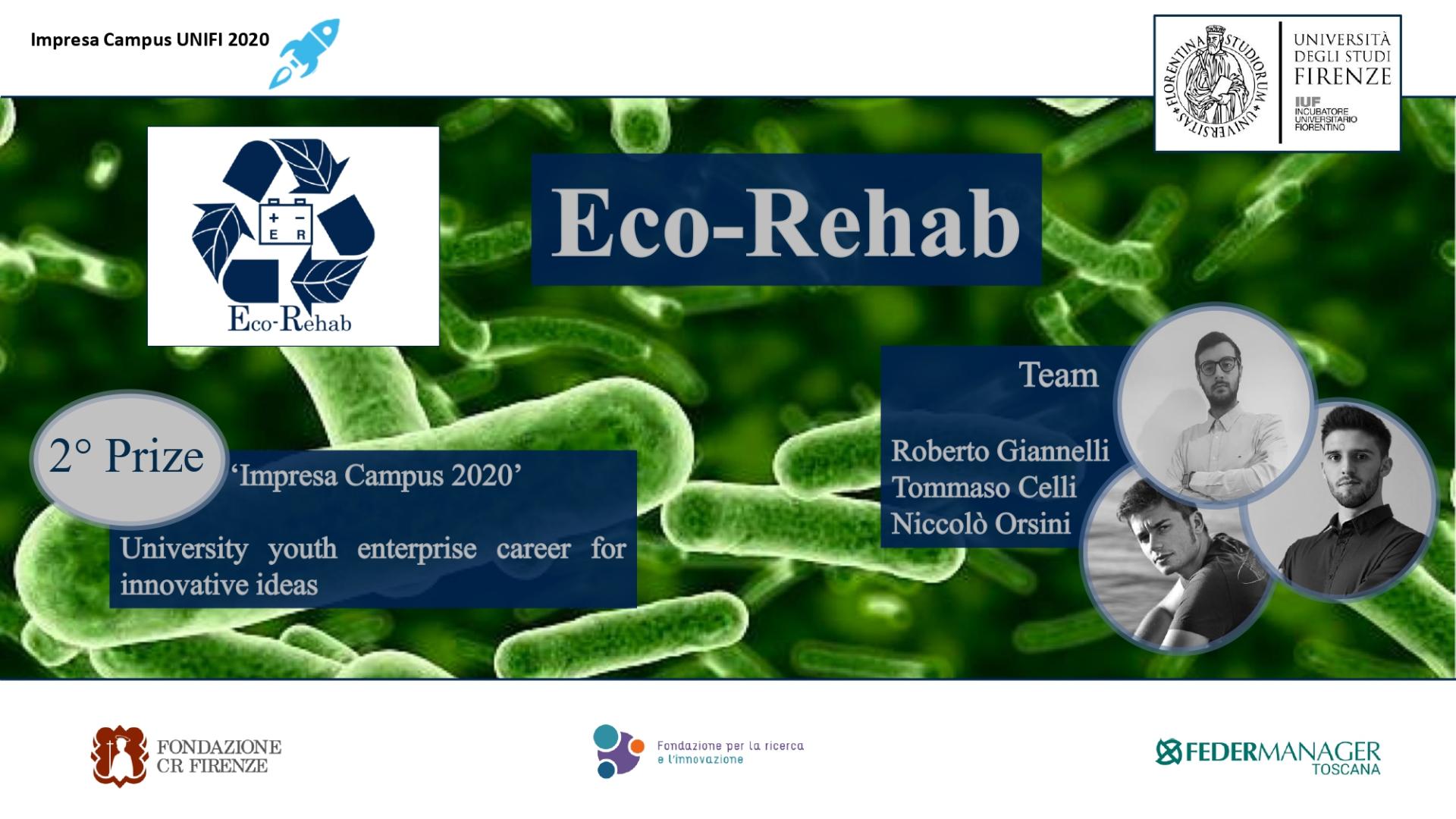
Eco-Rehab
Basic information
Project Title
Full project title
Category
Project Description
The idea aims to recover all the lithium from exhausted batteries and let the European market be independent from other markets, by the continuous growth of this precious metal for the increase in the electricity world.
The whole process would be carried out in a completely green way, without worsen the environmental conditions, by converting a process that is currently very polluting indeed into a completely natural process, pursuing goal 12 of the 2030 agenda.
Project Region
EU Programme or fund
Description of the project
Summary
The idea of Eco rehab is an innovative proposal to effectively recycle crushed lithium-ion batteries.
The innovation lies in bio-hydrometallurgy, a scientific process that combines the benefits of hydrometallurgy with biology, creating a new technology with a low environmental impact, with better performance and a significant reduction in costs.
The advantage of this technology is to provide Europe with an effective solution to recover precious metals contained into the black mass, reintroduce them into the market, making Europe independent and so reducing in this way the environmental impact. Furthermore, having a technology that effectively recovers precious metals from batteries, it would also be an important incentive for the transaction to the ever-growing electric automotive sector.
Key objectives for sustainability
The goal is to be able to recover metals, high concentrations of pollutants, using an eco-sustainable technique. Current recovery technologies rely on strong acids and high electrical voltages, with expensive, polluting and low-yield processes.
The idea aims to revolutionize this process (which has reached the end of the line) by using microorganisms able to recover the various metals from the black mass, thus succeeding in reintroducing them into the market by closing the metal cycle. This new completely eco-sustainable process will cut costs as it will not use neither strong acids, nor huge amounts of energy.
To achieve the goal, it was decided to start the search, from the study for the recovery of Lithium. Today, the very few recovery techniques of this precious metal have a low yield and a high cost, facing the growing demand for lithium batteries, which has grown exponentially over the last 10 years due to the growing use of electronic devices such as smartphones, tablets, PC, is destined to grow with the new automotive market, ever closer to zero-emission mobility.
To meet this increasing demand, it has been developed a technique able to recover the Lithium from the Black Mass, which it would be also lost, in an optimal shape for the manufacture of new batteries and with a high level of purity comparable to the one of mineral extraction, with a green process that is in complete opposition to the techniques used today.
The technology is still to be optimized and overall to be implemented with the recovery of other metals from the Black Mass. The same lithium process will be used in order to convert the disposal and metals’ recovery process into an eco-sustainable process with cost significantly lower.
Key objectives for aesthetics and quality
The idea will be introduced within an existing supply chain: consortia. This is to ensure a continuous flow of material to the treatment plants and to have well-organized and tested logistics.
The product recovered from the treatment will be reintroduced to the market through agreements with battery manufacturers, giving life to new 100% recycled products.
The facility will have a department dedicated to technological development and an operational department where the black mass’ disposal and recovery will be carried out. In this system, in addition to try to recover all the present metals, we will try to improve yields and above all to reduce costs and reduce the environmental impact.
Overall, a spacious environment will be required to guarantee the continuous vehicles’ influx that introduce and deliver the material to be recovered and the already recovered one.
Key objectives for inclusion
After reviewing and selecting the best scientific articles that could confirm and / or invalidate the idea, a procedure was studied that would be able to extract all the present metals within the black mass, primarily Lithium. This procedure must now be tested in order to verify and modulate it. A series of first experiments were studied and planned that could be carried out to validate the procedure at low cost.
Once these first experiments have been verified, a series of more expensive tests will be studied and investigated to improve the procedure to reduce costs and environmental impact. Also in this first phase, European companies were contacted to request which black mass work on. In fact, the goal is to start working directly on the material that will then be treated, that is a highly expensive and polluting process. The focus was directly on the process that requires the most change as it is inefficient, expensive and highly polluting.
Another incisive cost is the one of chemical analysis: to verify the effectiveness of the procedure it is necessary to carry out a series of chemical composition analyzes at different times, as well as analysis the black mass, provided by the companies, from which starts the experiment who owns varying concentrations according to the mix of batteries that were used to produce the black mass. These chemical analysis require special equipment owned by large companies.
Being in the design and construction phase of the prototype it required a series of small costs to be faced. However, they are compared to the enormous amounts of money spent annually to solve a small part of an economic, environmental and social problem that has been present for years. This gives us the strength to continue studying in an increasingly effective way in order to aspire to an eco-sustainable and prosperous future.
Innovative character
Once collected the exhausted batteries of many electronic devices (smartphones, tablets, PC) and of all electric motors (cars, scooters, scooters, drones), it begins a long journey that will lead to their disposal. Initially, the plastics and external casings are eliminated, then they are crushed and shredded to eliminate the acids contained inside. The leftover product from this process is called Black Mass, a metal-rich powder.
Brass, iron and copper are recovered and the remainder travels thousands of kilometers, with an environmental impact and a very high cost, to be disposed of in special facilities. In the latter, hydrometallurgy and / or pyrometallurgy techniques are used with a very low yield and a high cost. These techniques are expensive as they use concentrated strong acids and large amounts of energy, as well as having a devastating environmental impact!
The idea aims to completely change this process by creating a completely green technique, reducing the environmental impact and costs. The idea comes from Bio-Hydrometallurgy: a technique that aims to use the advantages of hydrometallurgy and microorganisms. Numerous articles have been published dealing with the theory of this technique, but an avant-garde procedure has not been created yet.
Eco-Rehab, on the basis of these techniques, proposes to create a new eco-sustainable process with low costs that recovers Lithium and all other metals by working directly on the Black Mass and using completely green and low-cost vehicles.