Collegium Academicum (CA)
Basic information
Project Title
Full project title
Category
Project Description
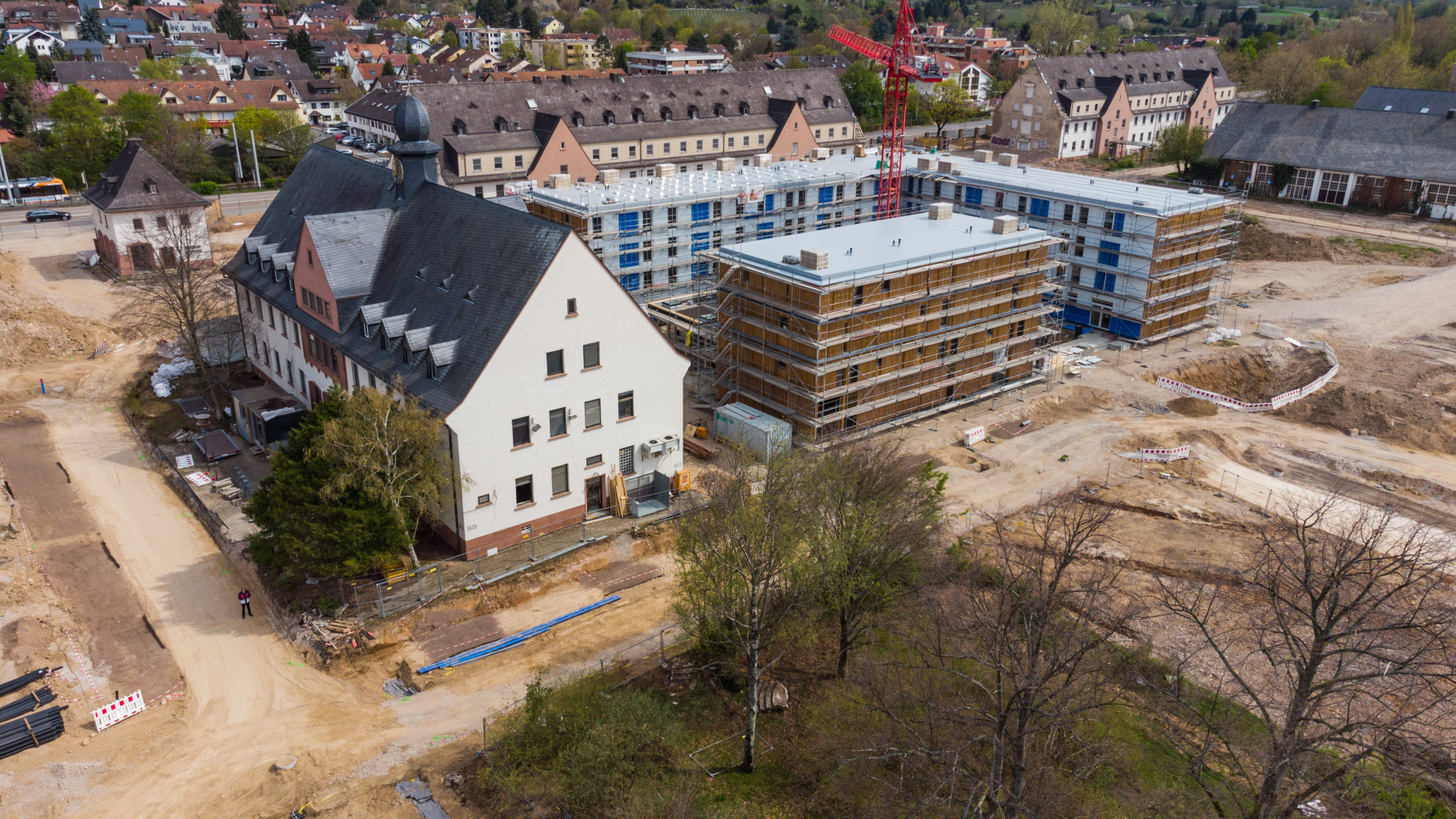
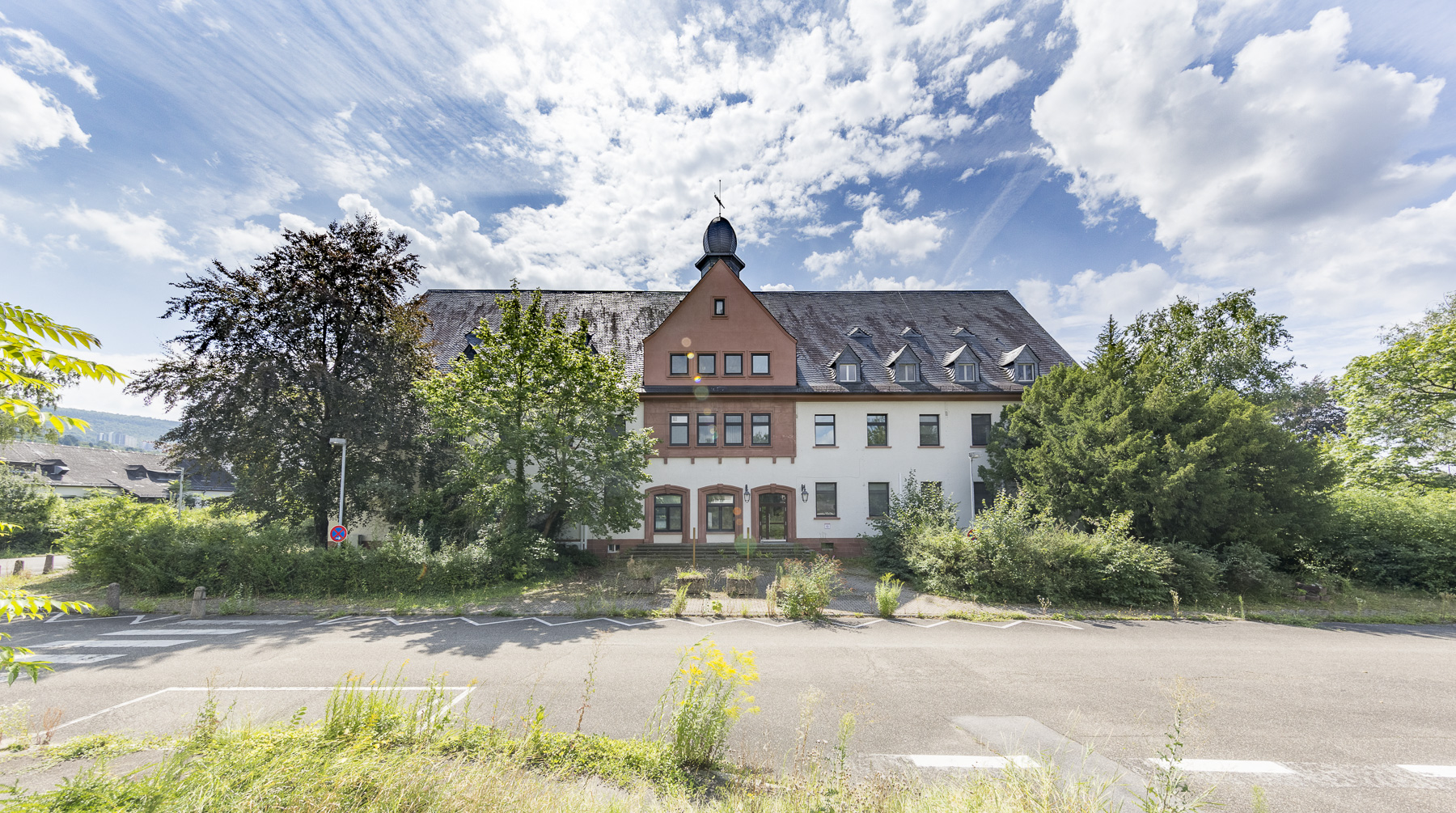
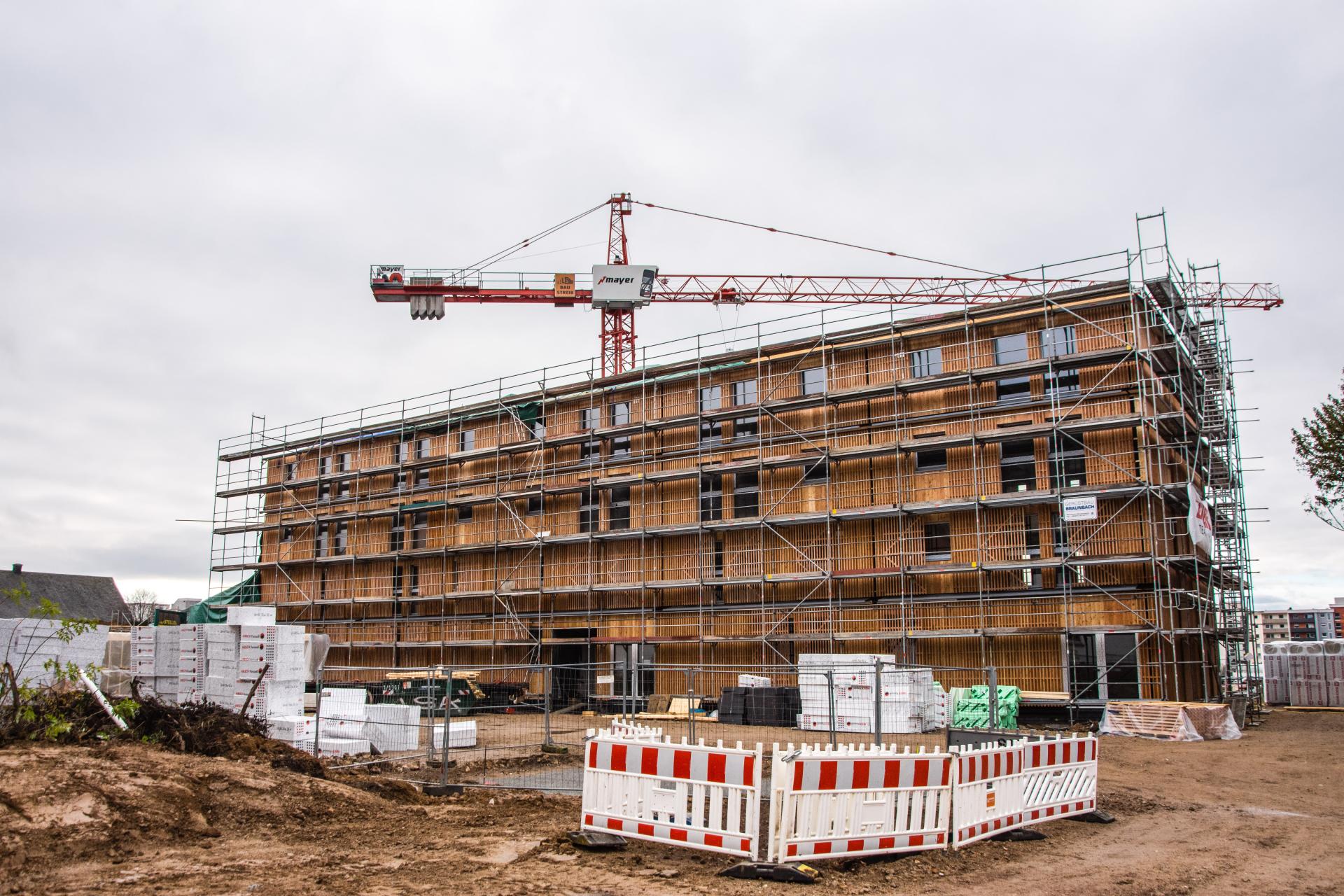
The CA in Heidelberg (Germany) is a self-governed housing project for over 240 students and apprentices initiated in 2013 by a group of young volunteers. After a long period of self-organized planning and construction, the new building will be inaugurated by the end of 2021. Besides the innovative four-level timber construction, two old buildings will be restored in the next two years that round off the concept of an affordable, ecological and self-administrated place for living and learning.
Project Region
EU Programme or fund
Description of the project
Summary
Building on the basic idea of the “Collegium Academicum” residence, which existed in Heidelberg until the 1970s, our project aims to create a place that makes affordable and self-determined living possible for students and trainees in Heidelberg. It makes democracy a tangible experience and at the same time promotes cultural and social exchange, self-determined education and social commitment. The construction was planned in tight communication with the city administration, our architects "DGJ Architektur" and specialist planners. The new building is a four-level timber construction that meets high ecological standards in terms of energy efficiency as a passive house and reduces resource consumption by using renewable raw materials which are obstructed pure of type to leave the materials recyclable. However, one of the central aims was to reduce absolute GHG emissions and resource use through sufficiency planning but also the reduction of rental costs per capita in order to create an inclusive living space. This was done mainly by reducing living space per capita to a sufficient level and providing common spaces for shared non-commercial activities. In addition to that, we are also renovating two former US military buildings. This is on the one hand a large old building will provide living space for young people participating in the educational concept of propaedeutic studies. This preparatory one-year and interdisciplinary course will be offered to young people at the stage between school and university. Critical discussion of different subjects will be the basis for rethinking perspectives and working together across disciplines. The second old building is a gatehouse located in the entrance area of the conversion area "US Hospital". On the ground floor, a shop-café is to offer space for meeting and exchange. In addition to the café, we also want to create other possibilities for use, such as the purchase of unpackaged basic food.
Key objectives for sustainability
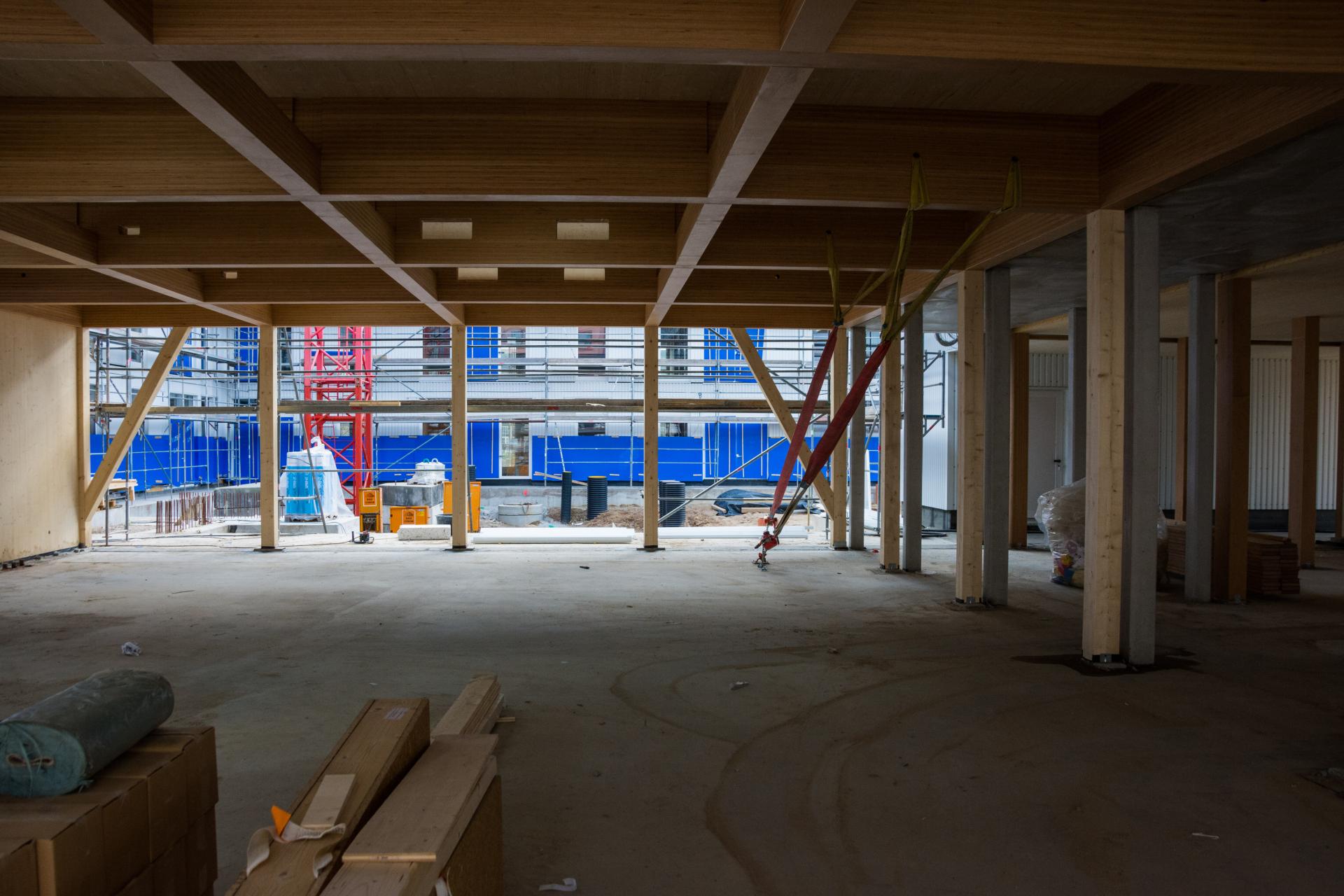
The innovative potential of our new building lies in the fact that it is planned as a pure timber construction. All parts of the construction and the supporting structure, including the fasteners, are made of wood. The building is made entirely of solid wood. Glulam and cross-laminated timber. The production of these timber-knot points, derived from traditional carpentry joints, is made possible because even complicated three-dimensional cuts can be produced comparatively cheaply with the use of CNC technology. These composite methods circumvent the problems of many modern timber buildings. On the one hand, the low CO2 emissions of wood are not compensated by connected secondary materials (wood-steel). On the other hand, the absence of composite building materials makes it possible to recover and reuse the wood used after deconstruction, which avoids the large quantities of waste. In addition to increasing the proportion of wood in the primary construction, it is important to reduce the construction costs for multi-storey timber buildings and to use renewable raw materials in inner-city residential construction in order to eliminate market barriers. Thus, in our construction, care is taken to ensure that the timber can also be used for structural fire protection and remains largely unclad. The unclad construction method not only reduces costs, but also allows the aesthetic and tactile quality of the building material to be experienced in the building. Energetic independence is supported by solar panels on the roof.
Key objectives for aesthetics and quality
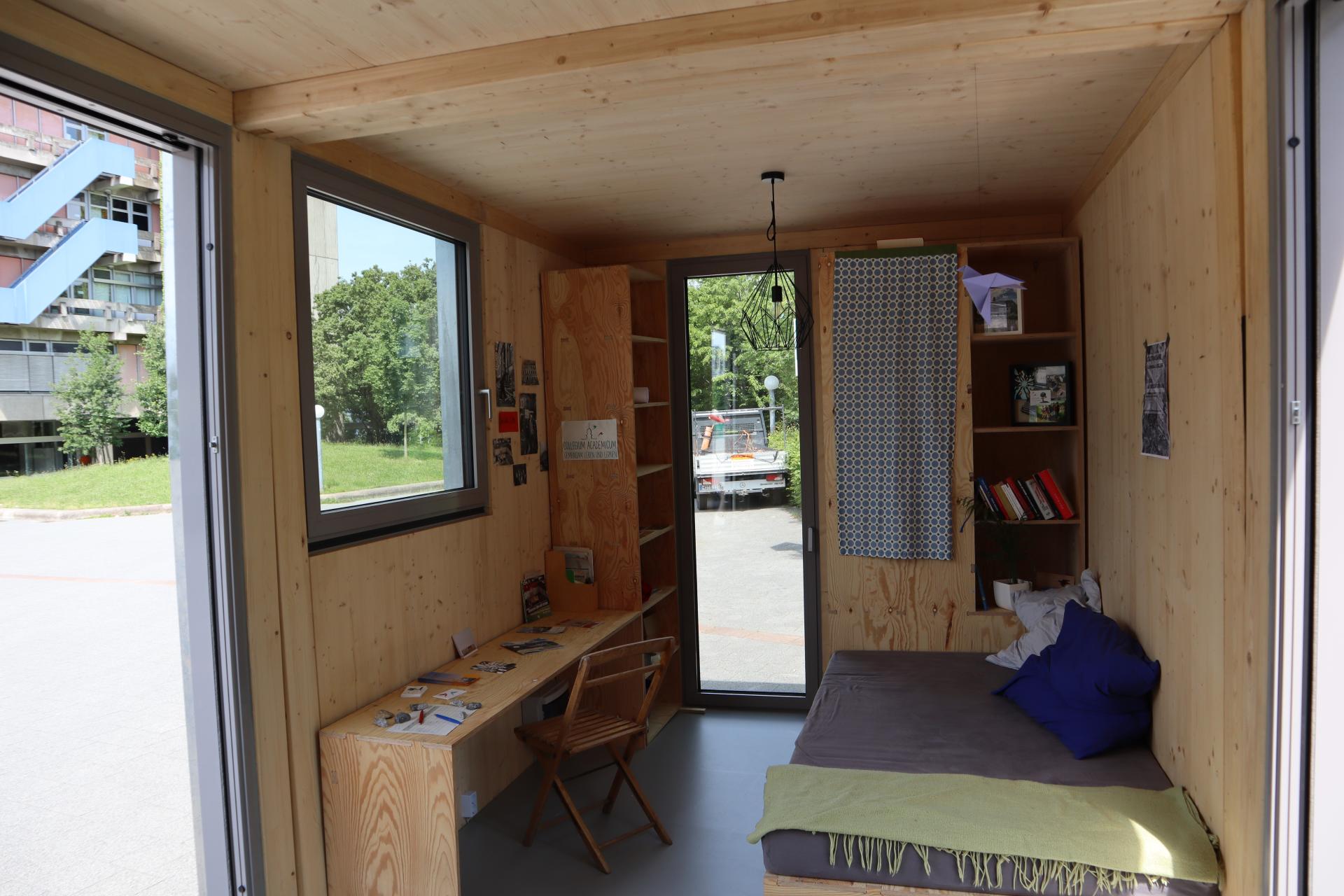
In terms of aesthetics, we have oriented ourselves towards a Japanese-style “shoji” wood look, which can be seen particularly well in the sun protection in front of the windows. We also created a generous roof garden above the assembly hall to combine aesthetics with efficient use of space in terms of biodiversity. In the old buildings, great importance was attached to preserving their typical aesthetic. The facade elements are made of Heidelberg sandstone and the slate roof tiles, the clock tower and the stairways have been deliberately preserved. The furnishings also create their own aesthetics, as high-quality wooden furniture of our own design (bed, wardrobe, desk) will furnish our housing project. In this way, the combination of sustainability and design is reflected in our concept again and again.
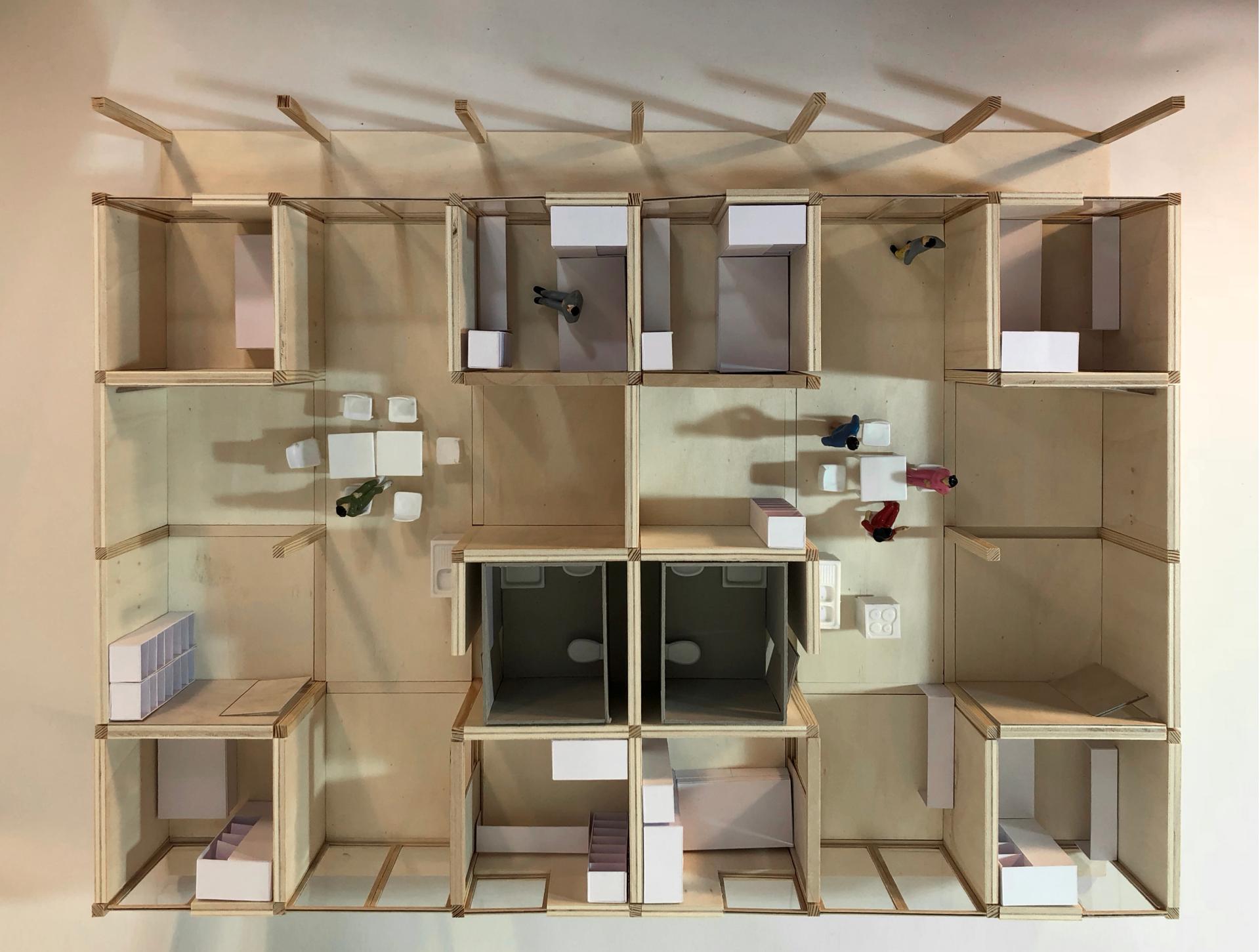
The fact that the residents see themselves as a self-organized community and not primarily as independent renters is reflected in the design of the buildings. With the shared workshop, multifunctional space, the big event room, and the community garden there is plenty commonly used space. Most of these parts are continuously designed by the project members so that the aesthetics and quality of places are not static, but alive and can be further customized.
Key objectives for inclusion
We want to create an open place where all people can express themselves regardless of their financial situation, physical or mental limitations, nationality, gender identity or other characteristics. Diversity is being promoted. Interested parties are welcome to join the project team or to apply for a dormitory place in order to actively participate in the self-administration and to help shape the project. We organize ourselves on an equal footing in flat hierarchies. The inhabitants will live in shared apartments of three or four persons. To include people with disabilities, some flats and the common areas are barrier-free.
To guarantee affordable living and long-term self-government, the CA is organized according to the model of the “Mietshäuser Syndikat”. The ground is unsaleable and in the collective responsibility of the inhabitants. The rents per capita are about 20% lower than for an average student room in Heidelberg what makes it financially convenient for the tenants. Unlike many other community housing projects, that are founded by the people that are going to co-live for years or even decades, the CA addresses primarily young people in a transitional life period. Social fluctuation will be high. This enables diffusion of self-organized practices and models of ecologically sustainable living to a growing number of young people from different social and cultural backgrounds. At the same time, the fluctuation rates require a challenging continuous knowledge transfer to maintain the social structure and steadily reconfirm the collectively defined norms of co-living. Thus, the CA becomes a long-term learning space for social practices of self-government.
Innovative character
The innovative content of the project lies on the one hand conceptually in the integration of the supporting pillars of self-government, education and sufficiency - and on the other hand structurally in the implementation of an innovative timber construction concept. The building project focuses on the following issues: increasing the proportion of wood in the primary construction and testing a new type of skeleton construction without metal fasteners. Through flexible communal living and spaces for creative use and events, the CA also contributes to research into space-saving living while maintaining a high quality of life. The model project focuses on the following areas of innovation:
- Development of new typologies and building designs for the creation of sustainable housing in the city (reduction of land consumption, climate protection, traffic relief, social structures).
- Optimizing the sustainability of building construction, taking into account renewable resources and life cycles of building components (environmentally and health-friendly building materials and constructions, renewable raw materials, reduction of climate-damaging gases, adaptability to changing usage requirements).
- Minimization of operating energy (energy saving, energy efficiency, use of renewable energy, avoidance of fossil energy consumption).
- Image enhancement and improvement of market opportunities for sustainable solutions through new construction and planning methods and the development of new market segments. The topic of pure timber construction with a high degree of prefabrication in residential construction is addressed in particular.
- Visible self-building components through self-made facade elements made of wood and participation of the residents via the wood workshop. This is designed in particular for furniture construction using an open-source self-assembly system, in which components are created using a CNC milling machine and then assembled into furniture.