CitySkin
Basic information
Project Title
Full project title
Category
Project Description
CitySkin is an experimental mobile application. The application uses mobile phones for data retrieval and mapping, to design an invisible skin of a city (an output map). It follows an user journey at a given moment in time and place. The project explores relations between subjectivity and raw data by combining hard data with visual mapping. Cities and their intrinsic diversity can be compared. Slightly different input variables can present greater changes in a recurrent path.
Project Region
EU Programme or fund
Which funds
Other Funds
foundation for science and technology, UT Austin Portugal program, 2010
Description of the project
Summary
As mobile phones are becoming ubiquitous machines with increasing processing power, this project will focus in discussing an experimental application, CitySkin relies on mobile phones for data retrieval with mapping purposes. This mobile visual system provides an accessible mean to design an invisible skin of a city (an image-map output) following a user point of view at a given moment in time. This project explores relations between subjectivity and raw data by combining hard data with and visual mapping. Cities and their intrinsic diversity can be compared; as well as slight differences in the input variables can present greater changes in a recurrent path. CitySkin records the mood of a specific derive, discussing the cultural implications on computing and the design of its ubiquity.
Key objectives for sustainability
This project intends to augment the sensitivity to environmental issues and create new relations with the urban landscape. Thus CitySkin tests relations between computation and art, acknowledging the incremental computation ubiquity allowed by mobile phones. City’s intelligence and a broad sense of Ubiquitous Computing is addressed by this application, proposing to test playfulness and a sense of discovery, thus, giving focus on the user experience. CitySkin produces outputs which give visibility to invisible layers present in the quotidian life, thus, adding a cultural impression to design and computation.
Key objectives for aesthetics and quality
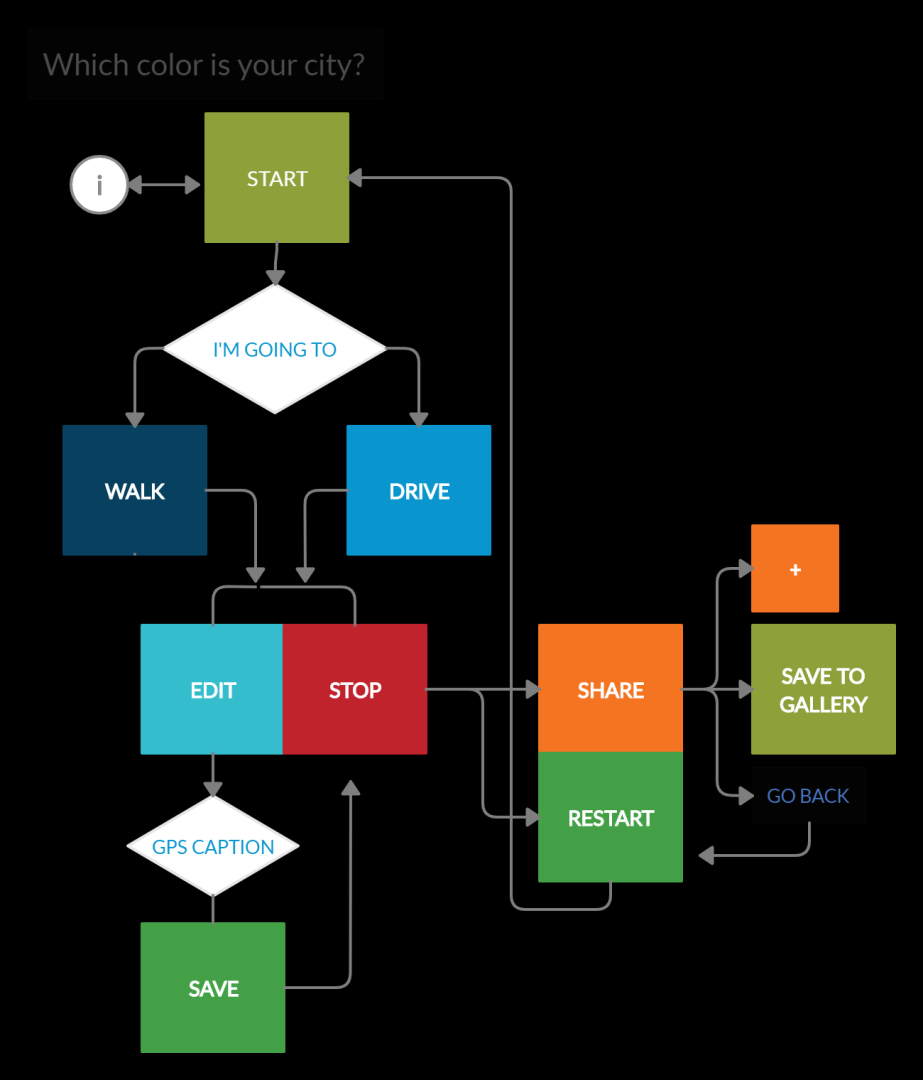
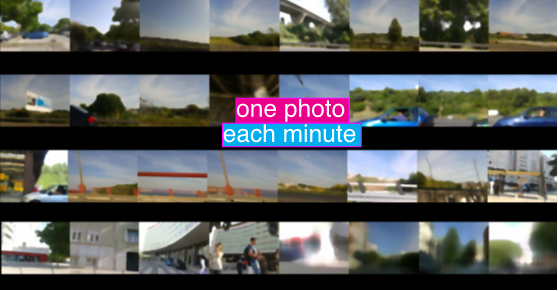
The final graphic map (skin) results from photos taken during an up to 60-minute journey, by foot or in a vehicle. Cityskin takes a photo each minute and has its location recorded. The difference between position A and B will define the velocity and this value determines each photo final length. A median filter is applied to each photo, in order to emphasize color, and its length is compressed or stretched according to the velocity variables. These images are lined horizontally, and a white space is kept between them. The white space adds readability to each picture, but also becomes an editable input text space.
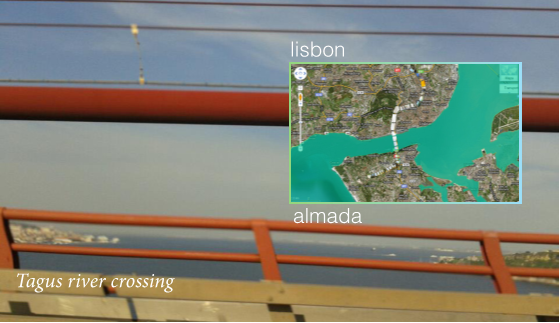
GPS coordinates are presented as default text between stripes. The users are allowed to substitute this geographic information by editing their own text labeling in each white line. The final map results from a representation of hard data and open variables related to movement and color – visual impressions, time, type of transportation and user input.
The final map will be presented as a stripe of colors, showing long stripes when the user is moving faster, and narrower stripes when the user is moving slower.
Key objectives for inclusion
Quotidian journeys are often a routine experience where landscapes blur into oblivion. CitySkin can provide insights about different layers of perception, and a singular perspective on urban reality. The application invites the user to find different maps around the city and get to known new places.
As such, Cityskin is offering an interpretation on data given from visual cues. CitySkin can visualize and find interesting differences, coincidence or patterns on journeys maps.
It becomes possible to compare visuals from different cities, but also the subjective variables given by an individual journey. These changes can be given by time spent in different locations, or even provoked by the user’s imagination.
CitySkin was designed considering that identical paths would provide completely different maps accordingly to the use, emphasizing the differences around the experience found in routine.
Results in relation to category
As a digital product, CitySkin provides a mean to compare and experiment with different times of the day or year of a specific place, but also between different cities. Furthermore, this application allows recognizing patterns of time. Finally, the information presented in the final map, can give the user, a visual and immediate way to evaluate activities that relate to routine and movement. This information presentation benefit from a comparative evaluation, like for instance physical activities (jogging), or by visualizing traffic jams, giving a tool to measure qualitatively and quantitatively the quotidian.
How Citizens benefit
The Cityskin project tests relations between computation and art, acknowledging the incremental step toward computational ubiquity allowed by mobile phones. Ubiquitous Computing is addressed by this application, considering the city’s intelligence. In a broad sense the project proposes to test playfulness and a sense of discovery, thus, giving focus on the user experience. The project also aims to challenge the dominant discourse of the "smart city", with its tendency toward quantitative data (traffic flows, phone data, revenues, etc) which arguably leads to an impoverished sense of the city as experienced by its users. Might smart cities instead learn from the post-war practice of the Situationist derive
Innovative character
CitySkin produces outputs which give visibility to invisible layers present in quotidian life, adding a cultural impression to design and computation. Each image reflects the point of view of a user along a path. There will be differences in colors and distortion on the output image (skin). Each skin will be unique and will reflect the singular point of view of the user’s time, place and playfulness. Finally. CitySkin suggests to slow down, and embrace contemplation.