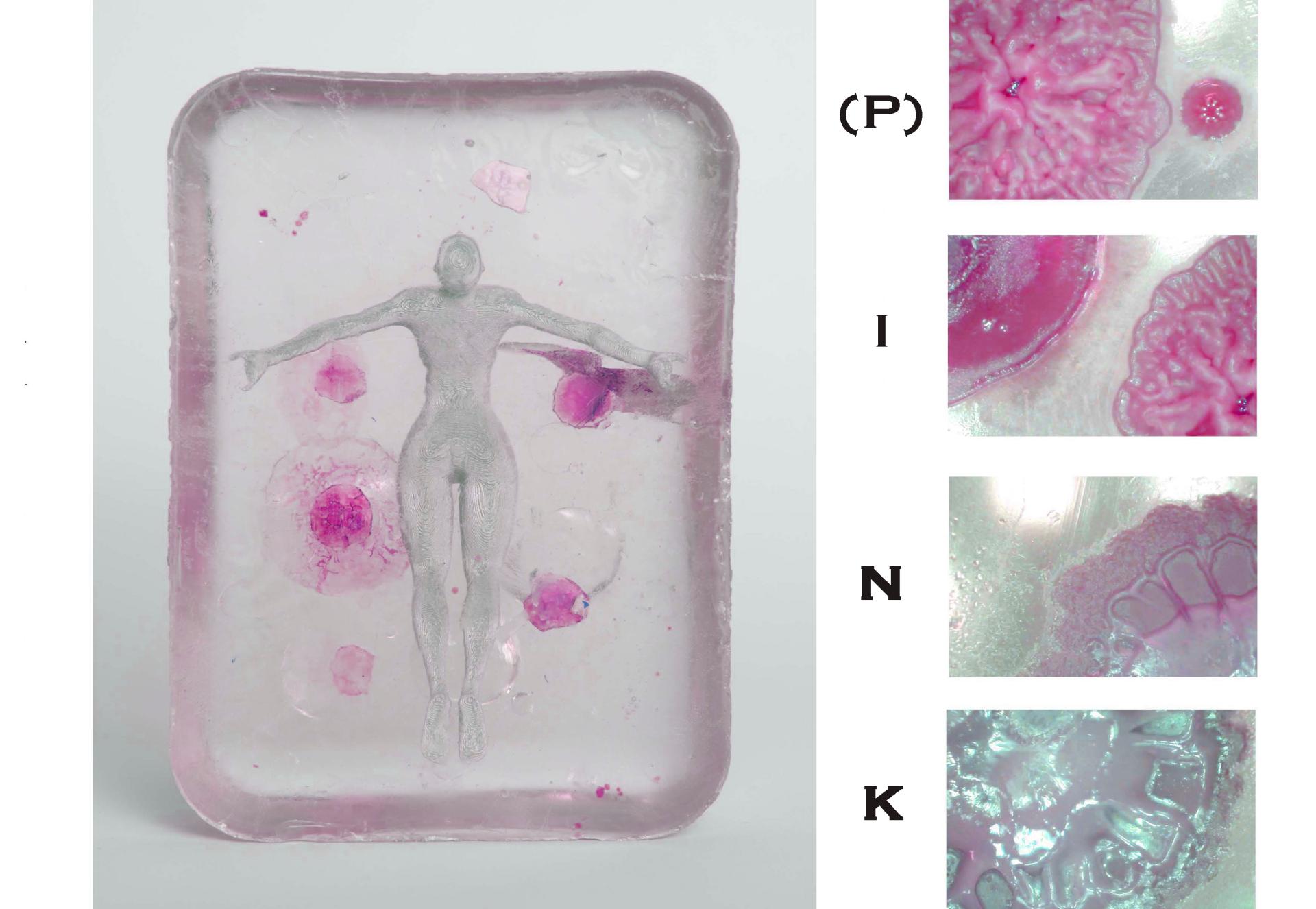
(P)ink
Basic information
Project Title
Full project title
Category
Project Description
An interior design object visualising the beauty of our microbiome. The bacterium Micrococcus roseus which grows on our skin is transferred to a translucent bioreactor where it produces a pink pigment. This can be extracted and used to produce art and design objects
Project Region
EU Programme or fund
Description of the project
Summary
A microbiota is an ecological community of commensals, symbiotic and pathogenic microorganisms found in and on all multicellular organisms from plants to animals. It includes bacteria, archaea, protists, fungi and viruses. Microbiota is essential for immunologic, hormonal and metabolic regulation of their host. Some, like bacterias, produce colourful pigments to protect themselves, communicate, or interact with other communities. In the case of M. Roseus, which produces reddish colonies they protect from UV radiation (Tong and Linghthart, Photochem Photobiol 65:103, 1997). Once cultivated, it is an infinite source of pigment production at a minimum exchange of light, air and nutrients like sugar, salt, water or proteins.
We design an interior design object visualising the beauty of our microbiome. The bacterium Micrococcus roseus which grows on our skin is transferred to a translucent bioreactor where it produces a pink pigment. This can be extracted and used to produce art and design objects.
Key objectives for sustainability
Appreciation for the benefits of interspecies symbiosis is key to a respectful and harmonic coexistence of human and nature. The recent pandemic has made people associate sterility with safety. Our microbiome though as part of us is essential for survival. Visualising the amazing properties of microbes by producing a pink pigment aims to evoke love for bacteria. Harvesting this biodegradable product from a personal source makes us independent of agriculture and animal products. We now exploit?! our own microbiome. For building the bioreactor we will make use of discarded glassware.
Key objectives for aesthetics and quality
The bioreactor is made of translucent borosilicate glass which presents the bacterial pigments in constant movement due to a pump improving its reproduction. A magnifying glass live stream is beaming the colourful life to the surrounding walls which makes the viewer feel like being soaked into the microbial world. The extracted pigment only by its color reminds of flesh and skin- something entirely organic and human. The extracted pigment can be used to express any artistic or design vision and might even be tattooed to retire to its origin?
Key objectives for inclusion
M. roseus lives on mammals, all kinds of skins are inhabited by it. Pink is pink. The dye therefore theoretically is easily accessible by anyone. Also the environmentally friendly extraction is causing no damage to textile producing countries. A globally fairer coexistence is enabled not only including all humans but also nature and especially all microbiomes.
Innovative character
Many fashion companies such as Colorifix, Faber Futures, Living colour, Pili Bio Paris, Amsterdam textile lab, Vienna textile lab or Kukka produce textile dye with bacteria or grow them directly onto the fabric. Due to the growth at room temperature, the use of far less water and energy than petrochemical processes and the possibility of using the remaining pigment for products requiring less saturated pigments than textiles, the process is very ecofriendly. The Application has so far been possible on cotton, angora, bacterial cellulose sheets nd shows great color fastness. The mostly used bacterial strains are the soil dwelling bacterium Streptomyces coelicolor and Janthinobacterium lividum producing Violacein which protects Amphibians from infections. Both have antifungal and antimicrobial properties which make the products they are used for not only less toxic but even beneficial for health. While there are already many concepts of bioreactors growing algae that filter the air and are afterwards used for pigment production, an interactive bacterial pigment product does not exist yet. Reason for this might be the lower risks faced when growing algae. Bacteria need to be kept in a safe in a securely closed environment to not eventually cause yet unknown problems. M. Roseus is nonpathogenic but may be opportunistic in immunocompromised individuals and due to a weakened immune system, lead to disease when these bacteria gain access to the inside of the body.