Via Appia: heritage and nature for all
Basic information
Project Title
Full project title
Category
Project Description
Wouldn't it be nice to imagine the Appian Way as an open-air museum for everyone? In which walking along the Roman Way would be safe, healthy and peaceful for everyone?
We propose a project based on participation that puts together sustainable mobility, accessibility and education.
Car-free days, intermodality and upgrading of pedestrian paths.
Activities with schools to learn how to build as Romans.
Accessible services co-designed with persons with disabilities and university students.
Project Region
EU Programme or fund
Description of the project
Summary
The Appian Way with its 2300 years of history and its incredible historical heritage that together with other historical masterpieces makes Rome one of the most interesting and beautiful places in the world. However, it makes it as well one of the most challenging to turn into accessible and sustainable.
The Roman Appian Way is an example of this dichotomy. On the one hand, it is one of the green lungs of Rome and it is an astonishing piece of art history. On the other hand, it is full of cars and it is accessible just for some people. From our point of view, both aspects need to find a way to match.
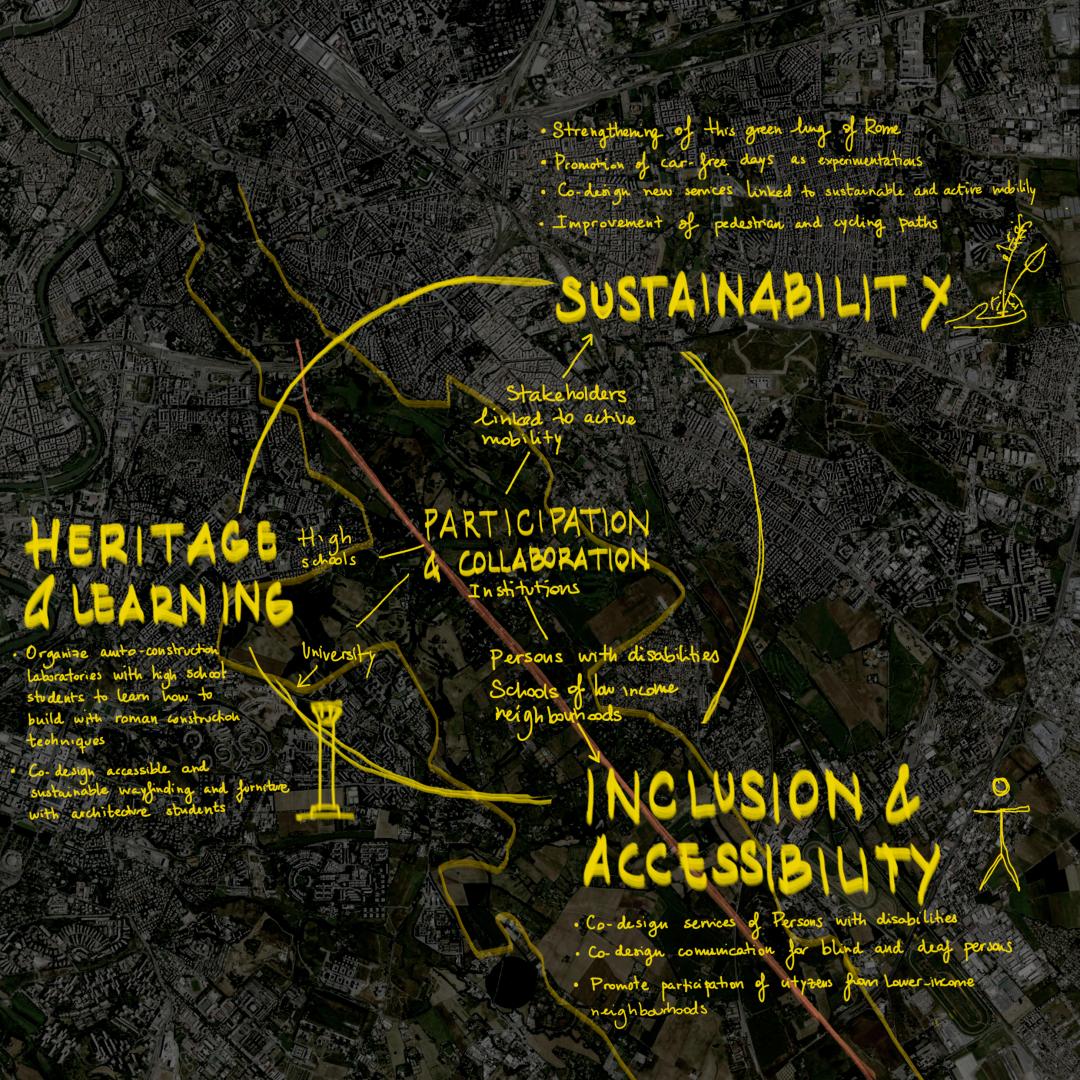
We would like to develop an idea based on the participation of citizens and the collaboration between stakeholders and institutions. A project that pursues actions such as the implementation of sustainable and active mobility, services and facilities for persons with disabilities and educational activities based on Roman architecture and inclusion.
These strategies could be a pilot project to improve accessibility and sustainability in other ancient sites of the city and in other cities.
Key objectives for sustainability
Green spaces correspond to 67% of Roman land, making Rome the third greenest capital in Europe. The Appian Archeological Park represents the most important ecological corridor that introduces nature in Rome’s city center.
Unfortunately, the quantity of private vehicles along the Appian Way makes it difficult to enjoy this natural space. For this reason, we believe that it is important to promote sustainable mobility.
In the long term, we would want to see an Appian Way empty of private cars (with the exception of residents and people with businesses along the Roman road). The Sustainable Mobility Plan of Rome foresees the implementation of a new tramway line that will cross the Appian Way and the park, and the implementation of buses along some streets on both sides of the park. We consider that in the future, as these projects will be developed, hubs with bicycle renting (also bicycles adapted for different disabilities) and pedestrian and bicycle paths from the bus or tram stop till the entrance of the park, should be constructed. As well as an intermodal parking.
In the short term, we want to start a collaboration with stakeholders linked to environmental preservation and promotion of bicycles such as Salvaiclisti, FIAB or Legambiente. We would like to launch car-free days one time a month, starting from Sunday during the European Mobility Week in September. To make car-free days more viable, we want to establish a dialogue with the owners of the restaurants along the road to know how it is possible to collaborate also with them. Services offered for biking could also be implemented with services for families and for persons with disabilities.
By collaborating with the Archeological Park Institution, which has in its own urbanistic Plan the aim to reduce private mobility, and following “GRAB project” of Rome’s municipality (bike corridor) we would want to make a part of the Appia accessible for bikes and pedestrians (also with special mobility needs).
Key objectives for aesthetics and quality
We believe that by implementing active mobility and accessibility of the pedestrian paths, the experience of visitors will change for the better and they will enjoy the ancient atmosphere created by its beautiful Roman ruins and its characteristic pine trees. It will become the open air museum that it should be.
Moreover, the project plans the realisation of laboratories with high school students, who will take part in the auto-construction of a small piece of Roman wall, in the open air, in a Roman contest, a lifetime experience. The aim of this activity is to make students learn about history in a dynamic and active way but also to get closer to engineering and architecture, which is important for us mostly from a gender point of view, trying to reduce the gender gap that these degrees still present in Italy. We will contact schools during July in order to include this activity in their study plans.
Students of Architecture and Arts will have the opportunity to analyse the area and then think of accessible solutions for temporary wayfinding and furniture that will be installed by June 2022.
From the point of view of visitors, the goal that the project pursues is to permit everyone to feel the astonishing beauty of the ancient remains, even people that are not able to see or hear. Some accessible guiding tours will be co-designed with the Institution of the Archeological site, persons with disabilities and organisations that represent them.
Key objectives for inclusion
By activating collaborations with some stakeholders and schools of Centocelle, one of the areas that surrounds the archeological site, characterised by a lower income than other surrounding areas, invite them to participate in activities in the Appian park. Try as well to promote sustainable mobility to go from the neighbourhood to the park, which is far 25 minutes by bus. The last aim is to make them feel that the archeological site could be a green area to enjoy and where to promote activities on their own.
On the other hand, our idea is to activate collaborations with organisations of persons with disabilities: deaf persons, blind or partially sighted persons; persons with reduced mobility or persons with cognitive disabilities to co-desing services and activities to improve the accessibility of the area.
First of all, the mobility solutions that the park offers, should be adapted to persons with disabilities such as tandem bikes for blind people or adapted bicycles for persons with reduced mobility and electric cars or buses for elderly people or persons with disabilities. The dirt tracks on both sides of the Roman way and the paths to reach the different archeological buildings should be exempt from any kind of architectural barrier, at least in some sections.
Another important improvement to do in terms of accessibility is related to information, mostly for persons with sensitive disabilities: wayfinding with tactile maps (with the right height also for who is using a wheelchair), 3D models of the masterpieces of heritage and videos using sign language and subtitles as well as digital solutions for both targets.
Innovative character
To promote car-free days and intermodal hubs is something not really innovative in other cities of Europe. Unfortunately, the starting point in this context is really challenging from this point of view. Trying to experiment with car-free days co-designed with public Institutions, important stakeholders for active mobility and owners of restaurants and other business inside the park, becomes innovative.
At the same time, accessibility, which is also a challenging aspect of Rome and of many historical cities of Europe, should be the base of any project, as written in the UN’s convention for the rights of persons with disabilities. Unfortunately, also this is not that common. Furthermore, we believe that the right for everyone to access cultural heritage is not the most important thing, it is also crucial to create a participatory context in which persons with disabilities design services and activities for themselves.
To conclude, laboratories to learn how to construct with Roman techniques would be innovative because the concept of open air museum becomes an open air laboratory where it is possible to learn by doing, and learn by imbuing roman architecture. It is also an approach that could get girls involved in construction activities and reduce in this way a gender gap related to education.