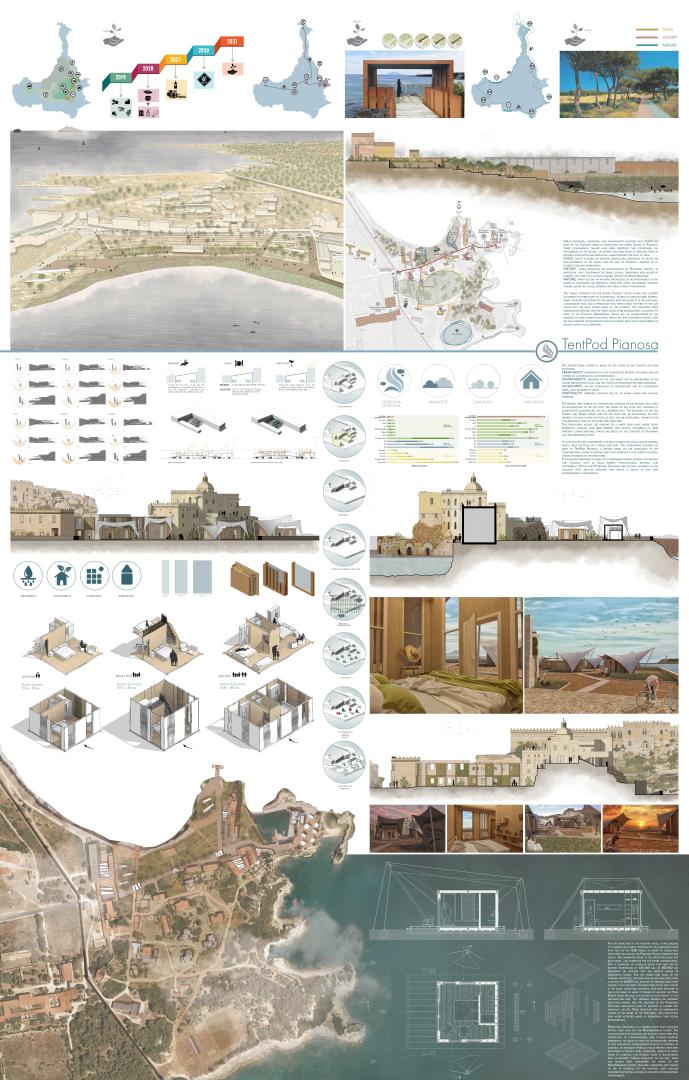
TentPod Pianosa
Basic information
Project Title
Full project title
Category
Project Description
The three themes Food, Nature and History have been translated throughout the Pianosa island in order to regenerate it in its entirety: both the Penal Colony and the country. The architectural project allows the coexistence of a recovery of the Old Port area together with a new area dedicated to the Glamping. An idea based on four keywords, permeability, sustainability, essentiality and modularity, in order to achieve the recycling targets aimed at the social reintegration of inmates.
Project Region
EU Programme or fund
Description of the project
Summary
The project is aimed at the rebirth of the island of Pianosa in its entirety. To achieve this goal, an in-depth analysis was conducted, trying to enhance the great wealth that already exists and to bring innovative ideas. Food, Nature and History are the issues on which attention is paid for the regeneration of both parts of the island: both the penal colony and the country. The architectural project allows the coexistence of a recovery of the Old Port area together with a new area dedicated to the Glamping. An idea based on four keywords, permeability, sustainability, essentiality and modularity, that integrates in the best way with the island's nature. We performed a careful analysis of the local resources in order to achieve the recycling and waste minimization targets. This led to an innovative usage of egagropili, dead leaves of Posidonia Oceanica that accumulate on the beach, to create the insulation layer of the new constructions. Moreover, we took into account as a crucial element of our project, the social inclusion activities for inmates supporting the work reintegration of inmates by involving them in the tourist services provided on the island: They will be able to learn new professions: from the construction of prefabricated modules (Glamping’s rooms) to agriculture and from cooking to accompanying tourists for the island tour. This project aims to bring the entire island back to life especially redefining the Old Port area in a functional and architectural way, to make it the beating heart of the island as it used to be in the past.
Key objectives for sustainability
The main concept behind the idea of sustainability is that resources of the planet cannot be used, exploited or damaged infinitely. So, the concept of environmental sustainability support a philosophy of life that is able to satisfy needs of the present without compromising the ability of future generations to satisfy in turn their needs. We decided to privilege "local" materials in order to reduce costs and pollution due to the transport. We also choose to prefer those materials which, once their life cycle is over, are easily reusable and those of which there is good availability on earth. Posidonia Oceanica, or more commonly called "Sea grass", has excellent thermal capabilities and has also good fire resistance which makes it an optimal product for construction. In some countries of Northern Europe, and in Italy, there are already projects that use Posidonia as well and as a thermal insulator also as an external covering of the structures. Another fundamental aspect of this raw material is that it does not require the use of chemical additives for its processing and application, a quality that translates into excellent benefits for humans and the environment. Furthermore, its use allows the freeing of the coasts from annoying deposits, thus allowing avoid stacking and therefore its decomposition. Wood in green building is the most widely used material as it has numerous qualities beyond to be renewable, recyclable and biodegradable. In fact, it has excellent characteristics: thermal-acoustic insulation, elasticity, flexibility, resistance to thermal and mechanical stress and wear resistance. Its physical characteristics also make it suitable for creating warm living spaces and welcoming, providing beneficial psychological effects such as well-being and relaxation. There sustainability is achieved with wood from forests managed correctly through regrowth programmed, present in the construction area.
Key objectives for aesthetics and quality
The basic idea of the project is naturalness, so the continuous search of the integration between buildings and landscapes. This concept is well developed in the area of the Old Port, where the accommodation facility of the project is located. The project is identified in a “glamping”, a word that came from the fusion between glamor and camping, and it’s an accommodation experience that recalls the idea of camping with all the comforts of a luxury hotel. The structure is made up of a series of pods, in 3 different sizes, developed in a hidden part of the port reachable by passing through the ancient walls of the first hotel built in Pianosa. These walls are maintained only through a metallic structure not visible from the port. The materials used are natural materials, namely wood for the structures and the greenery: this was used both for the flooring and as COVER for the steel structure of the port facades. These elements were chosen to recall, in fact, the essentiality of nature, that is the soul of the island. Each pod is made up of panels developed according to three semi-prefabricated configurations, which then define modular structures with a repeated facade scheme. Due to the high insolation of the area, each pod has two fundamental elements: they are protected by a specially designed tensile structure, in harmony with the tensile structure system designed for the common areas of the town, and they are raised from the ground by a platform in order to guarantees private spaces for everyone and a natural ventilation system under the base of the pods. Aesthetic sense is, therefore, an element of high importance, starting from the desire to maintain a historic internal curtain, integrating it with a modern infrastructure that is perfectly integrated with the surrounding environment, visible and invisible, and with natural materials.
Key objectives for inclusion
The penal colonies were born as one of the most interesting experiments of the Penitentiary Administrations and are proposed the objective of including a social purpose in the execution of the sentence. Mainly they contribute to the readaptation of the prisoner through work activities that allow a specialization in various trades, ranging from agricultural labor to specialized crafts. In the case of Pianosa, the inmates of the Porto Azzurro prison are transferred to the island to serve a third of their sentence and live in a semi-liberty regime, working every day to recover the island from different points of view. The aims of this initiative are the re-education and reintegration of prisoners through agricultural production, services for tourism and the recovery of the building heritage. The concept designed for the entire island is based on three words: Food, History and Nature. They will find development thanks to the inmates’ work. The main node of this project is certainly the existence of two totally different realities, that of civilians and that of prisoners. It is therefore essential to create and respect an environment of coexistence between these realities, always maintaining a free but controlled degree of participation, to ensure safety on the island and at the same time to allow the social reintegration of inmates. TentPod Pianosa is based on the concept of permeability, sustainability, essentiality and modularity. The last one is not only aimed at characterizing a regular and homogeneous aesthetic aspect, but also has the aim of making the new objects appear architecturally an easily modular structure, as regards the construction phase. The desire to simplify the assembly phase derives from a fundamental need: make easier the work of prisoners. Prisoners presence is the most important opportunity to rely on, thanks to all this, it is possible to intervene directly by forming a micro economy and organizing activities and services for the whole island.
Innovative character
Innovation does not only mean searching for new ways or materials that are the result of technological or productive evolutions. Often, as in this case, innovation is found in the simplicity of the process of reusing a natural and indigenous material of the territory in order to optimize the building product, redevelop the territory and act positively on society. From this concept was born the constructive idea of the pods of the accommodation facility located in the area of the Old Port. The naturalness and respect for the context are the basis for the development of the project, a process that led to the use of Posidonia Oceanica as building insulation. The use of this material, that is an aquatic plant very common in the Mediterranean, is advantageous from an ecological point of view as it can be found at zero km and does not require special treatments. But the advantage does not fall only on the built itself, but also on the territory: one of the problems of the climatic evolution taking place on our planet is the excessive growth of this aquatic plant, which at the end of its life cycle spills over to the beaches of the territories where it lived, including Pianosa. This situation, having reached a high level of criticality causes problems for the ecosystem itself, can only be solved by removing it from the beaches, causing large and expensive natural waste. The innovative concept of the project comes into play at this stage, including not only the innovation of the product itself, but also of the process and way of reusing natural materials: the Posidonia harvesting phase will in fact be implemented with help of inmates on the island, according to a concept of inclusiveness and social reintegration.