Common Gardens
Basic information
Project Title
Full project title
Category
Project Description
peer_protocol envisions the common gardens as a cultural platform. A space that can be communal as well as private. A space co-designed with the owner and community together. Where urban gardening, a key activity of urban resilience, comes together with social and cultural activities, curated by and for local users.
Project Region
EU Programme or fund
Description of the project
Summary
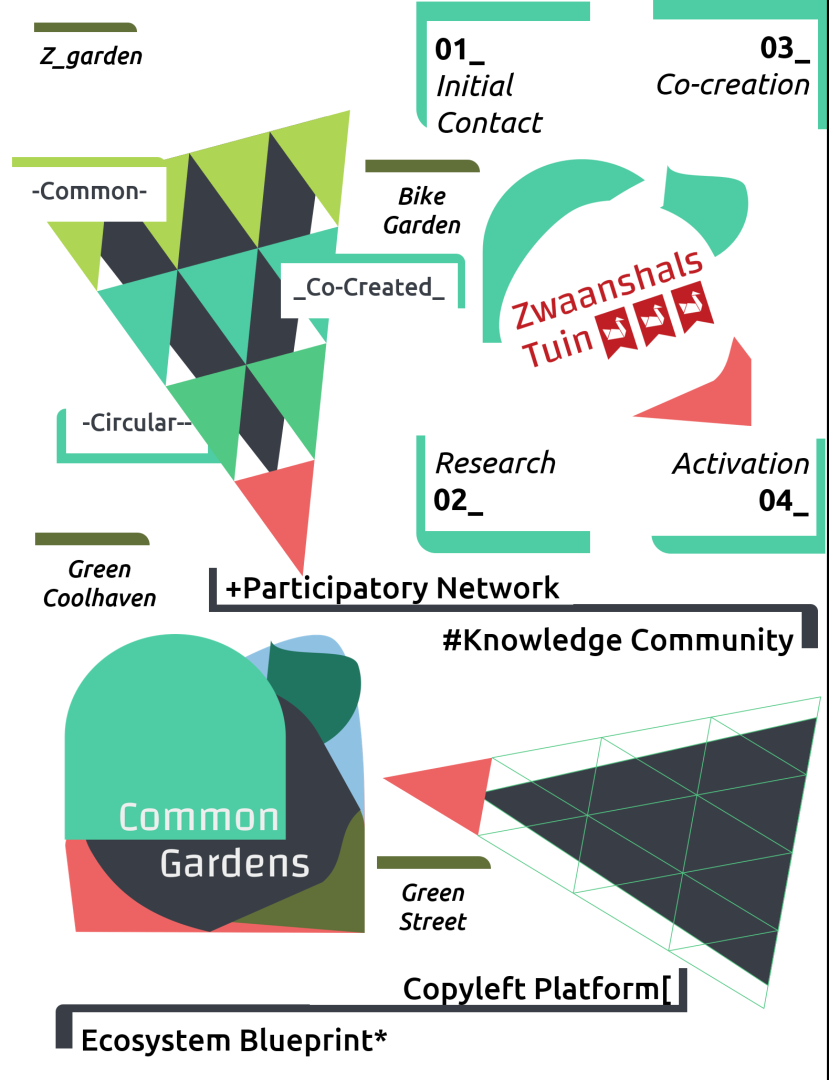
peer_protocol plants the first seeds of Rotterdam’s common gardens this summer. The idea of Common Gardens is to prototype and co-create a set of open-source tools and templates supporting grassroots initiatives and simplifying the participatory management of shared green spaces. The first prototype is an unused backyard shared by a hairdresser, clothing designers and resident neighbours. Together, we will co-create the Zwaanshals Garden across 4 phases - contact, research, co-creation and activation. Green Coolhaven, Bike garden, Green Street are other germinating gardens across Rotterdam to which the collective contributes to. Shared knowledge disseminates a nascent network of Common Gardens - it is meant to upstart, facilitate and engage people in re-creating shared spaces.
As a participatory network, the Common Gardens needs to generate enough interest through participation. With the development of a knowledge network around urban gardening, there is space for the development of global digital commons. This local ecosystem blueprint can be facilitated in other urban spaces and communities. The Common Gardens platform will benefit from contributions and updates of new versions of the platform’s digital content, including the latest local practices and common efforts.
Community resources behold co-creation. Between what is private and public, space can be common. On one side, co-designed with the community are the space layout and organization, the program and activities, the indicators and assessment criteria, as well as the social media story-telling traces. On the other side, facilitated by peer_protocol are the concept, digital and physical tools, design knowledge, materials, communication, brand and identity structures. The organisation facilitates and co-creates digital commons with and for different communities in order to fulfil common needs.
Key objectives for sustainability
Human-made enclosures of green space are not inherently sustainable. A sustainable garden depends on the sustained availability of resources within a given context. By designing circular resource loops, a space can increase its resilience. This creation of value produces shared benefits and increases the autonomy of a collective space... so what is the context for the sustainability of a common garden?
With the objective of how to learn, create and activate the circularity of value through shared practices, we invite citizens to teach and learn in a series of workshops. After the research phase in which possibilities are gathered and proposed, follows co-creation and a last month of activation. It's from this procedural evolution from which we co-create a form for the circularity of resources. The prototype for this sustainable garden is Z_Tuin. We are asking the neighbourhood for its dreams, needs and resources in no waste of knowledge of practices or materials. We document the local contribution of temporary urbanism to urban sustainability.
The creation of such common digital resources - whether co-designing communication tools or open data technologies - foster small-scale, decentralized, autonomous, and resilient urban initiatives, led by empowered and connected communities. In return, we create the circular conception of one specific set of items, including a materials database, cartography of local production ecosystem, drawings of design/iteration and notes on best practices and recommendations. With the temporary, circular and local Common Gardens, peer_protocol will create sustainable open-source knowledge and methods for community growth in (local) urban spaces towards a larger loop and scope in connected practices.
Key objectives for aesthetics and quality
The starting point is to test the methods and capability in producing urban and digital commons designing and implementing small-scale and community-based projects. Through these projects, peer_protocol will verify the effectiveness of its methodology and its ability to generate and maintain collaborative tools. This creates space to test and adapt peer_protocol’s methods. By mapping resources and processes, we prototype a service and product layer and propose a business model around shared resources.
Digital commons can foster small-scale, decentralized, autonomous, and resilient urban initiatives, led by empowered and connected communities. With a temporary, circular, small-scale test project, peer_protocol will verify its capabilities in designing global open-source knowledge and methods for community growth in green urban spaces. The work carried by peer_protocol is to be public and collaborative. Exceptions are made regarding private data. By principle, work carried by peer_protocol makes use of copyleft licenses in order to safeguard its reciprocal development. Enabling a layer of openness around the mentioned entities provides a space for shared digital and social innovations to take place.
peer_protocol envisions common gardens as a participatory platform. A space that can be communal as well as private. A space co-designed with the owner and community together. Where urban gardening, a key activity of urban resilience, comes together with social and cultural activities, curated by and for local users. Citizens can freely organize events and make use of the space through the use of a participatory budget. For example, an open-air cinema, a (regenerative) reading and presentation club, bicycle upcycling workshops or anti-waste dinners across the coming summer activation month of the Zwaanshals Tuin. We envision a cultural place and playful meeting point maintained by the community.
Key objectives for inclusion
The creation of digital collaboration channels, the sharing of digital templates, and the mapping out of the different processes in place are meant to facilitate and empower the co-creation of inclusive spaces. peer_protocol ensures a safe, inclusive and friendly environment for all, with collective care for the literacy of different contributors and appropriate use of (in)tangible tools or data.
The collective will gather interviews & opinions of participants (owner, close neighbours, citizens, peer_protocol members, students), producing visible outcomes in media, as photos and/or videos of the prototype activation phase and report on community-led Common Gardens processes. By making use of copyleft licenses in the creation of shared knowledge, we enable the dissemination of inclusive practices. Facilitating the creation of business models for its participants promotes inclusive neighbourhood development. Furthermore, circular economy and circular building principles widely contribute to regenerative city making and strengthening the role of local communities in a green transition.
The dream desk stands in the middle of the street - we invite citizens to engage in dialogue surrounding the use of a new community space as part of our research. Its use precedes one month of events planned by the different participants. This includes the creation of workshops suited to the community’s aspirations and based on the work and ability of facilitating co-creators.
The festival-ready Dreams online platform easily collects ideas, organises threaded discussions and enables decision-making by vote. Rooting our trust in community knowledge, protocols and other collaboration agreements enable an appropriate scale for collaboration in common pursuits. Private and public stakeholders are willing to fund the creation and maintenance of digital commons, here introducing 'cooperation-as-a-service' for different green local initiatives.
Innovative character
The city is not an isolated entity; it is part of a region, of a country, of a continent and the world. Just as a city is embedded in its physical surroundings, the leading ideas in a city are also part of a broader, dominant paradigm and logic. Social innovation introduces alternative ways of doing things. By shifting the power and responsibility for the management of our common resources, we empower different communities to make a difference in accordance with their needs by thinking globally and producing locally. The most appropriate in the creation of shared knowledge gives space to new practices. The usage of digital technology for the connection of communities and improvement of common practices allows for the appropriate local deployment of practices of digital social innovation.
Through the employment of open processes and products, peer_protocol aims to design global open-source knowledge and methods for community growth in urban spaces. Noting the possibilities found in alternative approaches to accounting and governance of common resources, as well as new open and participatory methods for decision-making, we look for solutions through the design of collaborative networks. The development of the Common Gardens prototype will result in the completion of a number of copyleft deliverables and contributions to the development of an open innovation ecosystem. The facilitation of open-source processes for city-making contributes to the participatory transformation of our shared spaces.
As opposed to the traditional start-up model, community-driven solutions are an ethical alternative in the way things are organised. By reducing the cost of participation in city-making, innovation can be co-created by groups of citizens and public entities. Different business models, the usage of participatory budgets and the continuous engagement with a common space will bloom change.