Lab2400
Basic information
Project Title
Full project title
Category
Project Description
Lab2400 inquires into the social and architectural possibilities of residual urban spaces within a specific urban fabric. It intends to generate fresh foundations for public housing based on specialized digital tools and an open design research program. The objective is to meet the demands of new forms of communal living, within a framework of compact, legitimate and sustainable houses.
Project Region
EU Programme or fund
Description of the project
Summary
Lab2400 inquires into the social and architectural possibilities of residual urban spaces within a specific urban fabric. It intends to generate fresh foundations for public housing based on specialized digital tools and an open design research program. The objective is to meet the demands of new forms of communal living, within a framework of compact, decent and sustainable houses.
In particular, it comes into effect inside the 2400 Plan from the Government of Valencian Community in Spain, as an experimental laboratory inside this project traditionally orchestrated for the impulsion of public housing in this region of Spain. It may be understood as well as part of the global network of Distributed Cooperative, which is already being applied in cutting-edge cities such as Zurich.
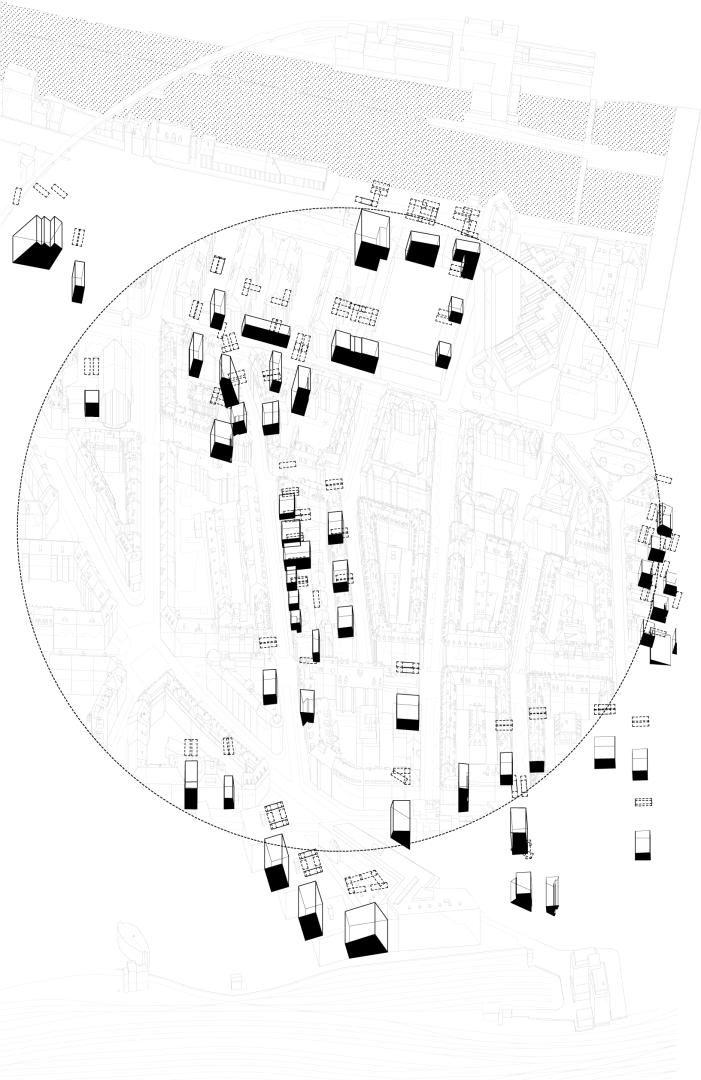
Lab 2400 intends to develop 10 interstitial and residual spaces from a city within the scope of the 2400 Plan, as smart urban densification prototypes with a strong social component. These ten disseminated, within a walkable distance, urban clusters put together the speculative idea of a new model of disgregated public and shared living. As new models are clearly needed in order to address the quandary of public housing in Spain, not only in terms of lack of government attention but also of social consideration.
The research program takes off from a digital sphere as it starts with the design of specific digital tools able to scan the compact public free spaces within the existing urban fabric. Depending on the limitations of any found site, the script is able to develop endless automatically generated design solutions based on minimum programmatic modules given to the script. This may be understood as raw material for the design team to uncover new spatial possibilities and experimental architectural prototypes. This hybrid form of digital-traditional design and participatory process materializes in an open website and database publicly accessible at every step of the research cycle.
Key objectives for sustainability
Sustainability is constructively presupposed, in terms of design strategies to strengthen livability conditions according to the specific climatic environment. But also, resource optimization is understood as a sustainability strategy specific to the project and accomplished by an initial parametric design that guarantees optimization of the available space of every study plot, on the basis of minimum units previously designed by architects.
The project is economically sustainable as it promotes circular economic cycles from its construction until its livability. As both local building materials will be used for its completion and the intangible network created along this kind of concentrated clusters may come into a new level together with its expansion along the city fabric and the nearby economy.
Lab2400 responses in terms of social sustainability with new models of public housing, promoting the construction in accordance with the real needs of the contemporary population. Avoiding the perpetuation of obsolete and outdated housing models inconsistent with the market demands, social evolution, and its upcoming agents.
As well as this, patrimonial sustainability may be read in the project as it is all based on the exploitation of interstitial and residual spaces of the existing city for the creation of new contemporary ways of living and the surrounding social impulsion.
Key objectives for aesthetics and quality
In terms of the aesthetic qualities of the project, these will depend on the specific local aesthetics and geometry to each particular country, city, or plot.
As already stated, the initial design will be developed on the basis of digitally generated geometric parameters reviewed finally by the architect, who, in accordance with its characteristic geometry, environment aesthetics, local materials availability as well as other factors, will develop the design proposals for each plot in a traditional way.
Interventions will be understood almost as if temporary, with a reversible impact but also ensuring the optimal comfort of users.
In each of the blocks, the programmatic combination will be promoted, since it is one of the main experimental bases of the project. Also, Lab2400 advocates for spatial experimentation in compact spaces in order to meet the needs of new housing experiences in both individual and collective ways of living.
Key objectives for inclusion
Inclusion will be addressed in terms of boosting new public housing concepts in different European countries on the basis of cultural investigation, with regard to public housing models and the possibilities of each one of these countries.
This investigation has the aim of looking into the decisive factors of each country so that the project would be introduced in its most integrated way in the culture and social scene of the city of study.
Within this framework, different cross-generational, intercultural housing models will be proposed with the main objective of housing democratization just as a change of today’s flawed public housing concept in favor of people at risk of social exclusion, emerging social agents and new generation talents. All social profiles have a place within this network of co-living and shared public spaces, as new forms of ownership are addressed and alternation between users guaranteed.
Social transparency is a major feature of Lab2400 and it will be tackled within the digital platform by means of a bustling, changing map and the register of the different steps of participatory processes that may take place.
Innovative character
Lab2400 is based on the utilization of existing databases originally created for different aims and its modification into specialized tools for urban densification. As not only, new forms of living are necessary but also new forms of addressing the design process.
The project materializes in the contribution to the social housing sector with a new model of distributed shared living along the city, with the resulting spatial saving and the inclusion of the city inside the new community, whilst changing the traditional co-living cluster into a model that a understands the city as a grid where the community expands, builds relationship and colonizes every available public plot. The existing city can benefit and actively participate from the new communities as well as addressing the debate of new forms of ownership.
The project aims to the creation of a disgregated physical community with open digital headquarters where every development step of each of the prototypes can be followed and will allow the community local growth, and why not thinking in a bigger frame, towards other cities.
As a global intention of the project, there is the understanding of the different social, cultural, economical, political, and legislative factors that allow the spread of this revitalization project towards different cities along the European context.