UNBLIND
Basic information
Project Title
Full project title
Category
Project Description
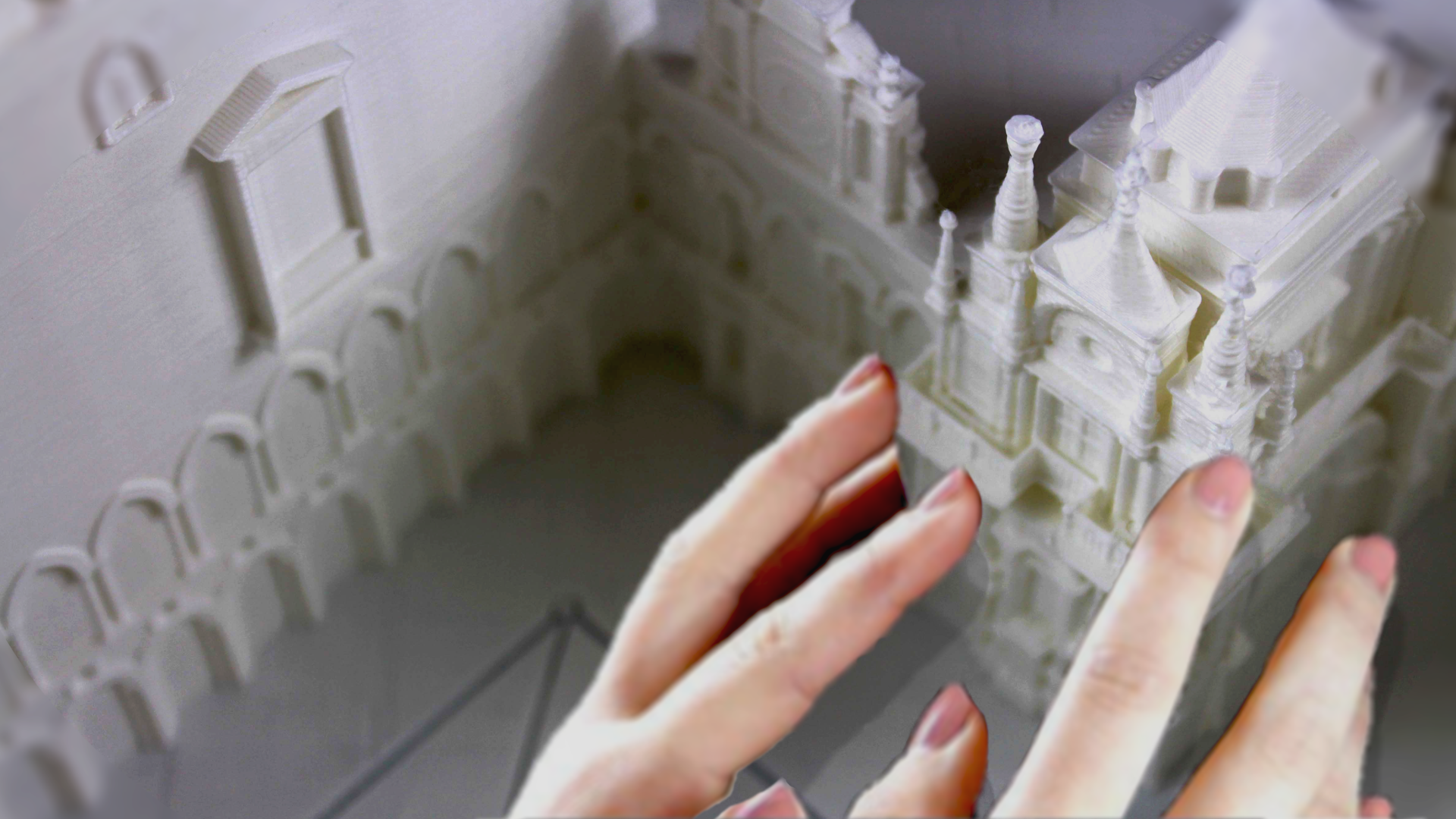
UNBLIND aspires to make living spaces available in new ways following the values of sustainability, aesthetic, and inclusiveness, linking technological research to local resources. This will be met by building visitor itineraries in both outdoor heritage spaces and museums where blind people can touch and experience architectural and urbanistic 3D models. In this way, we will enable every citizen to take part in the collective experience provided by cultural aggregation moments.
Project Region
EU Programme or fund
Description of the project
Summary
The aim of UNBLIND is to democratise access to cultural heritage spaces and make them available to visually impaired citizens using 3D printed reproductions of cultural heritage venues. The concept underpinning UNBLIND fulfils the vision of New European Bauhaus movement to preserve and transform our living environments, reconciling people with the space in which they live, which means also cultural spaces. Our idea is to make living spaces available in new ways, inspired by the values of sustainability, aesthetic, and inclusiveness and taking into account the cultural character of ‘places’. In our daily experience of European citizens, heritage spaces act as physical places of aggregation, where people interact with the present and the past, and connect with their own history. Our ultimate goal is therefore to include in such a collective experience the citizens who are usually excluded from it.
A blind person visiting heritage locations cannot enjoy their aesthetic value. Our idea connect them with ‘places’ entails making touchable and ‘visible’ heritage locations and objects by means of 3D printed models. 3D printing technology is a versatile means for reproducing cultural spaces and it is more environmentally friendly and sustainable than traditional mould technology. This is possible thanks to the use of printing materials based on biopolymers from organic waste, honouring the principles of the European Green Deal. In this way, the Green Deal principles become cultural, human-centred, and tangible experiences.
Our goal is to provide a proof of concept for building visitor itineraries in both outdoor heritage spaces and museums where blind people can touch and experience architectural and urbanistic 3D models, as well as other cultural artefacts that define them. The relevance of the idea is its scalability to different contexts, from open spaces to museums and archaeological parks, to establish common standards of accessibility to our living environment.
Key objectives for sustainability
The main objective in terms of sustainability of UNBLIND is to promote the use of 3D printing technology as a more efficient, affordable and sustainable method compared to mould technology commonly used for reproduction of heritage objects. We also aim to optimise the efficiency of this technology in terms of environmental impact and to quantitatively estimate its footprint, an exercise never undertaken in the conservation context.
The first objective will be met by using bio-based polymer as printing material to create 3D prints of heritage objects. This will be achieved by producing a polymeric printing filament starting from secondary and tertiary feedstock, which will be locally collected through eco-friendly approaches. Currently, the main biopolymer used in 3D printing is the polylactic acid (PLA) produced by recycling organic waste, such as corn-starch. We want to promote the principles of the New European Bauhaus by boosting research in low environmental impact solutions and in efficient (re)use of local resources for a more sustainable living experience. For instance, in the Venice lagoon, the by-products of food industry (i.e. mollusc shells) or algae collected during the cleaning of the city’s canals can be exploited in the synthesis of novel biopolymers suitable for 3D printing. This strategy is based on the principles of the circular economy that encourage the use of bio-derived materials in place of fossil-based ones and the use of by-products and waste from other production cycles as secondary raw material.
The second objective will be met exploiting Life Cycle Assessment (LCA) analysis for the quantitative estimation of 3D prints life cycle footprint.
Key objectives for aesthetics and quality
The aesthetic objective of UNBLIND is to create an enjoyable tactile experience for visually impaired citizens to appreciate the beauty of cultural heritage spaces. The opportunity to engage with the aesthetic value of our cultural assets enhances the principles of the democratisation of Beauty by combining the experience of handling a 3D reproduced heritage objects with the social function of inclusiveness. In the UNBLIND concept, functionality meets creativity making beauty democratic because it is available to every individual regardless of cognitive and/or physical ability.
Visualising 3D printed heritage spaces through touch provides an immersive physical representation of places aimed at thrilling, fascinating, and surprising the unsighted public. The high technological level reached by additive manufacturing systems will enable to reproduce the object not only in its dimensionality but also in its texture, granting to target public a holistic experience of the spaces. The original texture of buildings, monuments and artworks can be mimicked using a composite printing filament made out of powders of marble, wood, or metals. Decorative elements and any form of degradation that characterises the heritage assets can be replicated in the painting phase after the 3D printing by creating fictive topographic levels on the surface of the objects, thus reproducing elements of cultural spaces in a faithful and realistic way.
Beside their functional use, the envisioned 3D printed models represent an appealing set-up element for exhibitions open to the whole community.
Key objectives for inclusion
The key objective of UNBLIND in terms of inclusion is to make heritage spaces perceivable to people that are normally unable to do that, providing them a sensorial experience that makes possible to discover the enjoyment of heritage by the touch of their hands. Any citizen could be able to freely take part to the collective experience provided by cultural aggregative moments, despite their specific condition.
To achieve this, we plan to design visitor itineraries in cultural spaces - such as heritage locations, archaeological sites and museums - built around 3D printed elements, developing a visiting model where social differences are eliminated. Through a partnership with the Italian Union of Blind and Partially Sighted People (Unione Italiana dei Ciechi e degli Ipovedenti - UICI) of Venice, sightless citizens will be involved to define the best performing materials for recreating the texture of the original heritage items.
The 3D printed replicas will also be available for educational purposes to all sort of interested visitors. Printed ‘twins’ of heritage spaces work well as educational resources that integrate the values of inclusion and aesthetic in the cultural learning process of school-age citizens. The tactile experience they can offer in exhibition spaces makes the tour particularly appealing for children who can manipulate and physically explore the objects. The sensorial experience enables the visitor to perceive oneself as part of the place and history and develop one’s sense of responsibility towards the space and the artwork themselves.
In this way, 3D realistic reproduction of heritage spaces plays a social role in including sightless people in the perception of cultural spaces, and an educational role in promoting perceiving a sense of place in all the citizens.
Innovative character
The innovative dimension of our vision is to open the access to heritage space in an urban context to a part of the society that is usually excluded from it.
Our creative and interdisciplinary initiative create a space of encounter to design future ways of perceiving cultural spaces at the crossroads of art, culture, social inclusion, science and technology. This is embodied by the use of 3D printing for recreating scaled-down spaces and designing tactile exhibition itineraries. In turn, this introduces a new concept of museum set-up, no longer based only on original items display, but including a more complete sensorial experience. The concepts of virtual museum and digital recreation have been already employed with the aim of presenting monuments, artefacts and archaeological sites to public: this, however, can only be experienced by visual perception. Our concept instead promotes sharing cultural contents with all citizens. This vision of full accessibility to cultural heritage can be easily applied to different European contexts, with a view to promoting cultural dialogue. The additional aim of this proposal is to use the way in which sightless people experience reality to improve space perception also of the sighted ones. The innovative vision we propose is to appreciate diversity as an opportunity to learn from each other.
In order to bring the Green Deal to our scientific practice and embed it in our technological advancements we are called to a collective effort to imagine solutions that are sustainable, ethic and fair. The recycling of local organic waste for production of printing filament respond in full to this call, with a special focus on the local environment and the sustainable living.