Face, Pool, Two Towers and Ruin
Basic information
Project Title
Full project title
Category
Project Description
Modernist housing estates are rejected, just as the Haszkovó housing estate in the city of Veszprém, Hungary. Their stories are understood as the stories of failed urban developments, they are grey, sad and soulless. Can something be soulless and grey which gives home to 20.000 inhabitants? Instead of let our prejudices to drive our view on modernist housing estates, is that possible to reconsider our relation and think about them as “real cities” and to complete them with creative ideas?
Project Region
EU Programme or fund
Description of the project
Summary
Modernist housing estates are rejected, just as the Haszkovó housing estate in the city of Veszprém, Hungary. Their stories are understood as the stories of failed urban developments, they are grey, sad and soulless. Can something be soulless and grey which gives home to 20.000 inhabitants? Instead of let our prejudices to drive our view on modernist housing estates, is that possible to reconsider our relation and think about them as “real cities” and to complete them with creative ideas?
This collaborative project of five studios apply the concept of “urban artifact” which was established by the Italian architect Aldo Rossi in his 1966 book, The Architecture of the City. The urban artifact is an element that is characterised first and foremost not by its function, but by its type. It is strongly tied to the history of the city, which continuously shapes it, and thus, a complex-stratified, nearly artistic object, filled with meaning and pointing beyond itself, appears in the fabric of the city. Rossi’s conception of this is a reversal of the Modernist approach, according to which the new architecture defines the city, and not that the city defines the new architecture.
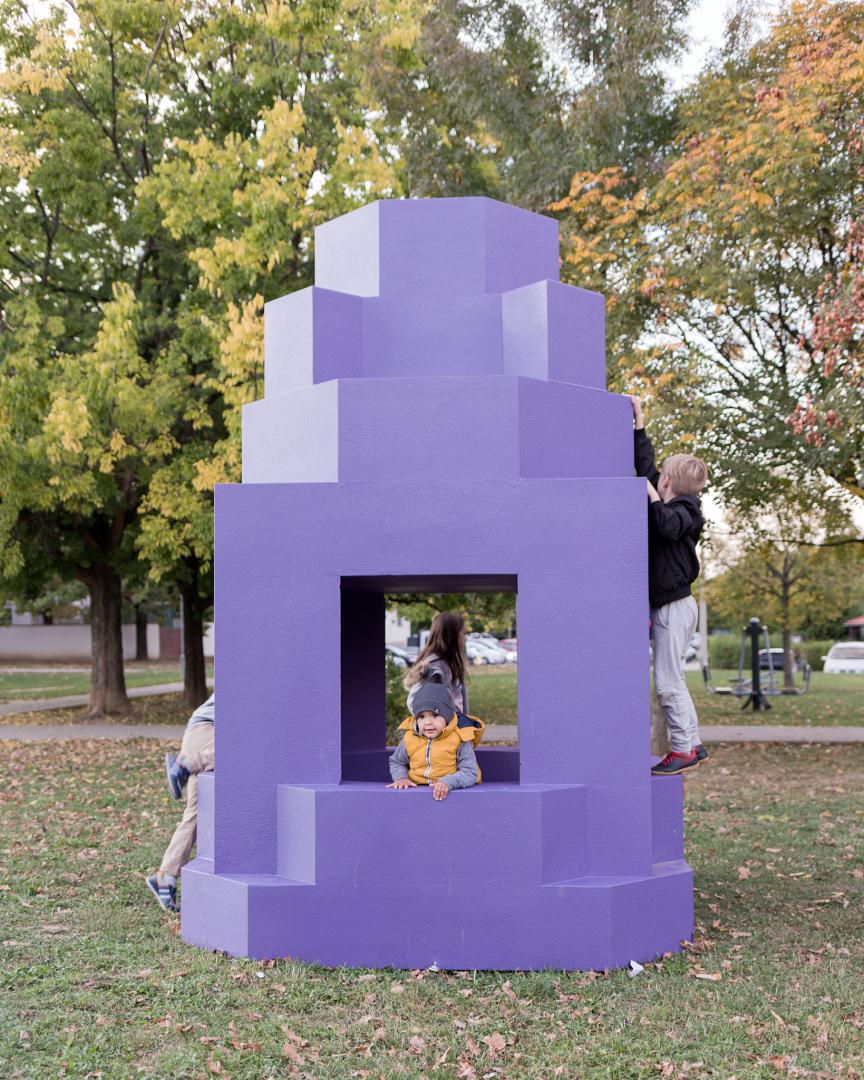
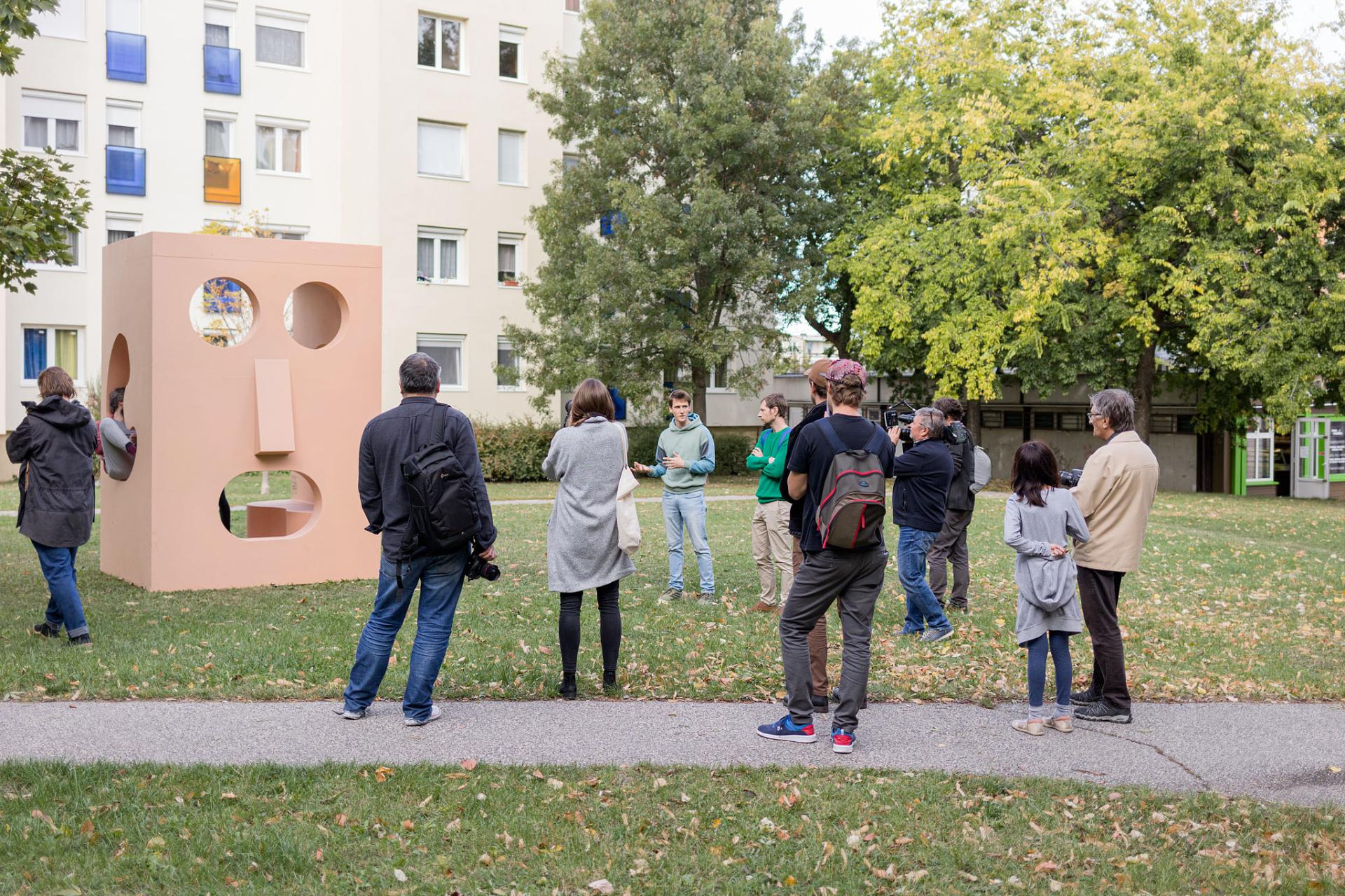
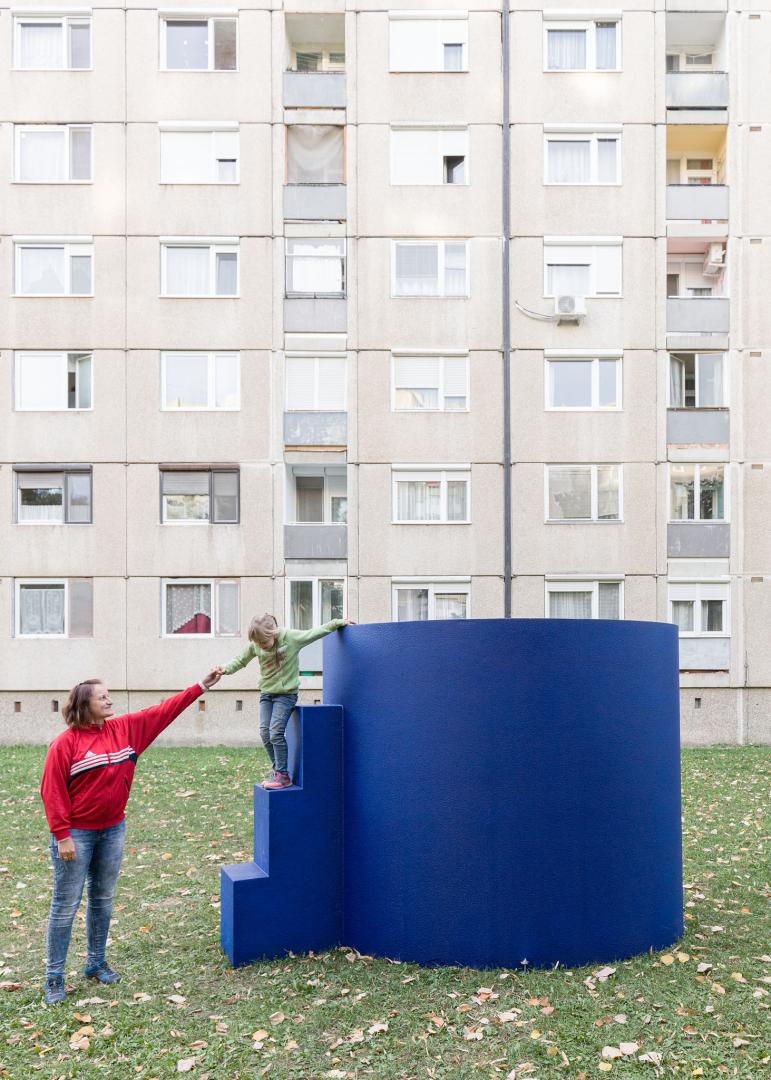
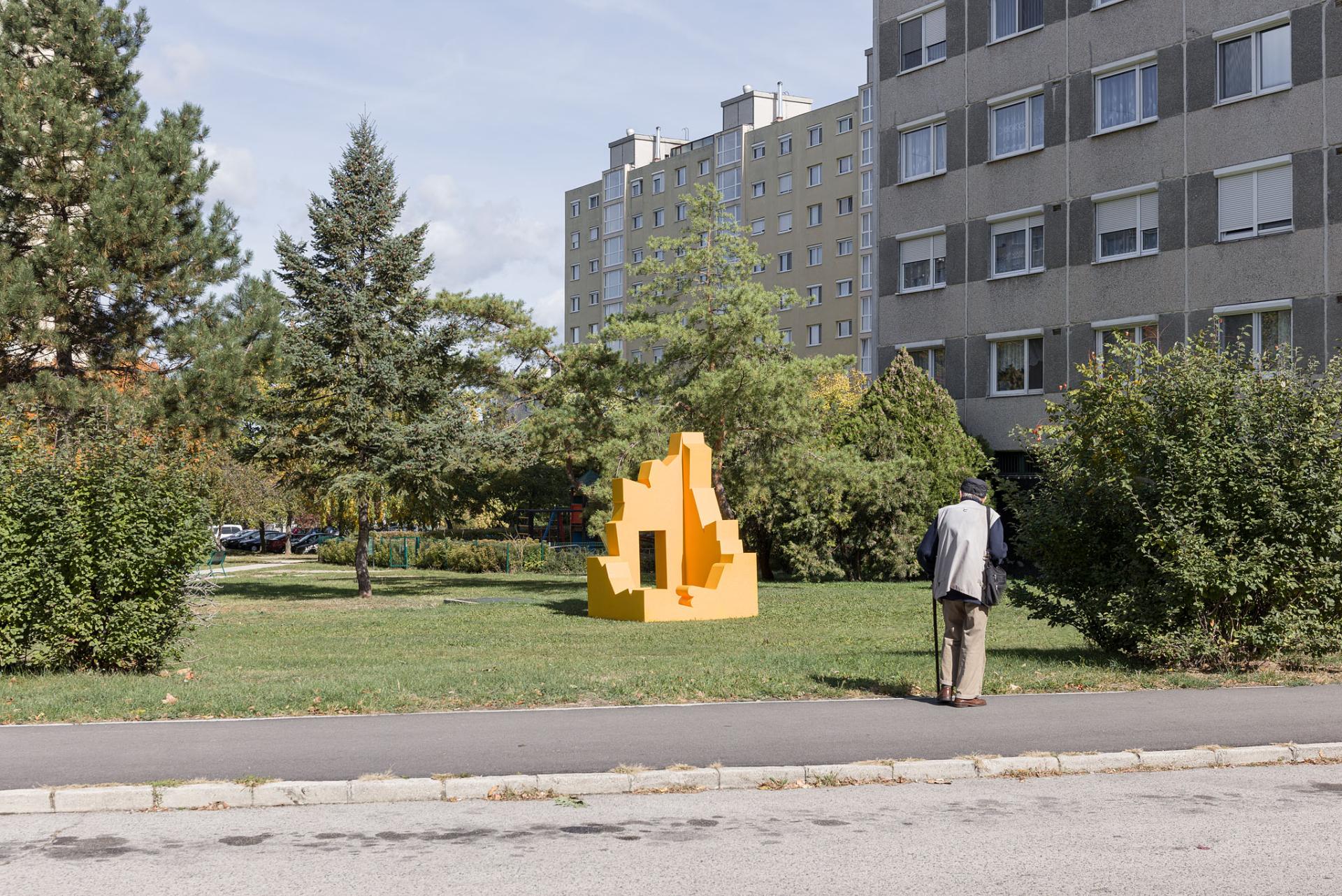
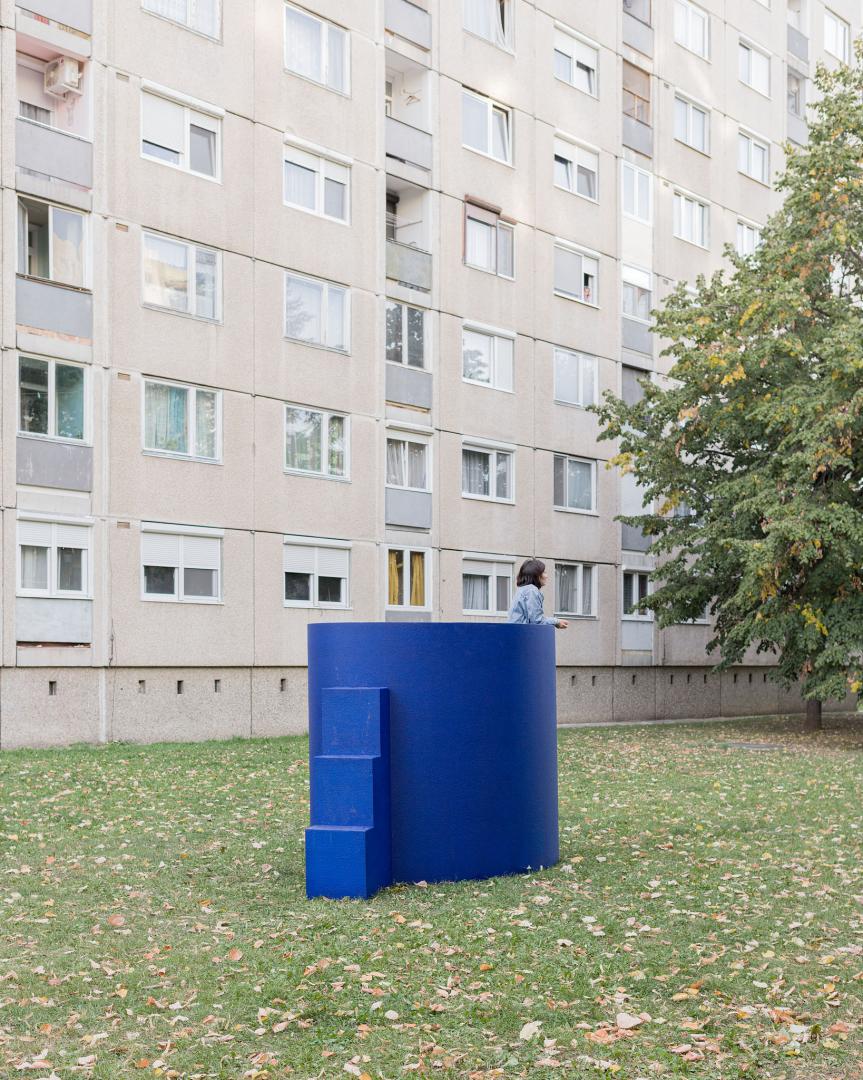
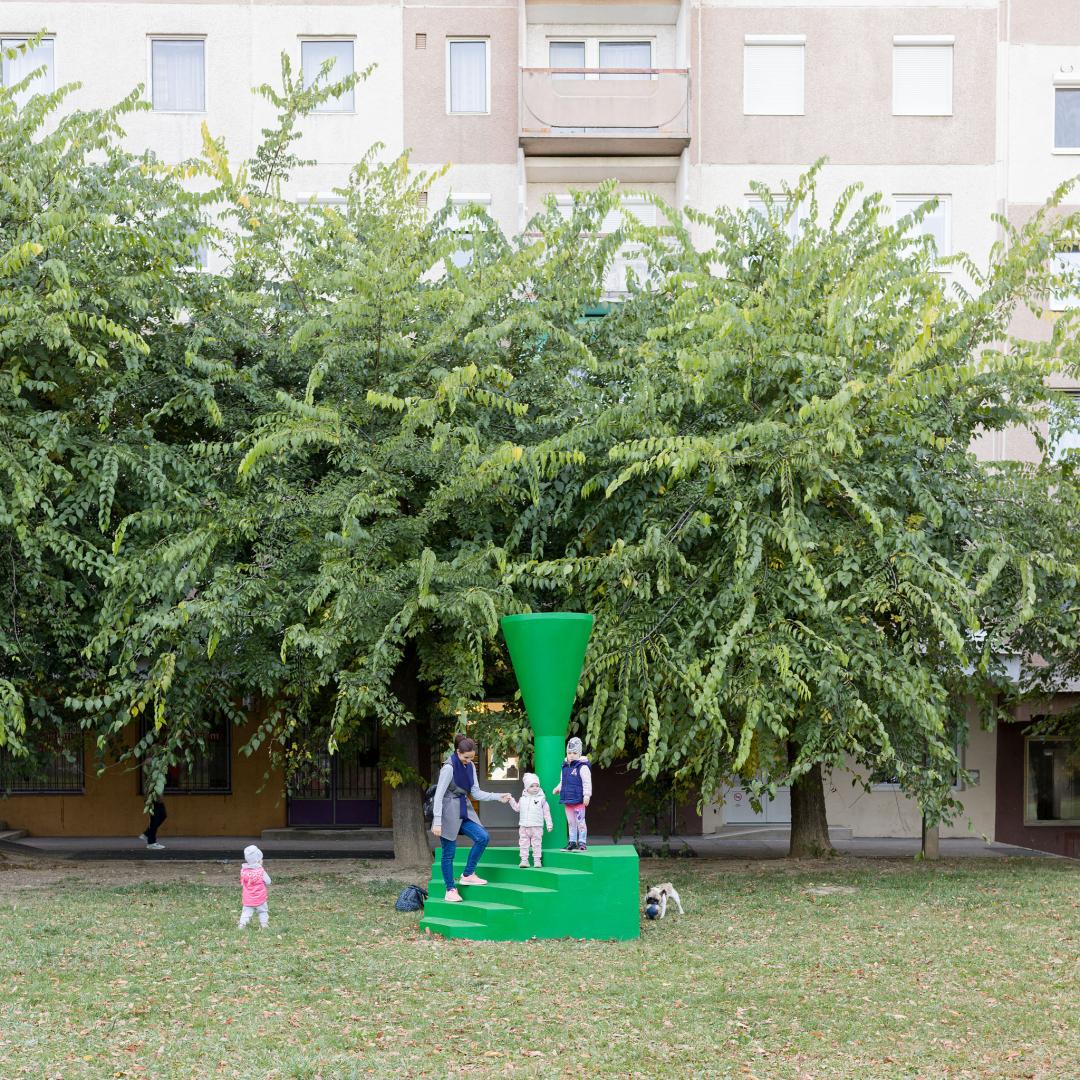
On the occasion of Veszprém Design Week in 2019 this collaborative project invited the visitors to experience a possible way to change the current state of Haszkovó with the help of five portable and durable urban artifacts.
In parallel with the installation a complete audio guide were presented that introduced the circumstances of this project. One piece of audio guide was made and attached to each installation and they are available on the following sites:
http://haszkovo.eu/#/face by Point Supreme
http://haszkovo.eu/#/pool by MAIO
http://haszkovo.eu/#/towerone by Supervoid
http://haszkovo.eu/#/towertwo by Edward Crooks
http://haszkovo.eu/#/ruin by Paradigma Ariadné
The whole audioguide starts here: http://haszkovo.eu/#/en
Key objectives for sustainability
Architecture and built environment can be only sustainable when habitants and users are conscious about the their environment. If those people who lives on housing estates can get closer to the history and meaning of these spaces that they are live in, than that could be a starting point to make their environment more sustainable. In this term this project only gives possible future for further discussion about the problems of housing estates with doing the first step: introducing the histories and knowledge that are related to these housing estates.
Key objectives for aesthetics and quality
These five objects serve as playful, outdoor furniture and their architectural quality also help us to see Haszkovó housing estate as something similar like a lovely historical downtown in any historical cities. In Veszprém downtown for instance these objects are common, they are the places “where we meet before having party” or places “where we had our first kiss”. The ‘Fire Look Out Tower’, the ‘Statue of Zsuzsi’ or the ‘Clock’ are also well known as identically fulfilled pieces of the urban environment in Veszprém. This project give a chance to define unique objects in Haszkovó which are also able to be fulfilled identically in the future.
The aesthetic quality and permanence of the urban artifact stems from its form or morphology, and it can be anything and turn into anything regardless of these, in terms of function (from synagogue to furniture warehouse, from furniture warehouse to library, from library to a fencing room…). The historic city is full of artifacts and references of the kind, however, this urban, temporal and mental layer is missing or can hardly be found in modern housing estates. We attempted to create such new artifacts—in a planned and deliberate manner. Our urban artifacts were designed especially so that such layers can be built on top of them, to allow people to connect with them, to have events hosted next to them, to serve a point of reference in the estate, to be featured in photos, to be cared for and to be vandalized. Thus I think everyone can find something to relate to on them: kids sit on them, climb in and on top of them, teenagers smoke and kiss near them, adults meet at them, take walks around them with their kids, or listen to the guided tour related to the project online.
Key objectives for inclusion
The key objective was to innovate abandoned urban public spaces of Haszokvó housing estate with elements that are able to provide enough information as well to open up discussions and debate about these abandoned and unused spaces. In this term it was welcoming for anyone who lives at Haszkovó housing estate and also anyone who are interested in open air cultural events and exhibitions.
Results in relation to category
This projects was available for almost two years, and 10.000 people visited it and used the objects and almost 7500 listened to the audio guides. While on the other hand we reach international media with this project on several occasions.
https://www.archdaily.com/928534/haszkovo-housing-estate-re-imagined-as-vibrant-urban-installations
https://hypeandhyper.com/az-arc-a-medence-ket-torony-es-egy-rom-2/
http://epiteszforum.hu/mit-uzen-egy-sarga-plasztikrom-haszkovon
How Citizens benefit
Many exhibitions came to life that was related to the problems and qualities of housing estates far away from housing estates. We wanted to bring the project to the right spot where we can face the problem. We searched for unused voids at Haszkovó housing estates and we placed objects there with the help of four other European emerging architecture studios, that objects were able to give possibilities for social interaction for cultural interaction as well. All the visitors gained experiences, good feelings about an environment that are rejected, and also knowledge thanks to the audio-guide, but it was up to they which the prefer to interact with.
Innovative character
This open-air permanent exhibition came to life before Covid-19 the world pandemic happened. Our aim was to innovate the medium of architecture exhibition and get this medium closer to the reality of architecture in urbanized environment. In this term the innovative character of this project is that we applied contents that are able to socialize one topic and introduced them on the right spot where people can face the topic. It was not an exhibition about the problems and qualities of socialist housing estates in a museum far away from the field, but an exhibition right on the field. We brought the topic to those people who can really benefit from it.