URBAN ATTRIBUTES.
Basic information
Project Title
Full project title
Category
Project Description
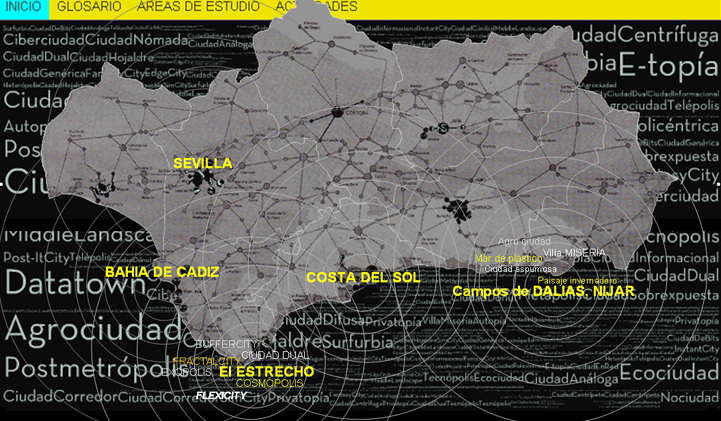
Urban Attributes undertakes a colaborative synchronic research of urban areas within Andalusia, and also of local and globally relevant phenomena which during recent decades have determined and defined ways of generating a city (speculation, touristisation,proliferation of infrastructures, specialisation, overdevelopment, spatial segregation, etc. It includes the study of adjectives and nouns assigned to the contemporary city by various authors. A glossary of attributes has been drawn.
Project Region
EU Programme or fund
Description of the project
Summary
Urban Attributes undertakes a synchronic study of urban areas within Andalusia, and also of local and globally relevant phenomena which during recent decades have determined and defined ways of generating a city. Two complementary work areas have been created together with a program of parallel activities launched in autumn 2006. With these we propose to generate circumstances, meetings, and encounters with agents that bring their knowledge and reflections to the debate. The Atributos Urbanos programme, promoted by the Andalusian Centre for Contemporary Art and leaded by Prof. Dr. M.Pelegrin (2006-2016), proposes a framework for reflection and debate on the contemporary city, through interactive and propositional work and research dynamics developed in different activities. Adjectivisations and subjectivisations on different areas for study generated a set of relationships which, acted as a knowledge relationship, revealing new issues with which to work from and for the city.
The first of these work areas includes the study of adjectives and nouns assigned to the contemporary city by various authors. A glossary of attributes has been drawn up with the aid of academic and relational research; these have served to describe urban phenomena from our recent history. This glossary generates a number of references to discuss and/or question during the course of the program.
To complement this we propose the analysis of five urban areas affected by intense socioeconomic, infrastructural, and cultural transformations, i.e.: the Campo de Dalias-Campo de Níjar, the Costa del Sol, the Straits of Gibraltar, the Bay of Cadiz, and the SE30-SE40 district within the metropolitan area of Seville.
To do so, work groups were created to identify and analyze aspects currently relevant to the configuration of new urban dynamics.
Key objectives for sustainability
The series of case studies presented in the Atributos Urbanos [Urban Attributes] programme reveal what happens when local idiosyncrasies are imposed on these dynamics, and these five samples manifest the increasing ubiquity of the urban in diverse territories. This could well be useful in the current process of reformulation of the concept of periphery and redefinition of new states of urbanity.
Andalusia has not escaped the late-capitalist geopolitical and socioeconomic model which has made the entire territory accessible to the city. In fact, perhaps owing to its border status and peripheral position in Europe, it is possible that some of the more characteristic global urban dynamics of the last few years of economic expansion have been aggravated there: speculation, touristisation,proliferation of infrastructures, specialisation, overdevelopment, spatial segregation, etc.
Through this work, and with an extensive work group made up of local agents and multidisciplinary collectives, we approach the unsettling urban surroundings of the Andalusian territory in search of the attributes that will help us name their urban reality. Adjectivisations and subjectivisations on different areas for study generated a set of relationships which, acted as a knowledge relationship, revealing new issues with which to work from and for the city.
Key objectives for aesthetics and quality
Far from wishing to diagnose this like a sick patient, we propose to talk about it without prejudices. However, we frequently find ourselves stuck for words. Aware of our increasing immersion in the Generic City (or attribute-less city) announced in 1994 by Rem Koolhaas, we have observed that in the last decade numerous authors have redefined “the city” and proposed endless subjectivisations of the increasingly complex and extensive urban. With them we share the need to name things, to generate urban attributes, in order to construct other words to associate with the urban processes taking place in this southern European territory.
The Atributos Urbanos programme, promoted by the Andalusian Centre for Contemporary Art and leaded by Prof. Dr. M.Pelegrin (2006-2016), proposes a framework for reflection and debate on the contemporary city, through interactive and propositional work and research dynamics developed in different activities. Adjectivisations and subjectivisations on different areas for study generated a set of relationships which, acted as a knowledge relationship, revealing new issues with which to work from and for the city.The exquisite glossary produced by the architects Carlos García and Plácido González4 served as reference, using a taxonomy or catalogue to compile the different adjectivisations which numerous authors have consulted when naming the city and its characteristic phenomena.
Key objectives for inclusion
Critical proposals, interpretations and projects on different fields of study confirm that normal tools are of little use when tackling the urban processes we are witnessing, and hence expose the need to find the guidelines which determine other ways of constituting cities in different enclaves:
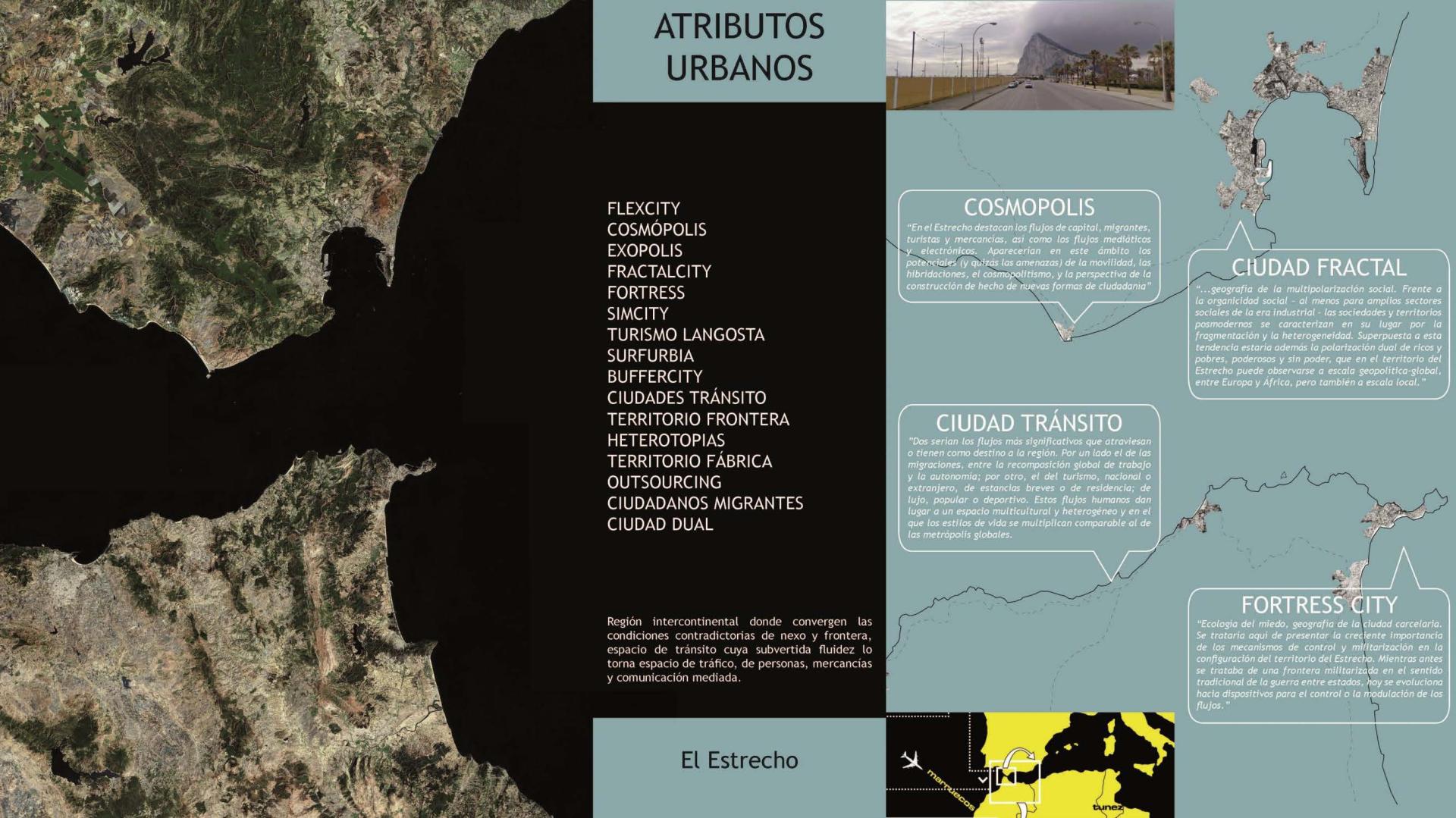
The metropolitan region of the Strait of Gibraltar concentrates in its territory the paradox of global geo-economic ordination: minimum geographical distance, maximum distance of levels of wealth. An archipelago of cities where many international borders converge transforms its surroundings into a continuous social, political and economic state of exception6. Its citizens see how free global transit (tourism, goods, real estate and production speculation) becomes traffic which regulates local mobility, while the transit of immigrants in search of autonomy, better living and working conditions, offers, together with information and communication traffic, the chance to build a communal space between both shores and reveals new forms of citizenship, despite the border.
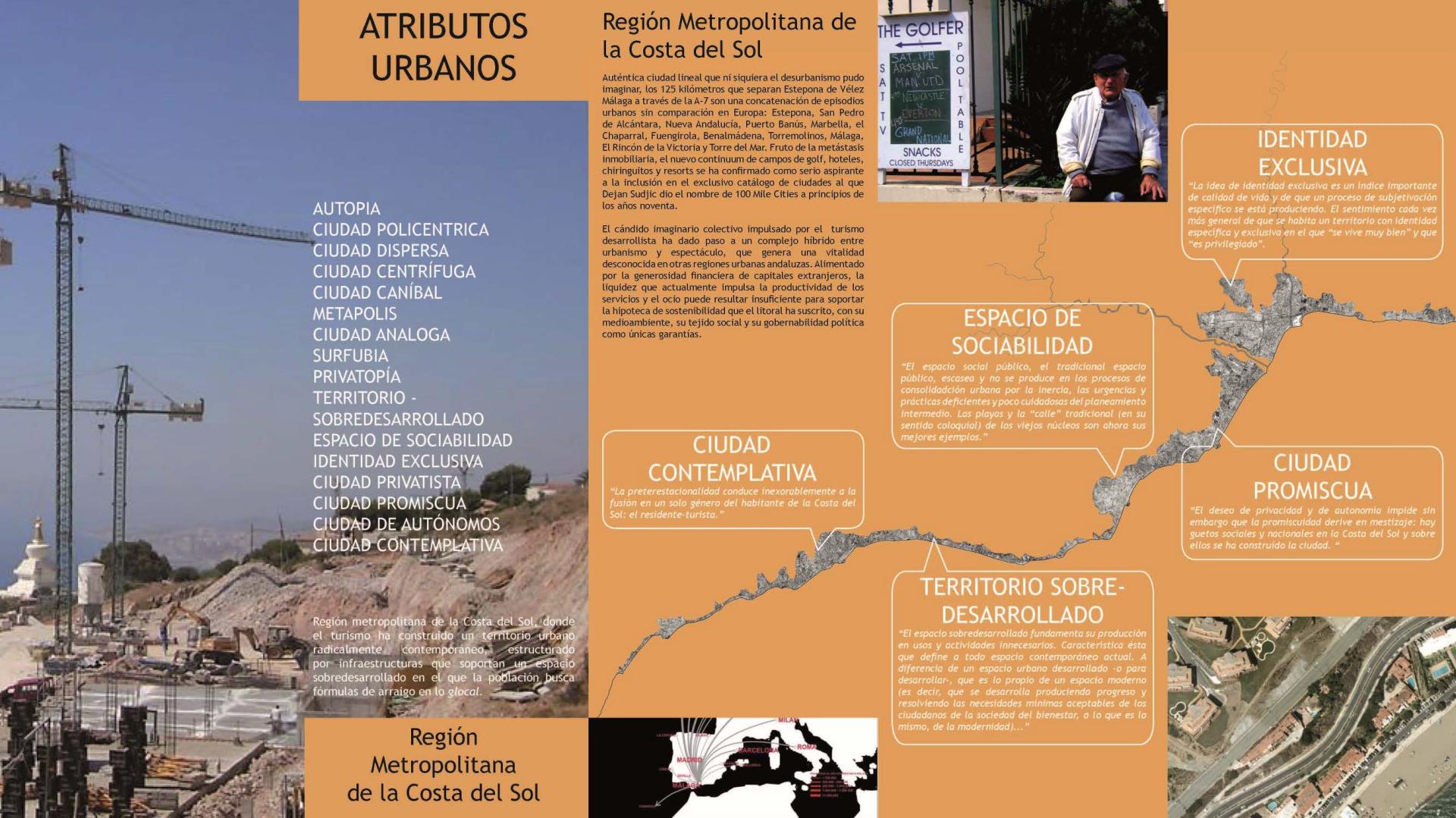
The Metropolitan Area of the Costa del Sol, boosted by the productivity of services and leisure on an international scale, colonises its overdeveloped territory with urbanism and spectacle. A critical reflection on this urban metastasis enables us to recognise other possible urbanity formulae for the contemporary city. Values or concepts such as “sociability spaces” or “private spaces socially open to the public” are offered as an alternative to the almost inexistent (public property) public space.
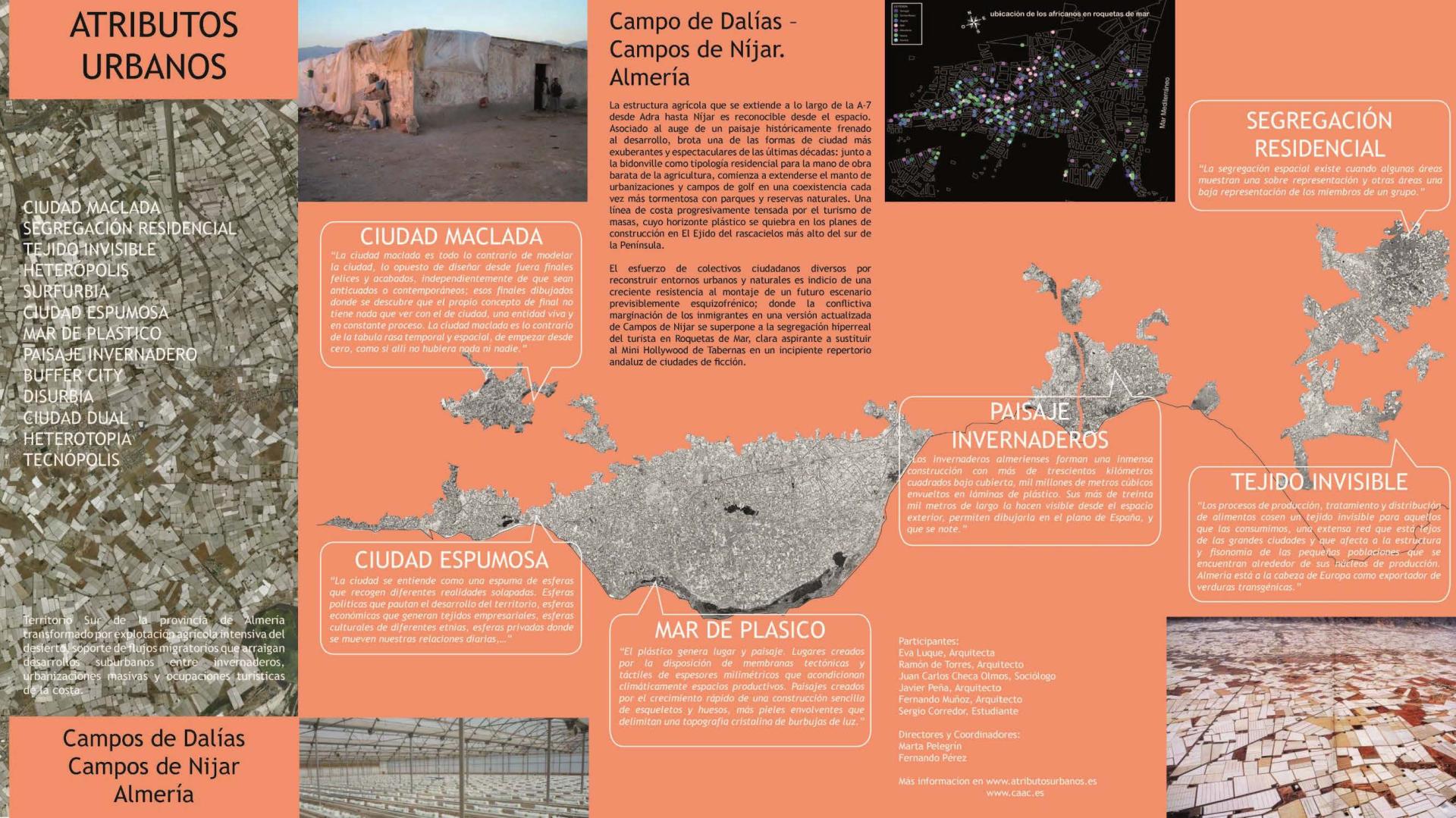
The landscape between the Campo de Dalias and the Campo de Níjar (Almería) is undergoing a profound transformation, mutation even, owing to the productive (agricultural and tourist) overexploitation of its territory. With evident signs of segregation and stratification, the growing tension in this agrocity, shows a scenario of emergence...
Results in relation to category
As Colaborating reseacrh projects reflects, the current urban process requires the decoding of the relationships system of its inhabitants and territory in order to give way to a new social and territorial articulation, a committed dialogue between its citizens and the desert land they inhabit and exploit.
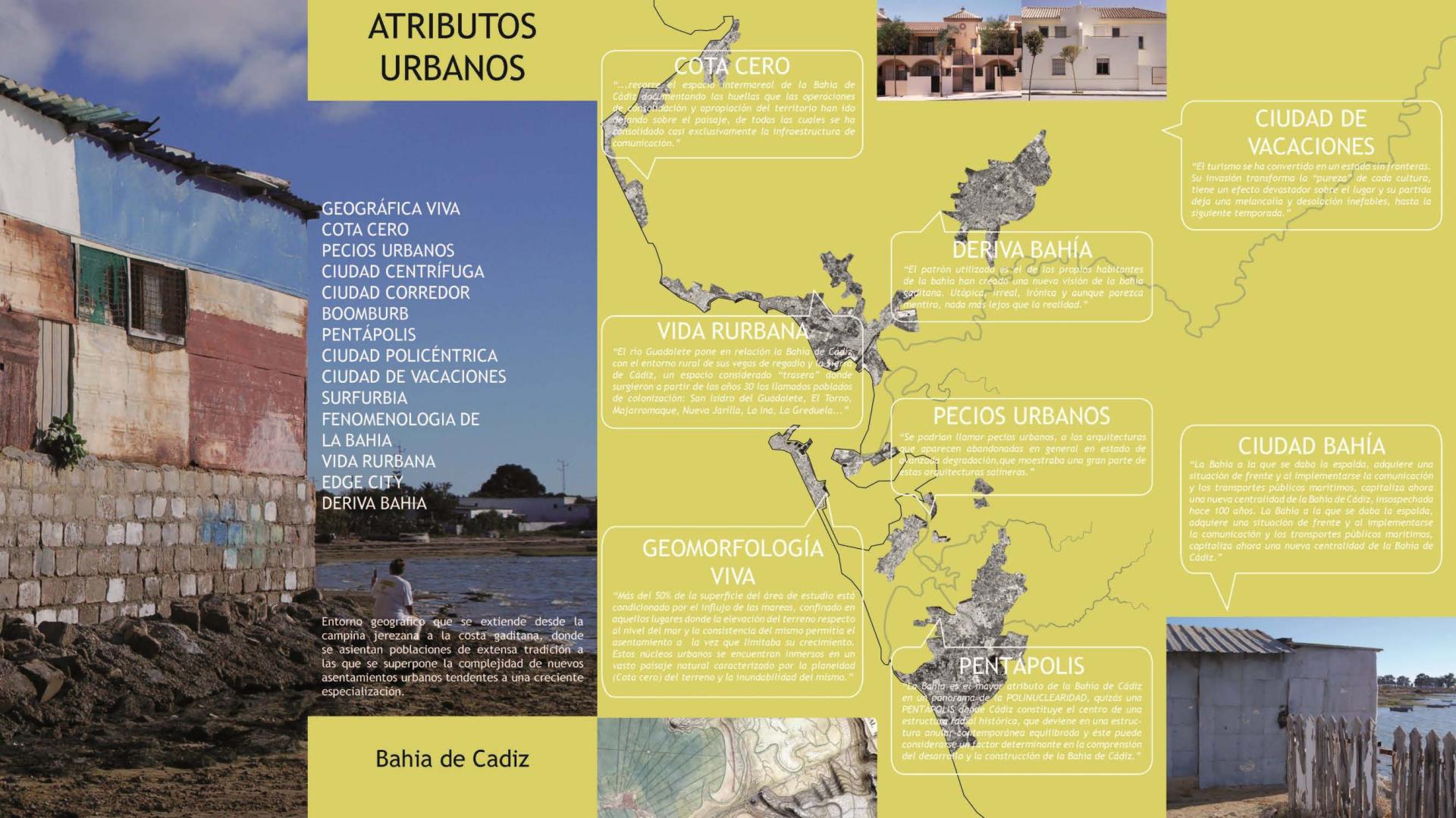
The incipient conurbation of the Bay of Cadiz, whose geography is historically determined by flood risks in the area, seeks equilibrium between its towns in an alleged competitive cooperation around the bay. This territory where the fluctuation of the sea level is in step with that of the population, is experiencing an increased specialisation of the surroundings where brown and green fields are turned into holiday cities whose seasonal nature inevitably generates other forms of urban production. Far from the coast, other peripheries formed by second and third homes offer new forms of rururban life.
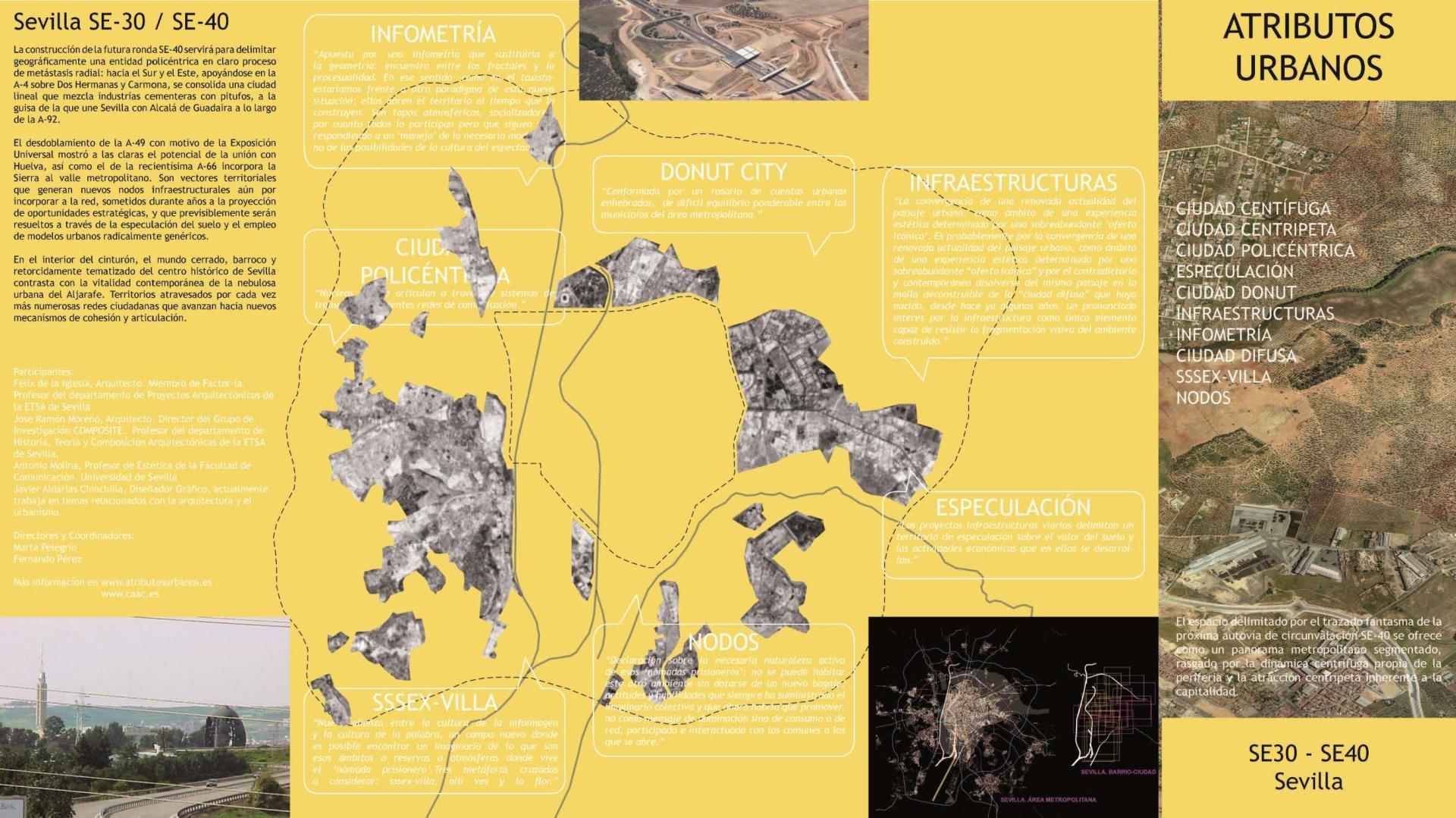
The infrastructure layout (SE-30, SE-40) in the metropolitan area of Seville is proof of the periphery’s characteristic centrifuge dynamic and centripetal attraction which constitute the city’s historical inertia. The infrastructures highlight a territory of economic speculation at node points in the network but can alsobe seen as “places from which landscapes, where fragmentation is resisted, are invoked as routes that allow the juxtaposition of autonomous urban visions and provide plastic configurations for continuity”. The tools used to work in this context are closer to intelligent and relational management of territorial databases (knowledge technology) than to traditional geography. Information exceeds physical limits and generates the possibility of planning creative processes for mediation with the city.
How Citizens benefit
From these Andalusian locations we propose other concepts or words, with which we can tackle and generate instruments for the reconstruction of an imagery of what is possible for the refoundation of a new parliament8 of things. Perhaps the territory and its settlers ought to be represented in this parliament, as Bruno Latour insists, on an equal democratic level for discussion and decision-making, giving voice to the production processes of cities, rather than to city models: To work with temporal and fluctuating dynamics phenomena, (that is to say, the permanent, although not constant, dynamics associated with phenomena of a seasonal nature or production times requiring care and contemplation through new action tools or tools for planning – if we persist on using this term) and projects which also work from the ephemeral to the perdurable. To locate spaces of the latent city, expectant urban spaces waiting or under pressure, and understand them as platforms for speculation, research and experimentation.
In them we can visualize processes, the sum of many small actions which are frequently associated with non-regulated phenomena, such as informal economies, precarious employment, immigration, and which frequently elude regulatory, political and police control, but constitute a basic pillar of the construction of the city. To recognise how new technologies have redefined urban and social imagery, and have generated other, non-material, spaces for mediation, interwoven in new spatiality, where flows, connectivity and data cohabit the city along with other economic, energy and power flows.
To represent the phenomena of immigration in this parliament, developing the contributions of the different collectives who settle in or pass through the territory constructing a new form of migrant city. To understand conflicting relationships in it as an opportunity for the implementation of flexible, dynamic and inclusive decision-making tools.
Innovative character
Equally, there are alternative forms of intervention developed by diverse urban agents which require autonomy and interaction in the reconfiguration and redefinition of urban space. Numerous creative (artistic and architectural) proposals work in these spaces on the construction of collective, collaborative and urban elements. Their interventions and ways of working show the emergence of an urban reality where urban networks progress towards new mechanisms for the cohesion of the environment and human subjectivity, in an ethical-political articulation of the territory, which guarantees its sustainability9.
The journey through these territories enables us to continue drawing up a cartography of attributes, new “words” to think up different ways of constructing a city, even if merely uttering them causes us to smile uneasily. More on www.atributosurbanos.es