Soblahovska street
Basic information
Project Title
Full project title
Category
Project Description
Soblahovská street revitalisation is a realistic view into the future. We propose a site specific project connecting the qualities of the past, reviving the public artworks and connecting them with elements of contemporary and environmentally responsible urbanism. We are supporting the alternative ways of transport, reconstructing sculptures, reviving fountain and adding a free time activities for residents or visitors.
Project Region
EU Programme or fund
Description of the project
Summary
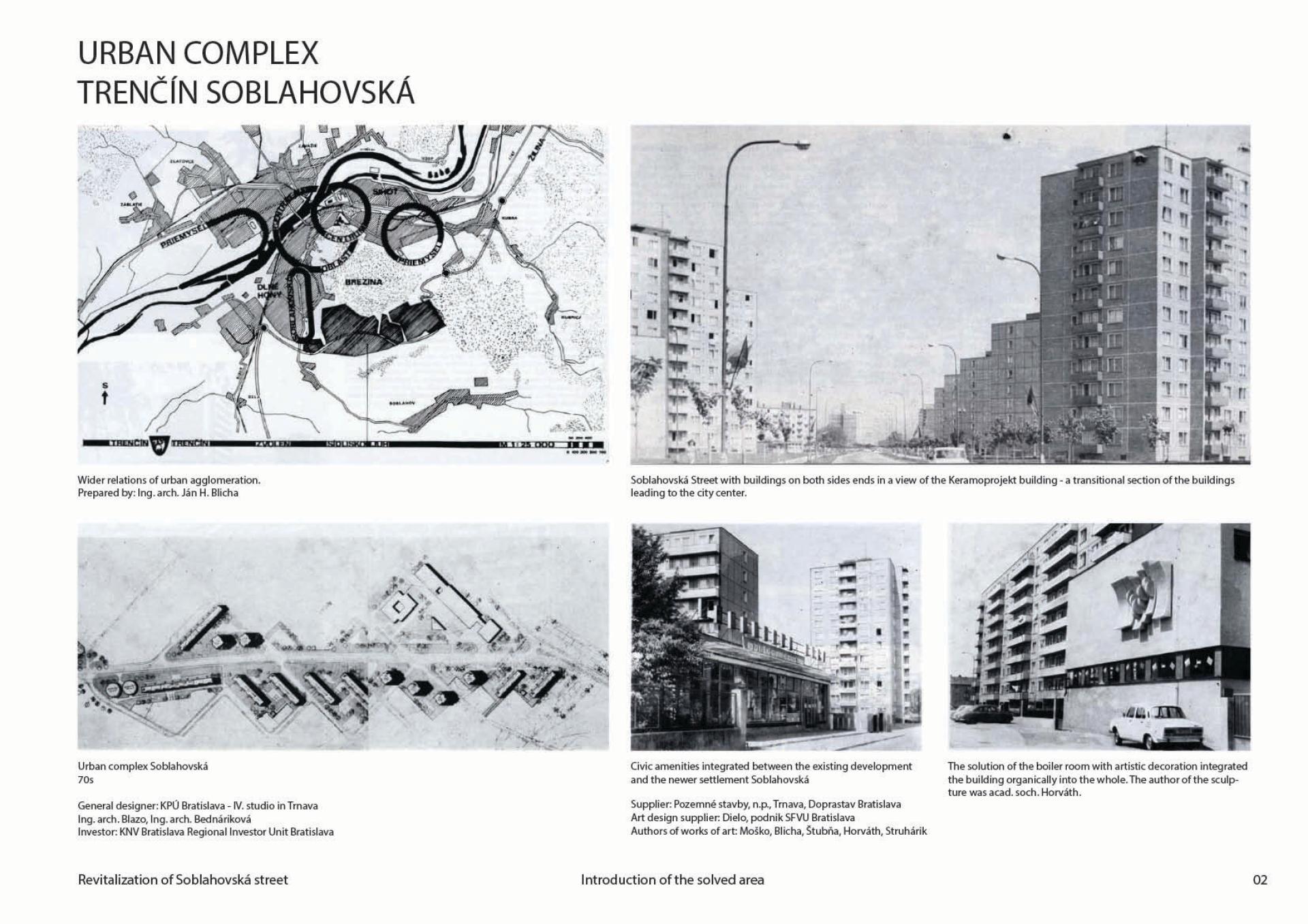
Soblahovská street revitalisation is a realistic view into the future. It was an ambitious panel housing project from 1970s with greenery, generous public space, playgrounds and artworks. Soblahovská, its benefits and potential is commonly overlooked today due to lack of care and a proposal for systematic revitalisation. We propose a site specific project connecting the qualities of the past, reviving the public artworks and connecting them with elements of contemporary and environmentally responsible urbanism. We are supporting the alternative ways of transport, reconstructing sculptures, reviving fountain and adding a free time activities for residents or visitors. The project was followed by a public art research and revitalisation proposals. The first steps towards a better public space are being done together with Trenčín municipality as we are currently revitalising one of the artworks and we are preparing for the next stages of the project in 2021.
Key objectives for sustainability
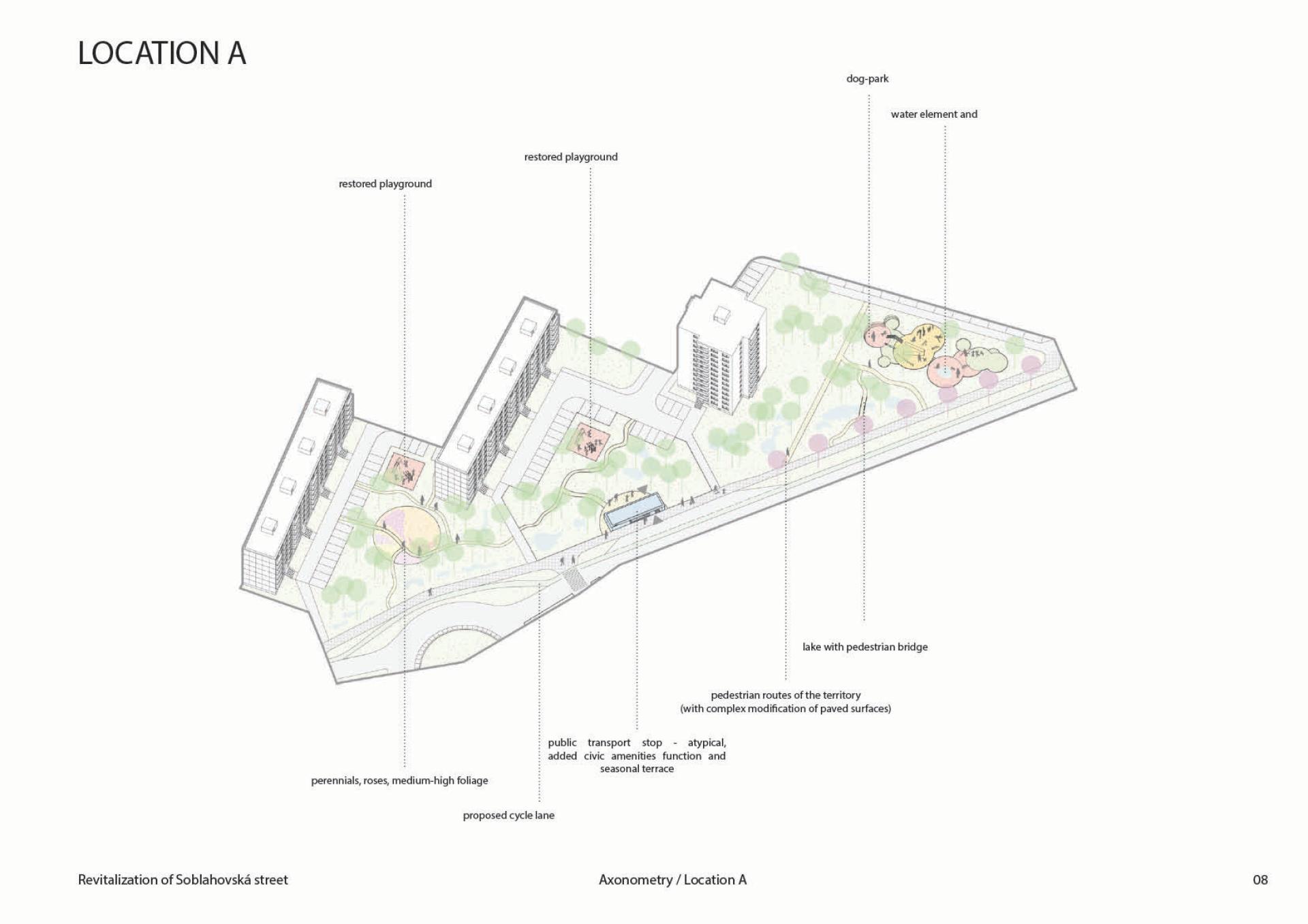
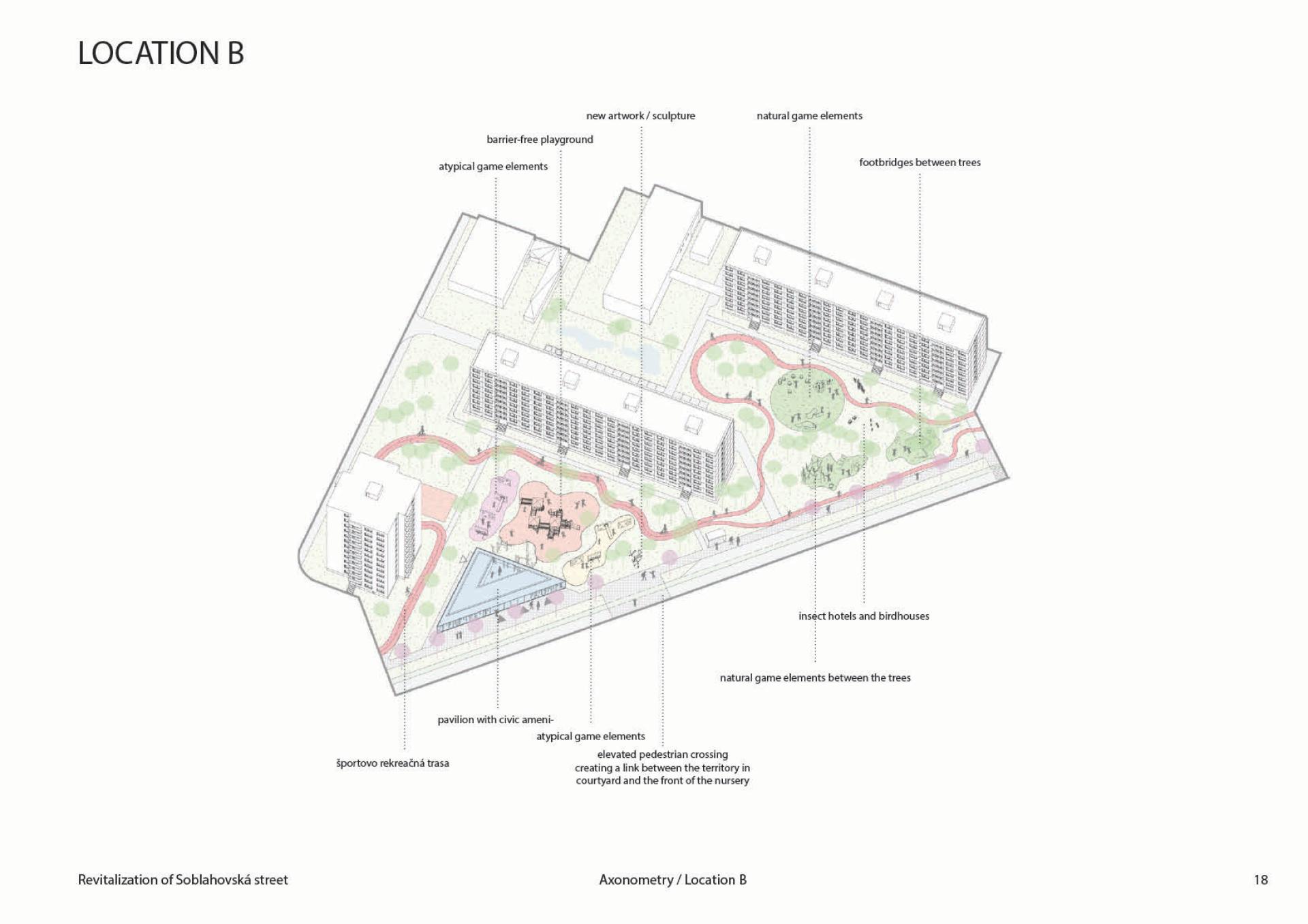
The proposal seeks to search us in all existing elements of Soblahovská Street to find their meaning and values and to try to save and revitalize them and show the public and users that we do not have to destroy even the elements of the past due to negative associations. The proposal seeks to work as much as possible with existing greenery and the addition of new vegetation crops. In the design, we also work with water and cooling water elements. We try to design waterproof surfaces for all paved surfaces and thus maintain rare rainwater in the area or collect that water to rain gardens and make street more pleasant, especially in summer. In the areas of the nursery, we work with the existing dense vegetation, add natural play elements to them and create homes for birds or various species of insects, thus supporting the ecosystem in urban areas. We will also try to consult the collection of rainwater in the raids and its possible subsequent use directly from the surrounding buildings.
Key objectives for aesthetics and quality
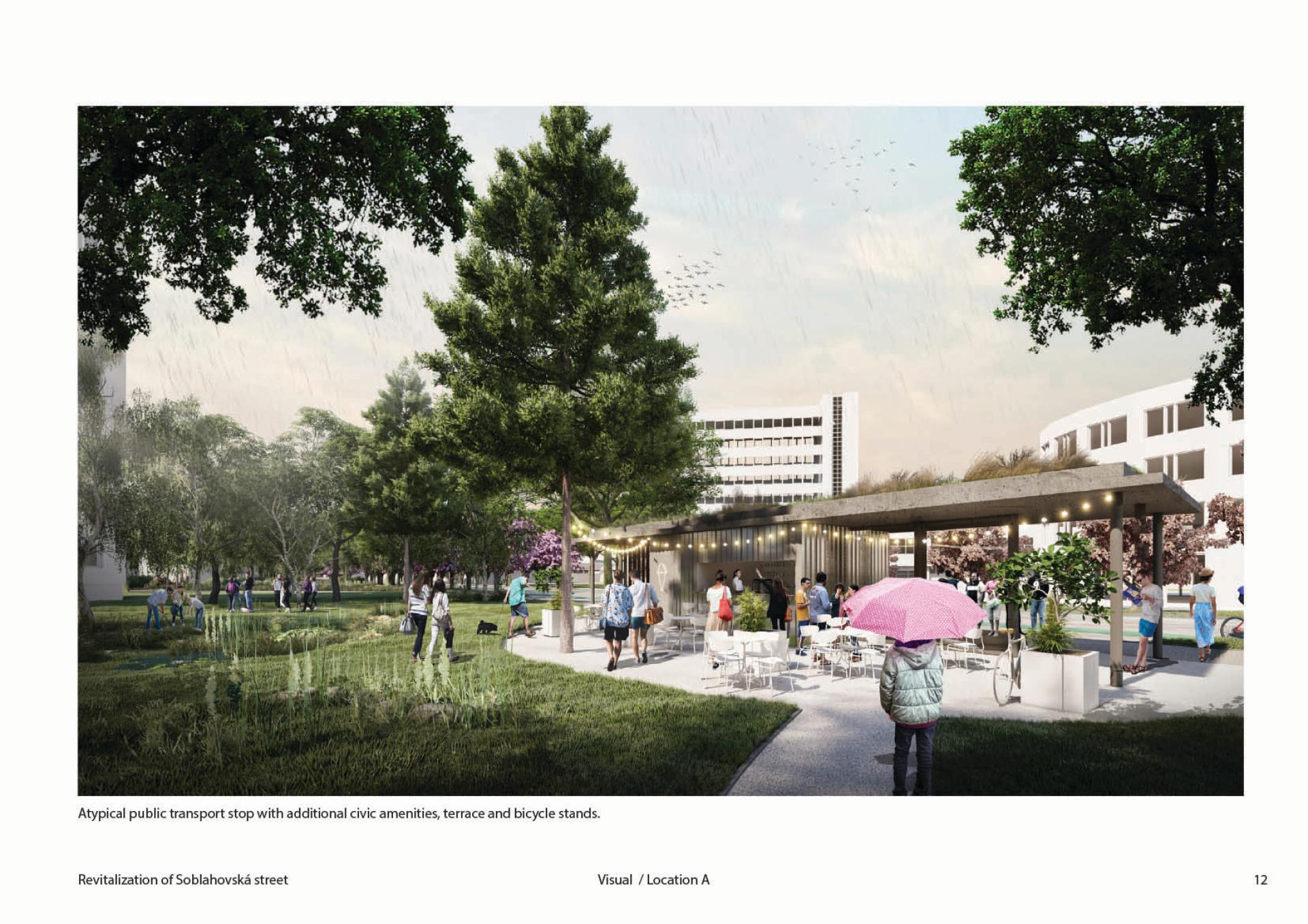
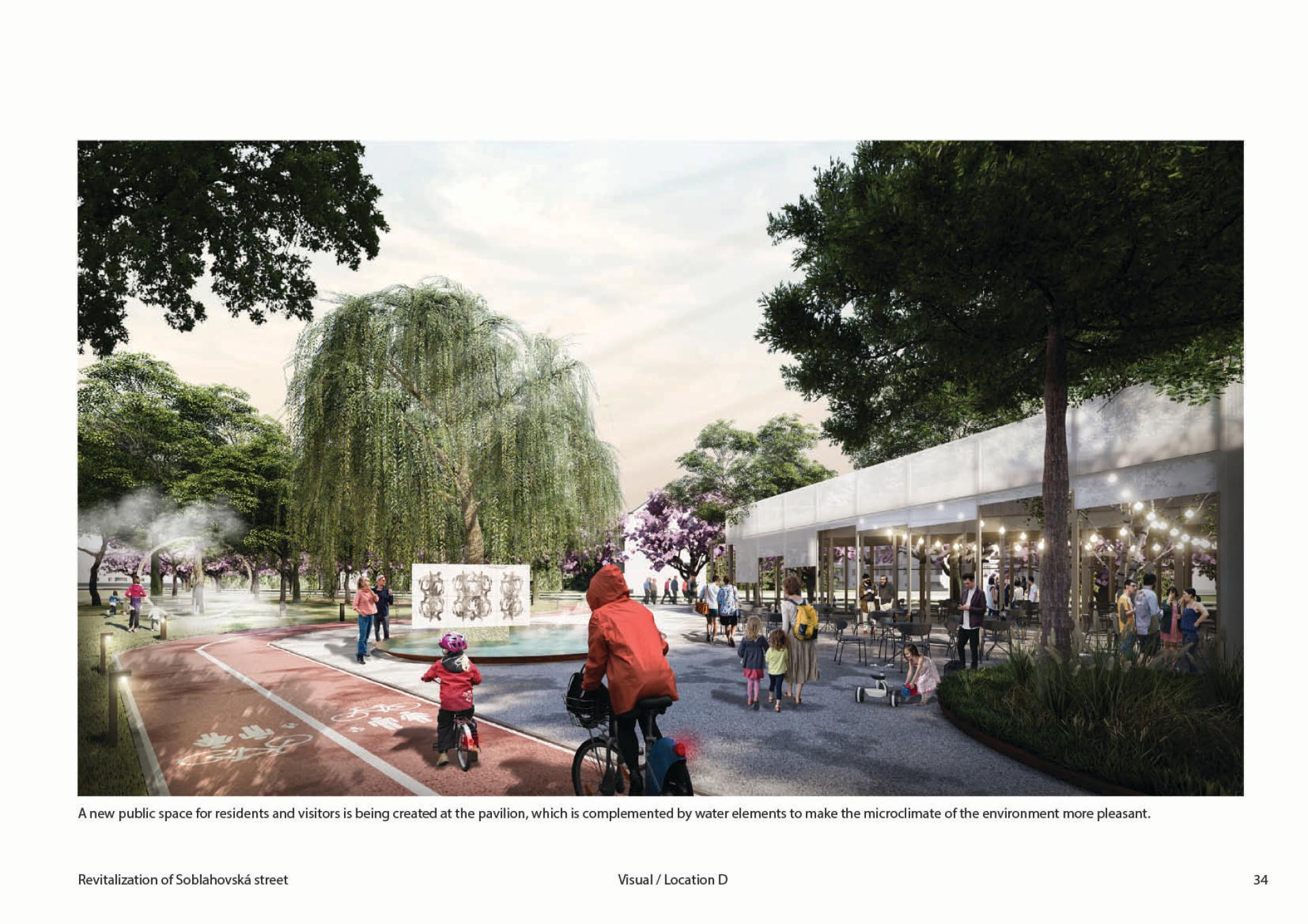
As architects, we think with broad intentions, so it is difficult for us to highlight the main elements of the aesthetic understanding of things. However, we can mention them a few. An important aesthetic element is the landscape itself, which we have restored in fluid and wavy curds as a contrast to the angular architecture of prefabricated houses and the rational urbanism of the street. They are also pavilions, the same and yet different. One with the atmosphere of the forest fits into the surrounding dense greenery, the other, more open with a terrace connected with a work of art and a water element, which can be understood as a sculpture. It is also a work with vegetation, its various forms, colors and groupings and the creation of a colorful and vibrant street. In the design, we also revitalize existing works of art as evidence of the past and create a new one, in current forms and trends. However, the street should function as a whole, and in every nook and cranny of it, the human user should discover something interesting or have a reason to stop. We thus create an aesthetically interesting whole from the transit street, apart from its functional use.
Key objectives for inclusion
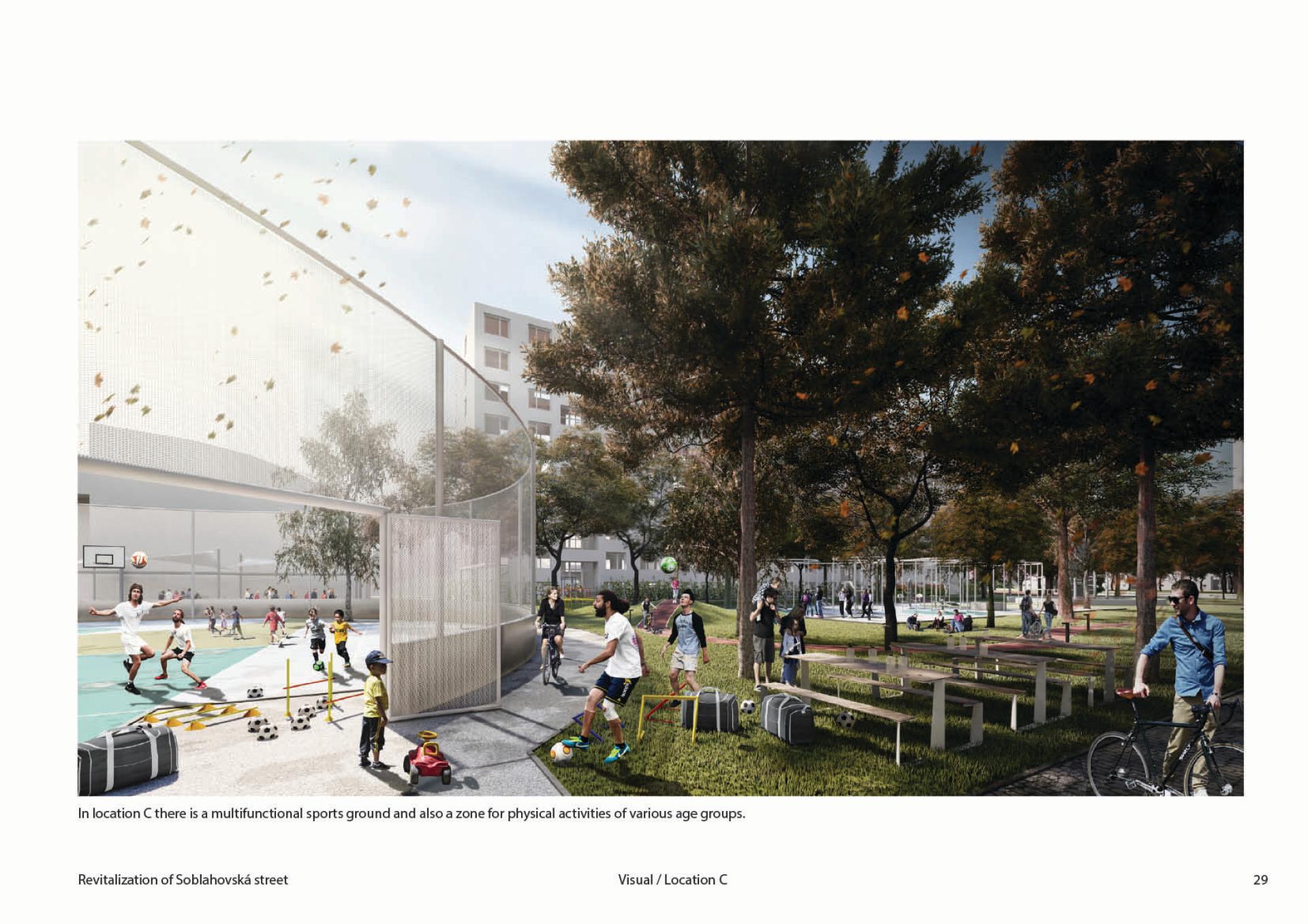
The design respects the history of cities, its values and the important genius loci. Therefore, let's try to work with period elements such as the transformation of panels from prefabricated apartment buildings to children's entertainment elements or the use of military concrete anti-tank coatings. We also want to preserve the existing play elements, revitalize them and breathe life into them again. The designs of the new pavilions themselves respect the local urbanism, they complement the missing equipment of Soblahovská Street with an inconspicuous face and a suitable type of architecture. An important element of Soblahovská Street are Sakura, strongly pink deciduous trees. In our design, we extend this alley, which is loved by Trenčians, and thus create a pink corridor lining Soblahovská Street along its entire length. History is the mother of science, so we think that the work of the Slovak National Uprising must also be made visible and thus give people a place to think and learn from the past. Therefore, in the vicinity of the monument, we propose low-rise vegetation in the form of flowers and meadows, which with their colors create a contrast to the gloom of the monument and the coldness of the war. Prosed revitalisation offers a series of public spaces for various age groups, various activities for local residents and visitors. All parts of the proposal are adapted as barrier free.
Innovative character
The aim of the revitalization of Soblahovská Street is to create an attractive and sustainable urban public space. From anonymous monotonous inner blocks
complex with spaces with a characteristic and distinctive atmosphere, which offers a range of activities for the general public. Revitalization is to create a residential
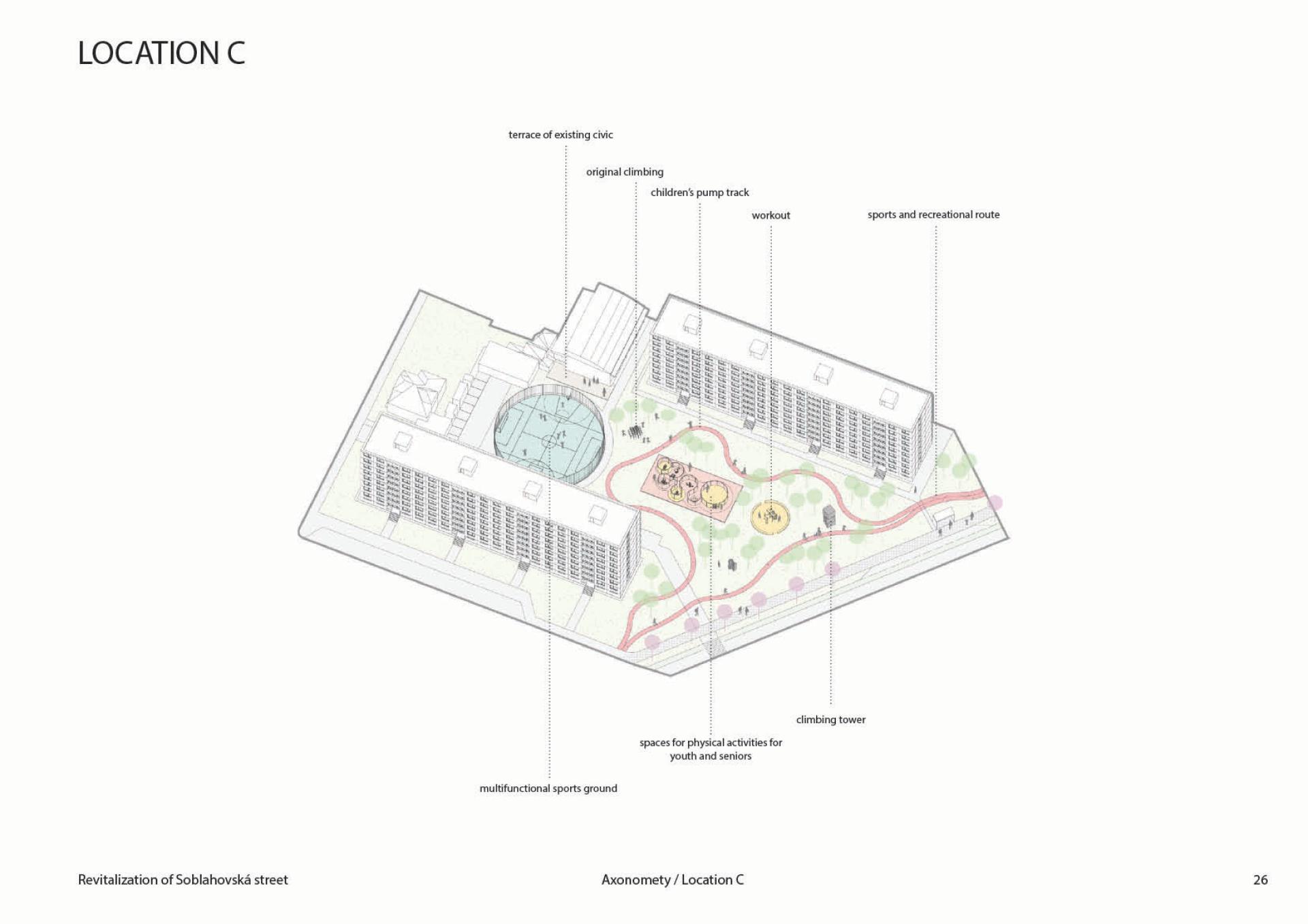
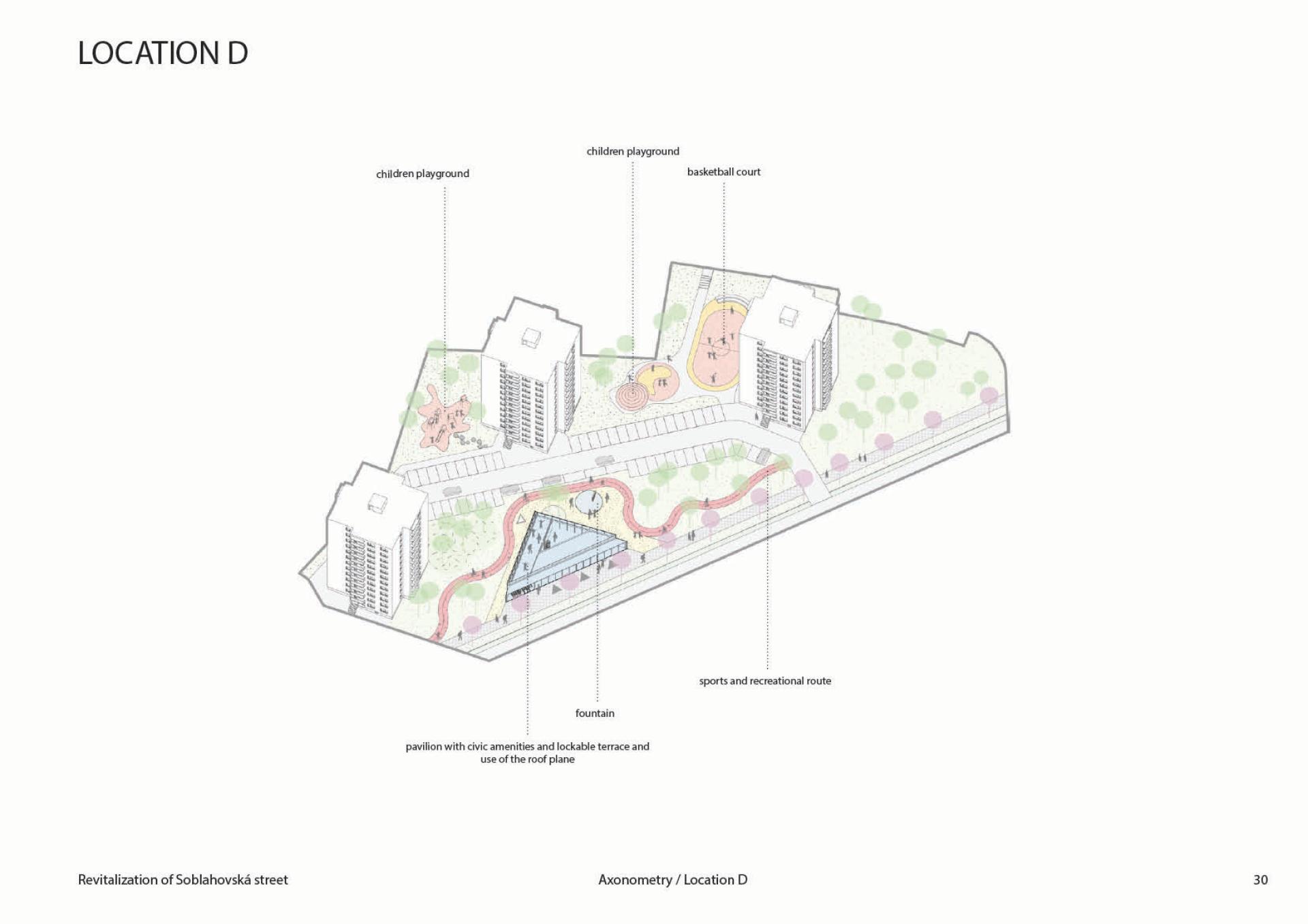
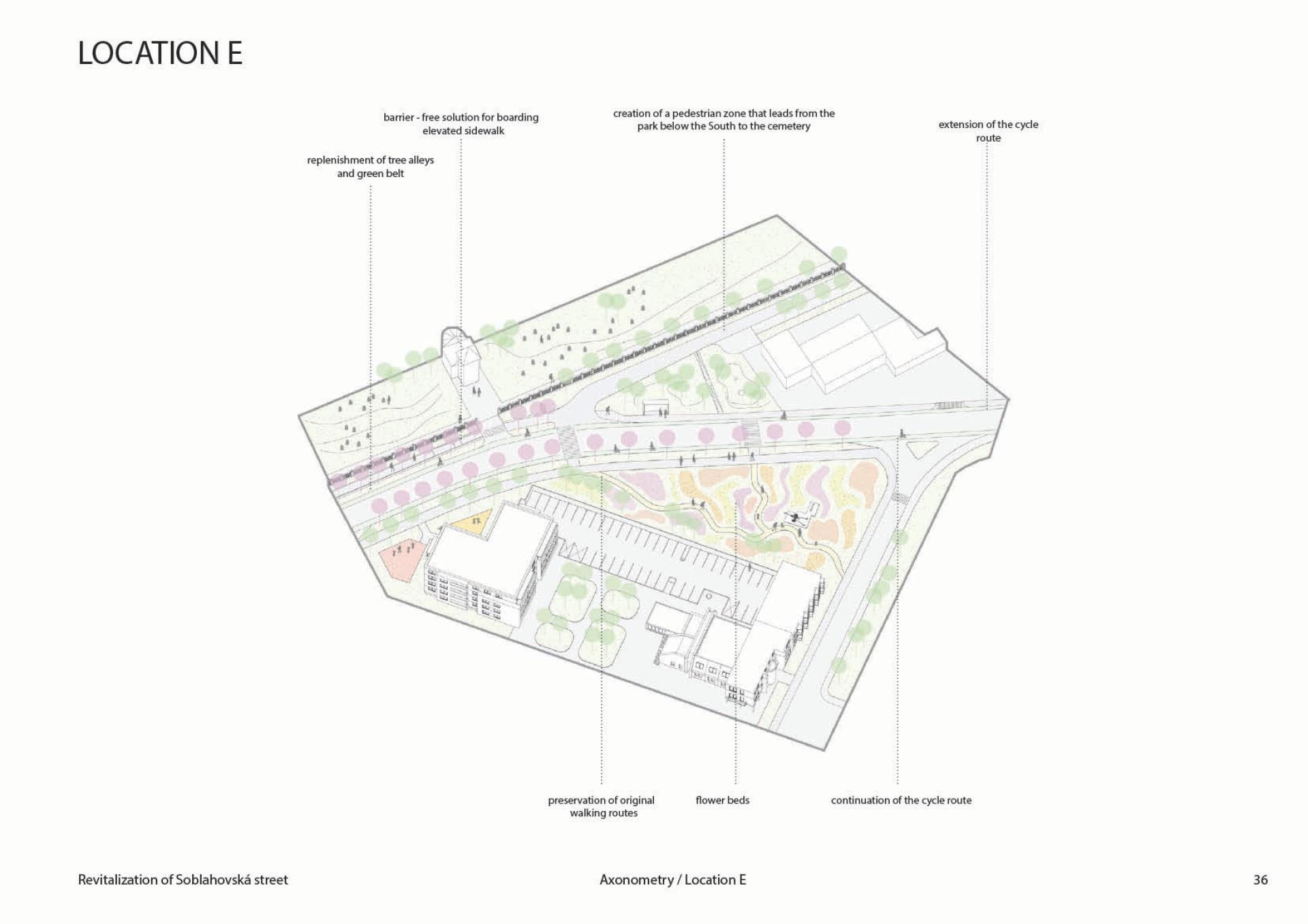
public spaces as well as new spaces for civic amenities, which will serve residents, but at the same time can create places to relax while walking or cycling to the city center. Soblahovská Street is divided into five localities, which are ideologically, but also functionally different and diverse, bringing new opportunities for sports, recreation, education. The concept also ideologically addresses the principles of sustainable design, care for the environment and the local microclimate.