Social Label
Basic information
Project Title
Full project title
Category
Project Description
Social Label is a movement that uses the power of design and communication to create new approaches to labour, learning and participating. Founders Petra Janssen (Studio Boot) and Simone Kramer (C-mone) design work activities that are tailored to the abilities and needs of workshop members, and create meaningful design so that people on the fringes of society can get involved in the labour market, and take pride in the attractive products they make.
Project Region
EU Programme or fund
Description of the project
Summary
Design Movement
Working together on an inclusive world, using the power of design and communication.
The Social label network is growing. All over the Netherlands leading designers and workplaces – from healthcare organisations to
businesses – are joining forces to create a socially sustainable design collection.
Self-esteem and new perspective
Social label implements design products to offer people with poor employment
prospects a podium and challenging work. By making use of their qualities and creating an appealing environment, vulnerable groups are given new opportunities.
Social purpose economy
There are many changes at the moment on a national and local level, for example the Social Support Act (WMO) and the Participation Act (Participatiewet). These are important policy themes for government and for healthcare institutes. Art and culture can make significant contributions. Creating things that have a functional and aesthetic value is important for all of us, and especially for people with poor employment prospects.
Our world is changing very rapidly. Here in the Netherlands the signals from government are impossible to miss. From retrenchment and decentralisation to local and regional agencies, as well as reduced budgets. And of course people everywhere are hard at work on these new changes. The Dutch are actively pursuing initiatives for new chances and opportunities. One of these initiatives can
be found in Brabant: Social label.
Key objectives for sustainability
designs labour
We develop the production of meaningful design products to create jobs for people whose health or other problems have prevented them from finding regular employment. Taking people’s personal qualities as a starting point, Social label
develops a customized productrange together with selected designers and workshop supervisors. The aim is to allow vulnerable people to take a step forward by making appealing products, learning a craft and taking part in activities.
Because when people create something beautiful and have an opportunity to showcase their work, they take pride in their achievements, boost their sense of self-worth, and feel encouraged to participate in society.
A different view on labour
Design, art and communication are used as ‘openers’ to start reshaping processes in participation, care and employment. An open designlab where we invent new solutions for working and living together. Where workers, customers and designers challenge each
other and learn from each other.
A new perspective on collaboration
By working together, people learn from each other. In a person-centred work environment, this principle can always be applied. Tailor-made work requires attention, and therefore time: everyone has their own (work) rhythm. If we want to achieve better societal cohesion, inclusivity is a must. It is essential that companies and organizations also integrate the concept of inclusivity
within their business values.
Design with meaning
Because Social label approaches new groups of people with a view to collaboration,
the profession of design is explained in a new way and applied in the service of people. What does it mean to create something? Design is a process of experimentation, analysis and conclusion, in terms of material, function and knowledge. Through this collaboration, the product gains new value, for the maker and the designer.
Upcylcing re- use is a starting point for all 17 productlines 2021
Key objectives for aesthetics and quality
Never out of collection Socially sustainable design
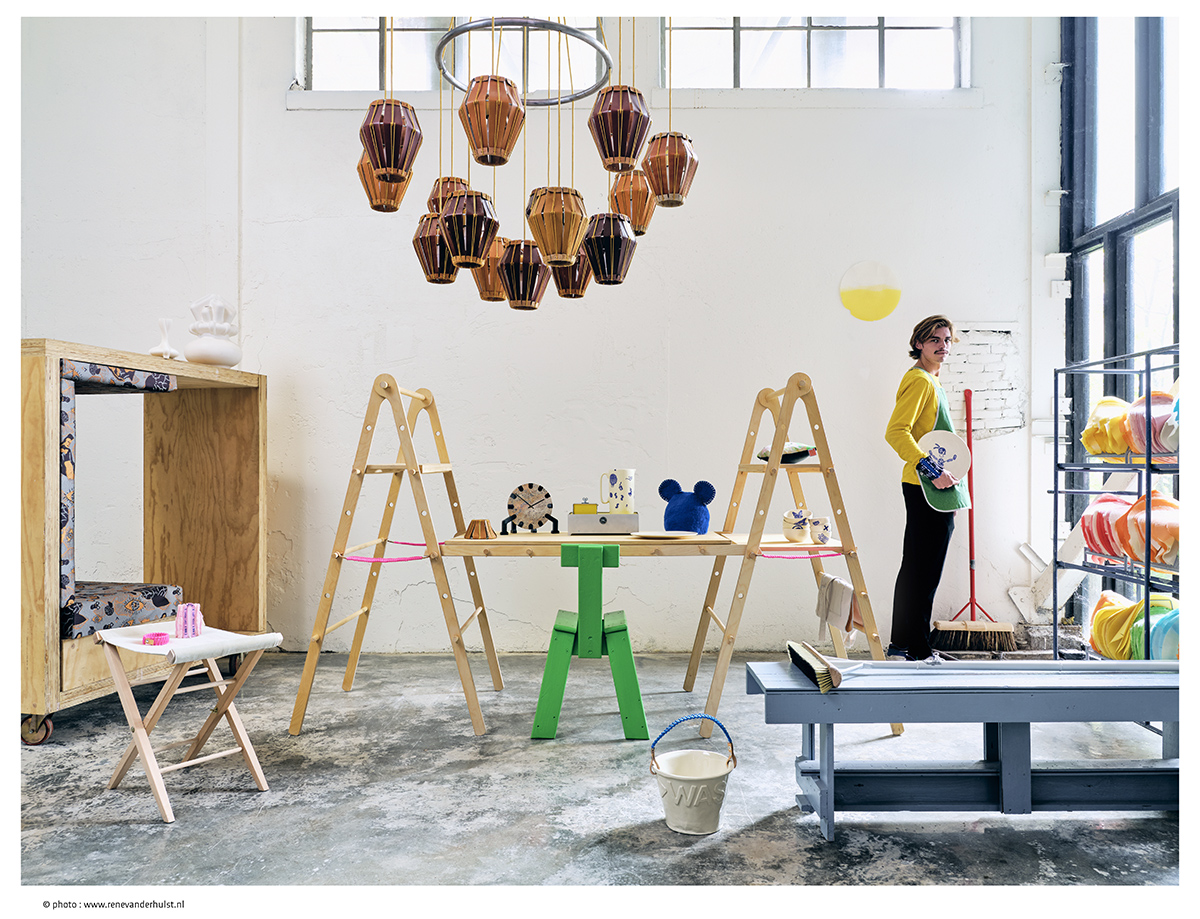
The socially sustainable house encompasses a huge number of designs to fill your house with. But only one of each type of design. This means there is no rivalry between the workplaces, and each workplace can be proud of its own product line and designer. The designer is not only designer, but also master and supporter of the product line that is initiated by the workplaces. This gives the products many values.
Design by doing
Product with meaning
Teaching within society can create new insights for everyone. Together with renowned Dutch designers, Social label is developing
its own design collection founded on skills, rhythm and challenge. Social label has the art-direction on the estatisc of the collection & community. We build together with the other designers a beautifull, meaningfull, affordable products for in your house.
Currently, 14 workshops and 17 leading
designers are involved in the initiative.
> Piet Hein Eek
> Dick van Hoff Van Hoff Ontwerp
> Edwin Vollebergh Studio Boot
> Borre Akkersdijk ByBorre
> Roderick Vos
> Haiko Meijer Onix Architects
> Edward van Vliet
> Marc Mulders
> Kiki van Eijk
> Jos Kranen & Johannes Gille
Kranen/Gille
> Joost van Bleiswijk
> Stefanie van Keijsteren
& Renee Mennen Studio Rens
> Ilse Crawford & Oscar Peña
Studio Ilse, Londen
> Rianne Makkink
Studio Makkink & Bey
> Petra Janssen Studio Boot
Simone Kramer C-mone
Key objectives for inclusion
Creating an inclusive economy
Social label began in 2011 duringa festival, in the form of field research. In 2012, the first pilot projects were launched. The initiative has since evolved into a movement centred around meaning for people and a new perspective
on design, work and collaboration.
But if we truly want to take inclusivity seriously and to see our mission become
a reality across society, more is neede
Designing a system change
Designing processes involving labour and participation in society by making use of
design and communication. We ourselves try to bring this into practice* to create
sustainable social innovation. Everyone can take responsibility for this change.
Designing a education method
They designed their ownworking method that is applied to the new product lines that are developed. From this basis they work with their own expertise and network. The Social label method as developed by them consists of four phases: People, Process, Product and Podium.
People
A match is made between a workplace or company and a designer, on the basis of
an extensive working visit by Social label.
Process
Social label initiates, directs and supervises the process. Where appropriate it suggests new collaborative partners, for example to link to target groups or for cooperative production processes. Together, suitable and feasible options are explored. We introduce an experienced designer with empathic abilities.
Product
The designer receives a brief from Social label, and then makes a bespoke
design after visiting the workplace and getting to know the people and available machinery.
Podium
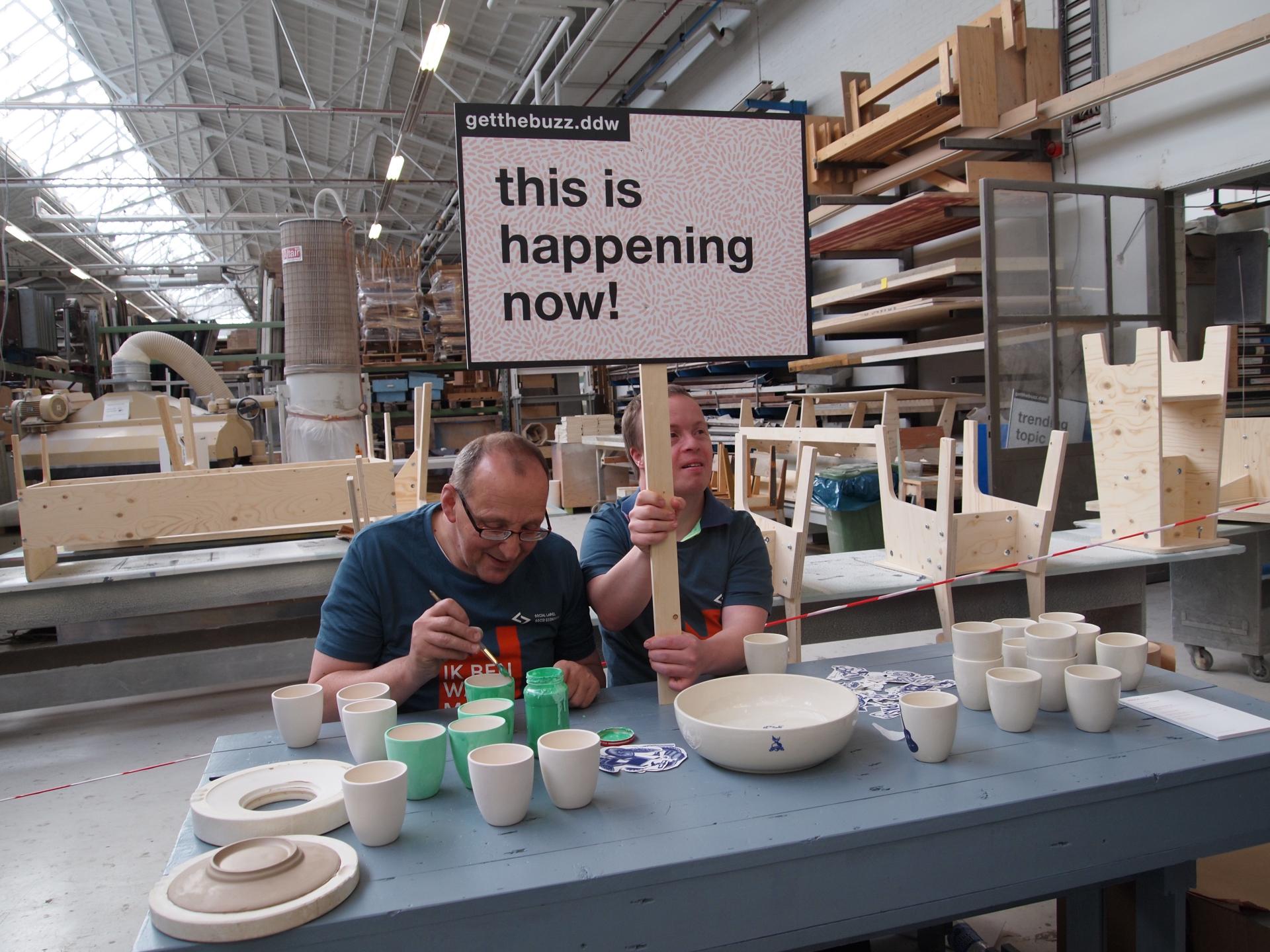
The makers – and their self-made products and the designer – play a starring role in various activities (expos, workshops, lectures) and in the campaign.
Results in relation to category
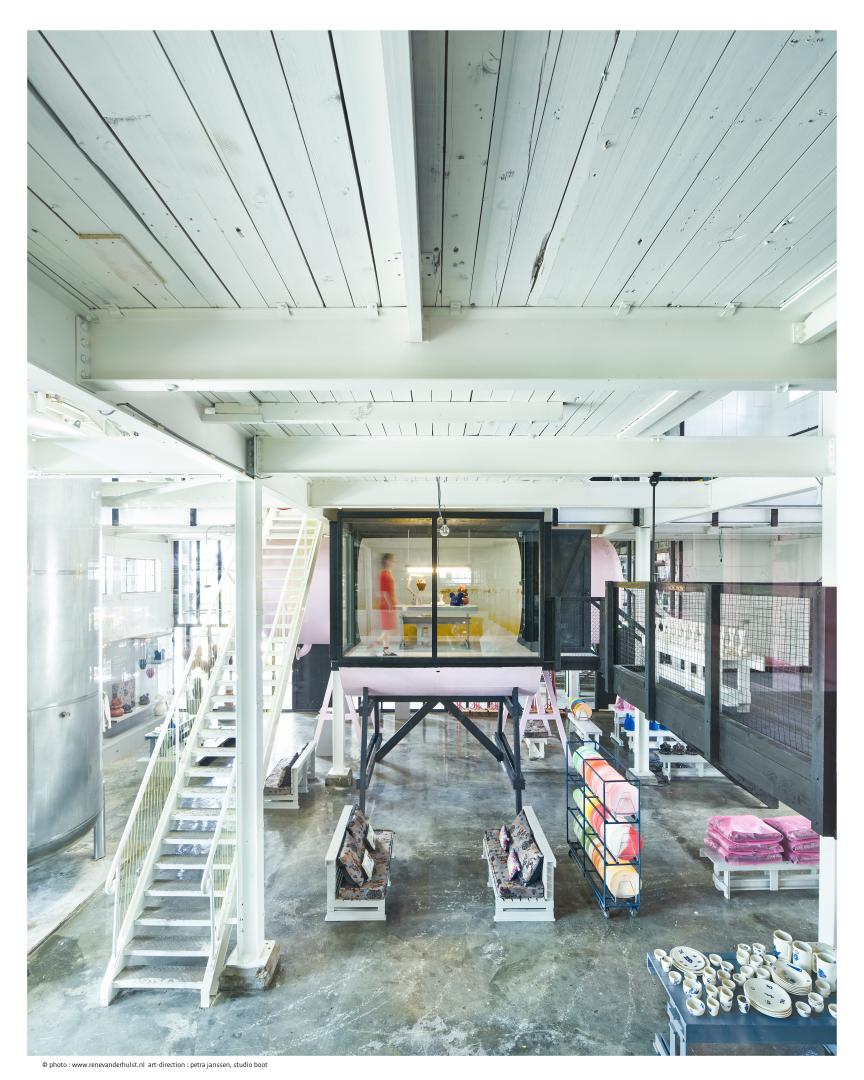
Designlab for social innovation In the Werkwarenhuis in Den Bosch a new space has been created inside a former factory. The space is a workplace for designers and makers, and a concept store for the Social label design products.
A lab for a new take on work, learning and participation through the power of design
and communication. The Social label Lab is the place where we work on the Social label collection and community. The place for
experiments in social innovation. And the public can shop inside the concept store across two floor of the listed buildings,
featuring work units made from recommissioned grain silos and water towers. Through its national platform, research and debate
Social label involves the public, experts
(in care, education and science), businesses and designers so we can all join forces in creating a human-based economy.
- Live workshops with workshops and designers
- public lectures with science and education
- Round tables with business, governments and institutes
- Lectures on designing labour(Social label Works publication)
- Shop with socially sustainable design products
Social innovation
Social label works with a growth model.The movement that Social label aims tojumpstart is becoming bigger and bigger.
As designers and strategic thinkers weask science, education, entrepreneurs,workplaces, designers and the public to bring us their questions from the real world.We can use this information to adjust the process to continually improve. The end result is a network of knowledge, a network of pioneers and a network of creative and social entrepreneurs.
‘Beyond the Banter’ (DOMUS)
by Jordan Hruska, journalist for a.o. New York Times and The Economist:
‘Designers possess the ability to stretch their imagination to offer more than just product. If the discipline follows more examples like those of Social label between now and then, perhaps
How Citizens benefit
Theory of change
Aukje Smit on the Social label product as flywheel, imaginator and influencer researcher at TNO Labor, advocates a social innovative entrepreneurship, with an eye for the growing dichotomy in our society. Social label’s imagination can be a stimulant for workshops and companies to operate more meaningfully.
Creative entrepreneurs and designers are increasingly playing a special role in social innovation*, among other things by looking for solutions for the widening dichotomy in society. One of the reasons for this is that people are realising that solutions based only on technology and scientific insights often don’t work, because they do not comprise the full complexity of society. As such,
innovation increasingly becomes a design challenge.
Storytelling, as used by Social label, is of a high professional quality and based on an entirely own vision of the importance of authentic stories, quality, timing and sustainability. It is not about something that sounds good for PR, hyping a product or ‘quick wins’, it’s about strategic storytelling. Starting in the design stage of the design product, thoughts are developed about
the consequences of what unfolds in terms of communication on various levels. Building a relationship with the makers and supervisors creates engagement and trust. This empowers the collaboration and results in beautiful authentic images and stories.
The principle ‘the power of imagination’ is also applicable in the Werkwarenhuis, which among other things serves as a showcase. Social label uses the Werkwarenhuis to create a physical meeting place, a ‘mini-society’ and organises activities that promote mutual exchanges.
Benefits; Inspiration &new insights / designer products to make and sell
/ New contacts and collaborations / More visibility / Establishing a reputation as pioneers / More professional working methods
in various areas /New experiences and positive attention for the makers /Being part of a bigger whole,
Innovative character
Since its launch in 2012, Social label has developed into an international label for 'design with meaning'. Within our national community, we work together with a broad network of social innovators, including designers, healthcare professionals, policy makers and CEOs.
We have acquired our own place in the Dutch design world with a new definition. Design with meaning, customised work designs so that the makers (clients) can take a step forward. We have had the opportunity to explain this at various lectures around the world (including the V&A Global Design Forum in London, the Global Grad Show in Dubai and the Salone del Mobile in Milan). The creators of the Social label products are regularly on stage at, for example
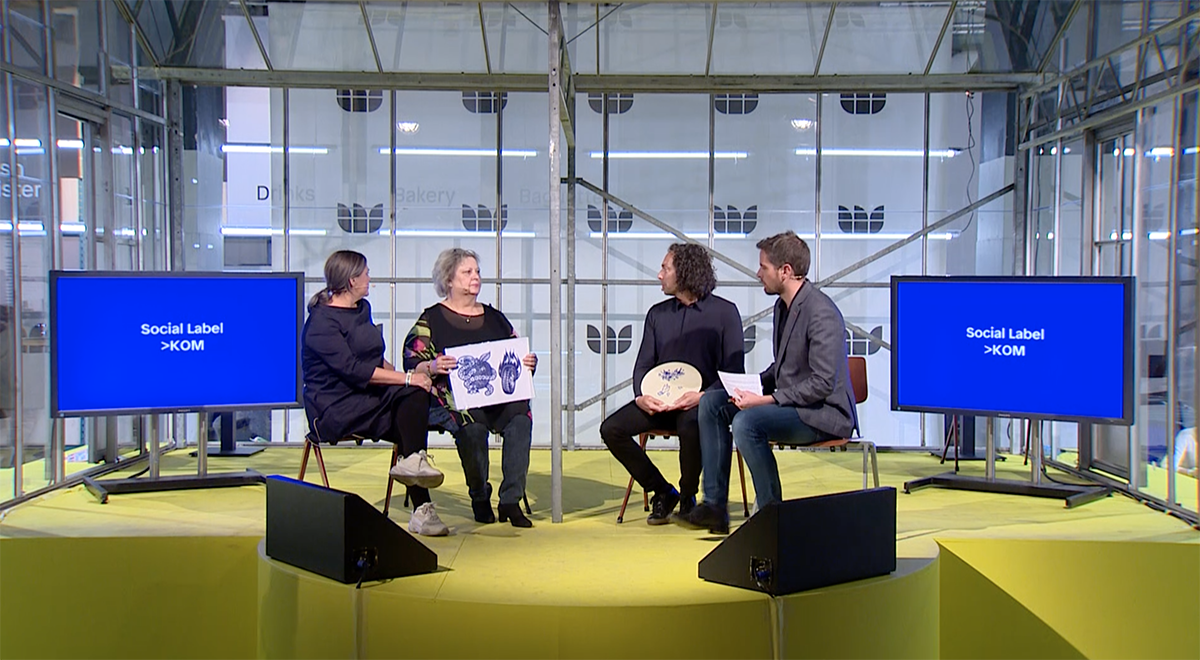
the DDW Talks and live workshops. For the makers, these are valuable moments that help them to participate in society again. Ans (maker of Social label >KOM) says: 'Thanks to Edwin, I'm getting better. She is a psychiatric patient of care institution Reinier van Arkel where she works on the narrative tableware designed by Edwin Vollebergh (Studio Boot). Affiliated workplaces are developing from occupational therapy to occupational day care. Commercial parties are becoming more social. Social label allows design to play a new role in society. For this we received the Dutch Design Award (DDA) in 2018 for 'Best Commissioning'. A nice crown on our work! In addition, in 2017 we were nominated for a DDA with Social label >VEEG in the category 'System Change'. In 2020, we were rewarded for the third time with a nomination for a DDA in the category 'Habitat' for designing an attractive living and working environment.
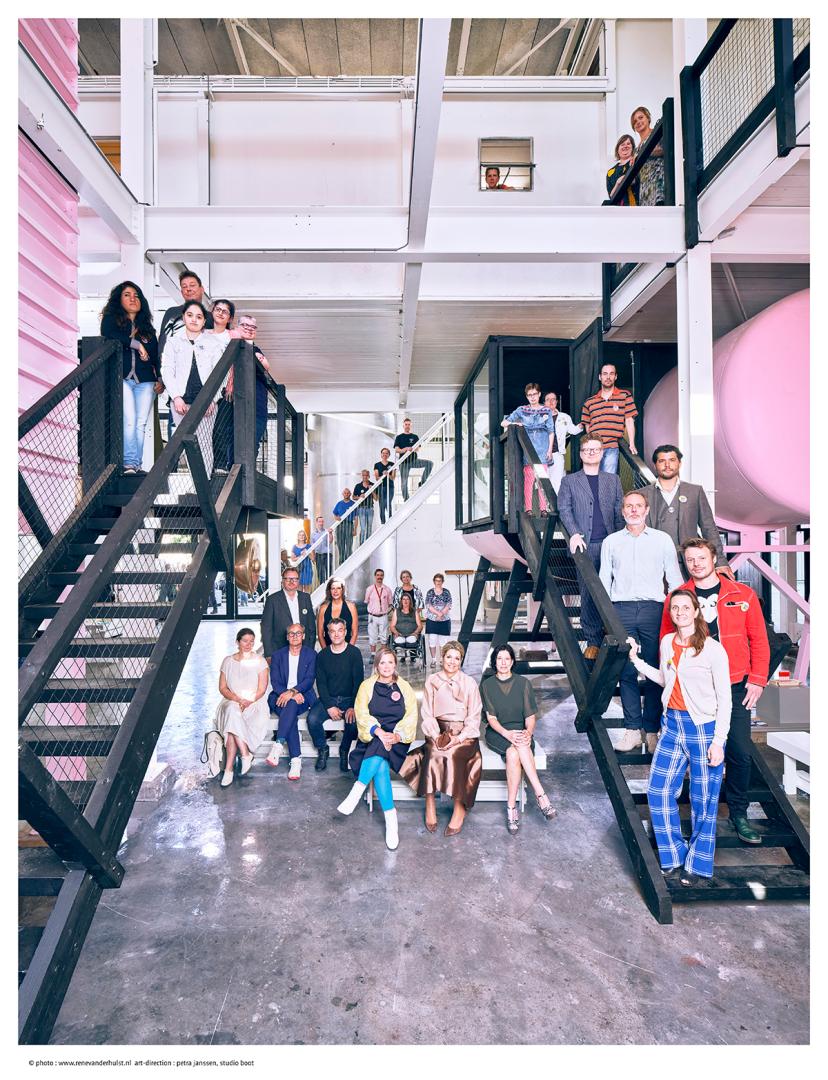
We also received recognition from national politics. Minister De Jonge congratulated us on our design award and Minister Van Engelshoven received our book 'Design Works' during the design fair in Milan. In May 2018, Queen Máxima opened the Social label Lab in the Werkwarenhuis in 'sHertogenbosch.