a 21st century decarbonized masia
Basic information
Project Title
Full project title
Category
Project Description
The masía (from the Latin mansus, means to remain) is a dispersed habitat system in the spanish southeast area at risk of disappearing and with it its autonomous and sustainable operation linked to territory and the identity of inhabitants. We rehabilitate a 17th century masía with decarbonization strategies, using local materials, modernizing the rammed earth local technique and involving artisans and people in a powerful circular economy project. An architecture that relinks human to nature.
Project Region
EU Programme or fund
Which funds
Other Funds
PROGRAMA OPERATIVO PLURIREGIONAL DE ESPAÑA 2014 2020, Beneficiario: Proyectos e Inversiones del Matarraña SL Proyecto: TE/0357/E50, Hotel Rural Torre del Marques 5*
Description of the project
Summary
The “masía” is a dispersed habitat system in the southeast of Spain. The term derives from the Latin mansus which means to stay. The masía, widespread in the area, has an identity character and autonomous and sustainable operation. Integrated into the landscape, it is supplied with it without generating environmental impact, in an ecological and lasting way. The current abandonment of the masias and their natural resource management systems represents a significant environmental risk, depopulation and loss of value.
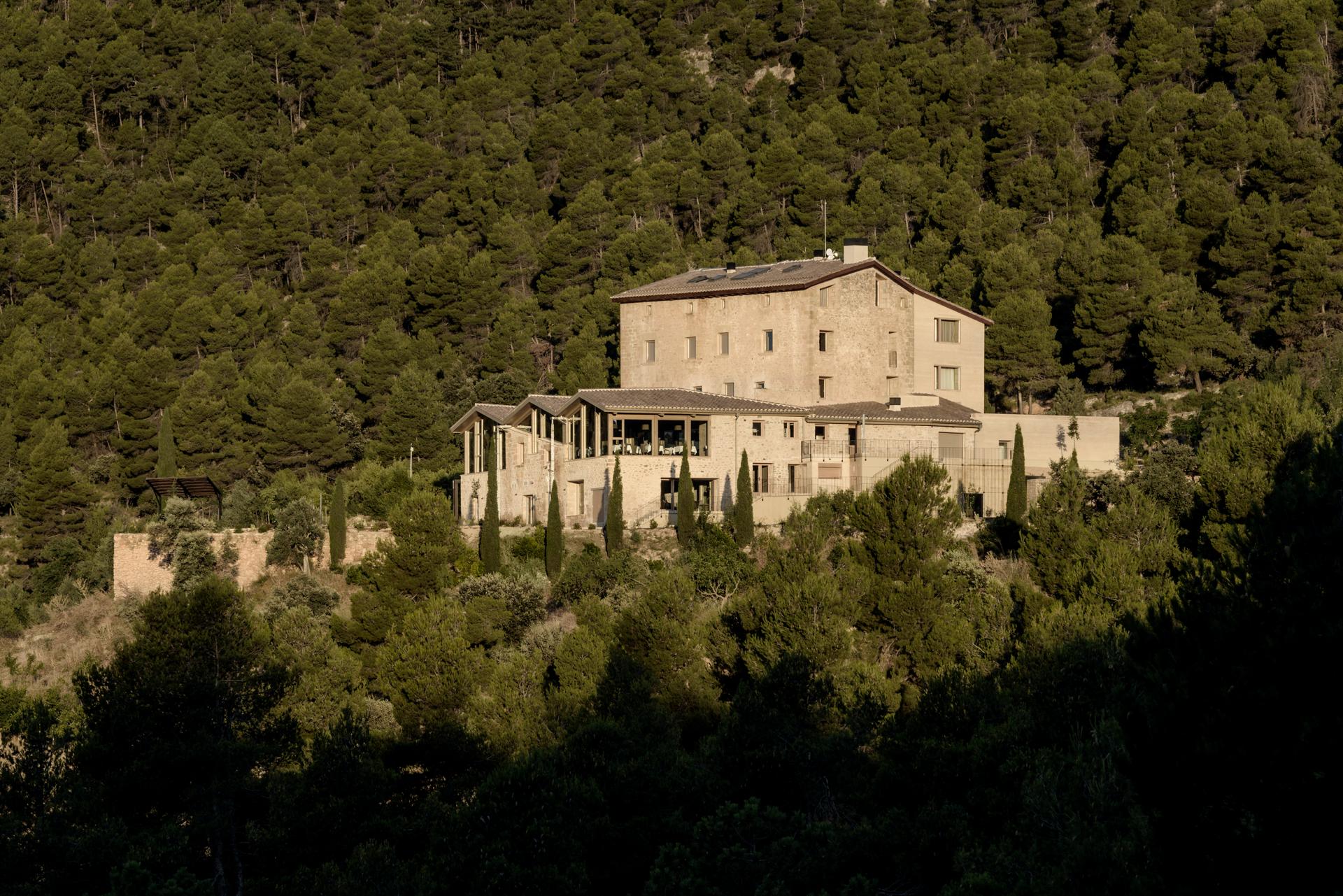
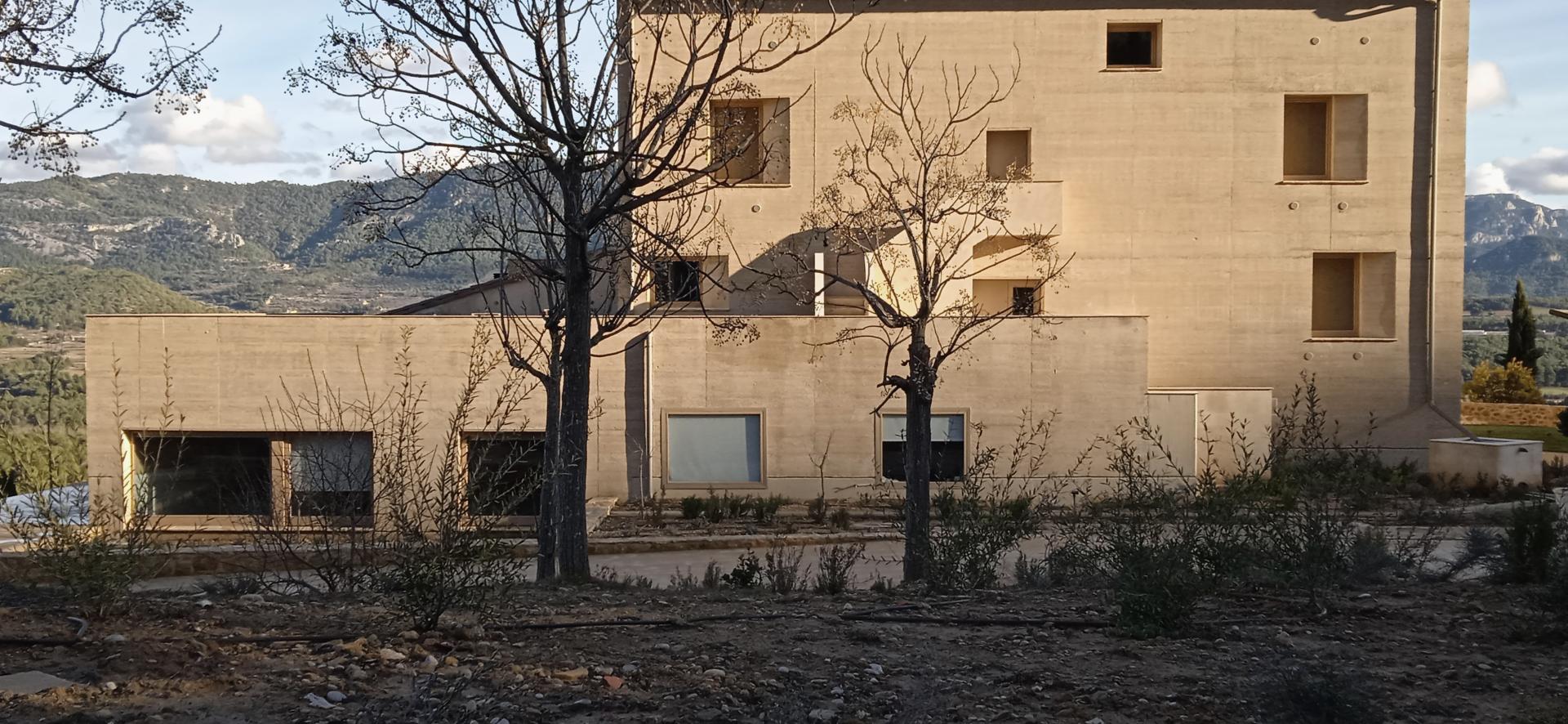
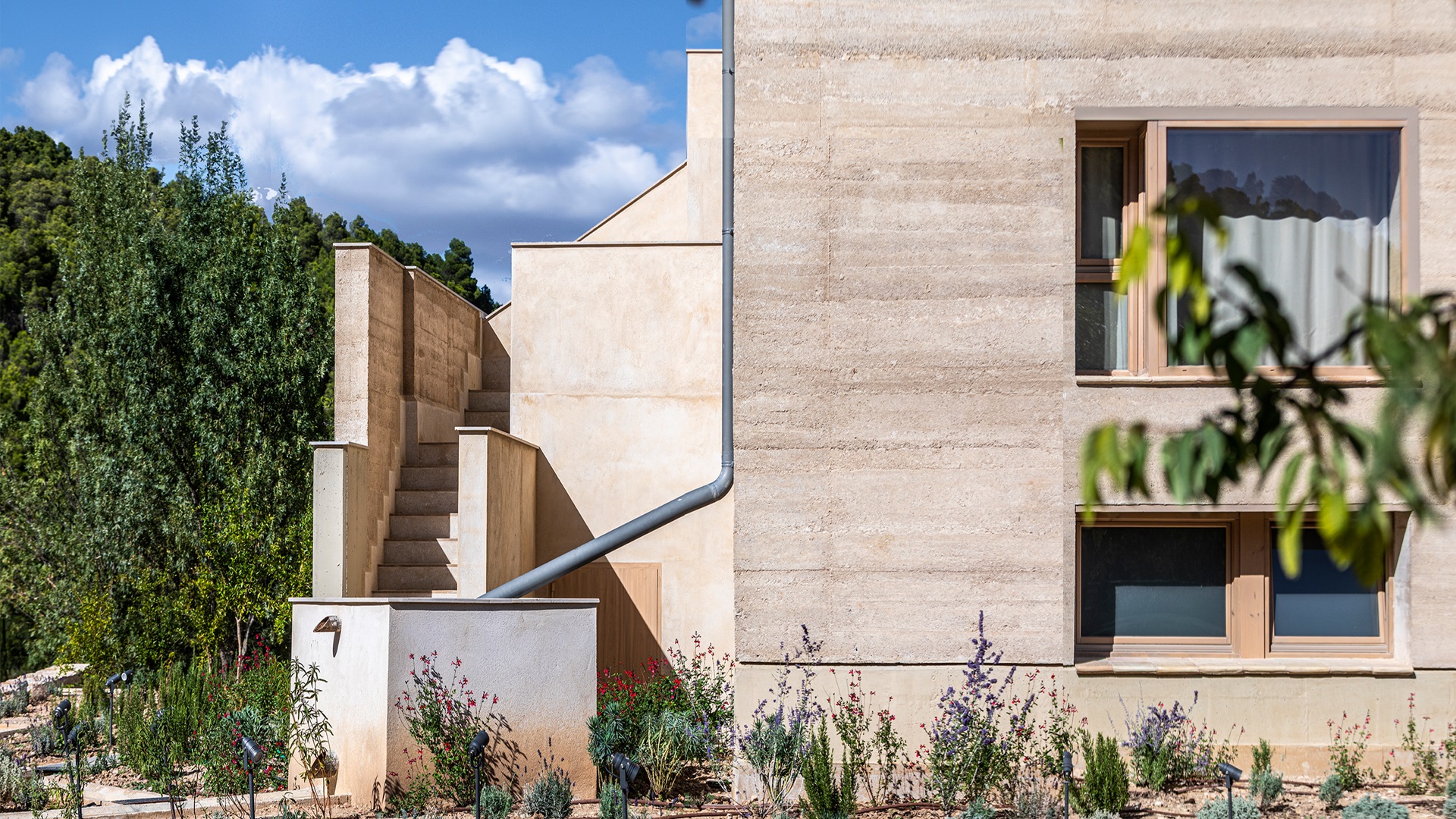
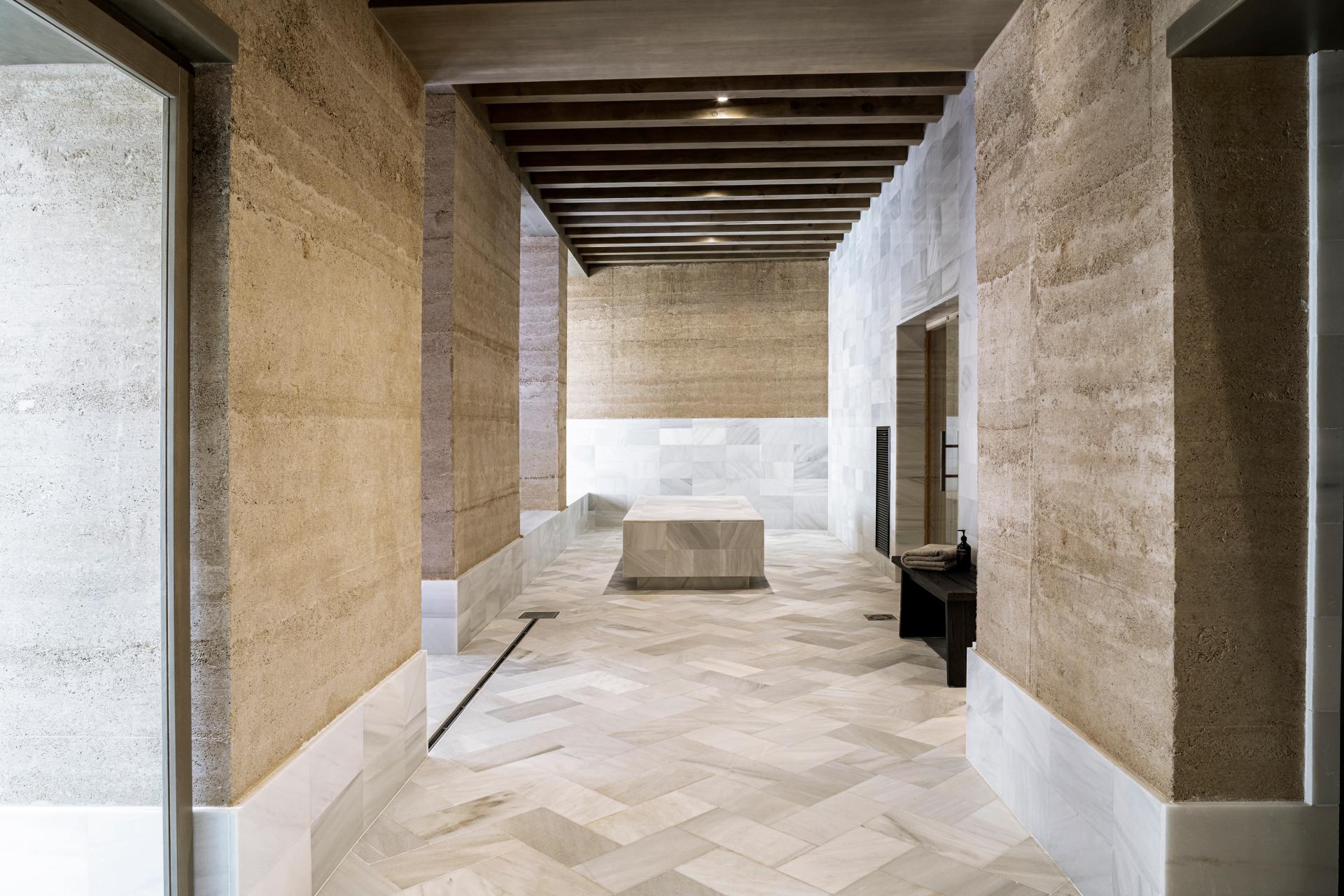
This project deals with the rehabilitation and expansion of a 17th century “masía” placed in Monroyo (Teruel), to adapt it to a luxury Hotel through decarbonization strategies and the reactivation of the management system of the resources of its environment. The expansion is done in rammed earth ,recovering this traditional local building technique. A conscious selection of local and little manufactured materials is made and local artisans are involved. This strategy leads to a powerful circular economy project with a very low ecological footprint. A life cycle analysis shows a 60% reduction in environmental impact compared to a conventional intervention. At the end of the useful life, the “masía” will reintegrate its materials directly into nature.
To reduce energy demand, bioclimatic architecture criteria are applied, enhancing thermal inertia and making the most of solar capture on the south façade. Water is heated by the splinter of the forest that is put into cultivation just like the agricultural terraces. A 100kw photovoltaic plant is installed following the strategy of self-generation of energy for self-supply. Building's annual energy balance generates surplus.
Architecture achieves the participation of local artisans, the renewal of traditional technologies, and the enhancement of local materials. The architecture reflects inhabitants identity through the beauty of natural materials, revitalizes social networks and relinks people to nature.
Key objectives for sustainability
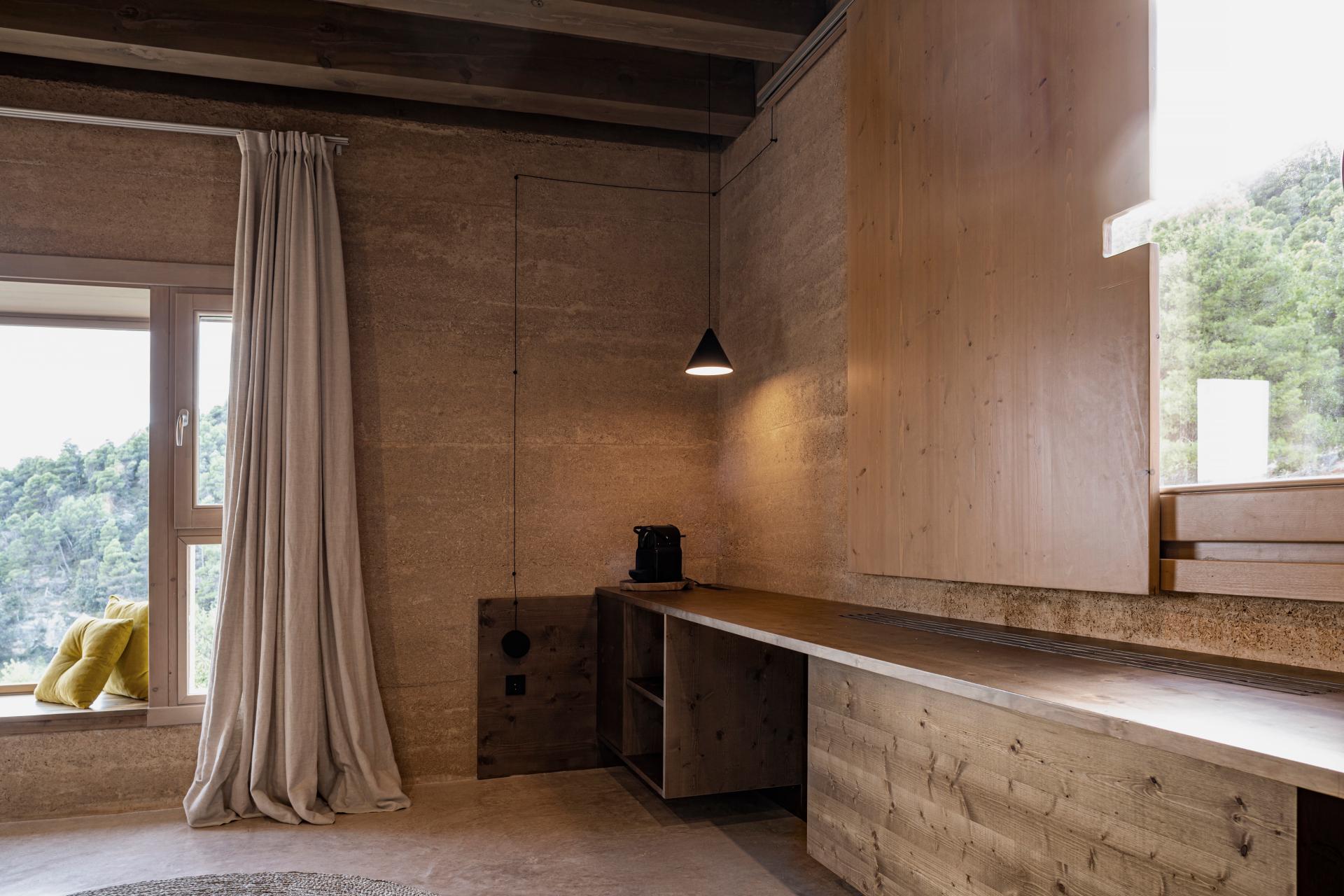
For the development of the project, we apply decarbonization strategies both in the building and in the use phase. The new “masía” at the end of its useful life will reintegrate a large part of its materials into nature. To achieve the closure of material resources cycle, 90% of the weight of building materials is local and little manufactured. The expansion of the building is built in rammed earth (Tapia). We integrate local artisans and we practice a conscious selection of materials with proximity and low environmental impact criteria: local clay interior plaster, local gypsum flooring, artisan ceramics, reinforcement of the existing wooden structure and new wood, lime, hemp and cotton insulation. This strategy leads to a powerful circular economy project.A life cycle analysis shows that the environmental impact (rehabilitation and expansion of the building) is 40% of that of a conventional intervention, of which 20% corresponds to the facilities. The ecological footprint is extremely low.
To reduce energy demand, a precise bioclimatic design is applied: superinsulation of the original volume, thermal inertia in the extension, large openings in the south façade and a greenhouse in the intermediate space between buildings. The energy that enters the building is stored in walls with great thermal inertia and redistributed inside, guaranteeing optimal thermal behaviour.
At the agronomic level, the crops (cereal, almond, olive and vine) are reactivated as well as the management of the forest to produce food and wood chips. We start managing the environment to produce the necessary energy (self-generation and self-supply). The hot water (hotel/spa/ restaurant/employee dwelling) is generated by a biomass district heating installation fed by the masia’s splinter. 100KW of photovoltaic cells have been installed making the annual energy balance of the building positive. A system of ditches and ponds collects and recirculates rainwater for irrigation.
Key objectives for aesthetics and quality
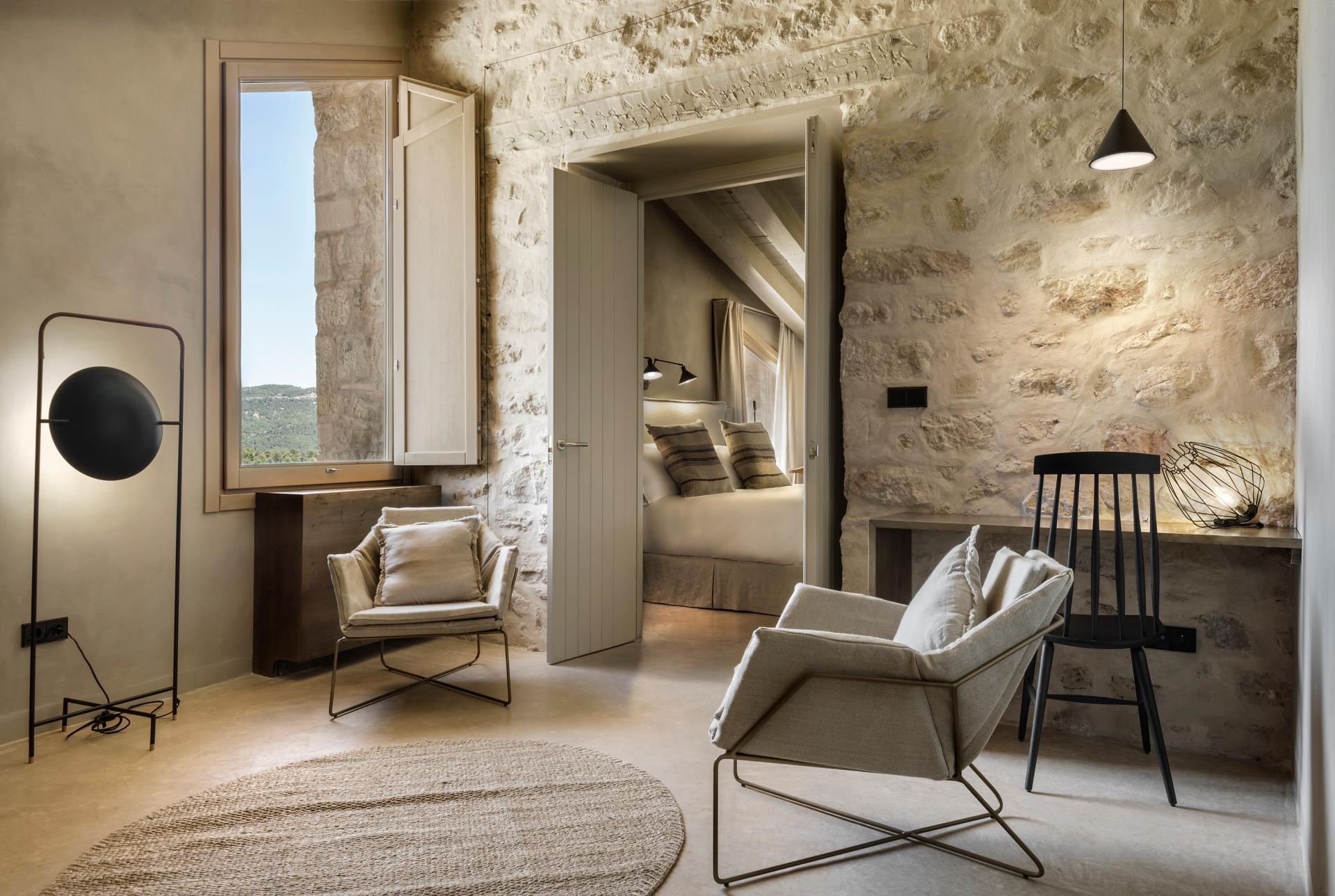
We develop an architecture that remains, that adds to the pre-existence, giving formal and material continuity, with respect for the local building culture but without prejudice innovation and reduction of environmental impact. This approach allows working with traditional materials in a contemporary way conforming spaces with the virtues of pre-industrial materials and with natural textures that provide well-being. Earth, Clay, plaster, stone, wood, straw, hemp and natural light are the materials that shape the spaces of the building. These healthy spaces, free of additives and toxicity, allow the user to reconnect with nature and perceive the architecture through all the senses. The beauty of the natural and the healthy is palpable and is translated into an ethical aesthetic, built with noble and local materials. This local materials and textures participate in people's identity. The way in which men and women have modelled their territory throughout history to make it habitable is “architecture” and in it their own territory is recognized. The new building continues this strategy in a contemporary way, integrating comfort and energy efficiency demanded by the 21st century and opening up new opportunities for traditional materials.
In the Hotel spaces raw materials have prominence with an exquisite care of detail and an impeccable implementation, resolve the luxurious spaces. A renewed luxury based on light, texture, natural, local, artisanal and revitalized agricultural landscape.Rooms are healing and regenerating, they exude coherence and commitment to people and environment. The vernacular buildings of the 21st century recognize the beauty of the natural and the healthy, practice ethical aesthetics and create an identity. The vernacular buildings of the 21st century integrate traditional and contemporary knowledge and technology, and project today’s architecture into the future due to it’s efficiency, healthy and low impact generation at the end of useful life
Key objectives for inclusion
We make an architecture that generates change which aims to accompany the paradigm change process towards a more conscious, respectful and inclusive way of living. The project, located in a depopulated rural area of the interior territory in northeast Spain where the slight economic activity is based on traditional agriculture, consists in adapting a heritage devalued “masia” (building/agricultural/forest areas traditionally running as a self-sufficient cell system) into a luxury rural hotel. The project deals with an abandoned system, its scale and its symbolic value deserve special care becoming an opportunity for the place and the inhabitants of the territory. Respect and integration strategies lead the process. The building is designed in affordable systems for local building firms, with little manufactured materials and simple technologies and local artisans are called in. The hiring of local artisans is imposed through architectural design, causing a powerful circular economy process.
After analysing the local traditional architecture, we apply technological innovations to reseed these renewed technologies in the place. The Tapia’s execution (rammed earth building technique used in load-bearing walls of the local traditional buildings) disappeared in the 50s of the last century. We recover this ancient technique and adapt it to the new regulatory requirements. We technify and systematize it’s execution to make it economically competitive. There is a seeding of low environmental impact knowledge and technologies. Local builders are trained to internalize the technoloy and thus be able to intervene in the still standing heritage of the area. More than 40 local artisans/firms intervene in the process reimforcing their self-esteem and identity. Young and veteran craftsmen, emerging and consolidated firms, coordinated and hand in hand, build a building that serving as a flag for the territory shows the power that energy efficient and low-impact architecture has.
Results in relation to category
The new conception of heritage includes not only the buildings but also the intangible heritage, the way of living culture and the cultural landscape to which the buildings serve as instruments. The way societies relate to their environment and manage natural resources is formalized in their buildings and their material structures. The “masía” is a widespread dispersed habitat system in southeastern Spain that, since its abandonment as a system at the beginning of the last century, has suffered a decline and a significant deterioration of its infrastructures. The recovery of the use of these self-sufficent cells and the implementation of resource management not only concretizes a way of inhabiting but also ensures the observance of a portion of the territory; Something very urgent today due to the abandonment of agricultural land that leads to the advance of the forest with the fire risks that this entails. A whole territorial management system depends on this revitalization which represents an opportunity for large portions of highly depopulated and underprivileged rural territories. The search for strategies and alternatives is in the public debate and in the concern of the administrations.
The revitalization project of the “masía Torre del Marqués”, apart from its hotel use, aims to develop a contemporary intervention methodology based on the recovery of the original energy self-sufficiency and material resource management to provide habitability to a portion of territory. The use either hotel, housing, agricultural, educational, etc. can be integrated into the proposed strategy and revert territorial problems at an environmental and social level, by applying systemic strategies of material decarboization and social integration.
To date, the project has been declared of provincial interest by the government of Aragon and has been selected among the 40 finalists of the international prize for contemporary eathen an fiver made architecture TerraFibra Award2021.
How Citizens benefit
With the recovery of the uses of the dispersed habitat, a door opens to new ways of inhabiting and repopulating the emptied Spanish territory. The new initiatives take into account the relationship with their territory. They are sustainable and will make possible the observance of the natural environment from the local. The new uses and their new inhabitants, together with the existing ones, will be the new centers of attraction and action, far from urban centers and distributed in a dispersed way, attending to needs without generating envoronmental impact.
The “masia’s” heritage recovery and their natural resource management systems are laboratories to reconnect with the environment. They are the opportunity for the reversal of depopulation and abandonment. New services are associated with the 21st century “masias”, these are new community facilites, they settle population in the rural places and create jobs.
This recovery project of the “masía Torre del Marqués”, one of these self-sufficient cells, gives visibility to the area, and transmits the essence of the place to visitors through the senses. The project associated with luxury and quality revulsively elevates traditional to contemporary values.
The project puts the fundamental parts of the system in the inhabitants hand. The use of the forest to warm up, the use of the cultivated land to eat, the use of the inert earth to build, the use of sheep to transversely maintain the productive system. The recovery of rainwater and its management, the anthropisation to generate fertility, the maintenance of green corridors to promote biodiversity. The reduction of the environmental impact generated by buildings, the construction through passive systems that reduce the energy demand of buildings and the conscious use of buildings by their users. The 21st century vernacular “masía” is a sustainable and systemic architecture that results in the identity of the places and their inhabitants.
Innovative character
The challenge of the 21st century architecture is to reconnect with natural environment and with people. In terms of reconnection with the natural environment, innovation lies on going down the road of decarbonisation. For this, it’s needed an energy efficient and self-sufficient intervention, made of natural, local and little manufactured materials, recovering the strategies of the traditional “masía”. This conscious material selection endorsed by a cradle to door life cycle analysis demonstrates and strengthens a methodology that is rooted in local material resources and in the reversibility of the intervention.
It is developed a contemporary bioclimatic and earthen architecture. Earth is an omnipresent building material traditionally widely used across the planet to build. Internationally it’s being carried out many scientific research for reintroducing this material due to the fact that it confers very outstanding hygrothermal comfort properties, it is very accessible and, if free of additives, its environmental impact is almost null.
This project is part of this process in which Edra arquitectura km0 participates, evidenced in its built examples and in its scientific production. This building is subjected to monitoring and parameterization of its hygrothermal behaviour, and is the result of the systematization of material characterization protocols, execution control and specific technological development for the use of earth and local natural fibers.
At the level of reconnection with people, the applied methodology takes into account the agents of the territory from the design stage integrating them into the architectural solutions to force their participation. The link between artisans and building firms with the new project enhances existing values and develops a powerful circular economy strategy. Architecture contains the identity values of the local society and projects them into the future through its material and formal solutions.