Structures of communal dwelling
Basic information
Project Title
Full project title
Category
Project Description
Ljubljana is a university town. Student life and university-related activities have left a big mark on its lively atmosphere in the last hundred years of University’s presence in the centre of Ljubljana. Nevertheless, the town’s identity is in danger of being watered down as a consequence of intensive turistification. Proposed project introduces student housing typology that can adapt to specific urban situations, thus enriching neglected areas of Ljubljana’s broader town centre.
Project Region
EU Programme or fund
Description of the project
Summary
STRUCTURES OF COMMUNAL DWELLING
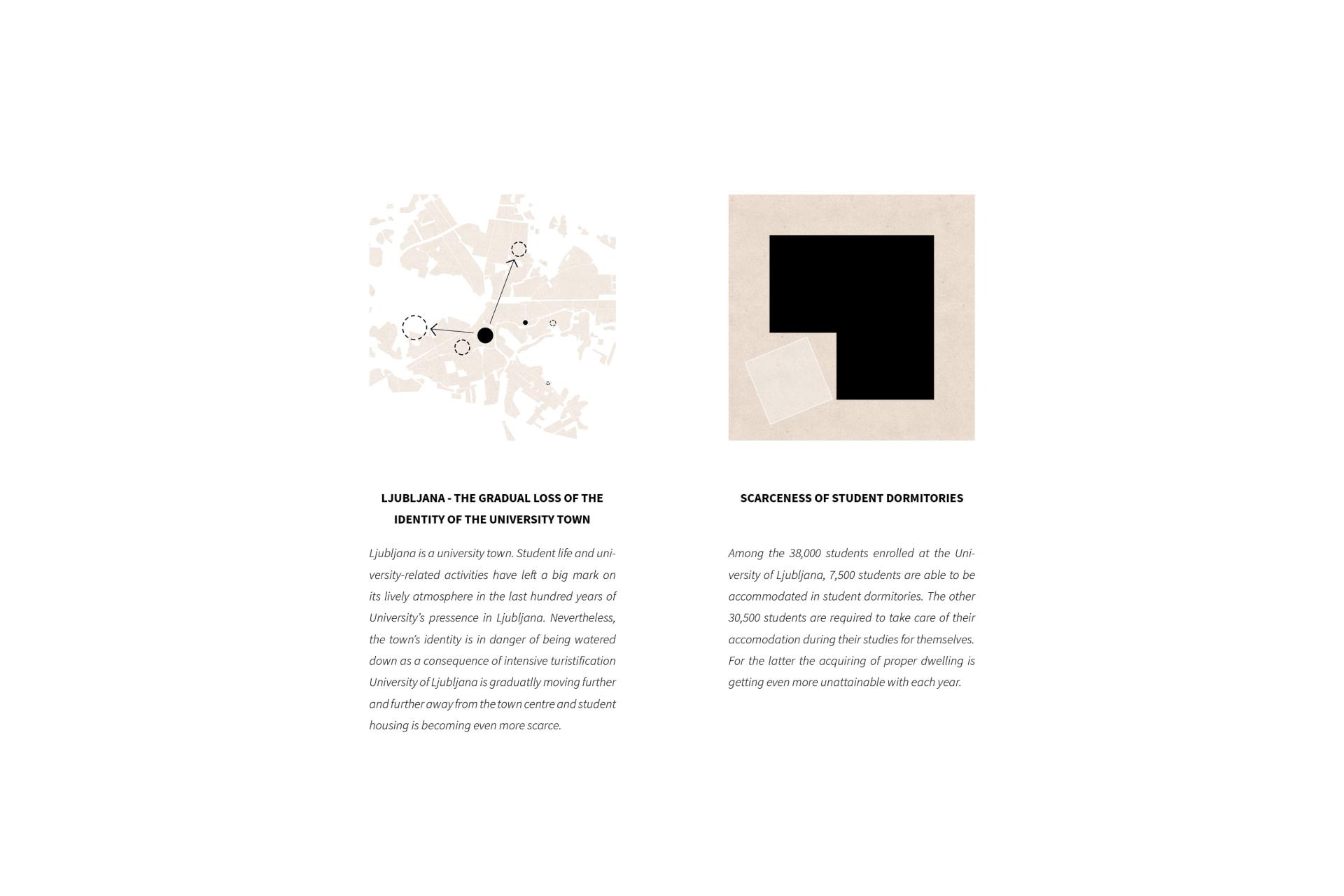
Ljubljana is a university town. Student life and university-related activities have left a big mark on its lively atmosphere in the last hundred years of University’s presence in the centre of Ljubljana. Nevertheless, the town’s identity is in danger of being watered down as a consequence of intensive turistification - causing University of Ljubljana to move further and further away from the town centre and student housing becoming even more scarce. As a response, the project poses the following two questions: Is it possible to establish a sustainable and co-dependent relationship between students and the town they inhabit? How would student life complement and enhance a townscape, be it spatially or content-wise?
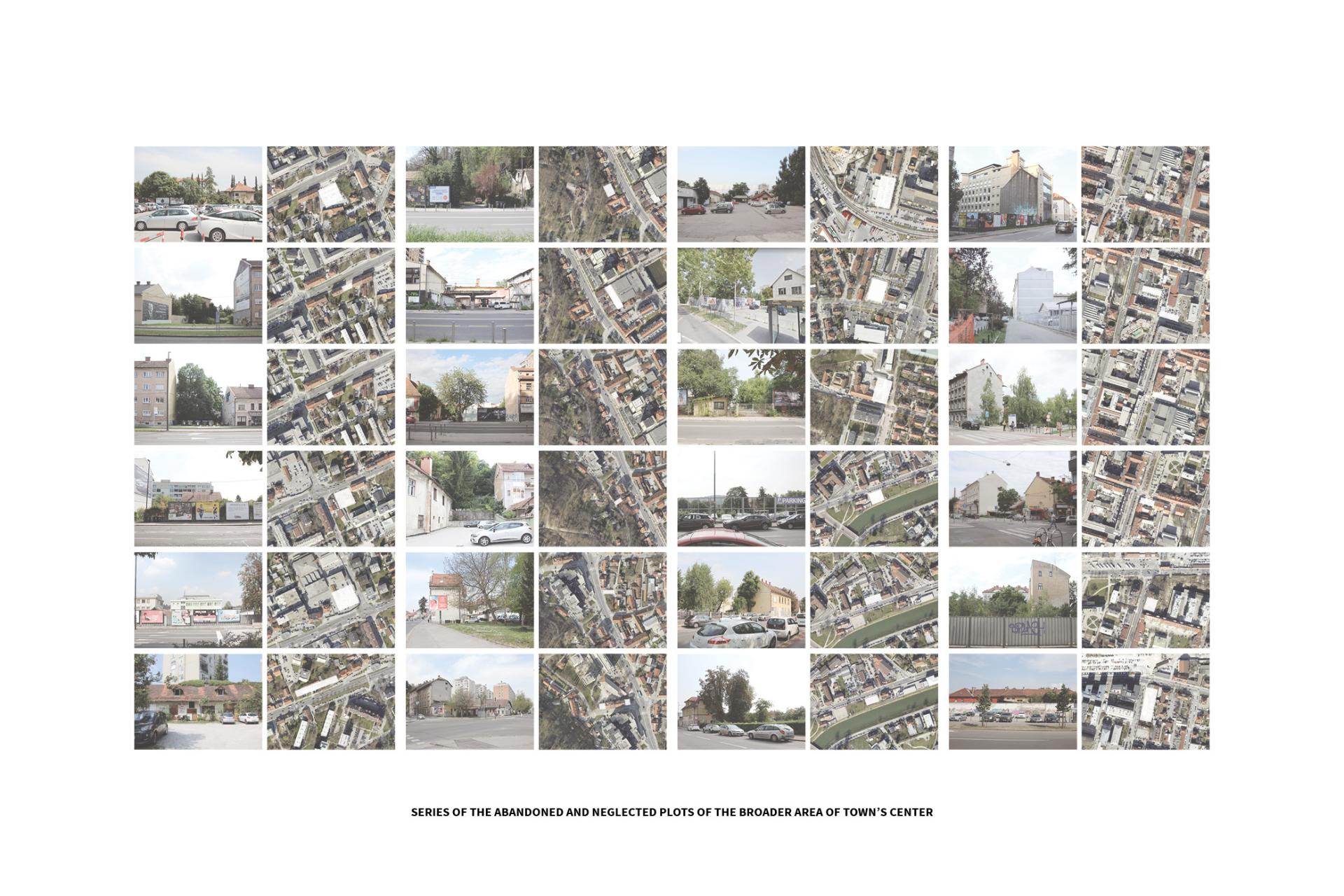
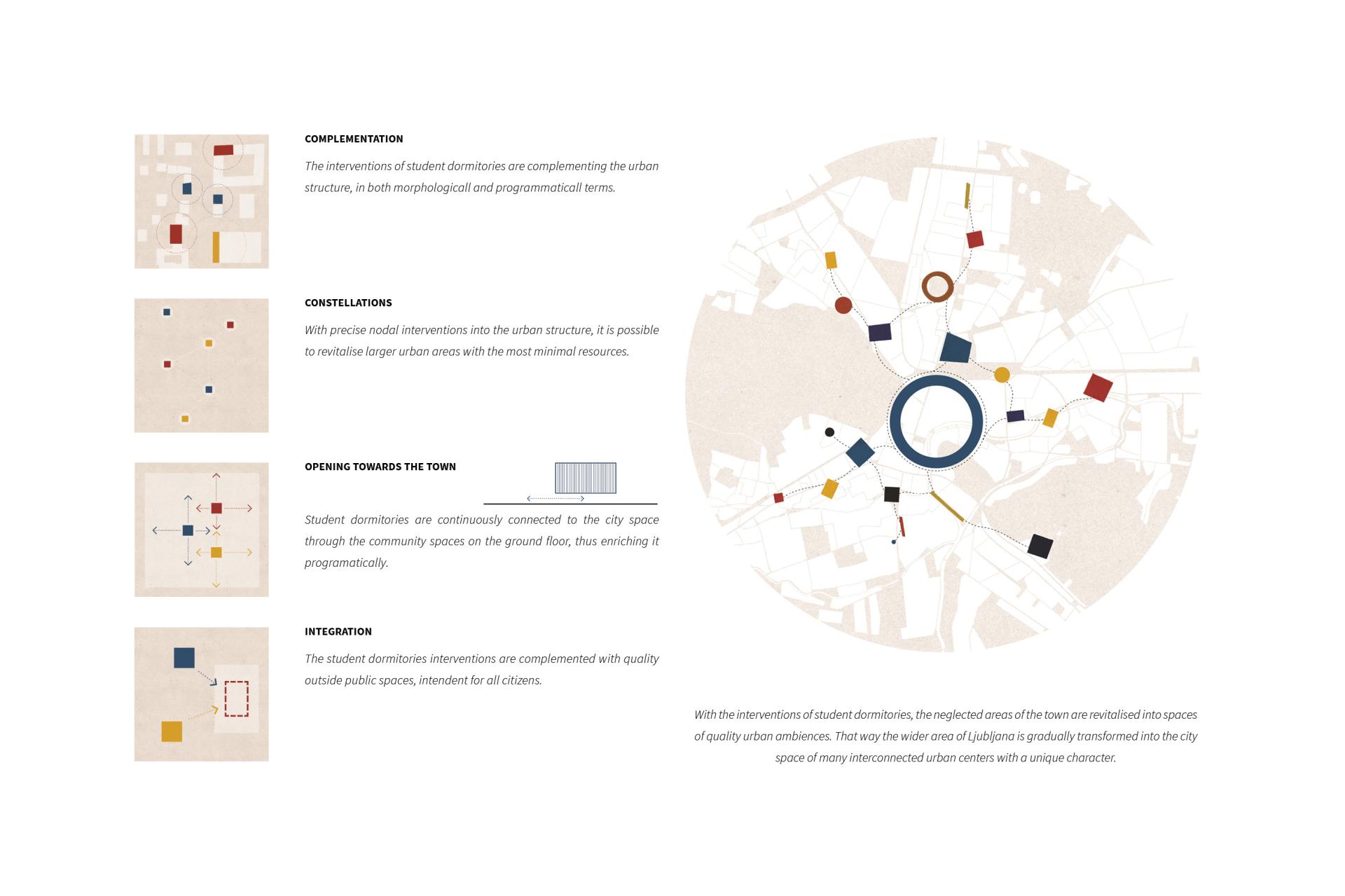
The proposed problem of integration of student dwellings into the structure of the town is not resolved by the classically complete architectural work, but as an open architectural system. The latter could adapt to specific urban situations with unique and unpredictable spatial conditions. The resulting student housing interventions would enrich abandoned and neglected urban sites both morphologically and content-wise, while also complementing the existing composition of university-related buildings in Ljubljana.
Key objectives for sustainability
The sustainable aspect of the project is realized through different layers of the spatial intervention:
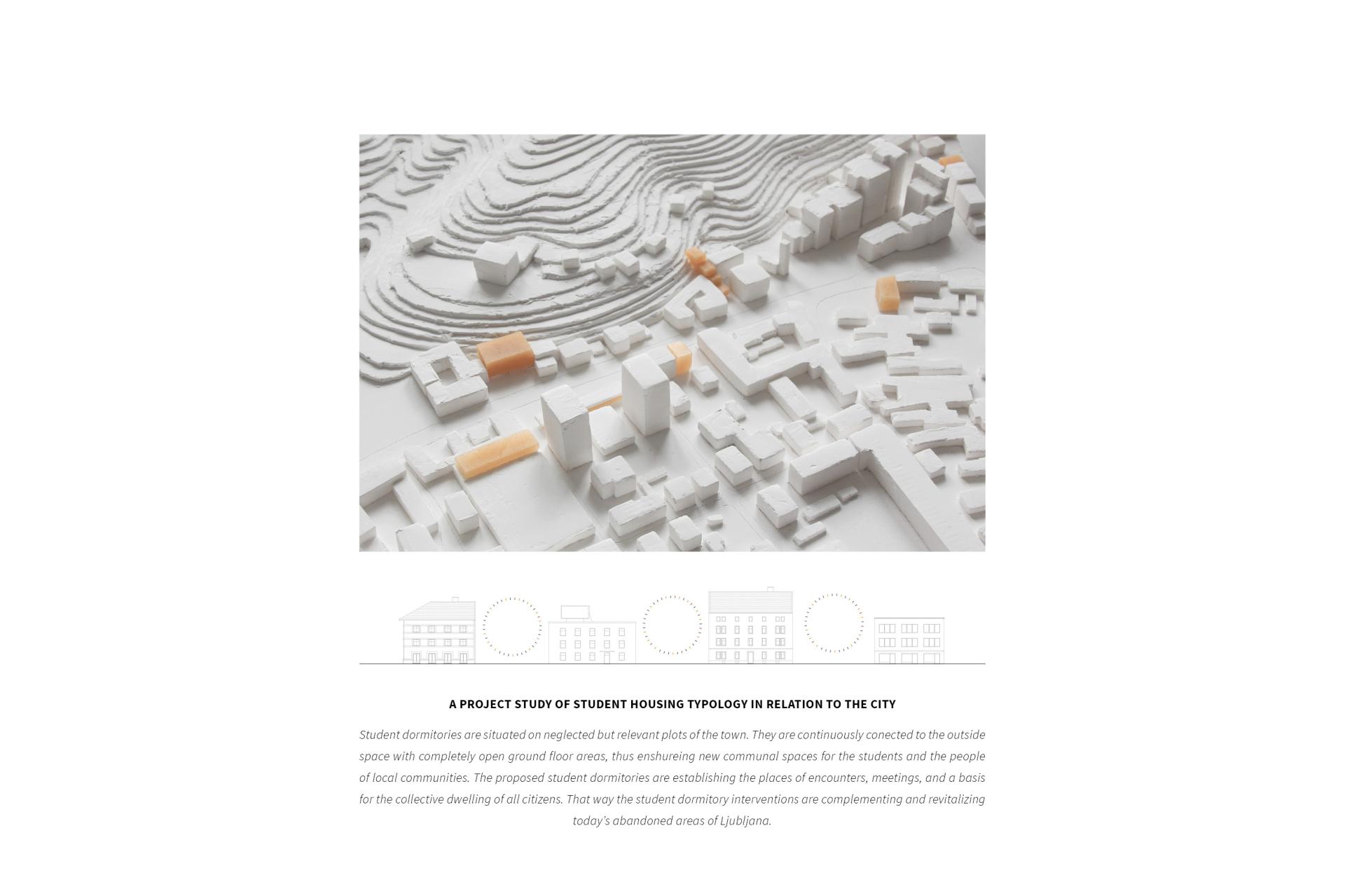
1 DENSIFYING THE TOWN STRUCTURE - Student dormitories are situated on abandoned and neglected plots of the city. The interventions are densifying the town structure on the site plots that otherwise would not enable usual architectural solutions. That way the proposed project stands in contrast to irrational and reckless expansion of the town – which would otherwise be consequent in increased number of daily migrations into the town centre and occupation of quality green areas on the outskirts of the city.
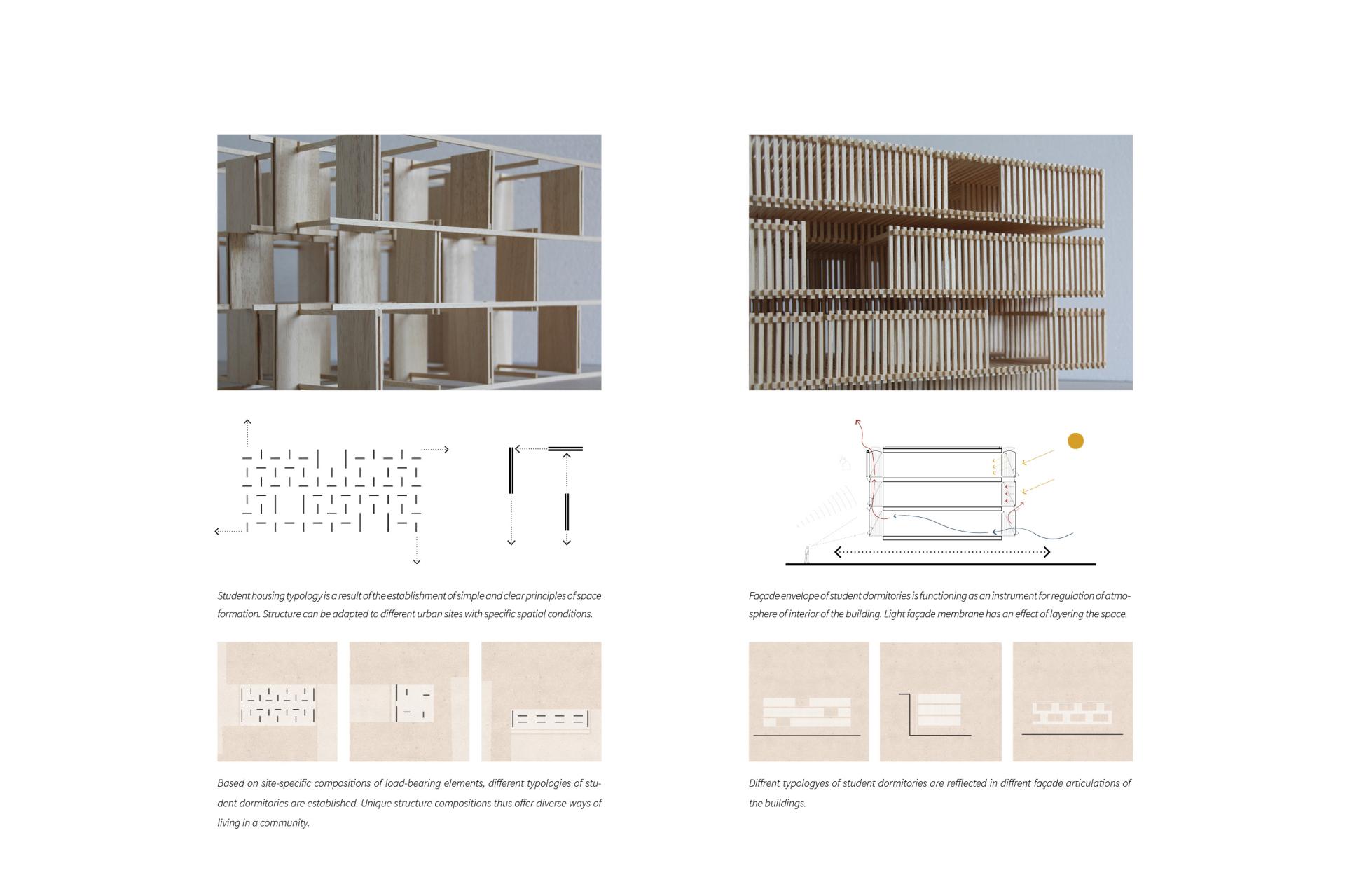
2 WOODEN STRUCTURE – Slovenia is a country with one of the highest annual increment of forests, but unfortunately it is not taking an advantage of its potential. The project is promoting simple innovative and sustainable construction of prefabricated wooden elements, which would cause minimal carbon footprint.
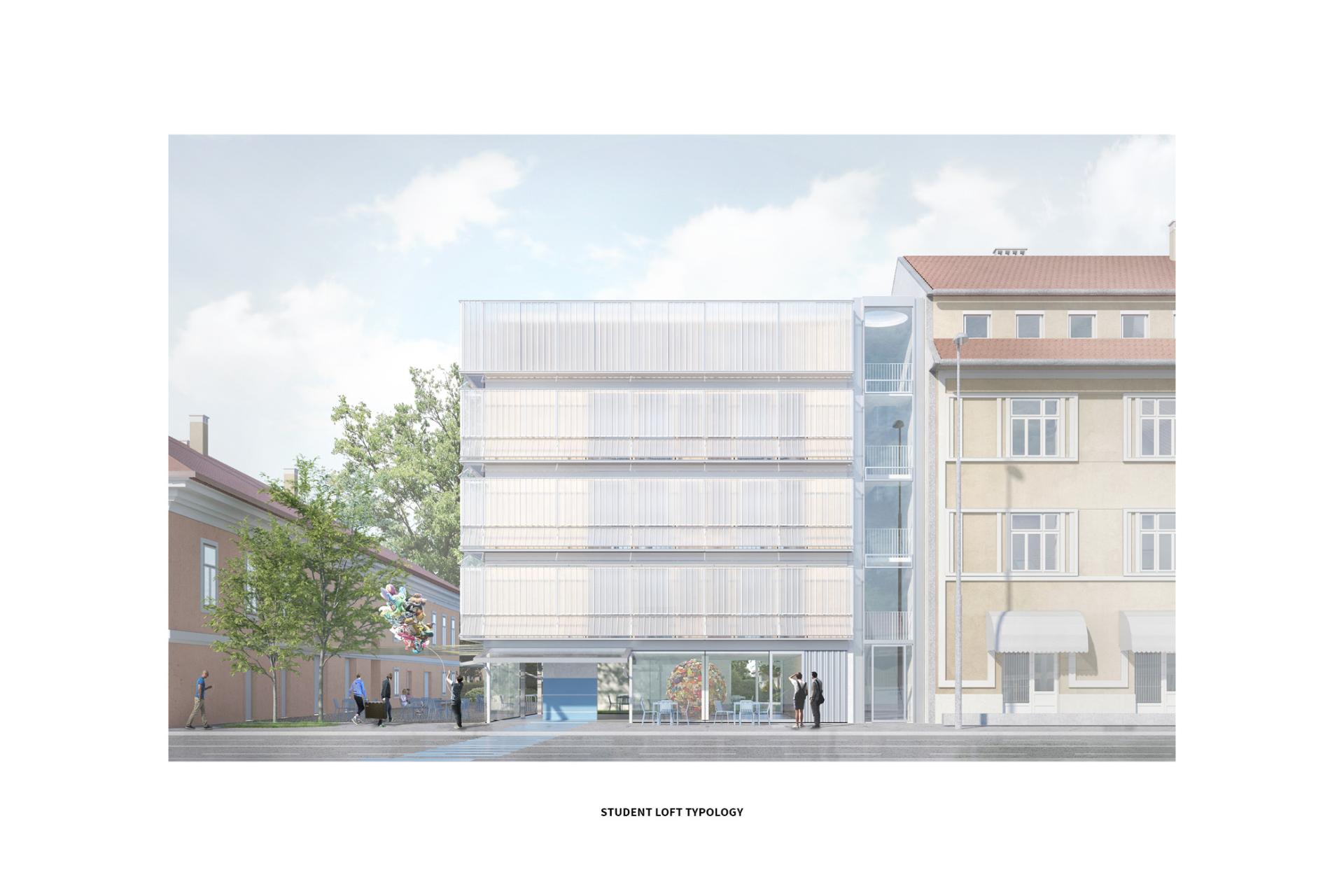
3 FUNCTIONING OF THE BUILDINGS – Student dormitories are designed in a way that they could adapt to different environmental situations. Façade envelope of student dormitories is thus functioning as an instrument for regulation of atmosphere of interior of the building. With opening or closing the façade flaps, inhabitants can regulate natural air ventilation and temperature of interior spaces.
Key objectives for aesthetics and quality
Fragmented and neglected urban spaces are inappropriate to live in, they do not encourage gathering, socializing or any other social activities. Consequently, they are intended solely for transition or utilitarian functions. Interventions of new student dormitories are placed in the context of such spaces, which are today undesirable by the citizens and therefore uninhabited.
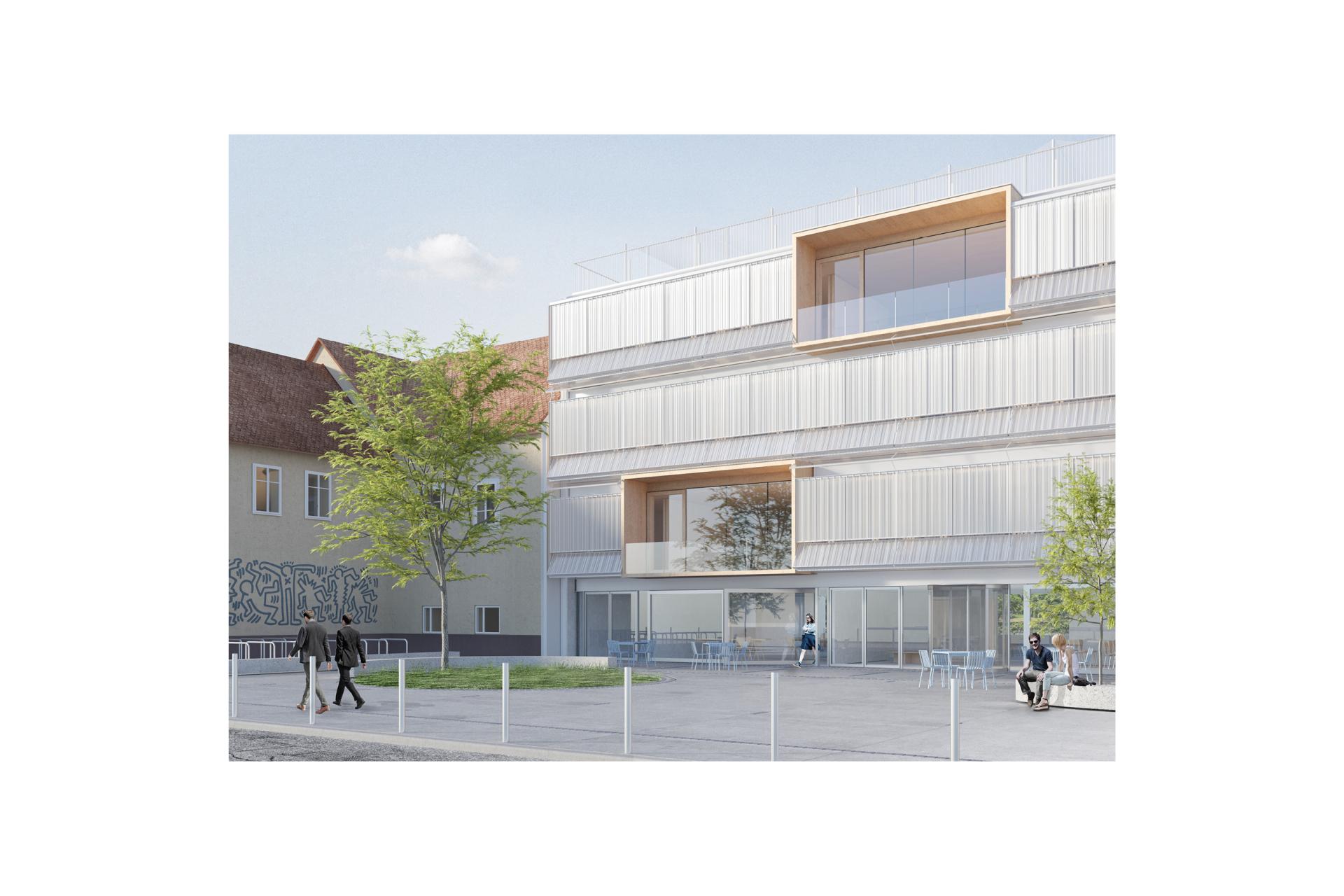
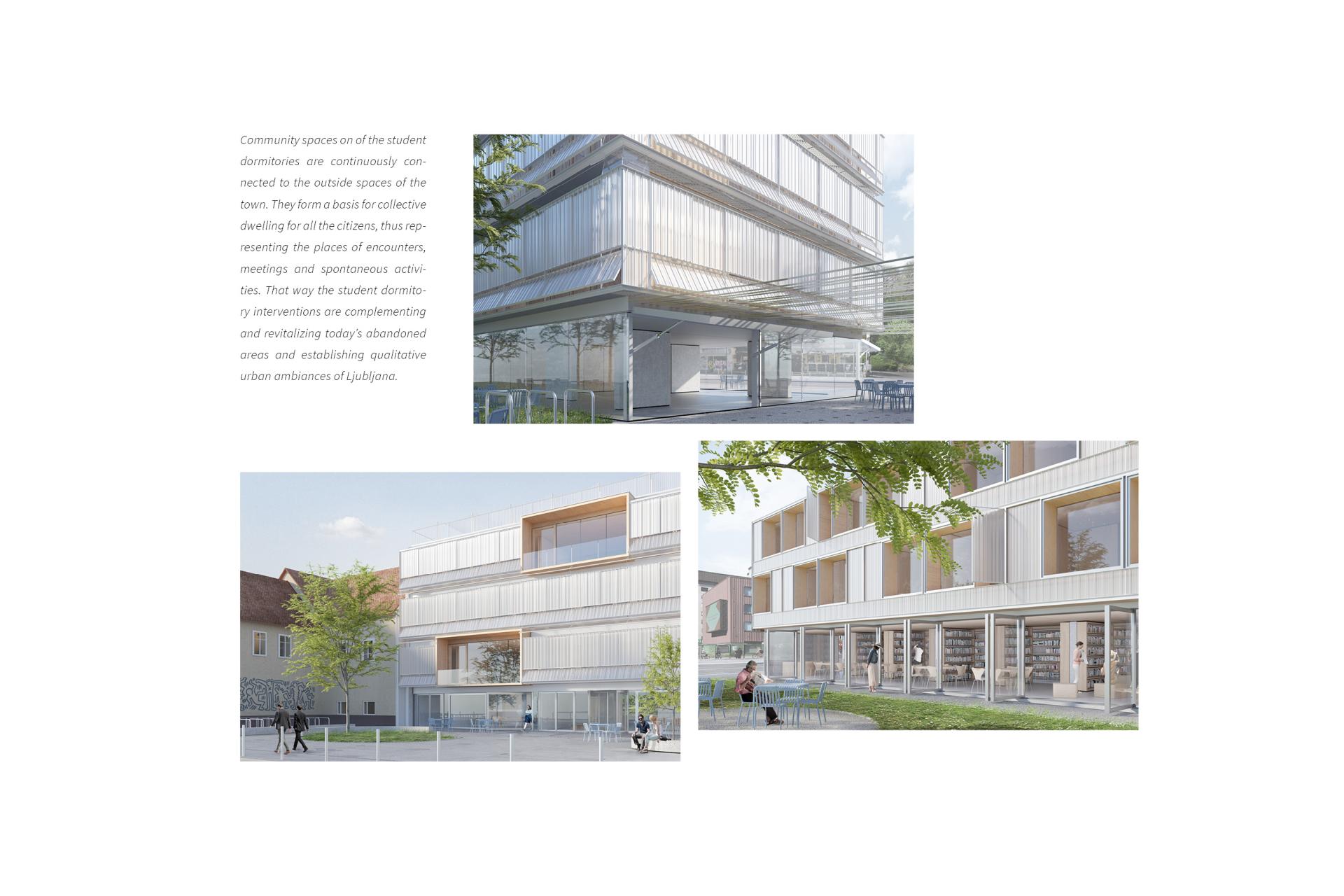
1 COMPLEMENTATION AND REVITALISING OF UNATRACTIVE AREAS OF THE TOWN – Interventions of student dormitories are completing unfinished and fragmented urban structure, connecting it into the new corelated entity. The student dormitories interventions are complemented with quality outside public spaces intendent for all the citizens.
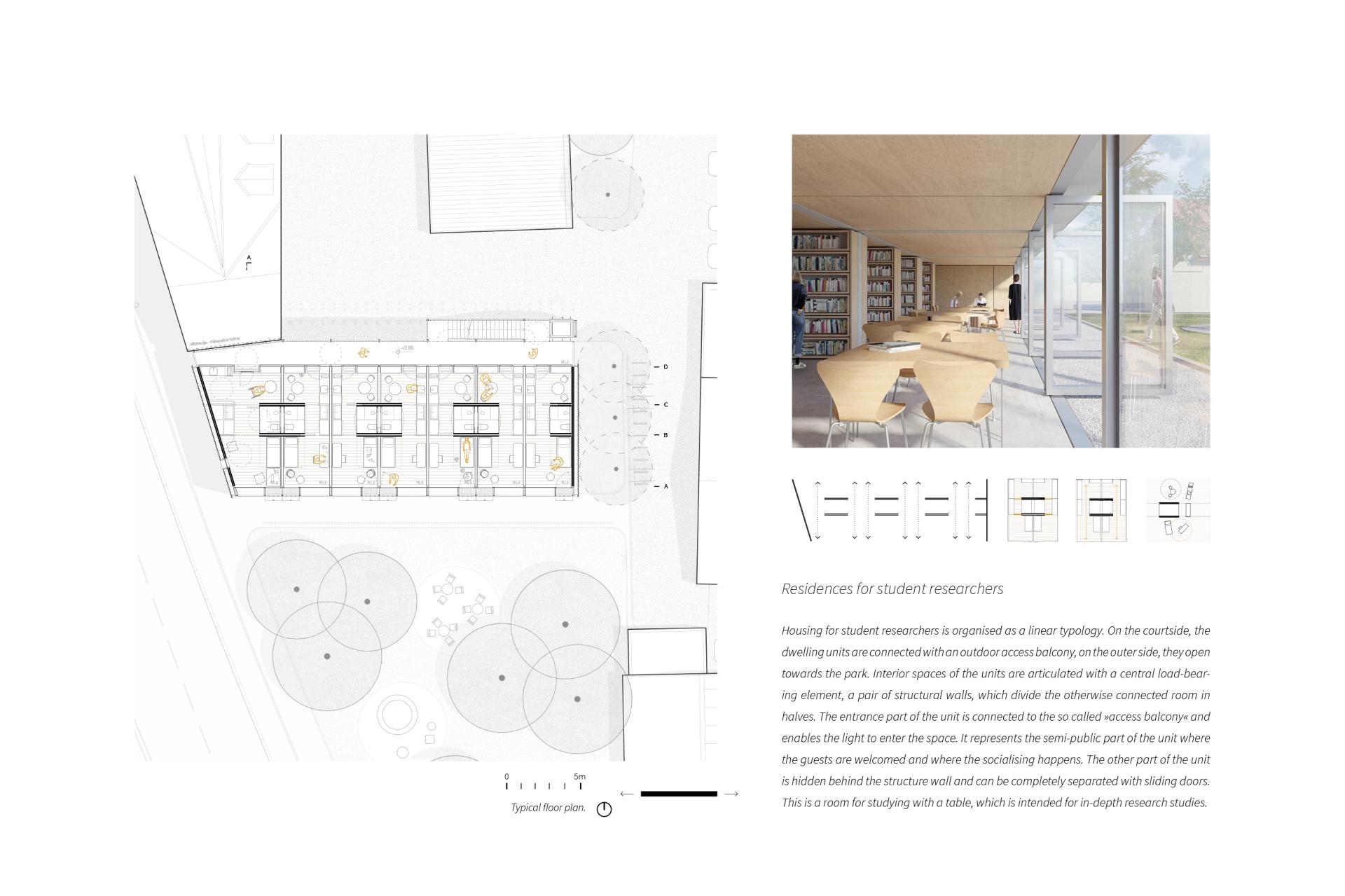
2 AMBIENCE OF INTERIOR SPACES - Important aspect of the project is also the design of interior spaces of the student dormitories. They are designed as bright, flexible spaces that are encouraging different activities, spontaneous interactions and socialising. The design of the space brings to the fore the fact of living in a community. The ambiance of the space is thus created by the people, that are inhabiting it, with their constant improvisation, spontaneity, their collective activities and socialising.
Key objectives for inclusion
The project study is based on providing housing for students - one of the society's weakest social groups.
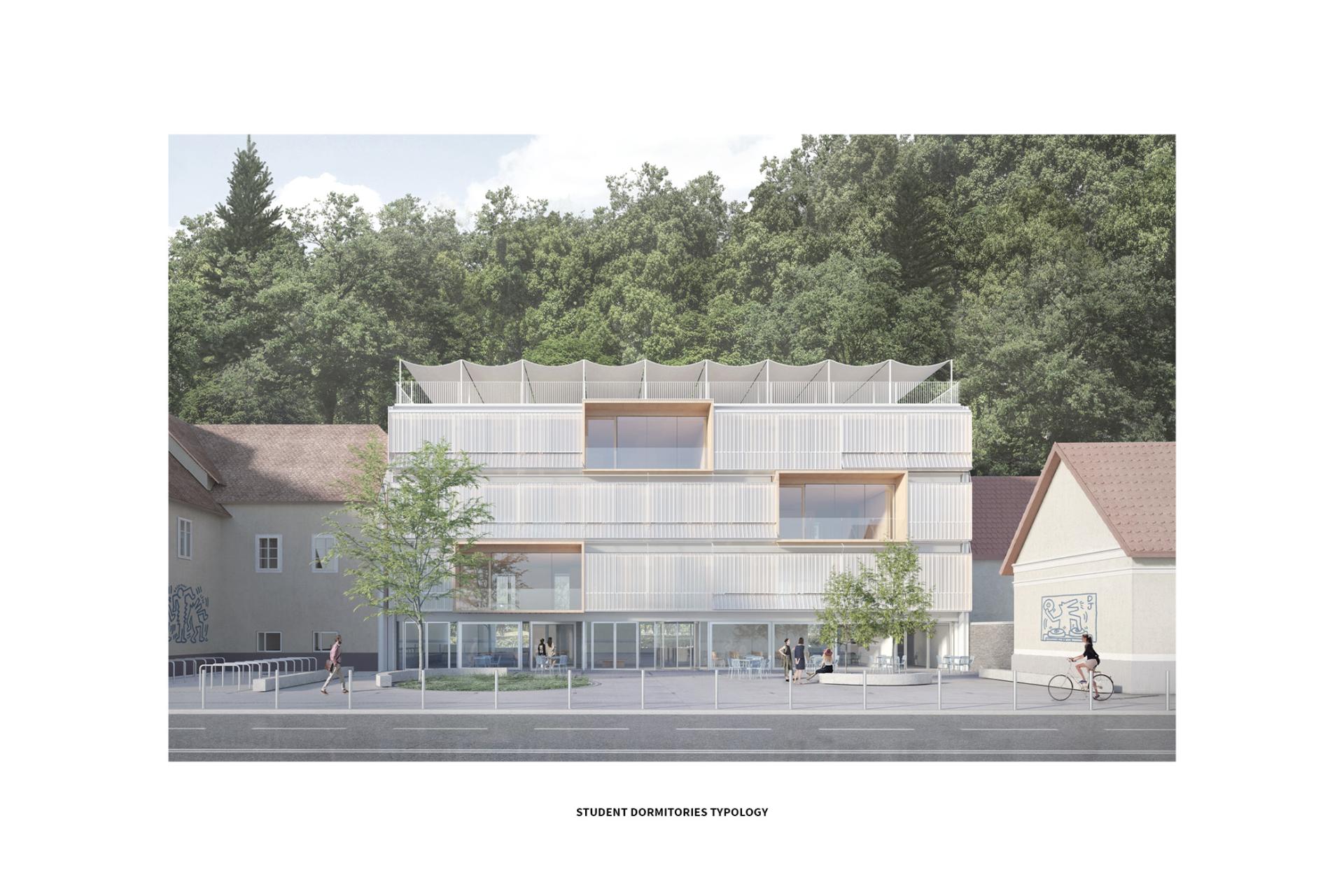
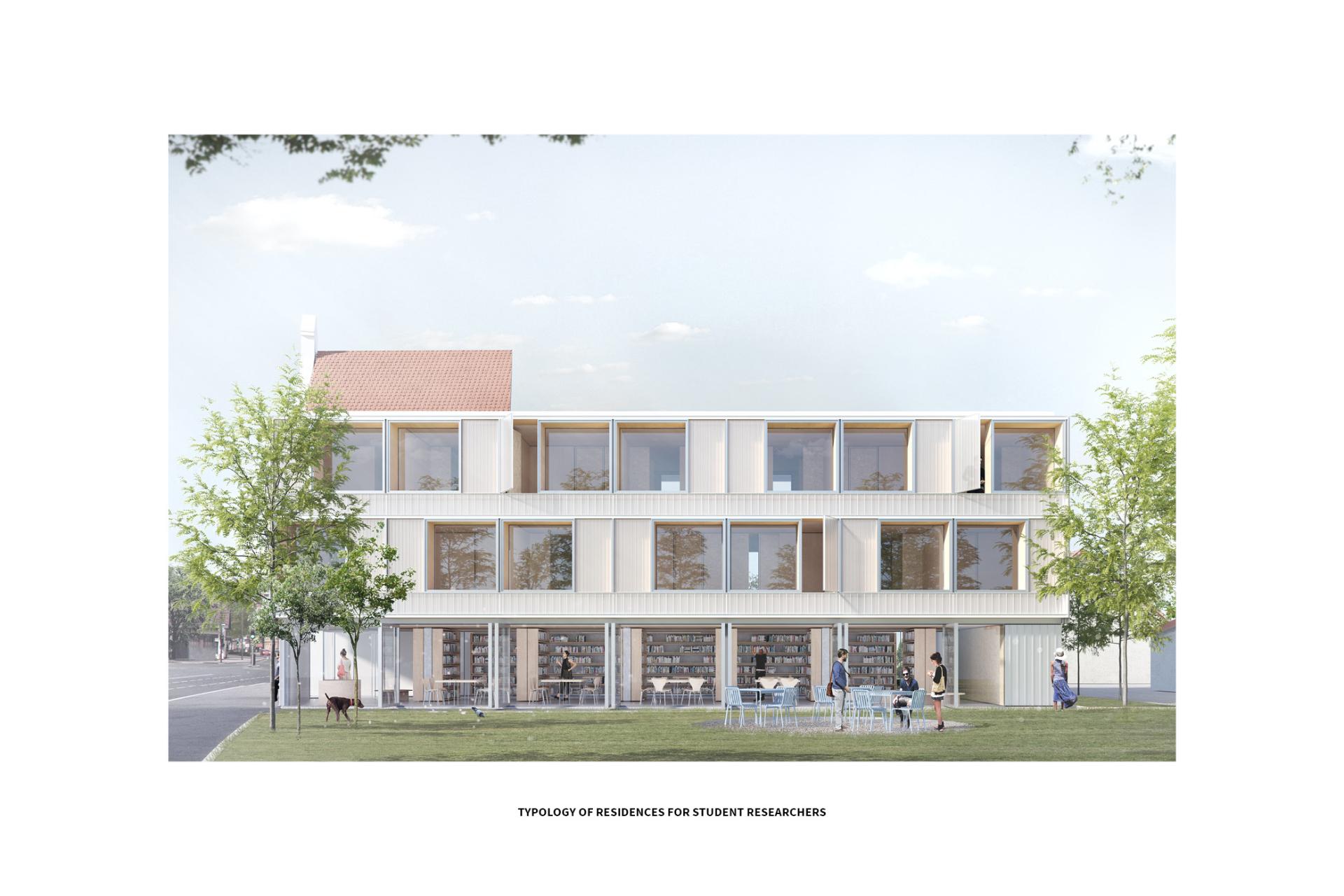
1 INCLUSION OF STUDENT COMMUNITY INTO THE TOWN - Through community spaces, student dormitories interventions open into the town space and thus enrich it programmatically. The new public spaces of the student dormitories are intended for both students and people of the local community. They are establishing the places of encounters, gatherings and thus the basis for the collective dwelling for all the citizens.
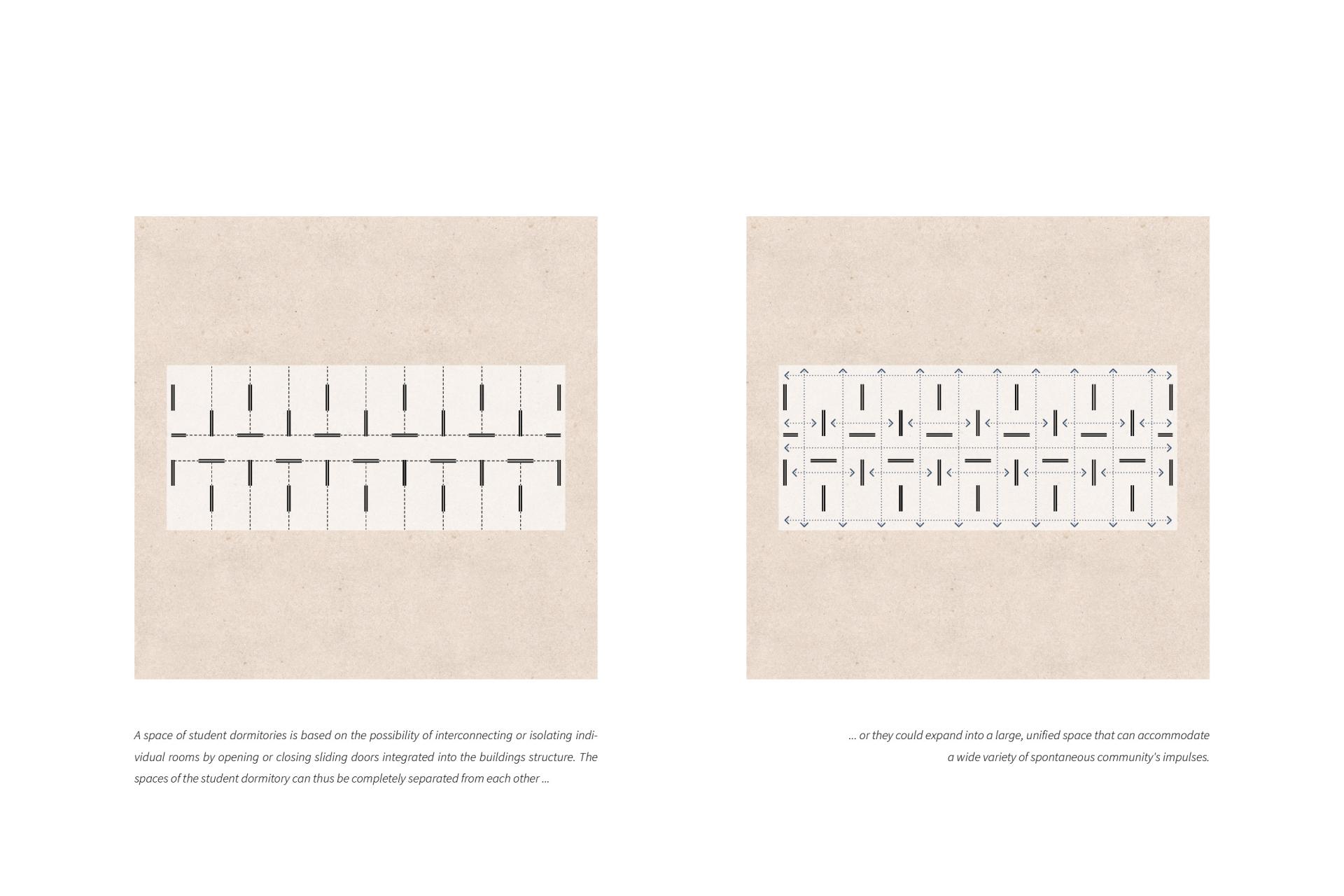
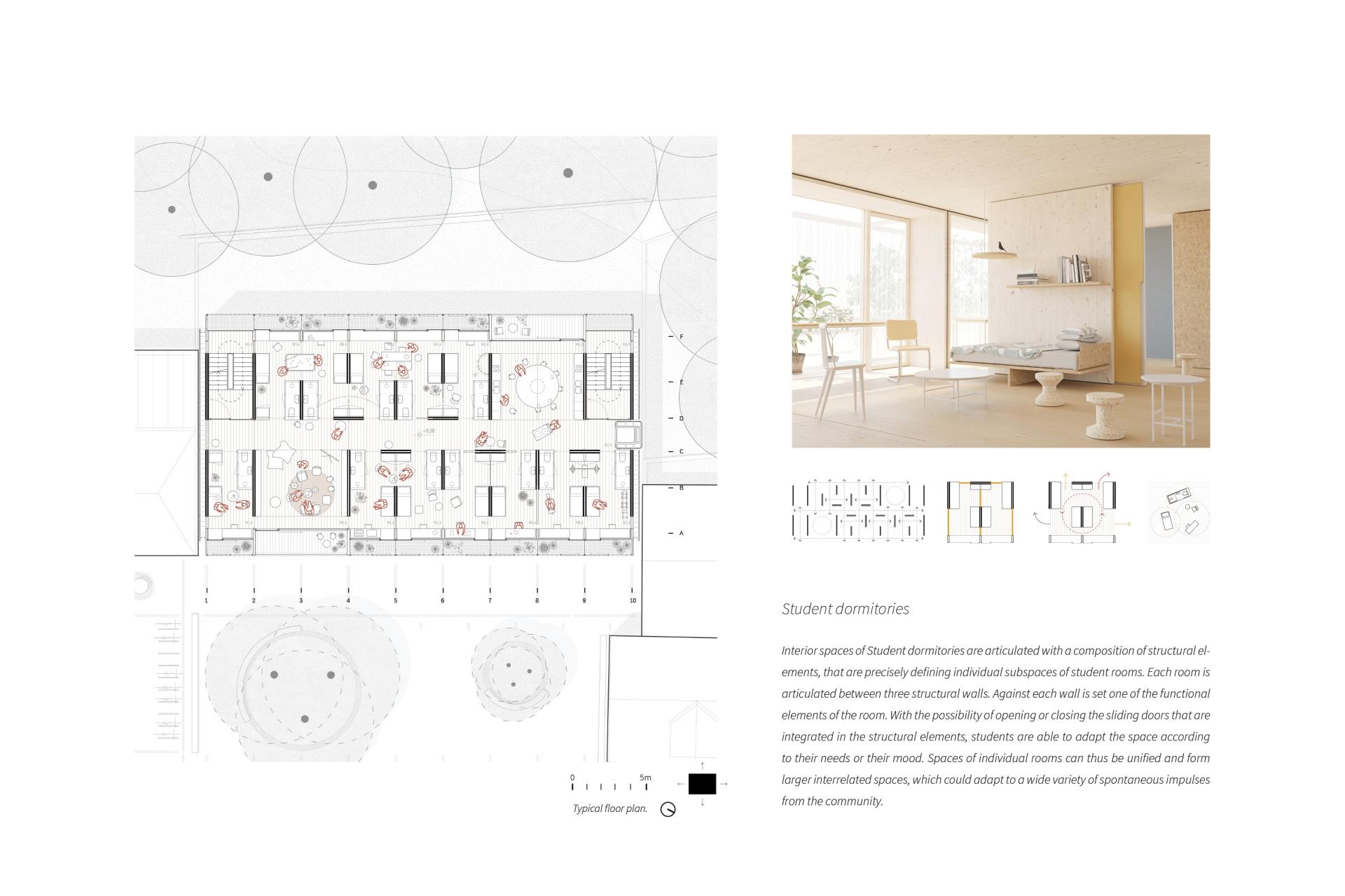
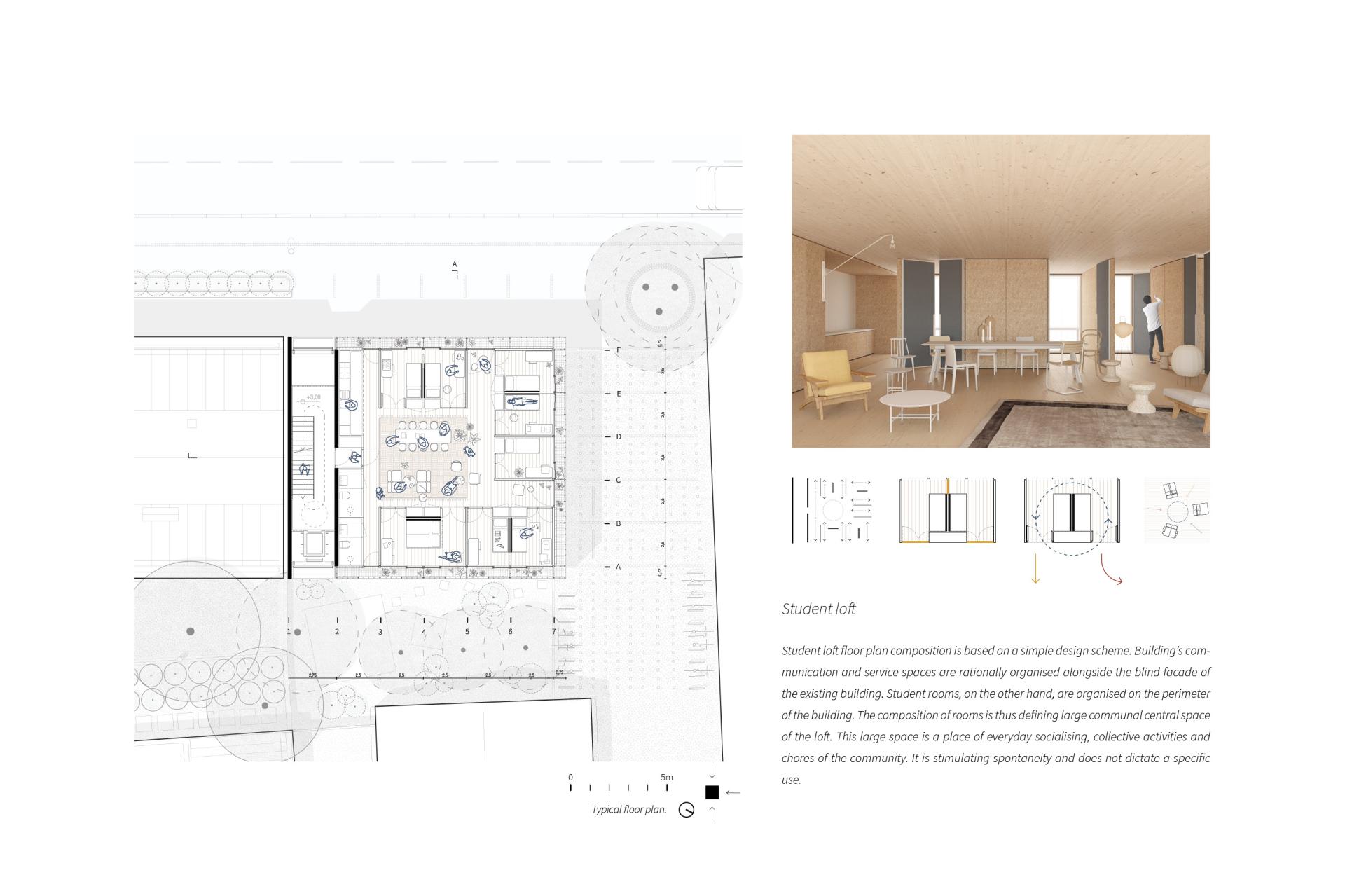
2 DESIGNED FOR LIVING IN THE COMMUNITY - The entire structure of student dormitories is designed in a way that enables and even encourages the basis for the communal living of students. Students are able to adapt the space according to their needs or their mood. Spaces of individual rooms can thus be unified and form larger interrelated spaces, which could adapt to a wide variety of spontaneous impulses from the community.
Innovative character
1 SIMPLE AND EFFECTIVE MEANS FOR COMPLEMENTATION AND REVITALISATION OF FRAGMENTED TOWN STRUCTURE
2 PREFABRICATED CONSTRUCTION SYSTEM THAT CAN BE ADAPTED TO SPECIFFIC SITUATIONS WITH UNIQUE SPATIAL CONDITIONS
3 REDEFINITION OF ORDINARILY CLOSED STUDENT HOUSING TYPOLOGY
4 DESIGN OF THE FAÇADE ENVELOPE FOR STUDENT DORMITORIES THAT IS FUNCTIONING AS AN INSTRUMENT FOR REGULATION OF ATMOSPHERE OF THE BUILDING’S INTERIOR