The Urban Seeding Process in Rijeka
Basic information
Project Title
Full project title
Category
Project Description
The Urban Seeding workshop is conceived as a situational design and planning based on the interdisciplinary composition of groups and meant to regenerate urban areas applying the principles of the circular economy in heritage adaptive reuse. By onsite analysing deprived areas and highlighting heritage regeneration needs in line with social opportunities, the workshop generate low-cost implementation ideas (the seeds) easily replicable in an urban calendar, ranging from restoration to regreening.
Project Region
EU Programme or fund
Which funds
Other Funds
CLIC PROJECT - Circular models Leveraging Investments in Cultural heritage adaptive reuse (2018-2021)
European Union’s Horizon 2020 research and innovation programme, Grant agreement No 776758
Description of the project
Summary
Urban Seeding is a sociocultural and planning tool, based on spatial experimentation and multi-stakeholder inclusion, developed by the University of Nova Gorica and the City of Rijeka, as a bottom-up tool for the implementation of the Cultural Corridor Model, an integrated urban system and a model for a sustainable regeneration of inner cities and urban deprived areas, adopting the culture and cultural heritage enhancement as a cross-leading principle for the adaptive reuse of urban voids, abandoned buildings and underused infrastructures.
The conceptual approach merging the UNESCO Historic Urban Landscape with Circular Economy and cultural heritage adaptive reuse and renovation highlighted gaps of conservation doctrine and its practice and the circular economy contradiction to the traditional linear economy accustomed daily everywhere. Having witnessed younger generations awareness of new trend and their willingness to engage and contribute towards greener and more sustainable behaviours, the students in their final year and young professionals were invited to participate in the urban seeding process in Rijeka.
Envisaged as a versatile and dynamic process, acting as a catalyst for urban revitalisation through a systematic step-by-step, co-planning, co-design and implementation of low cost and small scale interventions called urban seeds, which densification and diversification of the actions and programs offered would attract people to adopt space as their place, the Urban Seeding in Rijeka was implemented through architectural-urbanist workshop methodology with the support of the University of Rijeka and DAR- Architects Association of Rijeka from March to July 2020.
Key objectives for sustainability
The urban seeding process in Rijeka aiming to achieve enhanced urban space and quality of life within the inner-city, addressed sustainability on different scales:
1.) Bridging the local knowledge gap on sustainability and circularity, including the importance of local heritage preservation and integration into urban development, the workshop aimed at capacity building of future spatial planners, designers, managers and builders, enabling their future employment opportunities and commitments.
2.) Create a space for coexistence of Circular Economy activities and development of business initiatives focusing on the sustainability and resilience of the territory; Introduce the UNESCO HUL approach and reuse the fundamental cultural heritage assets within unique urbanscape.
3.) Adopting a more holistic approach, including not only tangible and intangible cultural heritage assets and urban heritage, but also citys' urban natural and green assets, addressing their improvement with eco-remediation and more sustainable approaches as a core of situated learning process aiming to achieve The Cultural Corridor. Additionally, the CLIC Project's constraints and the participants' perception were to pay specific attention to nature, health, well-being, and inclusion; which outlined circular spatial corridor from the city's waterfront towards the city's rivers inner canyon, and back, where circular economy and cultural heritage adaptive reuse experimentations could be tested and replicated. Furthermore, boosting the city sustainability by improving its inner urban accessibility and introducing re-greening solutions to bring more green into the dense urban landscape of Rijeka was considered.
Key objectives for aesthetics and quality
In the participative processes, transparent and just guidelines throughout the process are needed to ensure a positive, implementable and aesthetic outcome.
In the Rijeka Urban Seeding case, the youngsters committed to replanning and co-designing the urban core were mentored to integrate appropriately the new topics that were presented throughout the process (Historic Urban Landscape, cultural heritage preservation and adaptive reuse, circular economy, sustainability, nature-based solutions, ...) with their curriculum knowledge, thus following the design thinking pattern. This is how the proposals evolved in more detail to a level where some could be immediately implemented and tested, followed by evaluating the proposal common use. On the other hand, some proposals were more complex, required greater city t and city utility services companies involvement, thus more coordination for successful implementation and testing.
The participants, city administration, and both universities involved in the process found this type of urban heritage regeneration approach innovative in this part of the world and appreciated the experience.
Though the initiative, regrettably, severely modified due to the pandemic, having postponed the physical implementations of the feasible proposals in urban space, demonstrated a good methodology for participatory, co-creative and replicable low-cost solutions, attracting new uses in more sustainable, environmentally friendly and creative urban space.
Furthermore, even though not fully implemented, the pilot project showed a good balance in stimulating sustainable solutions respecting the design, which is the fundamental factor in enhancing and preserving the historic urban landscape.
Key objectives for inclusion
The workshop encouraged a multidisciplinary approach, giving participants from various fields the opportunity to work together, design and partly co-develop the Cultural Corridor. Capitalising the citizens and stakeholders vision on the revitalisation potential of the Cultural Corridor area, tested through urban seeding, the process was realised including the following principles of inclusion and integration:
1.) Recognising the local knowledge, diversity and practices, assets, history and stories, as well as local needs as crucial elements of the co-creative process.
2.) Encouraging the citizens and stakeholders to engage in the process on a multi-level enables complex spatial and cultural investigation and generation of ideas.
3.) Acknowledge the experimental engagement process results and find ways to integrate them into long-term urban planning and spatial improvements.
4.) Offer a possibility for wide collaboration through different participation channels, thus encourage the local initiatives for more inclusive participation in district improvements, spatial decision making, environmental impacts studied and regulatory frameworks.
5.) Support collaboration by inviting/including citizens to co-design and co-create space, together with ECoC 2020, cultural institutions (public and private) and other CSO’s and NGO’s, which are/or can be facilitating the change.
6.) Foster spatial implementation transparently and create conditions for long-term community maintenance expressing commitment.
Results in relation to category
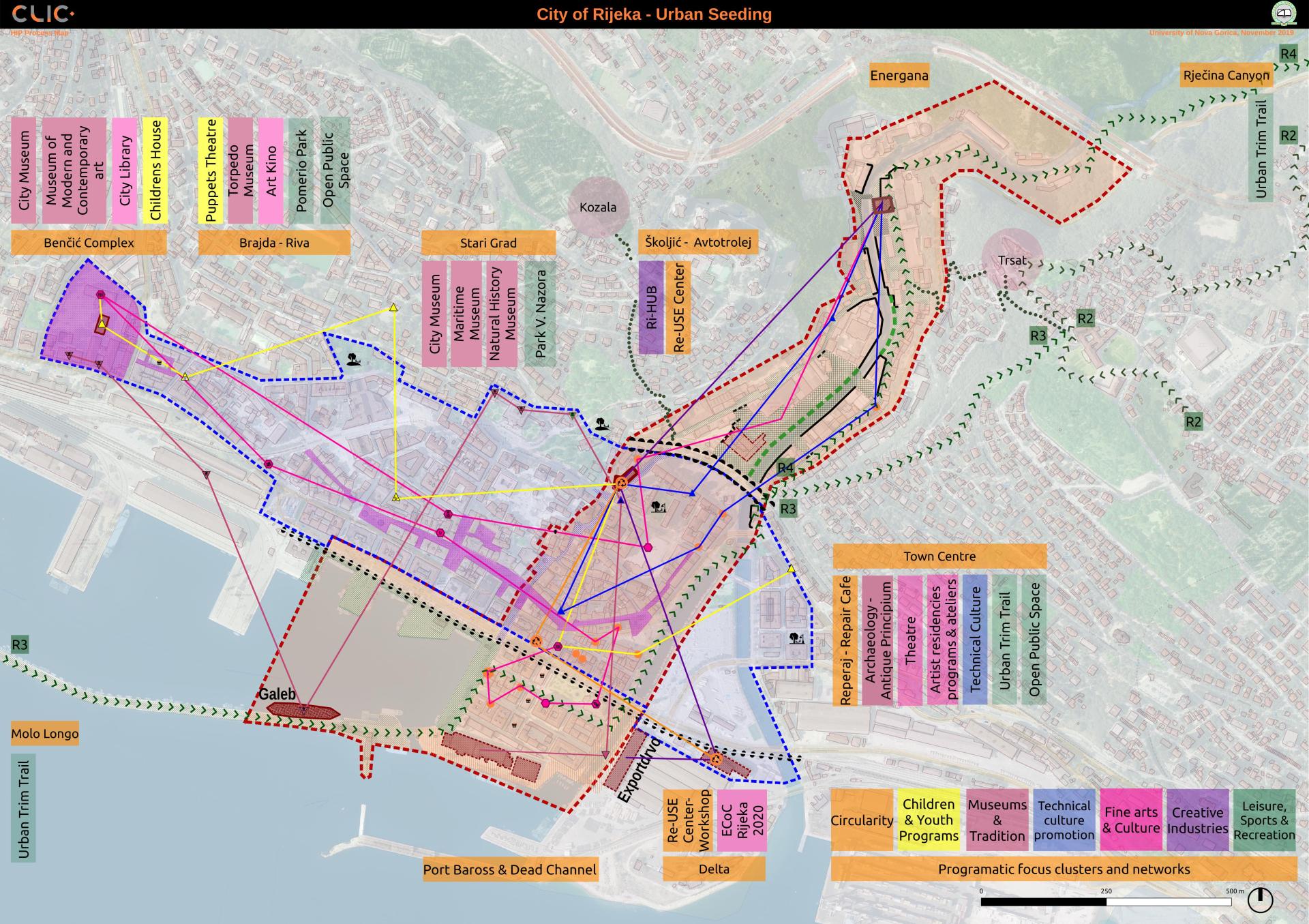
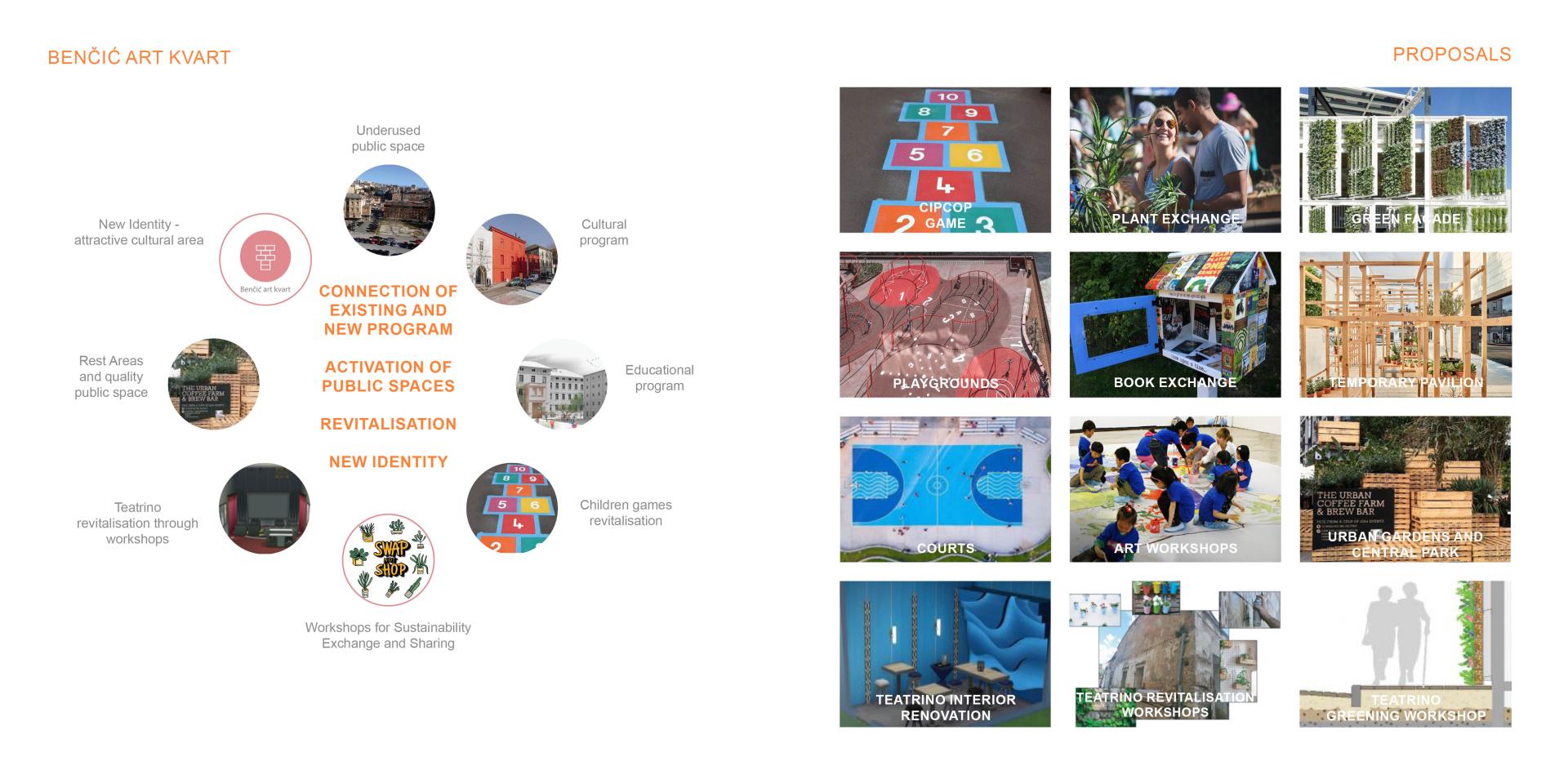
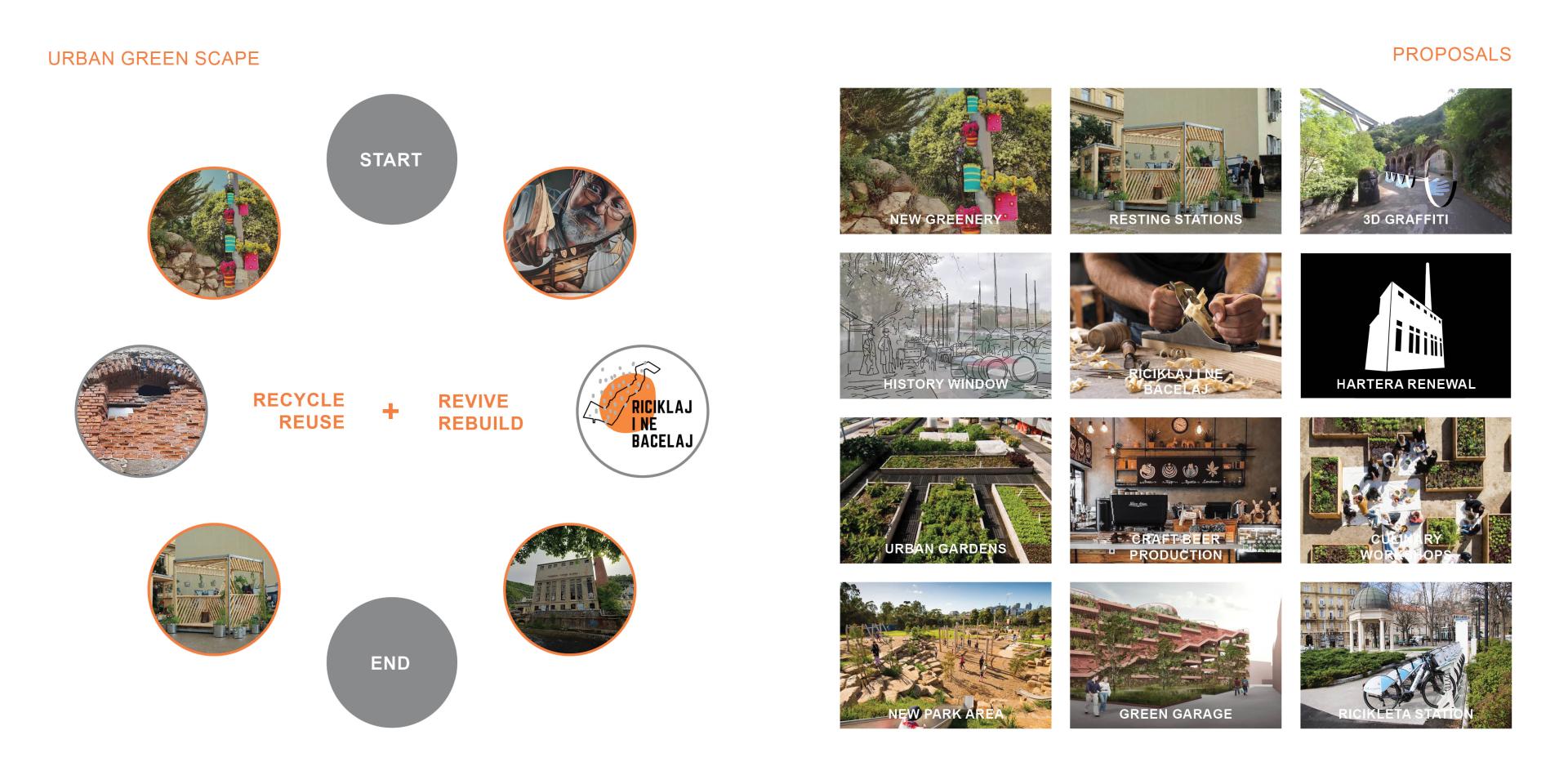
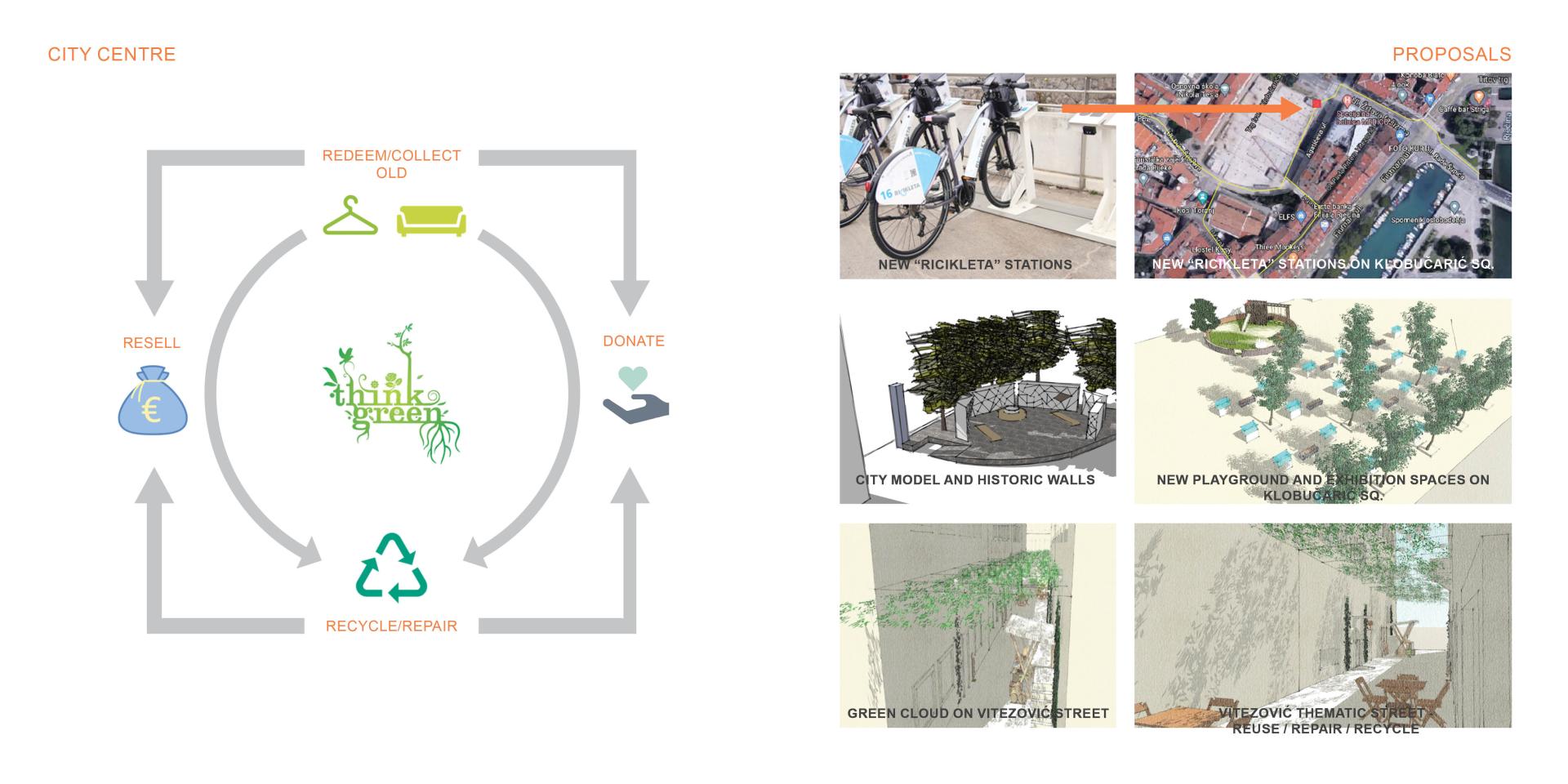
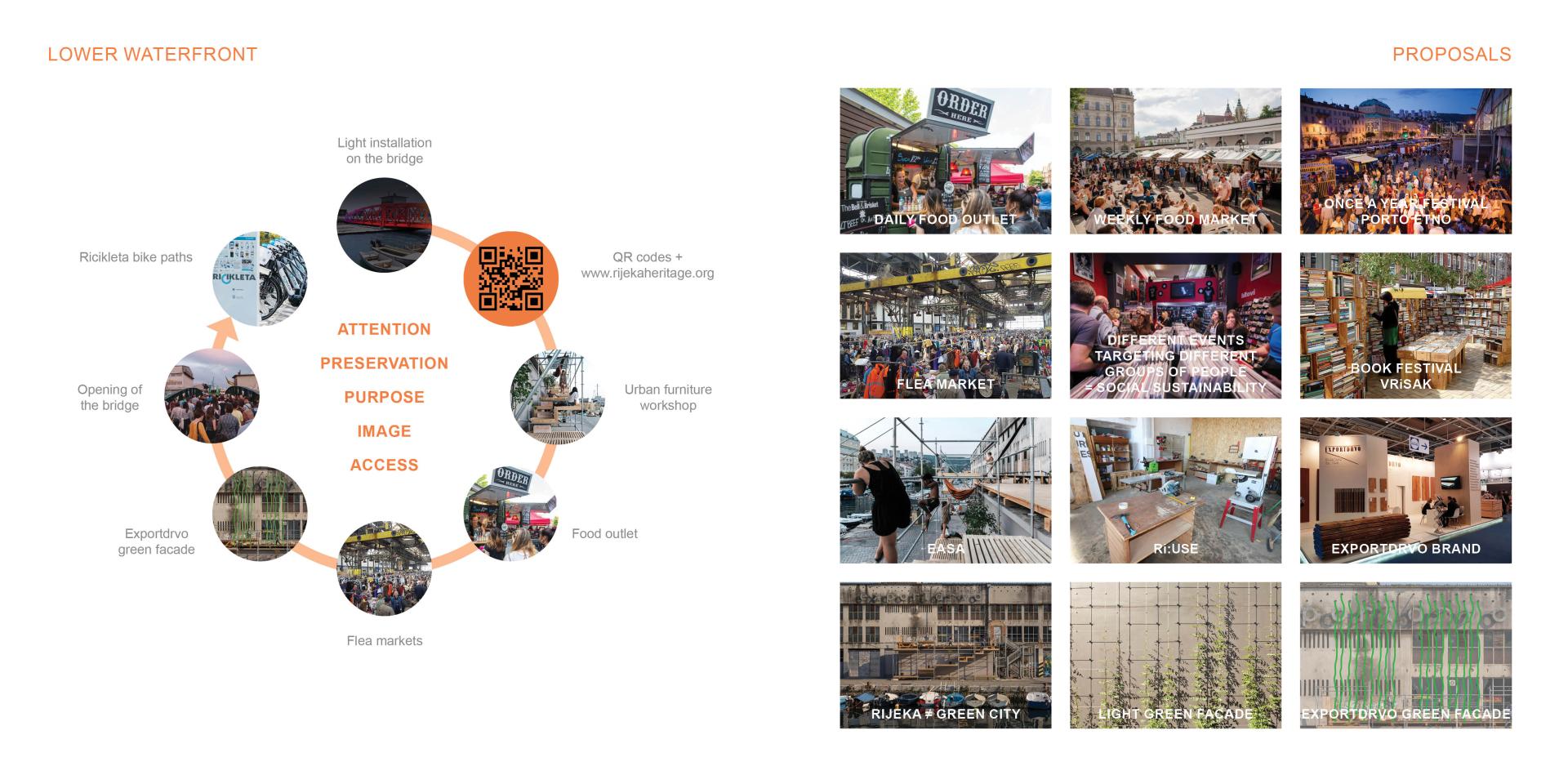
The multidisciplinary teams formed of University of Rijeka’s students (civil engineers, designers, economists) in their final year and DAR-Architects association of Rijeka’s young professionals (architects) developed several proposals for five different areas within the Cultural Corridor addressing the specific spatial issue and social-economic-cultural topic within interactive weekly workshop meetings from March to July 2020. This is how the tasks were becoming more defined weekly and gradually integrating: 1. urban/spatial dimension, while considering urban and public spaces and their connectivity and accessibility; 2. circular dimension concerning cultural heritage on three scales (urban, building and object); 3. cultural and natural assets within environmental integration, awareness-raising and positive env. impact; 4. social-economic-cultural dimensions by empowerment through social activation and sharing economy. Establishing a clear-thinking pattern incorporating these notions, the groups' proposals were integrated from object scale to building scale and urban vision and within groups (addressing the connectivity, accessibility and distribution).
The proposals offered solutions compatible with those already implemented in the city, which are low cost, replicable, and respecting the city centre's urban heritage. Additionally, the groups elaborated a long term vision for the area. This is how the proposals matched the vacant cultural heritage with existing and new programs or actions, upgrading as well the spatial and green urban system and natural assets in Cultural Corridor. The participants also self-evaluated on prioritisation of the proposals based on the impact on the circularity and cultural valorisation and on the feasibility of implementation in terms of available skills, time-frame (short/mid/long term) and costs. They mapped possible stakeholders (actors), which could facilitate the process, considering the main services they offer.
How Citizens benefit
The urban seeding process in Rijeka presented several benefits for the citizens/participants and the City of Rijeka:
1.) Stemming from the urban living labs or communities of practice, where individuals from different background jointly work on the specific spatial issue and offer their expertise for shared use, the urban seeding in Rijeka, while focusing on urban heritage revitalisation and creation of cultural corridor, it was essential to include appropriate participants with specific skills and motivation for their future long-term commitment through employment opportunities and career achievements. Conducting an intense research on urban issues of the cultural corridor area and applying circular economy to the culture and cultural space’ main objective was to open an investigation and discussion of potential new business models and job opportunities promoting circular-economy entrepreneurship.
2.) The learning-by-doing dimension of urban seeding stipulated the confrontation with the asset in the area, where the participants had to identify the need for co-design, investigate its spatial and historical stratigraphy and generate ideas through interdisciplinary debate, aligned with the sustainable circular city and stimulate the local culture and promotion of cultural and natural heritage valorisation.
3.) Stewardship is another beneficial concept in the process, as every urban seed success depends on the main actors' capacity and capability to monitor, promote, and protect the tangible and intangible results in the long term, enabling stronger citizens engagement.
4.) With urban seeding implementation, the city also benefits the citizens' vision of using the urban spaces and acquiring possible experimental projects that can test the new spatial uses together with the citizens.
Innovative character
The initiative of Urban Seeding was developed through the CLIC project process called Heritage Innovation Partnerships (HIPs), which main goal was heritage lead co-creation of local action plans for adaptive reuse of cultural heritage of four pilot cases of CLIC. In Rijeka, the initiative developed through HIPs resulted in the creation of the Cultural Corridor Model for urban regeneration and tools supporting its implementation. One of these tools was the Urban Seeding Workshop, which embraced the young citizens' vision of how they perceive, use, and envisions future space use through a co-creative process.