A cloister for the Science Park
Basic information
Project Title
Full project title
Category
Project Description
The cloister
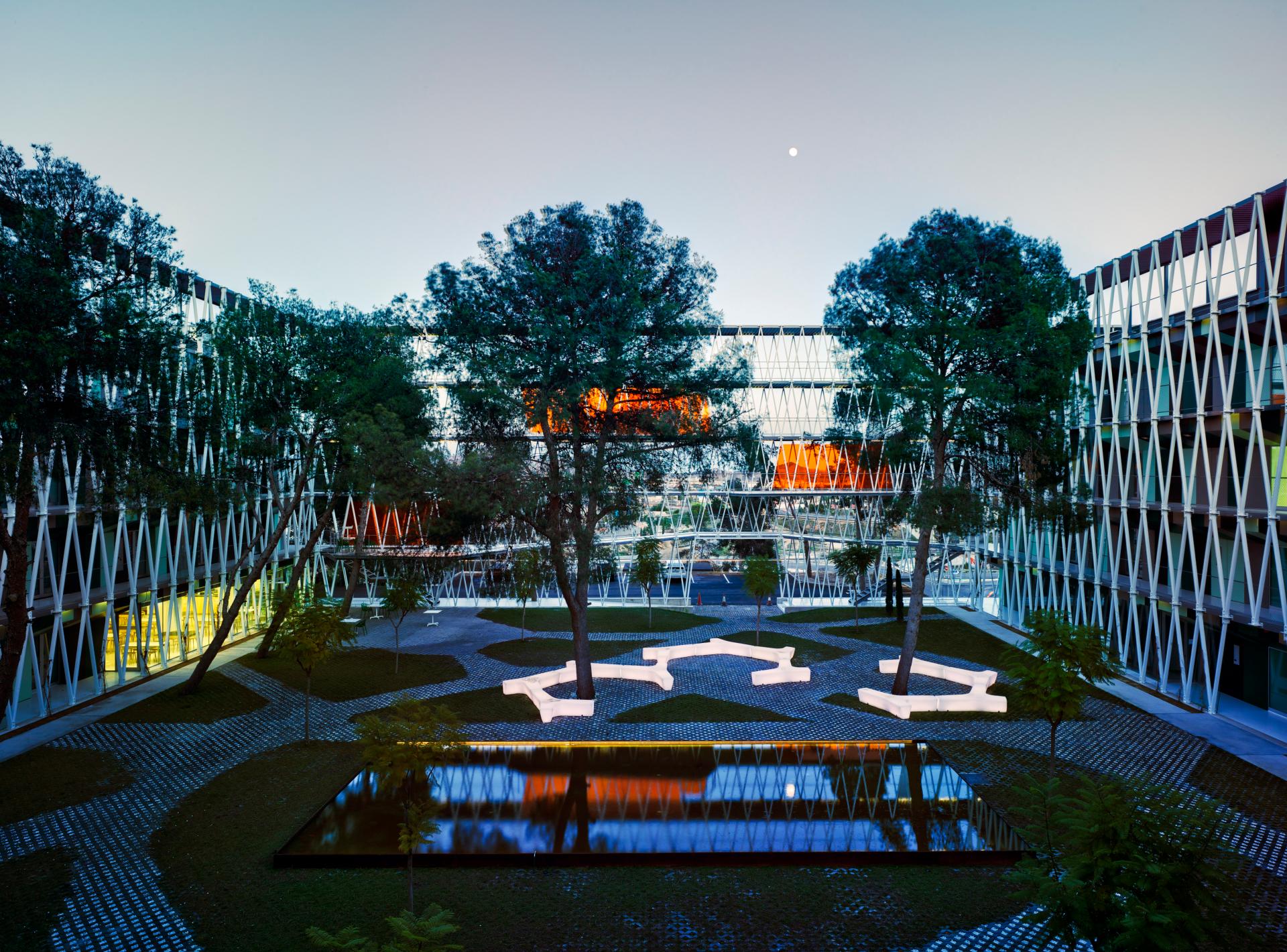
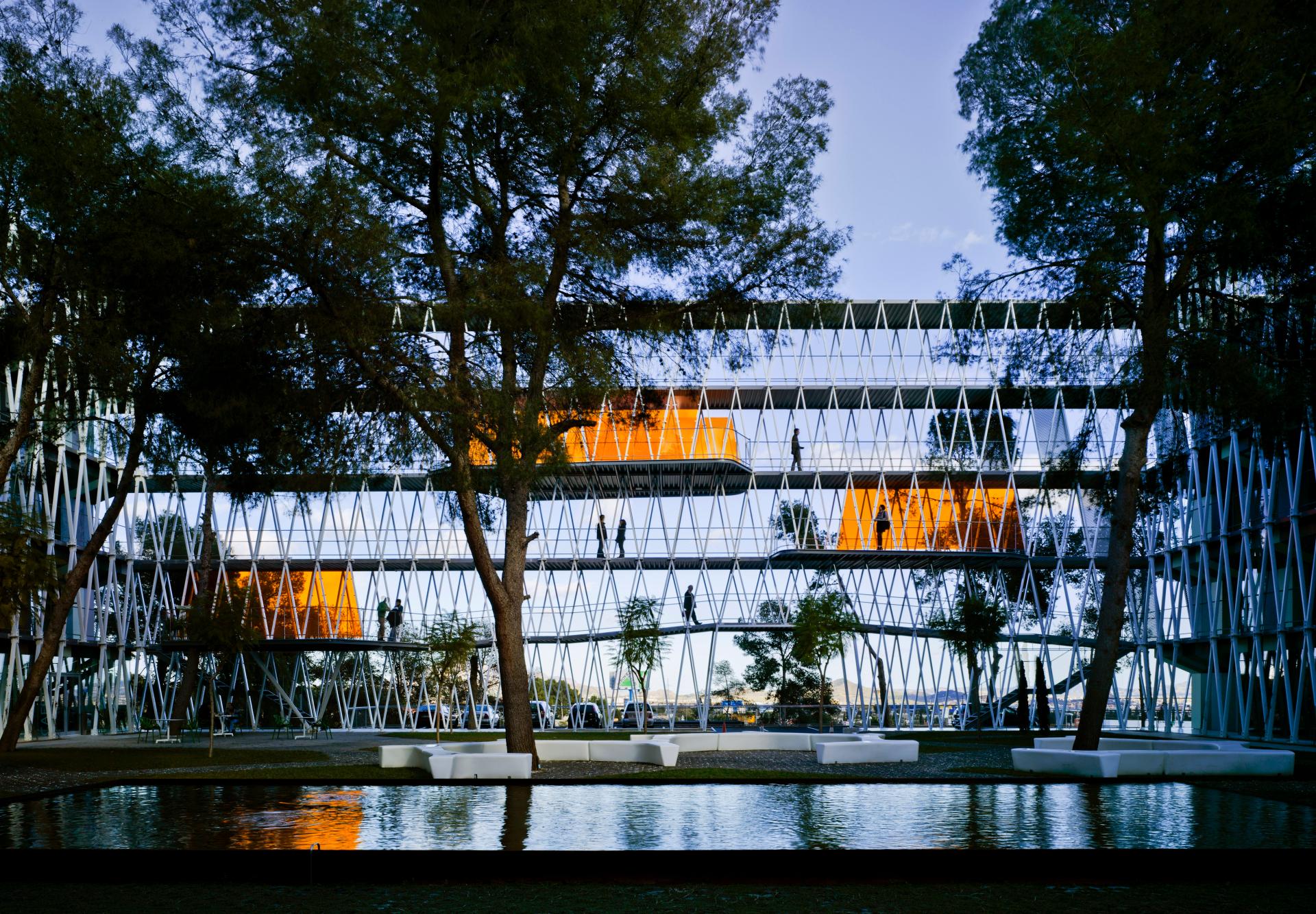
We have created a peaceful, quiet, welcoming space, where Nature itself becomes a space for reflection on our relationship with it.
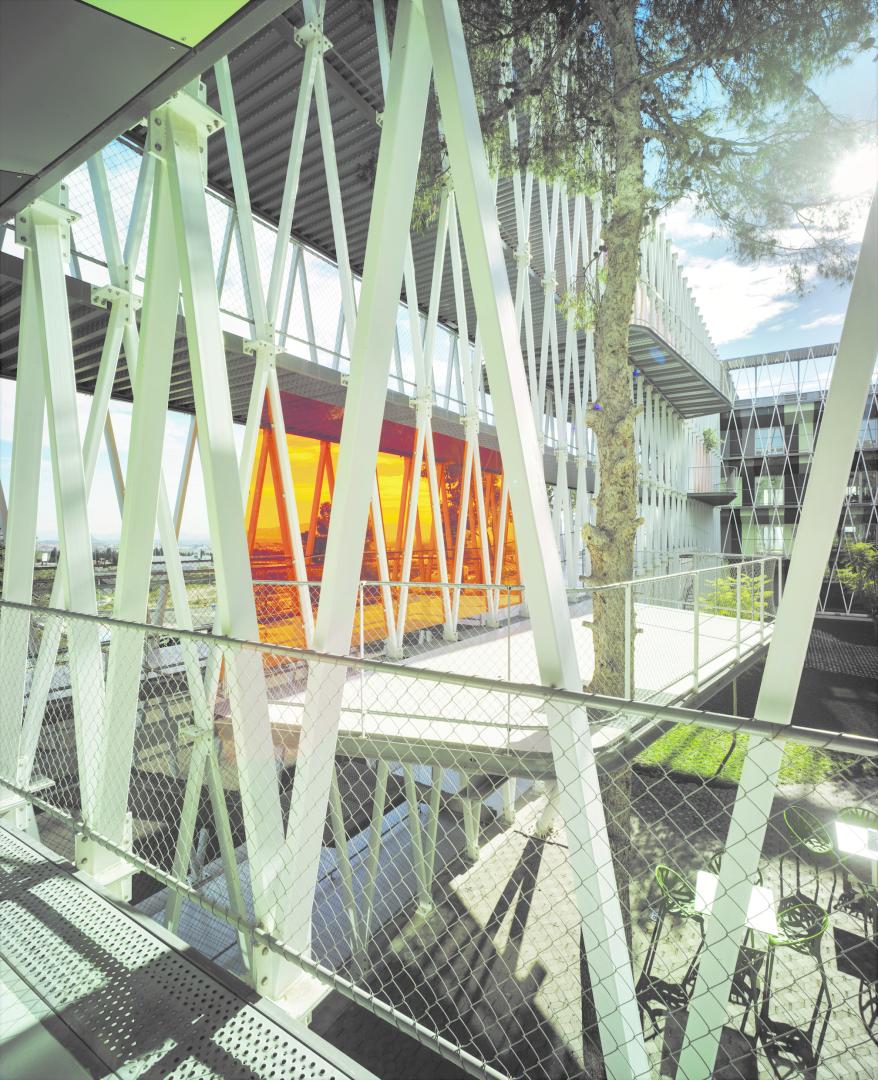
Where it is possible to walk or work among the treetops, giving character to the companies that are installed there.
Where humans and non-humans complement each other, establishing a new form of mutually beneficial relationship.
Where new synergies can be built between researchers and entrepreneurs and between citizens, students and companies.
Project Region
EU Programme or fund
Description of the project
Summary
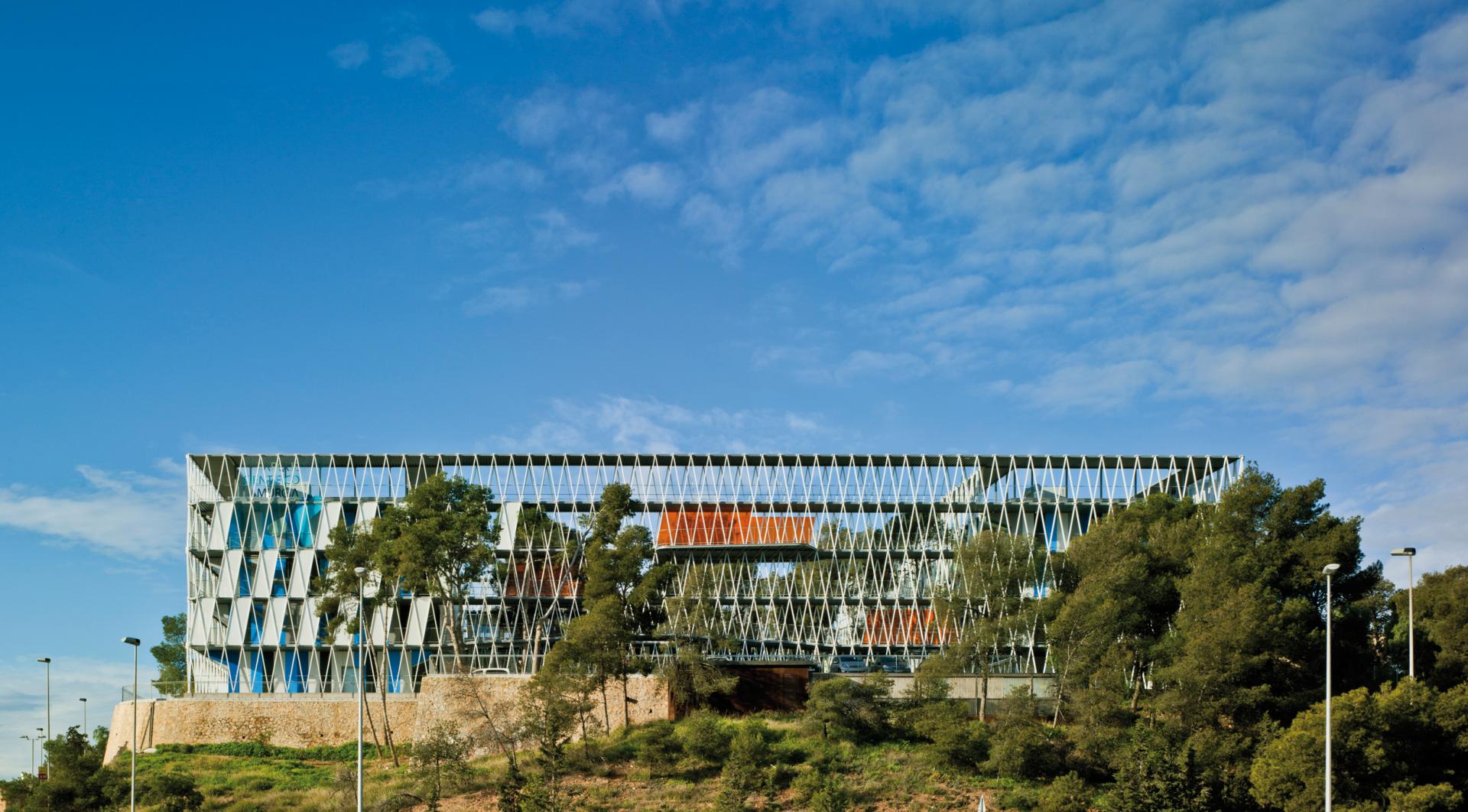
The centre was built on 3 old buildings of a former psychiatric centre located next to the university of Murcia. The project maintains and enhances the nature of the site by inserting the buildings within the Mediterranean forest and creating the precise mechanisms for their hybridisation. The programme, which enables the setting up of companies in areas from 50 to 300 sqm, is fulfilled by means of the flexibility granted by the modular use and facilities easily accessible from the façade and connected to the cover.
The cloister. We imagined a quiet, secluded, pleasing space. The term “Cloister” is related to Reflection and clearly tainted by the spirit of University. Conveyance of Knowledge and Encounter emerge as the raison d'être for the Scientific Park. That's why we presented a cloistral space open to the landscape. For this purpose the ensemble of three already existing buildings has been enclosed with as less mass as possible in a mighty gesture, which achieves the neutral essence substantial to reflexion through geometry and iteration. The structural rhythm reveals itself as a blank stave onto which we have progressively written our finds.
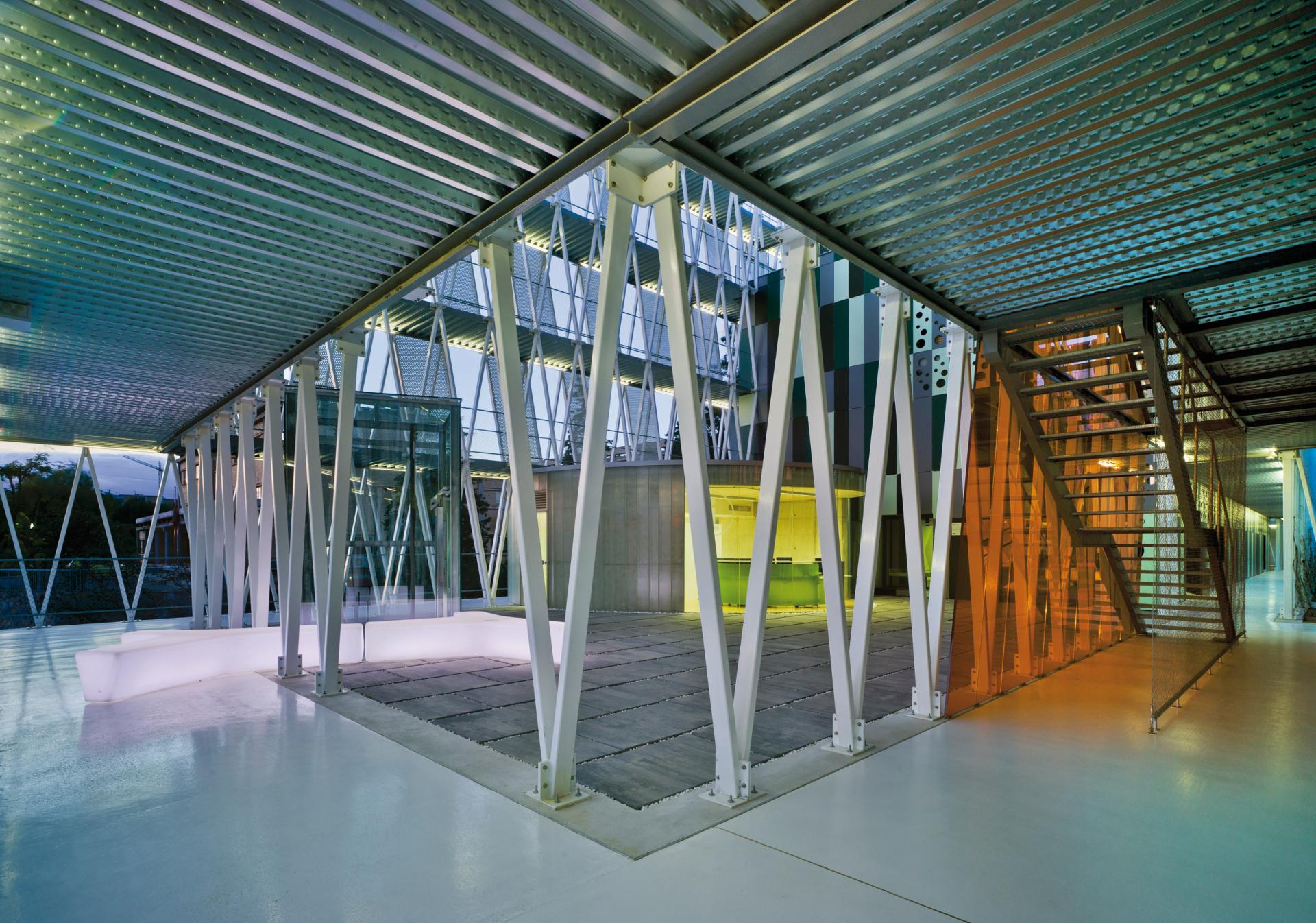
The skin. This new façade, built upon the old terraces, is a 2,10 m wide gallery which can properly asume diverse functions according to the needs of the whole ensemble. The new corridors surrounding the perimeter of the buildings widen notoriously the useful space of the inside (we fully agree with Lacaton & Vassal in considering that additional space and flexibility lead to a wider variety of likely uses in future and make the building more worthy and recyclable).
Why should we restore?. Decay represents the expression of Entropy itself, as it implies acting time and again upon the artificial nature in order to lessen its effects and restore the original levels of Information and Matter. Shouldn't this concept therefore play a decisive role in our drawing up of strategies that will affect our anthropized cities?
Key objectives for sustainability
Our cultural Zeitgeist is slowly but relentlessly transferring the cultural load from Matter to Energy and Information, a process shared alike by all the aspects implied in the production of artificial environments. The decrease in the use of matter translates into dematerialising, which can be achieved by two means:
- To reduce the consumption of matter.
- To take advantage and to reuse the available matter, already loaded with an entropic burden (and also an anthropic one, where territories are implied). This is the option proposed by our project.
To rehabilitate the existing: buildings and Nature
We support the recovery of disused buildings as a desirable line of public action, due to the savings it represents in terms of money, energy and, most important, territory. On this context, we stood for a minimum intervention which by no means should leave aside a strong unity and “brand” image.
We have reused as much available material and elements as possible. Rehabilitating old buildings or complexes avoids using new territories that can thus preserve their biodiversity.
To place the building at the service of the conservation of existing and new vegetation
The ensemble of the three existing buildings creates a courtyard, open to the east above a slope covered with pine trees which grants for far reaching views over the valley. The courtyard plays a key role in the microclimate of the ensemble as a whole. The plant cover, humidifiers and a water table added to this open space, as well as the already available tall trees and the draining exterior floors, contribute to create great comfort conditions. The rainwater gathered on the covers will be led to the old swimming pool and used for watering in the whole ensemble. Further energy savings rely on the modular air conditioning, the lack of it on corridors and common transit areas, the additional roof and the galleries open to the breeze blowing direction.
Key objectives for aesthetics and quality
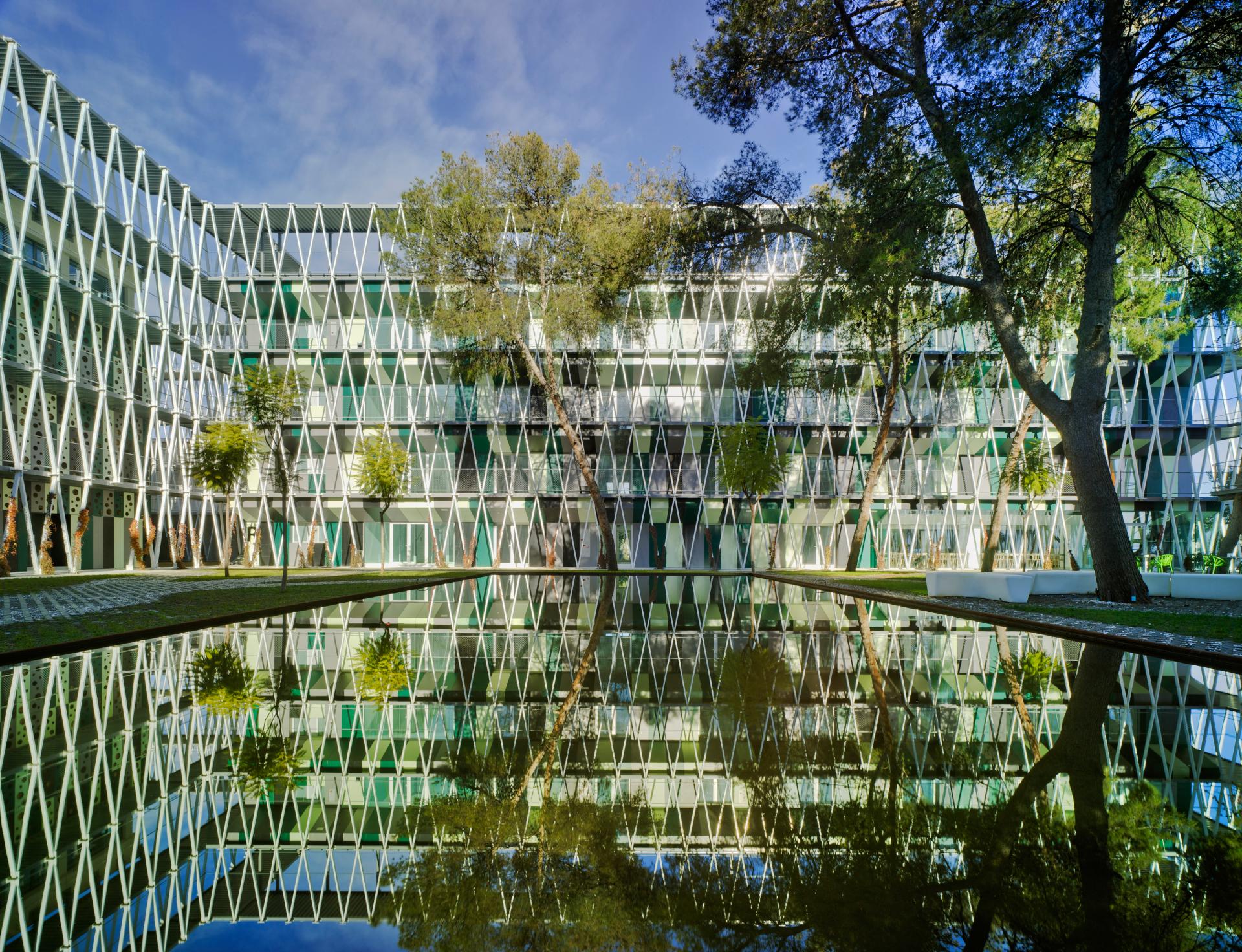
To generate a new image by adding layers in the name of comfort and energy savings. A plain shiny sheet metal box controls the outside. On the inside, the Chinese wisteria and five-leaved ivy creep up to four heights and fully cover the patio, building a real green wall which recalls traditional vine training. The impression from far away we have sought is a categorical though restrained one, which we deem most appropriate for a public institution. Beyond adding to the Foundation’s strong and unifying image, the new enclosure stands as a system which offers the solutions needed for the proper link of the 3 buildings.
To create workplaces in Nature, to create Nature in workplaces. The inclusion of existing and growing vegetation form a friendly working and research space which foster creativity and cooperation.
Changing façade. Each façade has been designed differently according to its orientation and its emplacement in the inner or outer courtyard. The density of metal sheets depends on orientation as well, making it possible to take advantage of the east-west breezes of the valley through the permeability of the structure.
Image and color. The Science Park generates a brand image that transmits the values of this institution. To define this image we established a color code:
Green. The facades of the courtyards. Spaces that relate interior-exterior and place value on the vegetal world and the community, the luminosity, the humid and fresh. Places from where the ideas come, with sensation of amplitude and stillness.
Blue and gray. The external facades. Dynamic spaces associated with movement and speed. Colors of the corporate identity of the Science Park visible from the highways.
Orange. Fresh, fun spaces, mini-environments in which to catch up, equipped with comfortable and ergonomic furniture. Collective and spontaneous spaces like circulations.
White. The neutrality necessary for any type of company to be able to customize and appropriate the space.
Key objectives for inclusion
To facilitate the establishment of companies in various sectors with the minimum possible investment.
The system we have developed welcomes the installation, without toilsome rebuilding, of research equipment by companies, access and exit pathways for workplace supplies and equipment, benches, as well as other facilities, i.e. for oxygen or gas circuits, anchored on the new cover. None of the former will need to alter the usual working inside the buildings and will not require any refurbishing or adding of new elements to the façade. The versatility of the system allows for the installation of research laboratories and a wide spectrum of companies in key productive sectors such as ICT and Bio-agri-food.
To improve connectivity and accessibility by unifying the three buildings
We have projected a new skin around the already existing one, which lends the three buildings, courtyards, latticework and already available trees a defining unitary character in only one gesture. Universal accessibility is guaranteed throughout the complex by the system of galleries implemented in this skin.
To create an open and shared space for knowledge exchange
The NE section of the gallery completes the ensemble and creates platforms at several levels, so that we can use these spaces among the canopy of pine trees to relax or to work, a possibility allowed by a Wi-Fi network which reaches this whole open air environment.
To attract diversity and spontaneous uses beyond the scientific field
The courtyard covered in green, the views over the city or the colour platforms between the treetops, mean that the building has a use that goes far beyond the original. It has become a venue for a wide variety of events including wedding shootings, university gatherings or group meals. Proof of this is that it has been the only contemporary building featured in a promotional video of the city of Murcia that is not a historic building or a Place of Cultural Interest of the city.
Results in relation to category
The dialogue between Architecture and Nature has produced the desired effect of creating a space for relationship and exchange of knowledge both among the established companies and in the relationship with the University.
The equal treatment of the existing vegetation has created an authentic microclimate and a friendly connecting space while at the same time preserving the Mediterranean forest.
The threefold façade allowed us to achieve several goals: we keep the existing one and add a second one in front of it to create a cavity wall meant to isolate from the outside and eliminate thermal bridges, while harbouring the service installations. The third component of the façace is the sheet metal enclosure, vertically arranged to achieve a sunlight dimming effect while still allowing high visual permeability. This element, together with the transverse air circulation based on Venturi airflow and temperature gradient, turns the façace into a key instrument for energy savings. All these technical aspects are covered with a green skin: vegetation as the last layer of the system.
We have expressed respect for existing biodiversity by focusing on the points of conflict that arise between architecture and nature.
The rehabilitation of existing complexes has made it possible to preserve the biodiversity of other unaltered territories. Making more city without making new city.
How Citizens benefit
The Science Park performs the functions of a regional network acting as a technological nexus between the scientific environment and the industrial fabric, based on a triple connection: the University, the Public Administration and the Companies located there.
The supercomputing centre it houses is used by companies and institutions of the University and the European Community. The Park has in its facilities all the services necessary for connection with the outside world, voice and data networks and connections with operators, as well as the common services necessary for the maintenance and care of the facilities, thus enabling the establishment of entrepreneurial companies.
The building promotes coexistence in its interior, contributing to the social and participative development of the citizens. The perimeter galleries allow universal accessibility and an encounter with nature, creating a space for inclusion, social relations and integration. The creation of open-air work spaces among the trees enables the exchange of knowledge and synergies between companies. The facilities created allow the use and access of students to its gardens and event and food catering spaces. The vegetation and the paving of the courtyard outline the most used routes in the building, encouraging the use of the courtyard as a link between buildings as well as a meeting place.
Furthermore, the building's circulation between the existing woodland has generated in the users a reflection on the inclusion of nature in the buildings and the feeling of wellbeing it provides. Making the vegetation a new skin reinforces this sensation.
In operation since 2010, we have been able to see how the use fully corresponds to what the designers had imagined, not only in the rental modules, but in all the communal and relationship areas.
Innovative character
The creation of a new skin that solves the problems of energy savings, increases usable surfaces, resolves access and evacuation, provides specific modular installations for each module while supporting vegetation, is a novel way of rehabilitating buildings.
A simple bolted structural node and a single bar resolve all the singularities of the adaptation of the new skin to the old buildings. This structure becomes the support for the vegetation that will grow up to the top floor to form a green wall.
All the wiring and plumbing installations will run through the façades according to the modular design of the air conditioning system while always taking into account the peculiarities presented by some of the supplies or evacuation ways likely to be added later on, so that they show no impact on the normal function of the building. Thus, we can easily follow the pathways of these installations in all their length, as they run from cover to ground through different channels, all of them readily reached from the façade.