Synthetic
Basic information
Project Title
Full project title
Category
Project Description
Synthetic, created in 2012, is the École supérieure d’art et de design TALM-Le Mans’ action research experimenting with robotic techniques on a large scale with a design methodology. The research has been engaged in an overall reflection on the challenges of production in the digital age: questioning the impact of digital production methods on work organisation in the field of art, design, architecture and engineering.
Project Region
EU Programme or fund
Description of the project
Summary
"Computer Science is no more about computers than astronomy is about telescope." E. W Dijkstra
Synthetic, created in 2012, is the École supérieure d’art et de design TALM-Le Mans’ action research experimenting with robotic techniques on a large scale with a design methodology, drawing support from a network of schools and universities, industrialists and research laboratories in Europe and beyond. The research has been engaged in an overall reflection on the challenges of production in the digital age: questioning the impact of digital production methods on work organisation in the field of art, design, architecture and engineering.
The Synthetic research programme was initiated at TALM by Felix Agid and Christian Morin, both of whom have been working for several years on issues related to the use of computers as computationally-assisted devices that concretely dominate practices and modes of production: what is commonly known as computationalism, or the computational turning point.
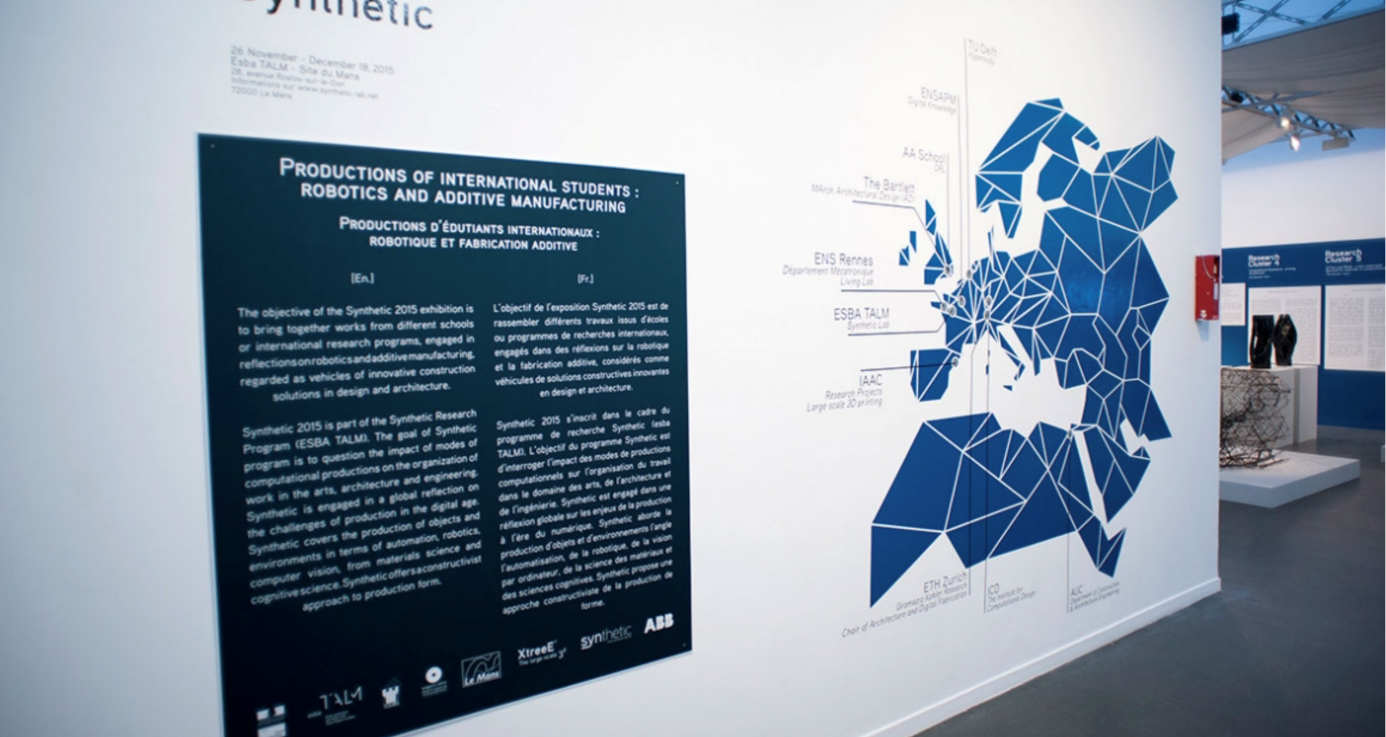
European network – and beyond – Synthetic
• AA School (London, England)
• AUC (Cairo, Egypt)
• ENSAPM (Paris, France)
• ENS Rennes (Rennes, France)
• TALM-Le Mans (Le Mans, France)
• ETH Zurich (Zurich, Switzerland)
• Fine Arts of Alexandria (Alexandria, Egypt)
• IAAC (Barcelona, Spain)
• ICD (Stutgartt, Germany)
• The Bartlett-UCL (London, England)
• TU Delft (Rotterdam, Netherlands)
Synthetic prefigured the creation of the TALM-Le Mans Master's degree Computational Design and Mechatronics, opened in 2018. As part of the inauguration of this mention, the Robotic Interaction exhibition was held from 30 November to 19 December 2018 at TALM-Le Mans, restitution of the Robotic Interaction workshop.
Key objectives for sustainability
Synthetic approaches the production of objects and environments from the perspective of automation, robotics, computer vision, material sciences and cognitive sciences. This multidisciplinary programme combines the challenges of innovation and efficiency, aesthetic renewal and the positive environmental impact of production methods.
It is from a realistic perspective, which cannot exclude the challenge of technological determinism, that Synthetic attempts, through collective experiences such as workshops, colloquia, experimental creation platforms or the realisation of prototypes, to perceive the concrete effects of the computer on forms (objects, environment and symbolism), on work and its organisation, and on manufacturing costs.
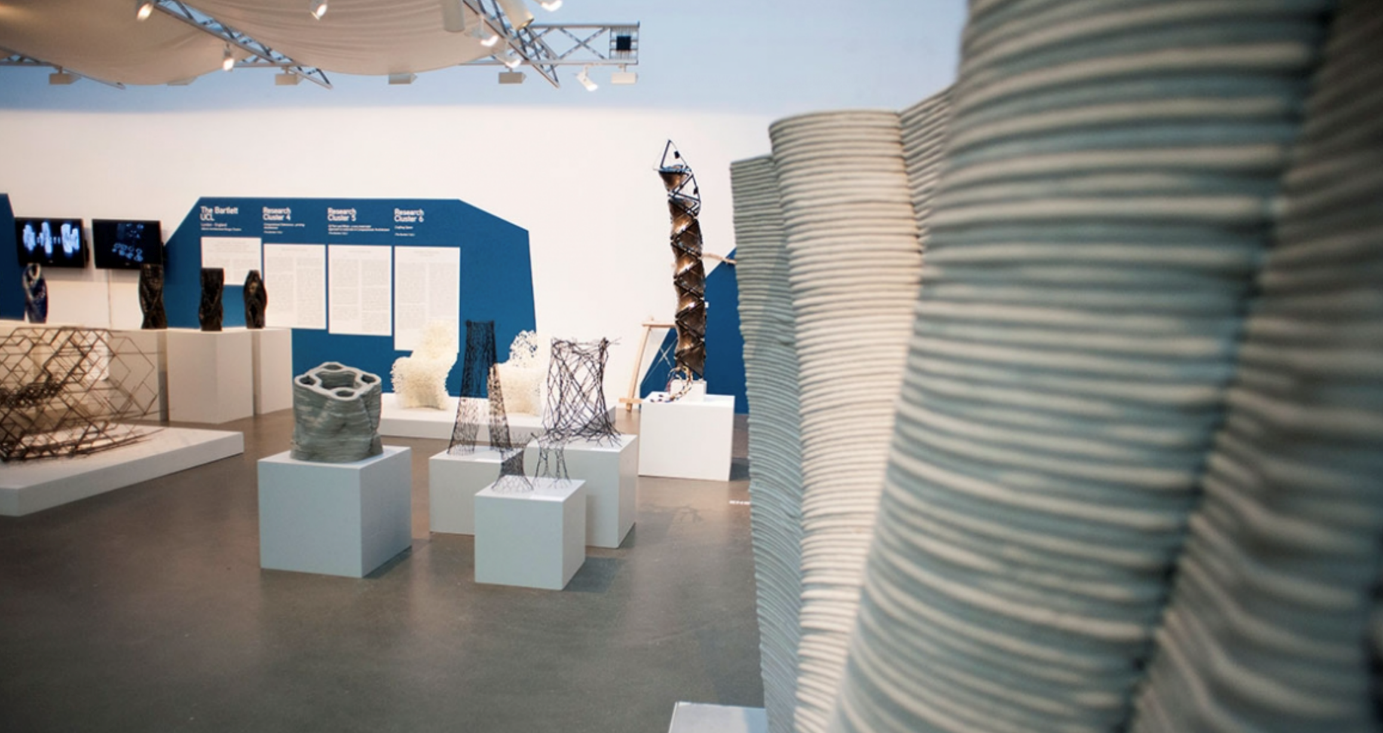
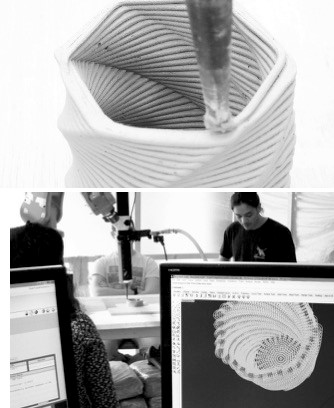
The programme has enabled the development of advanced research on additive manufacturing, and more specifically on the printing of bio-sourced materials (clay).
Key objectives for aesthetics and quality
The problematic of the use of the computer as a logical machine is understood from a realist point of view, where its fundamental characteristic is to constantly extend its field of action to other fields of knowledge and practices. In other words, this use, which derives deeply from a redefinition of calculation, is never limited by a technique but constitutes a link between industrial production and construction, between the history of techniques and concepts of culture, between the increasing specialisation of the productive environment and the convergence of practices in the computational era. This perception of the computer as the demonstrator of the stage of global construction (object and environment) leads the experiments carried out within the framework of Synthetic towards a prospective and profoundly speculative approach, convening the history of science and epistemology as well as the creation of tools and concrete implementation, philosophy and the history of art as well as object-oriented programming. We see the computer as a theoretical element that bridges the gap between the scientific revolution of the 17th century and the two great industrial revolutions. If design as such raises the problem of transversality (art, engineering, philosophy and history), the computational mode, due to the generalisation of the use of computers and associated production systems, seems to us to be the almost unique engine of the convergence of practices and knowledge. The issues linked to teaching design in the digital age cannot therefore serve only the idea of embedded technology: as a global technological complex, it is in the effective crossroads between practical uses, abstract knowledge, semantic and language games, and new organisational paradigms of production (whether capitalist or not), that the pedagogical scope of the digital (because it was previously of a theoretical and philosophical nature) reveals itself in its entirety.
Key objectives for inclusion
The Synthetic research programme was initiated at TALM by Felix Agid and Christian Morin, both of whom have been working for several years on issues related to the use of computers as computationally-assisted devices that concretely dominate practices and modes of production: what is commonly known as computationalism, or the computational turning point. Because of the generalization of both personal and collective use of computers and associated production systems, the digital appears today as the almost unique engine of the convergence of practices. And because it governs almost all industrial and cognitive production devices, the digital plays the role of integrator of fields. This recasting offered by computational processes and robotics in particular has only one origin: the use of the computer as a logic machine, and the ability of the computer to integrate all segments of manufacturing-oriented knowledge. The computer is neither a tool nor a means.
It is from a realistic perspective, which cannot exclude the challenge of technological determinism, that Synthetic has attempted, through collective experiences such as workshops, colloquia, experimental creation platforms or the realisation of prototypes, to perceive the concrete effects of the computer on forms (objects, environment and symbolism), on work and its organisation, and on the costs of manufacture.
Synthetic has an open and collaborative constitution, in a context where culture, technology, work and politics are linked by the computer. The programme integrates a network of schools, teaching centres or departments in relation to its concrete objectives and make possible to train creative designers, committed to a new economic era.
Results in relation to category
The common denominator that Synthetic wants to integrate in its corpus of research (robotics, material science, neuroscience) is the question of work as a form of valorization and the question of forms understood in a broad sense.
Synthetic addresses the production of forms (robotized or mediated by brain-machine interfaces) from the perspective of the inexorable decrease of work in the spectrum of value creation and ultimately in the framework of the whole production of design. Since the basic research object is the constructed form, the results will be both theoretical and plastic or constructive. The economic approach is essential, but it must be accompanied by sociological and historical studies (history of techniques and hard sciences). The plastic approach must be integrated into the field of engineering.
1. - The "software" tools which are tending towards an increasingly advanced domestication.
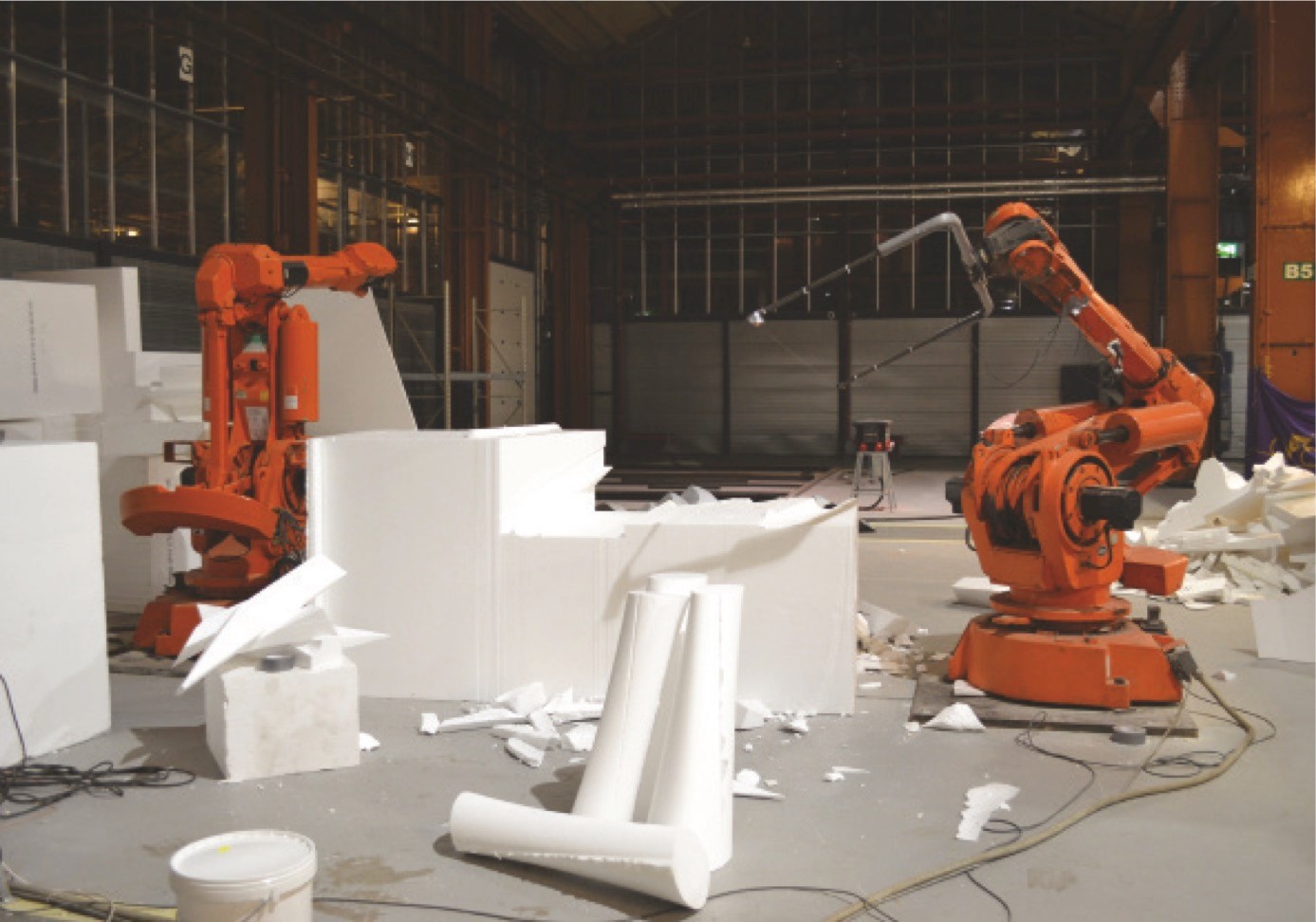
2. - The associated 'hardware' tools (mechanical, electronic, robotic), such as robotic assistance, the manufacture of specific tools (hot wire drill, robot armed with a kinect, robot armed with an STL arm, etc.).
3. - Composite materials that can be machined, cut and assembled by a robot: polystyrene associated with concrete / wood associated with concrete / carbon fibre applied by robotics / carbon / all types of metal alloys / emergence of nano materials.
4. - Design and production processes: BIM (Building information modelling) or parametric in the broad sense, which reconfigures production standards; multi-scale production; simulation; file standards (STEP files etc.); machine standards.
5. - The inexorably decreasing need for labour: the valorisation of work; the decline of manual work; work in the third industrial revolution.
6. - Virtual reality / augmented reality / brain machine interface / 3D interaction in a broad sense.
How Citizens benefit
The results of the research were presented at several public exhibitions throughout the programme.
For example :
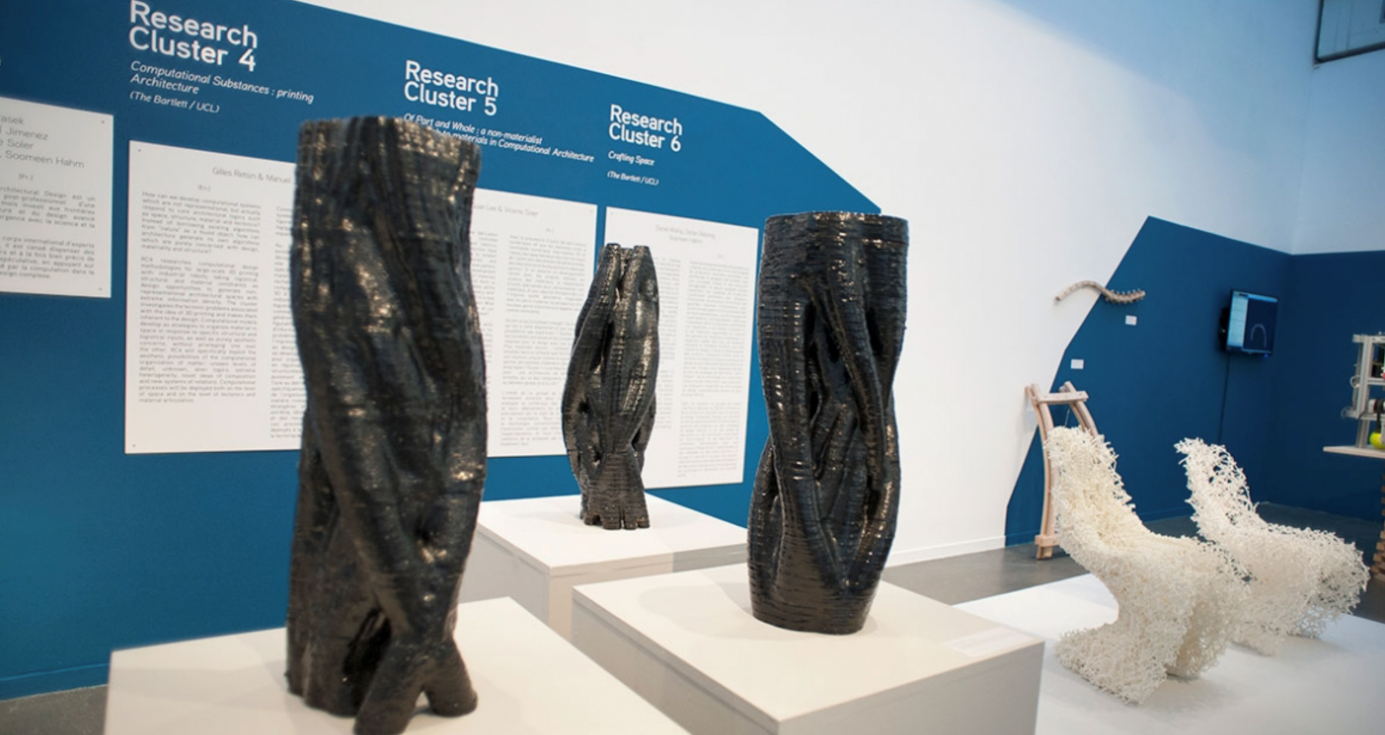
- Synthetic Exhibition, 2015 : the Synthetic exhibition brought together the biggest European academic players working in design on the questions connected to robotics and 3D printing.
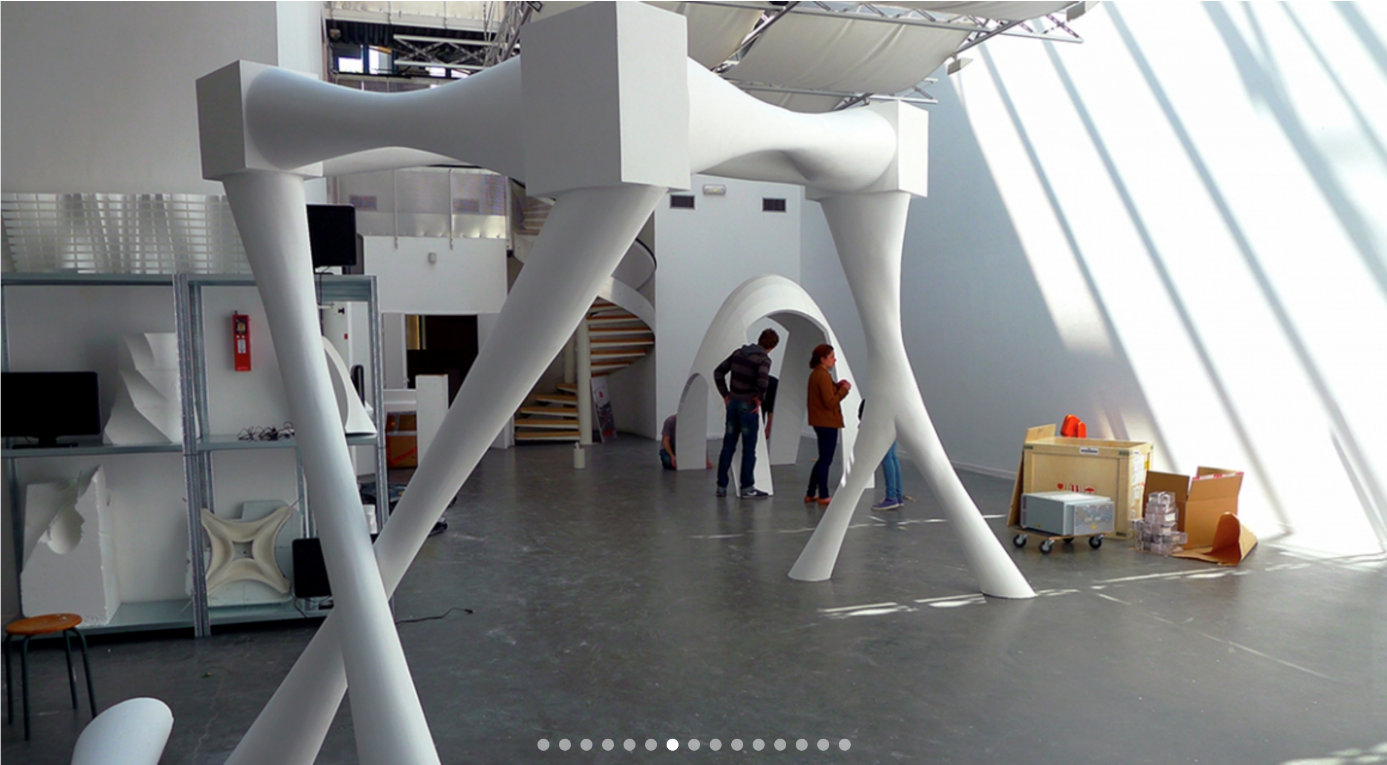
- Robotic Interaction, TALM-Le Mans, IUT de Nantes (department of mechanical engineering and automated production and the IRCCyN laboratory), 2018. Robotic Interaction, experimentation exhibition for the implementation of structures crosslinked with the help of a six-axis robotic system, questioning the potential of automated assembly on complex habitable structures. Its objective is to question the interaction between robotic manufacture, digital design and environmental challenges. Transdisciplinarity, collaborative project management, machinery manufacture, so many different intelligences for efficient experimentation. The exhibition is the result of this experimentation. The students of TALM-Le Mans have worked together on the creation of prototypes, sculptures, structures, large-scale works, sometimes close to monumental, from design to manufacture, verifying the importance of experimentation in the approach of the most modern digital tools. The robot in communication with the computer is the binder between experimentation, creation and innovation.
Innovative character
Building on the experience of the Résonances research unit, Synthetic has sought to keep experimental practices at the heart of the programme, and is keen to maintain a balance between theoretical interventions and experimentation. As an integrative field, computational research must be nourished by diverse knowledge and allow researchers and students to interact with a variety of contexts and backgrounds.
Synthetic has made it possible to deepen general research on the links between computational devices (or computational mode) and the artistic experience or field of design. It opened up new fields of research on neo-mechanism and epistemology, notably by encouraging the school to equip itself with digitally controlled machines (robot, laser cutter, 3D printers), allowing students to experiment within the school. Finally, the programme has enabled the development of advanced research on additive manufacturing, and more specifically on the printing of bio-sourced materials (clay).