Greening roofs in Barcelona
Basic information
Project Title
Full project title
Category
Project Description
The 1st Green Roofs Competition of Barcelona City Council has promoted the execution of 10 green roofs in 10 private buildings distributed throughout the city. Green roofs improve the energy efficiency of the buildings, increase their value and create new spaces for the community. Moreover, green roofs bring important environmental benefits to the city, by increasing its resilience to climate change.
Project Region
EU Programme or fund
Description of the project
Summary
Barcelona City Council aims to achieve a more sustainable city, promoting, among other strategies, the implementation of green roofs in the city’s buildings. The 1st Green Roofing Competition of Barcelona City Council consisted of the naturalization of 10 roofs in the city of Barcelona.
The contest had three distinct phases. The first phase consisted of the registration and presentation of a first proposal that was evaluated by a jury of experts. The top 50 finishers received a grant of up to € 1,500 for the initial technical work with the idea that most participants could enter the competition and thus avoid having an initial technical expense. In this first phase, 45 proposals were submitted.
In the second phase the shortlisted proposals delivered a preliminary draft, and the same jury of experts from the previous phase selected the 10 winners, who obtained a grant of 75% of the total costs for the realization of the green roof up to a maximum of € 100,000. In this first edition, the winning buildings had the following uses: 3 residential buildings, 1 geriatric, 2 schools, 1 hospital, 1 occupational center for people with disabilities and 2 companies.
The third phase consisted of a follow-up by the technical services of Barcelona City Council of the execution of the 10 green roofs that won the competition. The 10 winning roofs undertook to carry out regular maintenance and to allow Barcelona City Council to access these spaces for a period of 4 years in order to disseminate their benefits and monitor their operation. It is intended that the monitoring of these spaces will help the city council to collect empirical data on the operation of these constructive solutions, which will allow quantifying and parameterizing their benefits.
Key objectives for sustainability
If participants wanted to get a good score in the green roofing competition it was necessary to establish strategies to improve sustainability in the projects. The sections that scored the most were the optimization of the water cycle, the increase of greenery, the incorporation of vegetation adapted to the environment, the generation of energy and a program of sustainable maintenance of the vegetation.
The following measures set out below have been incorporated into green roofs and have had a positive impact on the resilience of our city to climate change:
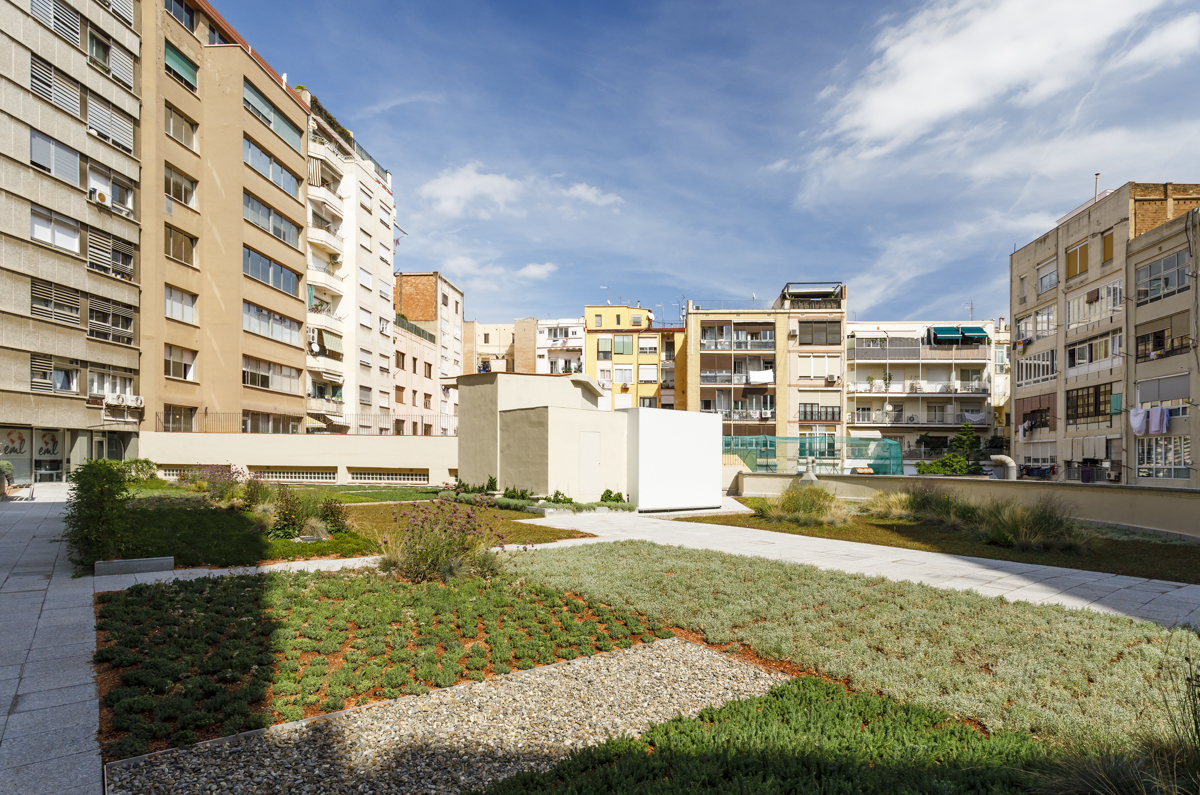
- Increase in the green area of the city. The sum of all the roofs represents a total naturalized area of 5,500 m2. This increase in vegetation on a city scale helps to reduce the heat island effect, decrease air pollution and increase biodiversity.
- Improving the roof water cycle. The increase in storms due to climate change and the general non-permeability of buildings and streets needs the inclusion of new permeable surfaces that help relieve pressure on the city’s sewer system to ensure its proper functioning. Green roofs are able to retain rainwater and drain water from the roof more slowly than a traditional roof reducing the impact of strong storms. It should also be noted that some projects recover rainwater, through tanks and a water supply system, to irrigate the built-in vegetation.
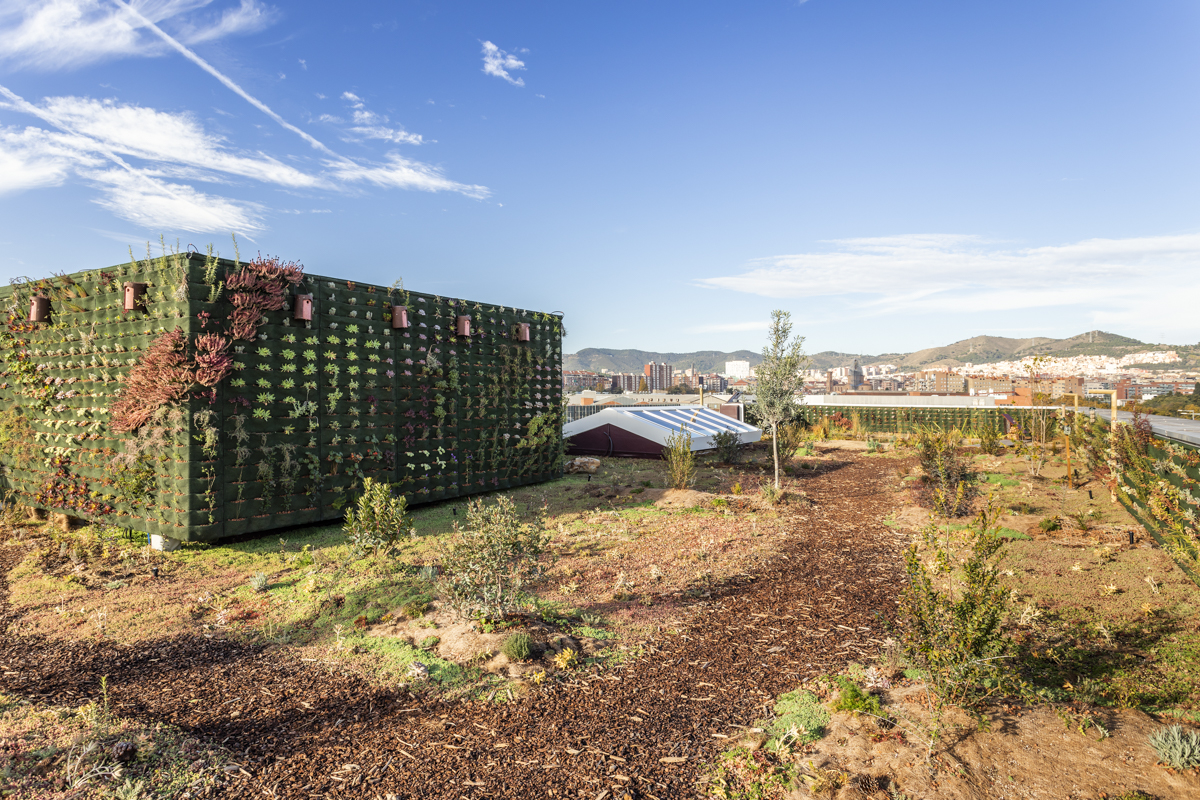
- Strategies for increasing wildlife in the city. Green decks incorporate new habitats for birds and bats by incorporating nests and feeders. Insect hotels have also been built to improve the influx of pollinators.
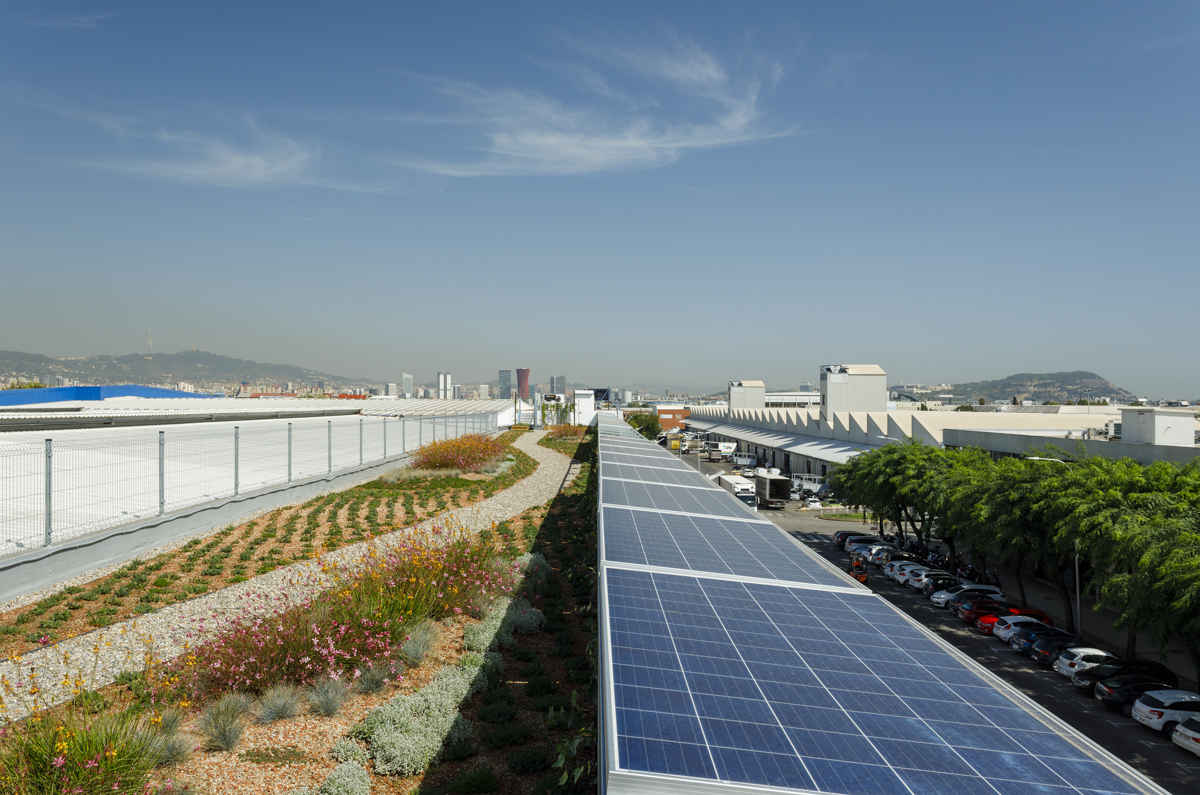
- Energy generation systems using solar collectors that combined with vegetation increase its efficiency.
Key objectives for aesthetics and quality
The winning green roof projects have improved the city’s urban landscape.
The roofs where the action took place were almost unused and in poor condition. In addition, all the roofs had facilities (air conditioning machines, wiring, pipes, chimneys...) disorganized, many of them obsolete, and distributed throughout the space.
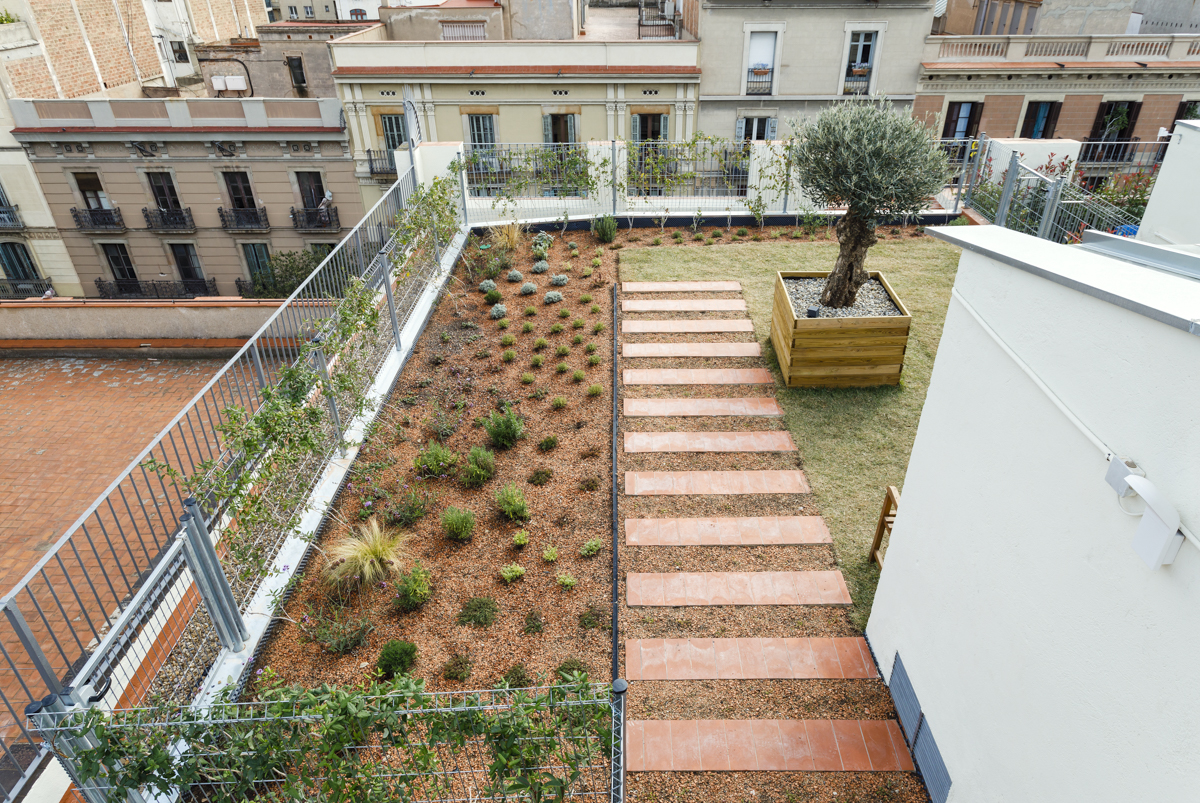
Therefore, in the interventions, in addition to the incorporation of vegetation, the restoration of all the elements of the roof (sills, stairwells, pavements ...) and the tidying up of the facilities were carried out. The aim was that once the project was completed, the intervention would have improved the overall roof with an overall compositional project respecting the original roof.
It should be noticed that generating natural spaces on the roofs of buildings helps to create a more environmentally friendly urban landscape and brings nature closer to the built city. And this is a new living landscape, which evolves at different times of the year, but which always brings quietness and beauty.
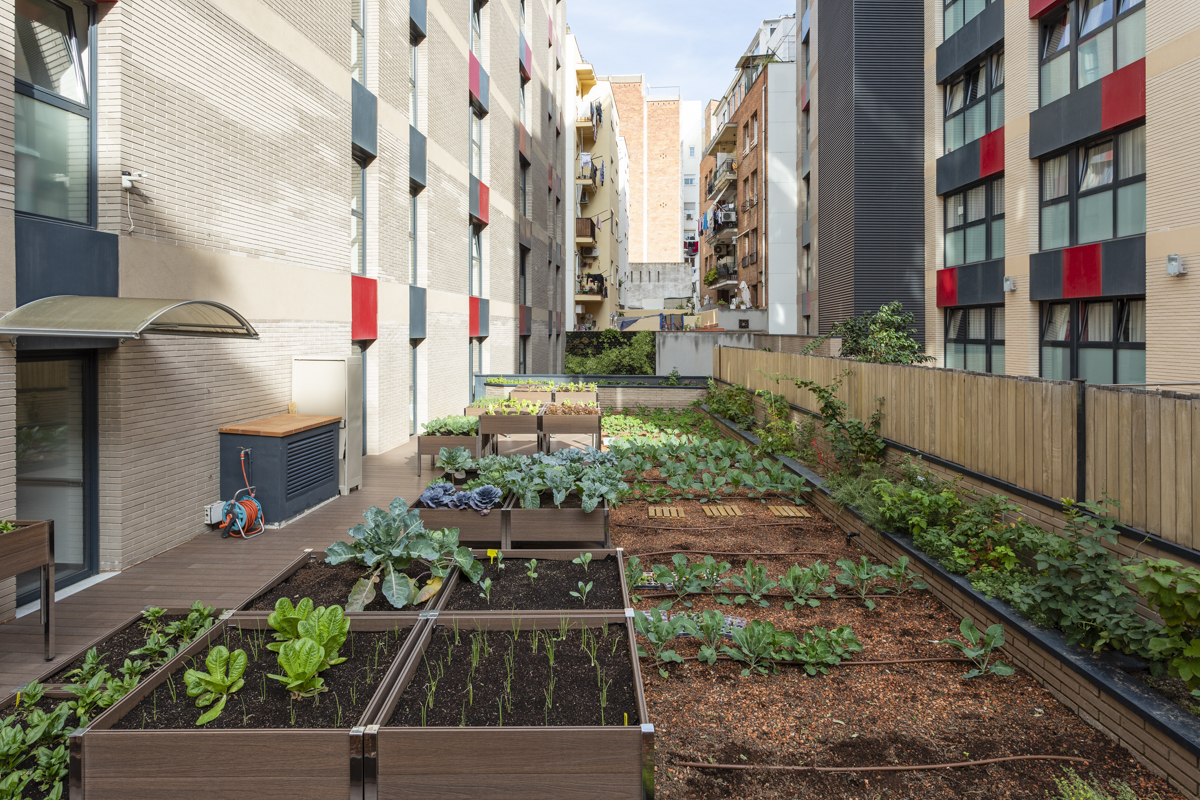
All projects provide landscape benefits, but we can highlight the intervention that was carried out in a residential building inside one of the blocks in the Eixample of Cerdà. The Cerdà plot in its beginnings proposed interior garden spaces that over the years were filled with buildings. The naturalization of the roofs that are in the interior of the blocks of the Eixample, at a height of ground floor, supposes a landscape improvement for all the inhabitants of the built crown that can enjoy, visually, of a space vegetated and not of a roof that would possibly be in poor condition due to lack of maintenance.
Key objectives for inclusion
The green roof competition established as a requirement that building users could access and use these spaces. One of the most important aspirations of the competition was to create new spaces of sociability to improve the social cohesion of the inhabitants or users of the building.
Currently, the roofs of buildings are generally underused, although they are a space of opportunity. That is why all the projects encourage the recovery of the use of this community space in the building. The projects use different strategies so that users can enjoy a pleasant space and at the same time be in contact with some nature.
Some projects focused on allowing users to walk or play sports on the roof by creating plant-delimited paths with the intention of enjoying the vegetation and seeking quietness away from the city’s traffic and stress.
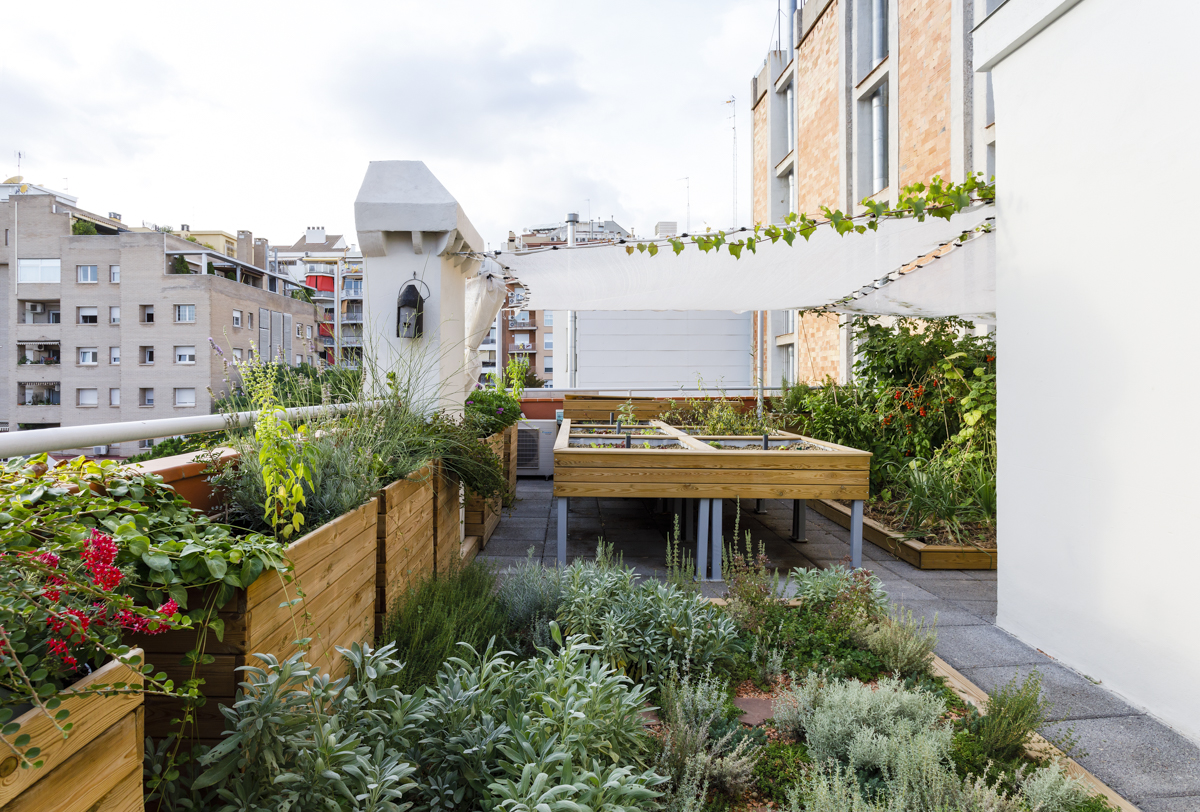
Other projects created pleasant living spaces with the incorporation of benches and other elements surrounded by vegetation that allow users to use them as spaces for relationships, reading, work, socialization ...
In those buildings in which users are more vulnerable, such as schools, the geriatric hospital or the occupational center for people with disabilities, green roofs projects have meant a new space for coexistence that brings direct benefits to the health of its users.
Results in relation to category
The competition gave priority to green roof projects that were self-sufficient, in terms of energy and water, used recycled materials and avoided waste as much as possible.
In terms of energy production, virtually all projects that have sufficient sunshine incorporate photovoltaic panels that supply the lighting of the roof itself, the lighting of common areas of the building and the system irrigation if it needs a drive system.
As for the water cycle, all the green roofs installed have a layer that retains rainwater for watering the plants. Some of the projects include tanks to collect rainwater which is then used to irrigate the plants. Thanks to this system of collection and reuse of rainwater, there are covers that are completely self-sufficient in terms of water.
With regard to recycled materials and waste reduction, mention that construction waste such as crushed pottery has been used to make roads, the pavements that were extracted from the roofs have been recovered and reused, composters have been incorporated for the remains of pruning.
The new vegetable gardens are managed by the users of the building, who care for and consume the products of the harvest. The plant remains and the pruning of the garden itself go to the composter and the compost that is extracted is used to fertilize the plants. It should also be noticed that in some cases, the vegetable gardens are irrigated with rainwater stored in the tanks, with an efficient drip irrigation system that is driven with the help of the energy produced by the photovoltaic panels.
How Citizens benefit
The green roof competition is based on promoting the involvement of society in these types of constructive solutions as its implementation not only brings benefits to the users themselves but also to all citizens in general.
The competition sought to provide economic incentives for building owners and neighbourhood communities to embark on this path to sustainability. The reception from the private sector was very good because, despite being a new initiative and a constructive solution very little applied in Barcelona, 45 participants entered the competition.
As the contest progressed, questions from other owners and managers who were interested in such solutions were received. It has also been a boost for the technical teams that designed the projects and the builders who executed them. In this sense, thanks to the results and the media repercussion that the competition had, other green roofs have been built promoted by the private sector in the city.
It should also be noticed that residents and users of the winning buildings now have a new community space. These spaces are used much more often. This is the case, for example, of a nursing home whose users can now use accessible vegetable gardens and naturalized areas outside.
The success of the first green roofing competition has meant that a 2nd edition is on the way, much more focused on the most difficult to activate residential buildings, in which, despite the health crisis we are experiencing, they have registered 47 participants with a very good reception by the media.
Innovative character
Green roofs are not a traditional solution for roofs in Barcelona. The roofs of Barcelona are mostly flat and ceramic. Barcelona is a dense and compact city with a deficiency of nature in the city. The roofs open up an opportunity for the creation of new spaces that incorporate green into the city.
It is also true that green roofs are not a new solution but if it is new the impetus of a public body like Barcelona City Council to promote these solutions, non-traditional, in the private sector and in our latitudes.
It should be noticed that the green roof competition not only aims to create a green space, but also seeks to create spaces where different environmental and social strategies converge. So it’s not just about creating rooftop gardens, it’s about designing ecosystems that are self-sufficient, incorporating strategies for generating energy and reusing rainwater, combined with socializing spaces.
The green roof competition project has a strong value of disseminating the benefits of these constructive solutions. It is worth highlighting the symbiosis that has been created between the public and private sector in this project and can share for 4 years the experience of a green roof in operation, the quantification of its benefits and the realization of visits for dissemination between citizenship.