Mierīgi!
Basic information
Project Title
Full project title
Category
Project Description
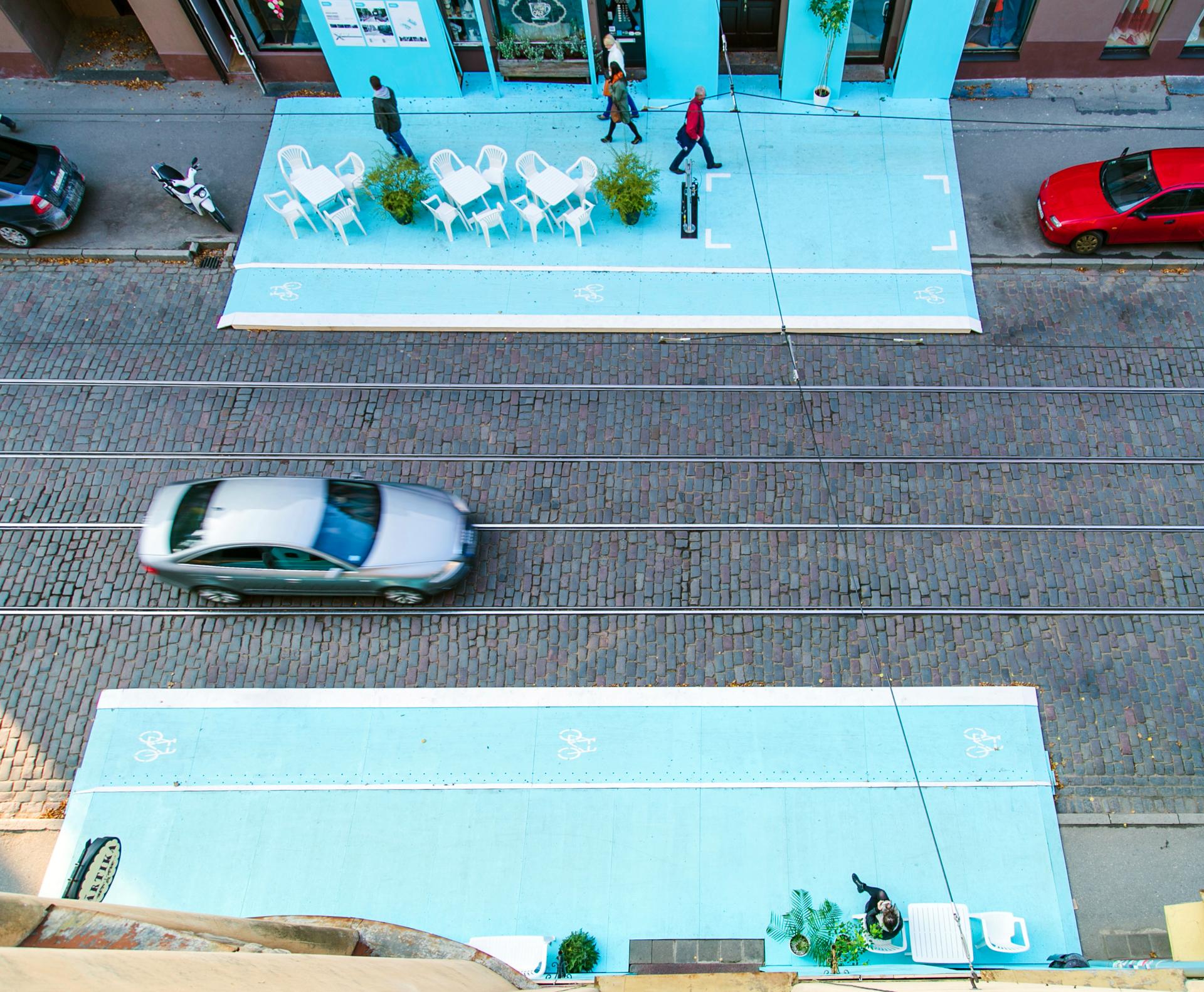
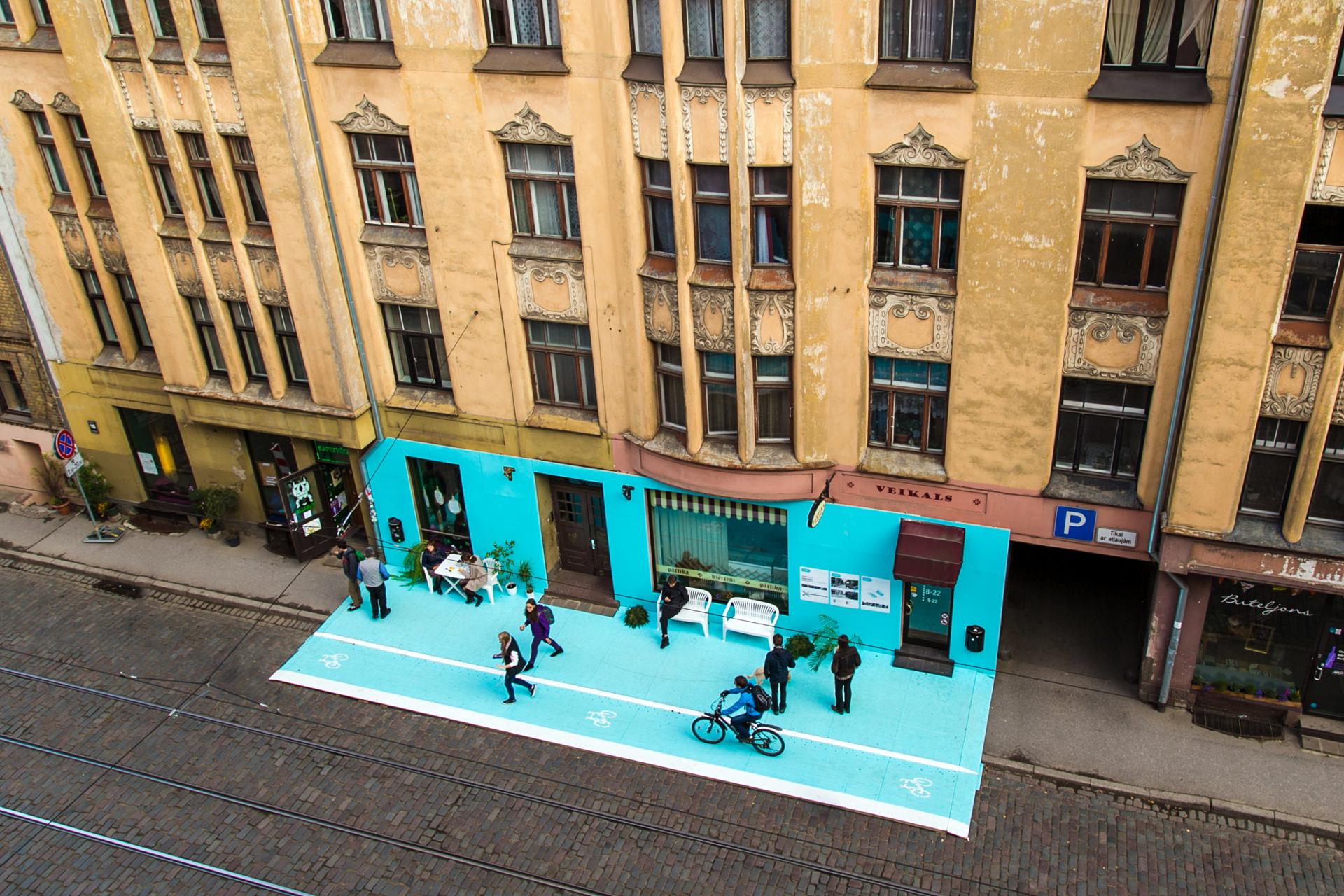
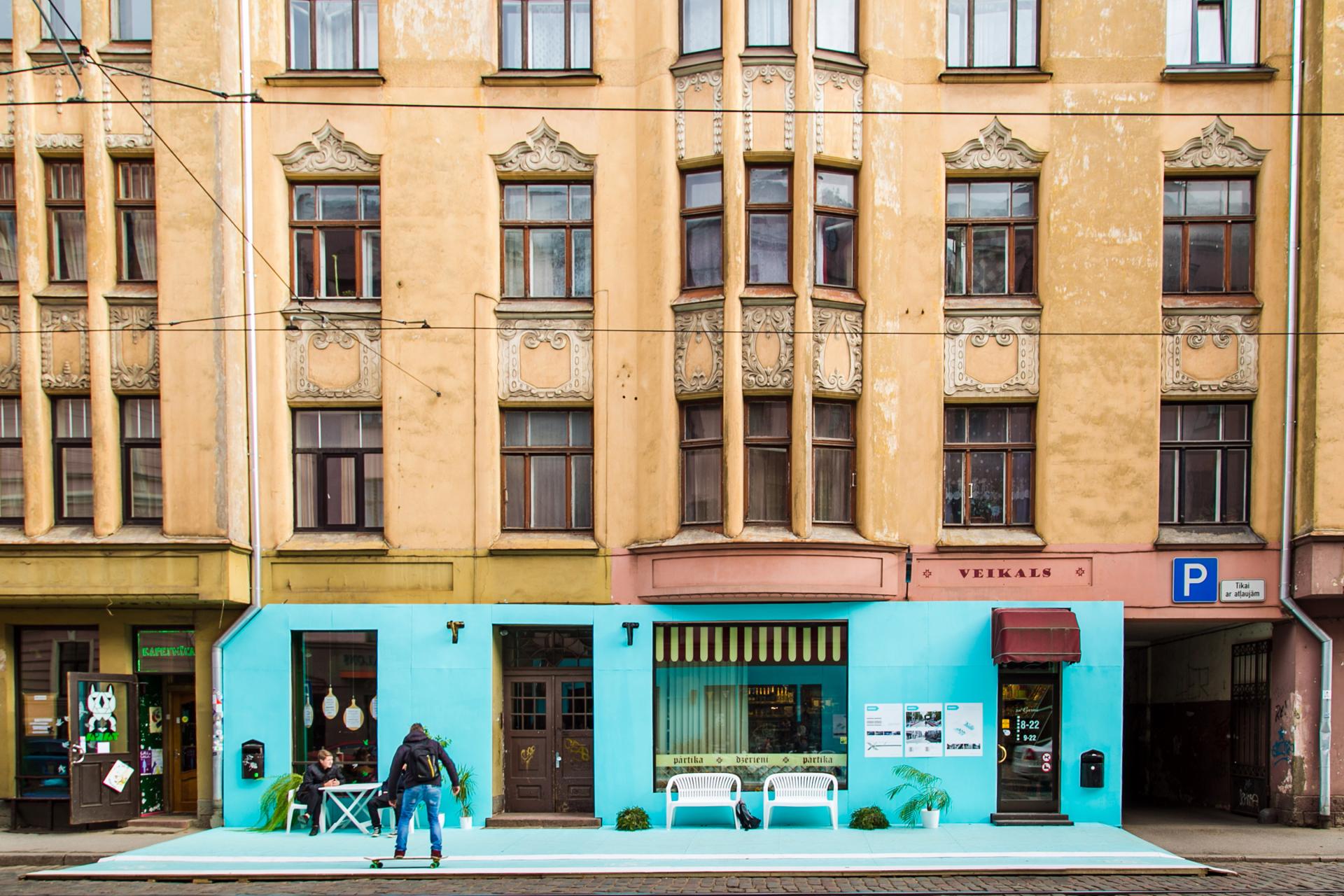
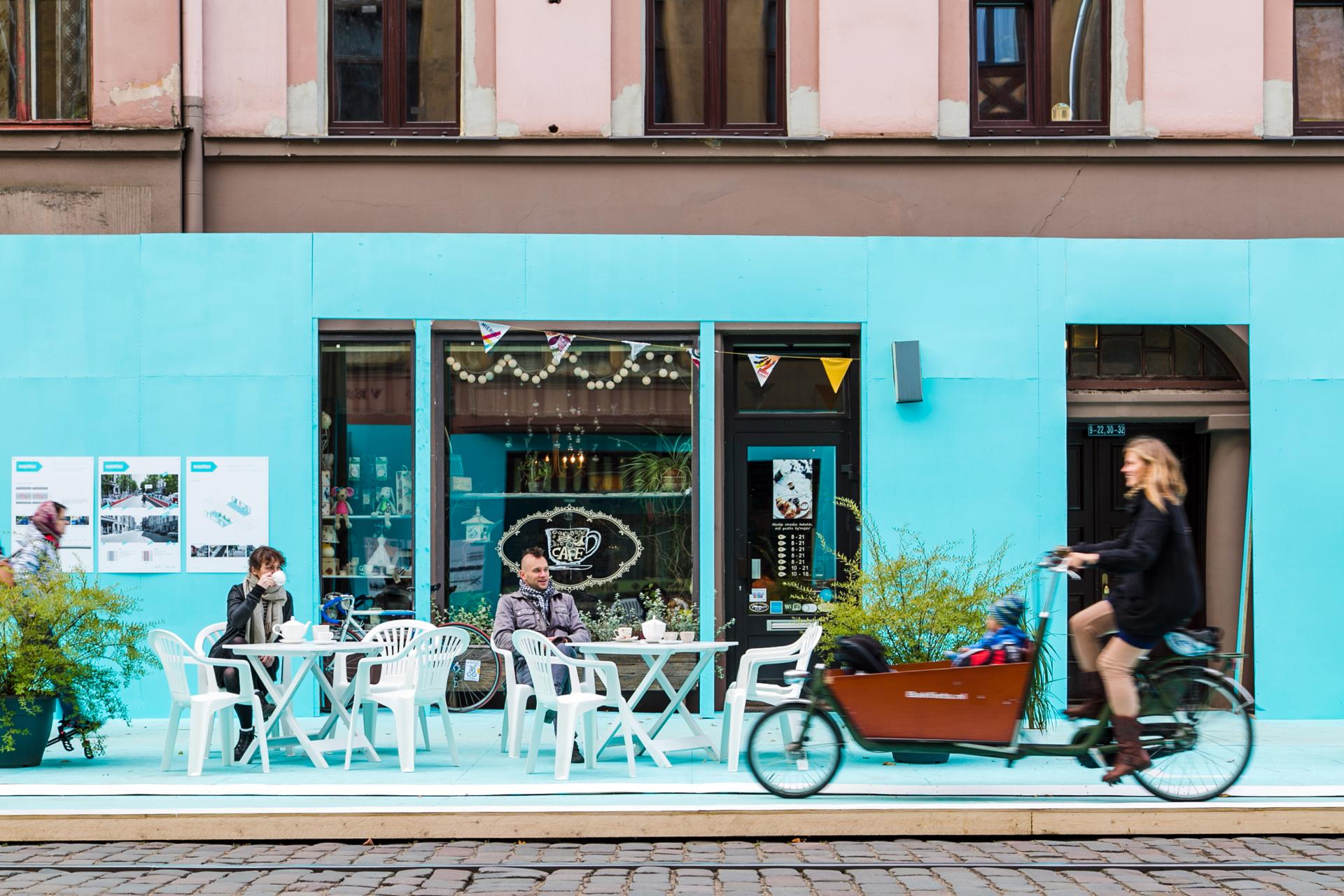
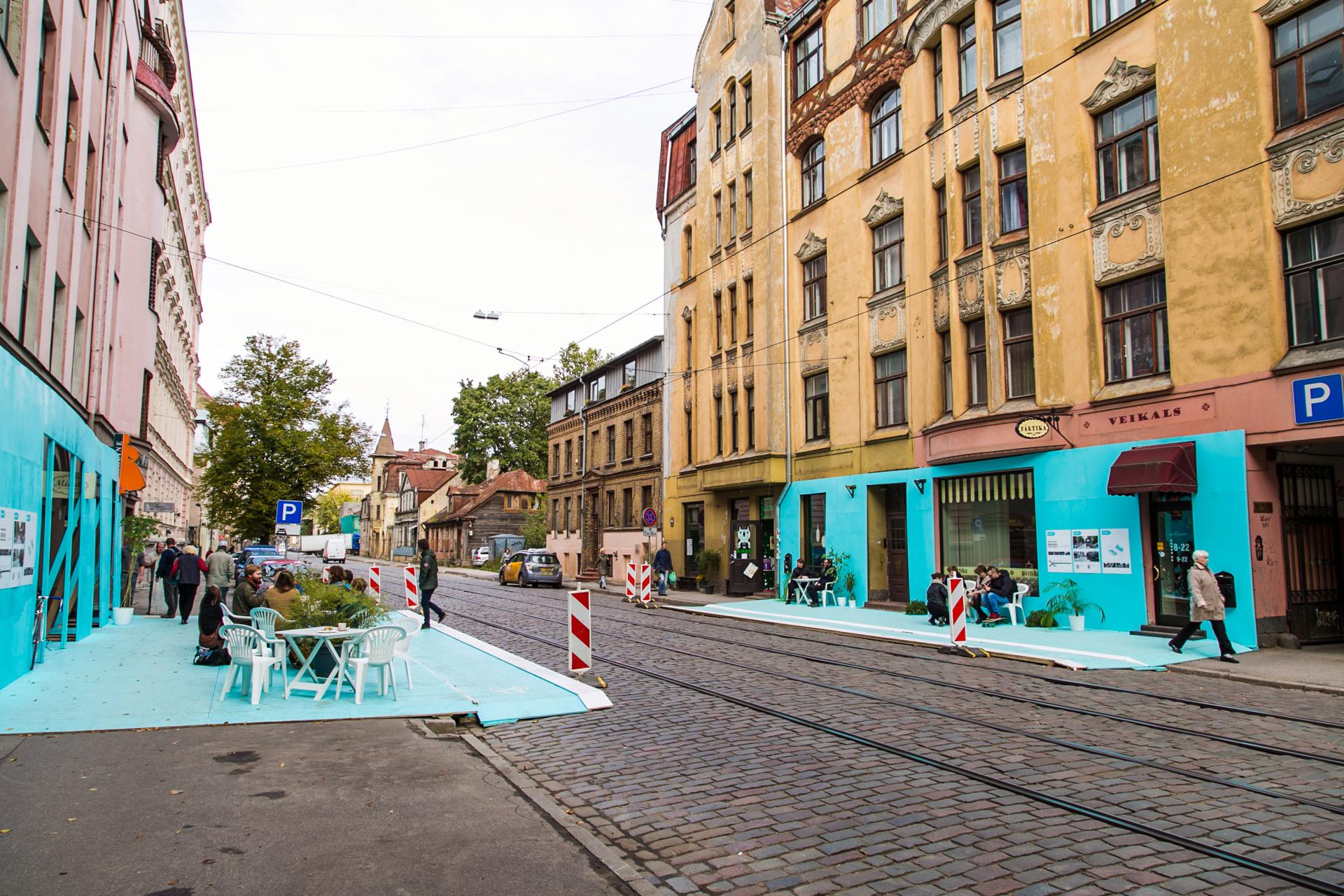
To prove that Miera Street in Riga can be a space for both mobility and social life, Fine Young Urbanists built a 14m-long street prototype on a scale 1:1 featuring wider sidewalks, bicycle lanes, street furniture and potted plants. The mock-up was built in three days and remained in place for a week. The two urbanists used this time to discuss street design with passers-by, local residents and small business owners, discovering an effective method of involving the public in the design process.
Project Region
EU Programme or fund
Which funds
Other Funds
The project was part of the Riga — European Capital of Culture 2014 programme.
Description of the project
Summary
To prove that Miera Street in Riga can be a space for both mobility and social life, we built a 14m-long street prototype on a scale 1:1 featuring wider sidewalks, a bicycle lane in each direction, street furniture and potted plants. The mock-up was built in three days and remained in place for a week. We used this time to discuss street design with passers-by, local residents and small business owners, discovering an effective method of involving the public in the design process — no one can pass through a brightly coloured installation without wondering about its purpose. The mock-up also allowed us to test the proposed redesign of the street profile in real conditions and to promote more inclusive urban design in Riga and beyond.
The meaning of the Latvian word "Mierīgi" is "peacefully", "easily". We aimed to demonstrate that it is possible for pedestrians, cyclists and vehicles to coexist more peacefully on a street that has been transformed with rather simple means.
Key objectives for sustainability
Miera Street is a flagrant example of spatial injustice — over two thirds of its section serve moving or parked vehicles; the street space is loud, dusty and unsafe for pedestrians and cyclists. Such auto-centric streets marginalise children, the elderly, people with disabilities, worsen conditions for small businesses on the ground floor, contribute to pollution in the city, and, ultimately, to the climate crisis. Our objective was to demonstrate that the street can be completely transformed with the help of design — the traffic can be calmed, there is enough space for cycling lanes and wide sidewalks, as well as plants, street furniture and even parking spaces for locals. A well-designed street serves as space for social interactions, it helps strengthen the local community and local economy, makes the neighbourhood more sustainable. Mierīgi! was a glimpse into a more sustainable future.
The installation has helped to promote the concept of Riga as a cycling-friendly city and was used as a case study in the Riga Cycling Development Strategy, commissioned by the city's Traffic Department. Even though the Mierīgi! experiment was approved and supported by the city, no real efforts to redesign Miera Street have been made since.
Key objectives for aesthetics and quality
Good design has always been an important part of our work. Tactical urbanism projects often use only paint or scrap materials that, to their disadvantage, result in rather improvised aesthetics, whereas well designed, properly built spatial installations have a much stronger impact on their users.
The Mierīgi! installation measured 14m by 18m and was built using sturdy plywood sheets. It was then painted a vividly blue colour with white details, creating an almost surreal setting. The installation was completed with outdoor furniture, a bicycle maintenance stand, potted plants and panels with information about the proposed street design. The point was to make the suggested street space changes attractive and comprehensible.
We used the time of the intervention to discuss street design with passers-by, local residents and small business owners, discovering a highly effective method of involving public in the urban design process — no one can pass through a brightly coloured installation without wandering about its purpose. The materials, colours and details of the design prompted countless conversations.
Urban prototyping with mock-ups is the cheapest, fastest and most reliable way for testing changes in the urban environment. A mock-up allows you to feel the space with your body, to see if you want to stay there, find a comfortable place for yourself. It is also a way to avoid costly design mistakes. For example, 30cm in drawings may seem as an unimportant measurement, but it can make a big difference on the ground.
About 80% of he materials used for the installation were later reused for other projects.
Key objectives for inclusion
Our project proposed to reduce the four car lanes to two, which would then be shared with the tram. This made it possible to insert a bicycle lane next to the sidewalk on each side of the street and also freed space for pedestrians and café owners to put chairs and tables on the sidewalk for their customers. It was immediately evident to everyone that the quality of life in the fourteen-metre section of Miera Street had significantly improved. If the redesign project were realised in its entirety, the street would become safer for everyone — the traffic would move slower, it would be easier to cross the street, especially for children and older people. Cyclists would have a designated space and wouldn't interfere with pedestrians anymore, as well as would be more protected themselves. People in wheelchairs and with prams would have more freedom of movement as well. In the mock-up we added benches where older people could take a rest or rearrange their bags after shopping, and people immediately started using them. When we arranged tables and chairs in front of a café, the owner claimed them and started serving coffee and cakes. This small section of Miera Street became welcoming and residential instead of mainly serving vehicular traffic.
Results in relation to category
In 2014, we made a video of the Mierīgi! project and posted it online. The idea resonated with people worldwide. By now the video has been viewed over 120 thousand times, and we have received countless messages from people wishing to build street space prototypes in their cities. The project was among finalists for the European Prize for Urban Public Space in 2016, and it has been included in numerous publications, exhibitions and film festivals worldwide (São Paulo Architecture Biennial, a+u magazine, domus magazine, MoMA Uneven Growth online exhibition, to name a few). We are often invited to give talks at architecture and urbanism schools, and it seems that Mierīgi! is regularly referenced by students as an example of tactical urbanism. The project's popularity proves that communities, activists, urban designers all around the world are looking for innovative ways to let their cities know that people want to reclaim street space from cars. Mierīgi! has provided inspiration as well as a practical tool for testing urban design ideas in situ.
In Riga, the project inspired local activist groups that have by now become powerful advocates for sustainable urban development and work directly with the City Council and developers. Many of the currently vocal urban design activists helped us build and test the Mierīgi! installation. They have continued to test design ideas with mock-ups in public spaces, however, Mierīgi! remains the largest one to date.
How Citizens benefit
Miera Street has a long-established and active local community. This was one of the main reasons why we decided to work on it in the first place — there was a possibility to engage directly with the people who live and work in the area and care about it. They provided valuable insights on how the street is used daily, what the main issues are and what exactly they would like to improve. We started our collaboration in 2012, and it went on for more than three years. Mierīgi! was an exploration of communication between urban designers and the local community — we started with drawings and photomontages and ended with a 14 by 18-metre installation on the street — it was important to us that everyone understands what we mean by proposing to allocate more space to pedestrians and cyclists. While building the installation, the support of the local community was indispensable — they provided a workspace, a storage, security, organised meetings and promoted the project.
Of course, not all reactions to the project were positive — there were people who see cyclists as a nuisance in the city, people who don't enjoy the rumble of street cafés or people simply annoyed by the colour of the installation. However, a friendly, informal conversation is the best way to explain why changes in street design are needed, to reach a mutual understanding or at least respectfully agree to disagree.
Innovative character
The project borrows methods from design thinking, architectural and urban planning practice, however, mock-ups of such scale are rarely used. Usually, only certain details or constructions are tested in such manner. Mierīgi! is innovative in two aspects: communication and design. The installation proved to be a highly effective tool for discussing urban design with the public and city administration as well as for testing the proposed street redesign in situ. The international attention the installation has received proves that there aren't many projects as eye-catching and meaningful as Mierīgi!.