Meridiana Avenue Transformation
Basic information
Project Title
Full project title
Category
Project Description
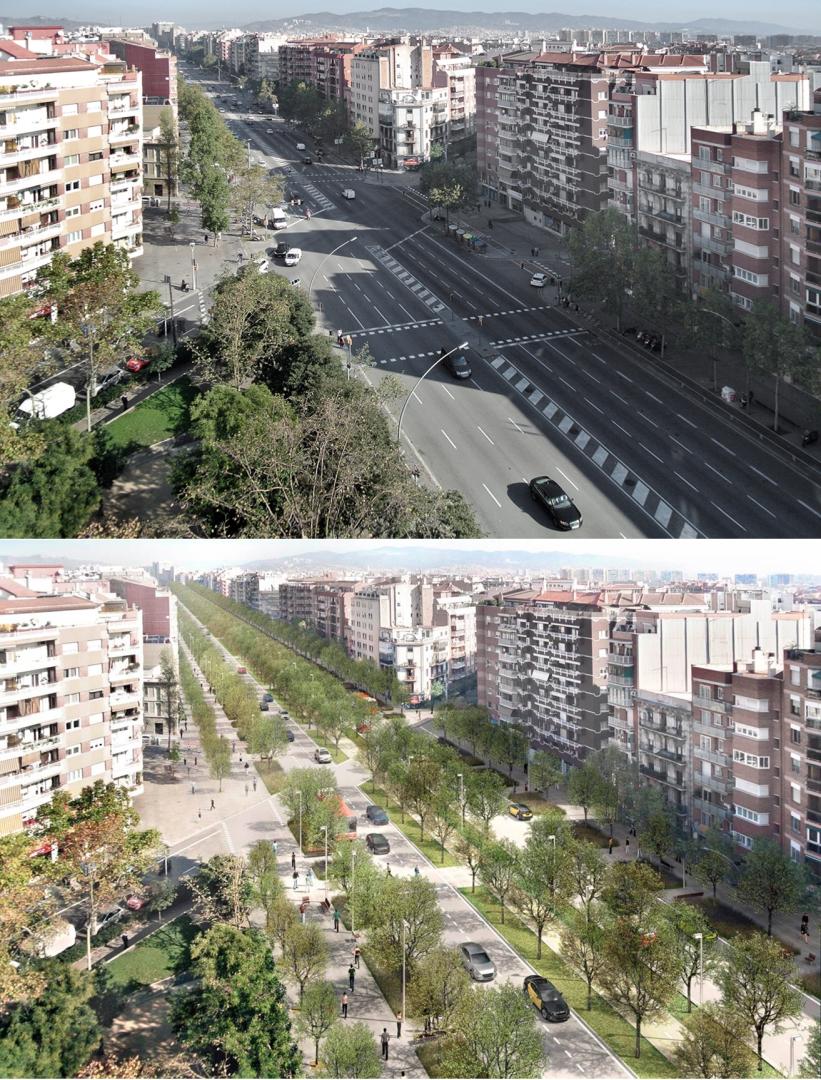
The project to transform the avenue along 6 km aims to turn it from an urban motorway into a city civic axis of reference, a new green avenue where children leisure spaces and street furniture invite citizens to enjoy it and not perceive it as a barrier that divides neighbourhoods. Meridiana is becoming the example of how Barcelona wants big avenues to be, and at current time the 1st km is already transformed, the 2nd one is now being transformed and the rest are being projected.
Project Region
EU Programme or fund
Description of the project
Summary
The transformation of Meridiana aims to reverse its current character of urban motorway, turning it into a civic axis of reference for the city. The strategy proposes its transformation into a green street where the vegetation, space for leisure and street furniture invite you to live it and not perceive it as a barrier that divides neighbourhoods. This implies to make the necessary changes in mobility to advance the pacification of the road, prioritizing the use of public transport, segregating bike lanes on the roadway and recovering the full width of the sidewalks for pedestrians. The final purpose is to improve the environmental quality of the surrounding neighbourhoods, implementing the greening of public space and promoting sustainable mobility.
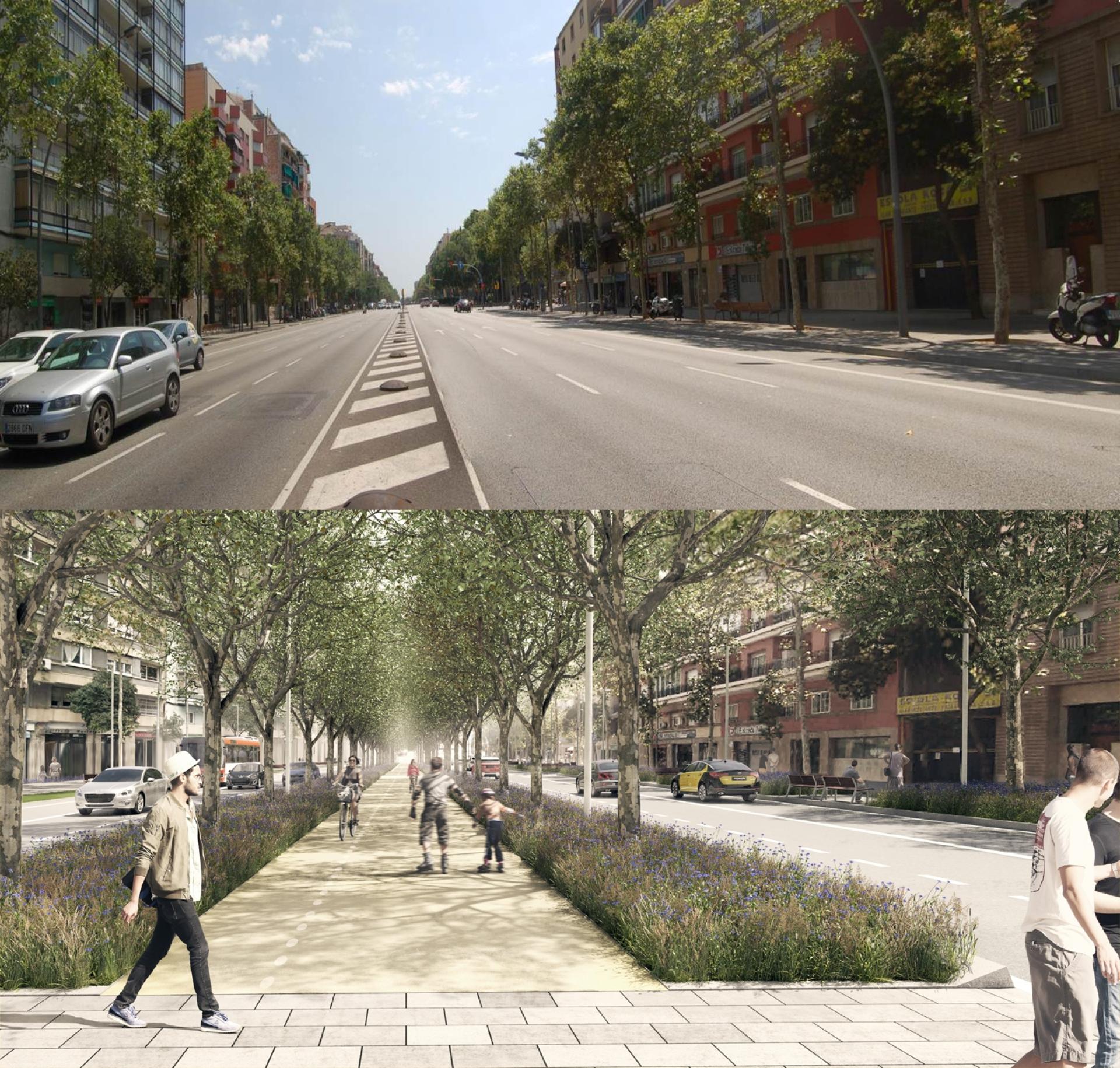
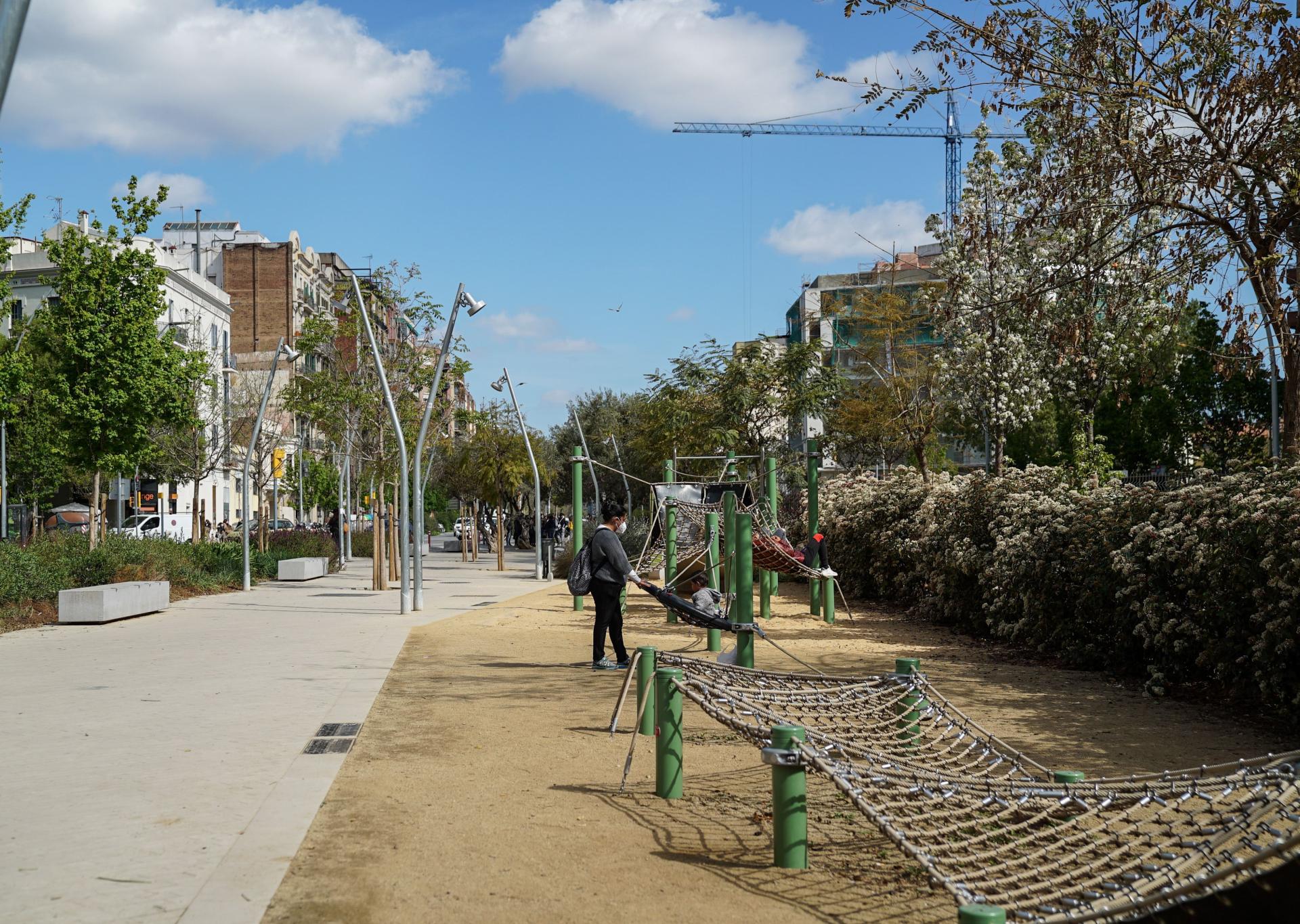
To achieve this, the proposal deals with the division of the current road into two smaller ones, removing one traffic lane per direction and reducing its size in order to gain a central space for landscape divider that contains a bike lane protected by rows of trees on each side. The existing twelve meter wide sidewalks keep their current curb, but the space previously occupied by the bike lane is used to implement parterres that improve the quality of the walkway along the sidewalk and at the same time serve to ward off pedestrians from traffic.
Moreover, there’s an important work on the transversality of the avenue. This is being done through the increase of the width and number of existing crossing points and the reduction of the crossing distance through the implementation of pedestrian refuge islands in the middle. This improvement is done as well as throughout the punctual transformation of the road divider into transversality nodes, with singular paving and singular vegetation. They become a kind of landmark-pauses that sequence the route longitudinally and are located strategically to intensify the connection between the neighbourhoods. Meridiana is the example of how Barcelona wants the big avenues to be.
Key objectives for sustainability
From the very beginning, the Meridiana Avenue transformation project had as a premise to keep or reuse all the elements that can be used as a clear manifest of a model intervention in terms of sustainability, which also implied a reduction in costs and construction time, minimizing the inconvenience caused to nearby neighbors.
In this sense, the first main decision was to maintain the existing curb, which also meant not having to "make a street box". In addition, all the granite slabs on the sidewalks were reused to complete a 4-meter granite strip that houses fords, flowerbeds, bus stops, bike parking lots and other urban elements.
In addition, the 145x15.25 pieces that made up the existing tree grates were reused as a delimiting element of the agglomeration of the new central bike lane, and finally the walking sticks and lighting columns were maintained due to their good condition and we only changed the lamps to LEDs to improve their performance, consumption and light quality.
In the part of the node, although it was completely renovated, the central boulevard maintains the existing 16 meters so as not to have to make "box" and a light-toned pavement was chosen to minimize the warming and the island effect of heat.
Finally, most of the existing trees were maintained and the number of trees was almost doubled, as well as the implementation of new parterres on both sidewalks and mids and a node that involves the improvement of shade areas and also to mitigate the heat island effect of cities.
The intervention was used to implement a groundwater pipe for the irrigation of vegetation and the parterres were left level with sidewalks to take advantage of part of the rainwater, achieving savings in water consumption.
Key objectives for aesthetics and quality
The first consideration made by the project was the comparison of Meridiana Avenue with other 50 m width streets in the city. While the Diagonal or Gran Via had 4 rows of trees, Meridiana had only 2, with a 26.5 meter road that, despite the widening of sidewalks in the late 1990s, maintained the character of an urban motorway. The main decision was to add two new rows of trees and split the current road. With the elimination of one lane per direction and the reduction of the width of these, a space of 9.5 m was released which has been used to build a central green area with a double row of trees and flower beds that delimits a quality bike lane.
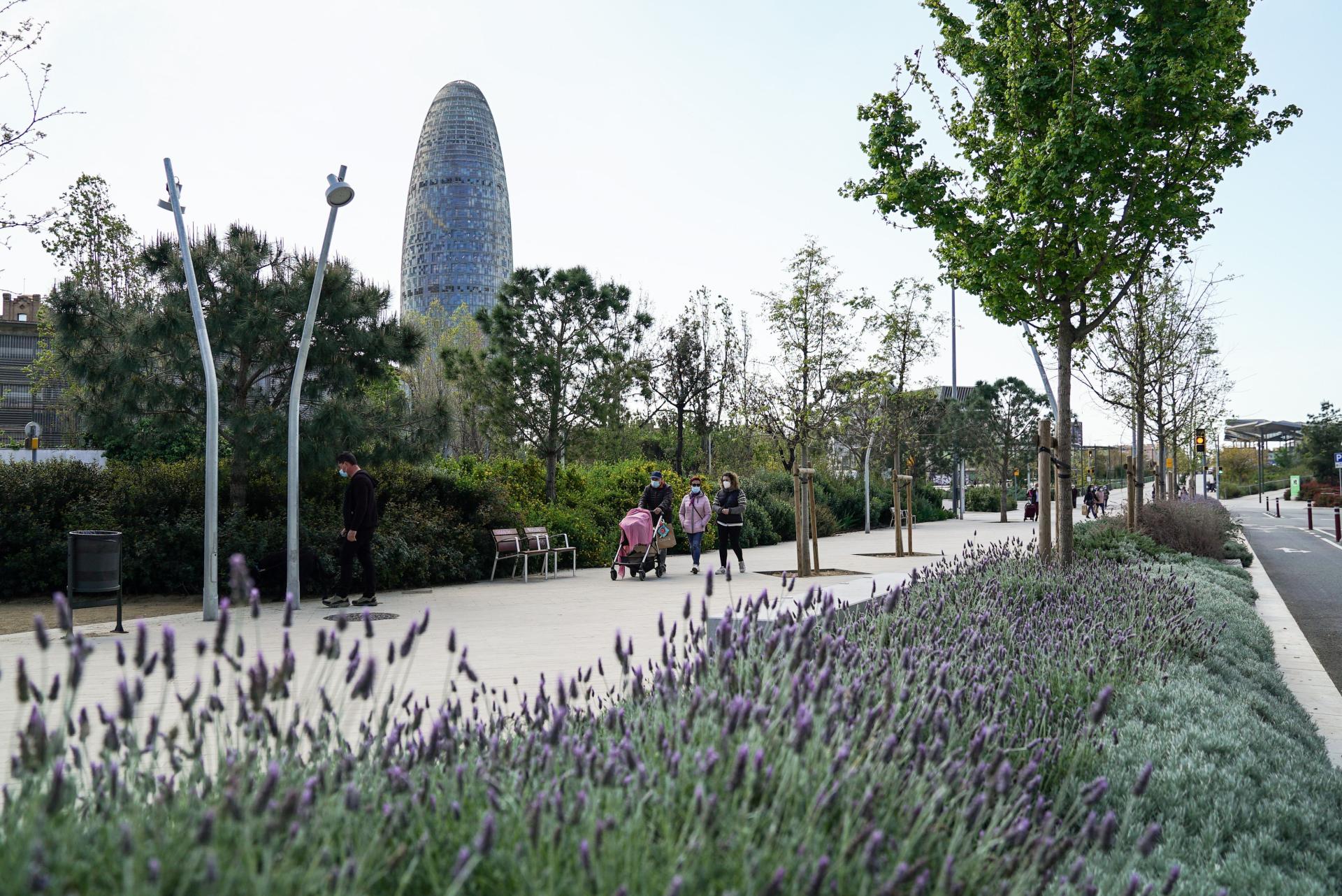
In addition, on the sidewalks the 2.40 m granite strip that contained the old bike lane has been extended to 4.00 meters by reusing the same pieces and contains bush parterres with alignment trees. All the elements are placed with a uniform criterion and with a careful study of paving and ford parts with total integration.
However, it is worth mentioning the consistency in the formalization of the sidewalks versus the centerpiece. While the sidewalks along their entire length maintain the granite strip with parterres and the “panot” (sidewalk pavement) next to the façade that gives it the idea of unity of action, at the central space at the nodes changes the material characteristics to emphasize the contrast with the rest of the track and achieve the goal of sequencing the avenue. In this case, the pavement and other urban elements dialogue with the neighboring project of Glòries Park, widening the boundaries of both urban transformations.
Finally, we must mention the conviction that to attract users to any space it is essential to make its configuration attractive. Thus, the choice of pavements, trees, shrubs and street furniture has been key to humanizing and dignifying a road that has been an urban highway for too many years.
Key objectives for inclusion
In public space transformation projects in Barcelona it is mandatory to work for the inclusion of all groups and the Meridiana, as an emblematic project, has taken a step further.
Already in the project phase, different citizen participation days were held around gender mainstreaming in response to the demands of various groups according to age, gender or functional diversity, and several of the premises in relation to better lighting, living and sitting spaces, removing corners and improving accessible routes, among others.
First of all, the main measure in favour of inclusion is to make wide sidewalks, and in the case of the Meridiana not only has the width of 12m but it has been also widened by 3-9m in the section between Independence and Aragon streets. The sidewalk fords have been widened in width and number to facilitate and increase cross-section, and the slope has been reduced to fit the standard and make them more comfortable. In addition, tactile button and indicator pavements have been integrated into the pavements using hydraulic tile or granite depending on the strip where they are located.
When crossing the road, the central green area is offering large shelters at the level of the street that make it easier for the elderly to cross the road despite even with the improvement in traffic lights they do not have enough time to cross the road.
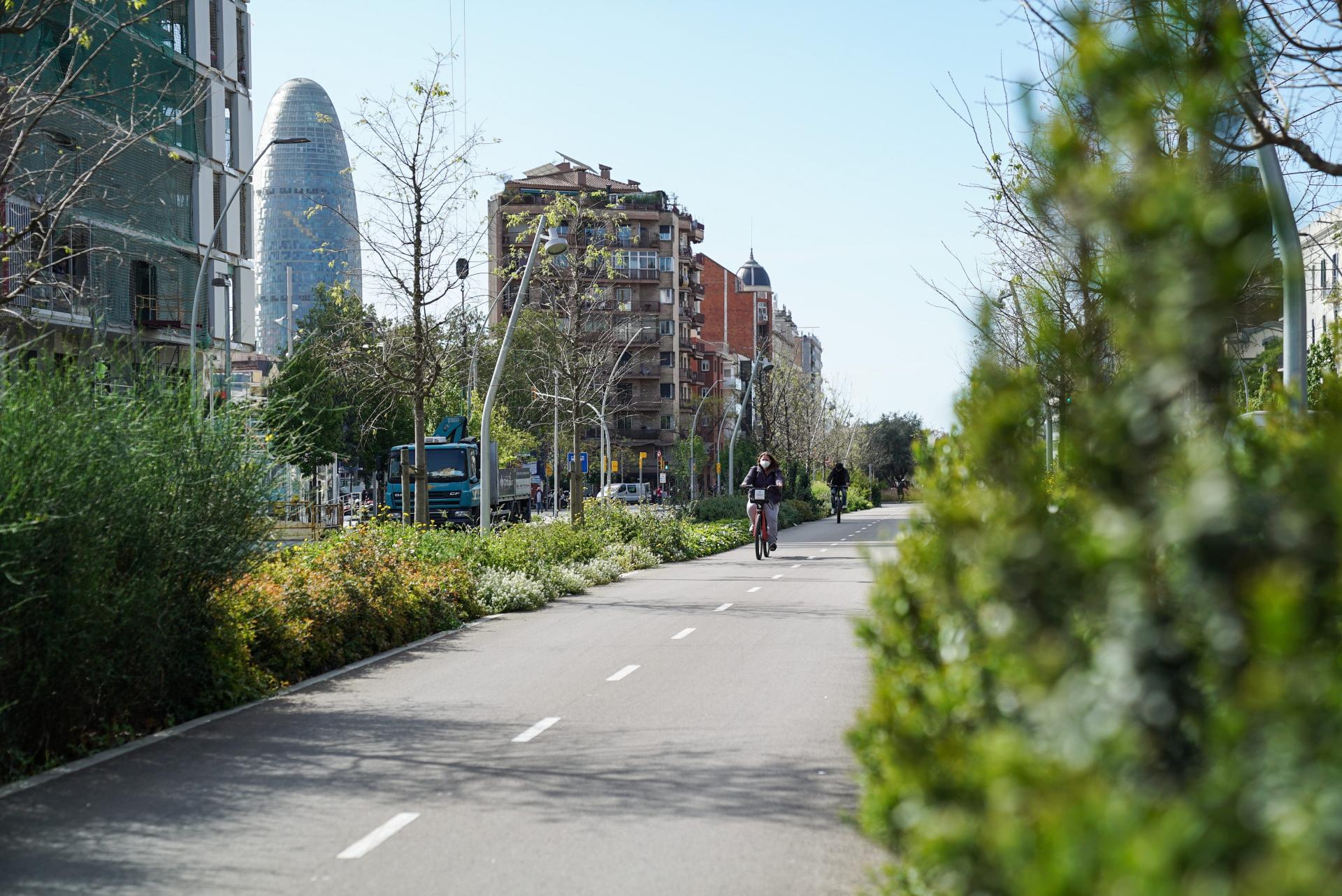
Bicycle users get a wide and comfortable bike lane, well separated from the roads by a parterre on both sides and protected from the sun by the double new row of trees. In addition, all the manoeuvres of the bicycle are resolved in this same space minimizing the possible conflicts between cyclists and pedestrians.
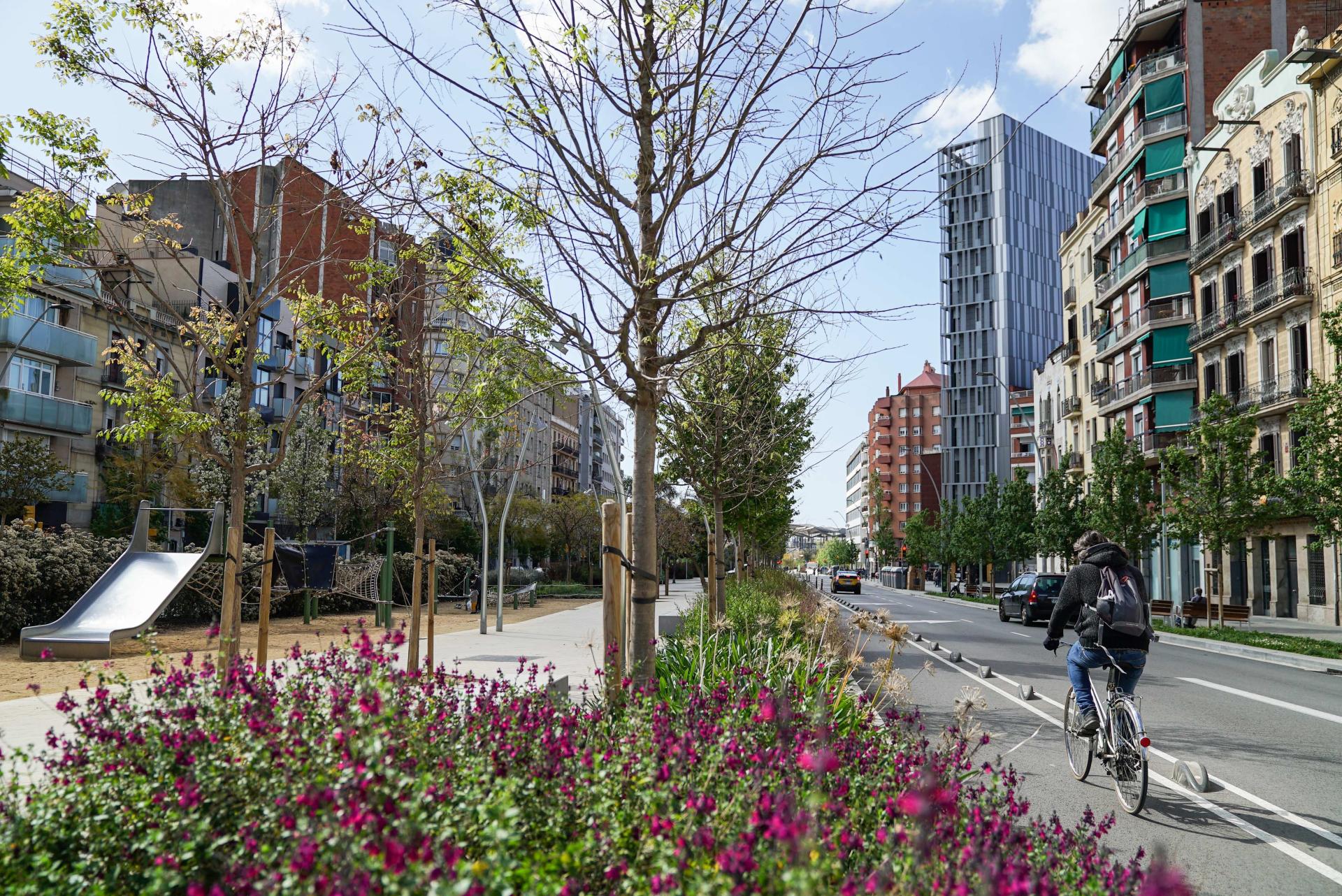
Finally, the central boulevard of the node, for the exclusive use of pedestrians houses two newly created children's play areas, which are part of the municipality Plan for Play in Barcelona's Public Spaces and among other innovations in its design includes the choice of inclusive game elements.
Results in relation to category
One of the neighbourhood requests for the transformation of Meridiana was literally “to turn the avenue into a civic axis of reference for the city, a green avenue where vegetation, children's leisure spaces and street furniture invite the public to live, and do not live it as a barrier that divides neighbourhoods”. And so this premise has been the basis of the project.
Going from an avenue with a road of 26.5 meters to two roads of 8.60 separated by an average of 9.5 m with a double line of trees and flowerbeds that delimit a bike lane has changed the appearance of the street becoming a new green corridor. Not only in the performance on the street, but on the sidewalks parterres of 4 meters wide and variable length have been implemented. These parterres, in addition to separating the longitudinal pedestrian route from the motorized traffic, are also useful to improve the conditions of the subsoil and restore the health of existing bananas that after 25 years had not developed a good canopy due to strong waterproofing 'a nutrient-poor soil due in part to the existence of two subway tunnels and railways.
The selection of the species of the parterres both on the sidewalk and on the central part has been done following criteria of sustainability at the level of choice of native species with few water and resilient needs, but also with a criterion of stratification of the verse that helps the biodiversity attraction. So much so that in the months since the opening of this new transformation, the news came out in the press that after many years, crickets could be heard again on the Meridiana, a street where traditionally only the noise of vehicles could be heard.
As a main result, we have doubled the number of existing trees and improved the conditions of the existing ones, and we have placed large areas of parterres where there were none before, attracting biodiversity and fulfilling the municipality goal of increasing 1m2 of green per inhabitant.
How Citizens benefit
The project to transform Meridiana Avenue started with the demand from SOM Meridiana, a group of different neighbourhood associations in the areas that are being crossed by the road, asking the administration to convert the current urban highway on a civic and green axis of reference. In short, we are talking about 4 districts and 16 neighbourhoods that cross the road and a population of more than 150,000 inhabitants, considering an influence of 200 meters.
During the project and construction phases, regular meetings were held between the administration and the neighbourhood platforms to explain the evolutions of the project and works and meet their demands, as well as a diagnostic work that includes several meetings on gender issues, together with groups various aspects related to the habitability of the road.
Although the direction of the avenue transformation project corresponds to the chief architect's management team, the quality of the intervention would not be understood without the involvement of other departments, such as mobility, green spaces, district, and participation… in addition to the different external teams that write the executive projects or execute and direct the works. The success of transforming such a long and long process would not be understood without the collaborative, multidisciplinary and transversal work of different points of view under a single and clear goal.
In the end, when the whole avenue is transformed, the different phases or the hand of the different teams should not be noticed. Meridiana's project is about the particularities of each of the teams, is a global project where both the citizenship and the municipality are co-responsible for the final result.
Innovative character
The most innovative aspect of the Meridiana transformation is the project methodology itself with the joint involvement of neighbours and administration. Together with two of the objectives of an increase of 1m2 of green per inhabitant and the reduction of a 21% of private mobility on the road in the near future.
This holistic view of transformation makes all items and project decisions being interrelated. On the one hand the reduction of number of vehicles and their speeds achieves reducing the number of lanes and the width of these, dividing in two the road and improving the conditions of the bus lanes and the characteristics and locations of bus stops, placing them close to metro, railway and public bike share station interchanges, giving an alternative supply to private vehicle users who switch to using public transport.
With the space freed up we manage to implement a green average with double rows of trees and flowerbeds that house a bike lane, and freeing the sidewalks of the current bike lane we get space to place flowerbeds that improve the conditions of existing trees and in this way we close the circle.
Already entering more specific issues, the Meridiana project, and in accordance with the Urban Mobility Plan, clearly specifies that the pedestrian is the priority number 1. Thus, important work has been done to increase and improve the number of crossing points, of making sidewalks passing through all the streets that cross the avenue and that are not basic network and finally an effort in the implementation of nodes that intensify the pedestrian crossings, that link the neighbourhoods on both sides and that it sequenced the pathway to reduce the speed of private motorized mobility.
Meridiana is a global project of transformation both in its core and in its transversality.