Adaptive living for unfinished buildings
Basic information
Project Title
Full project title
Category
Project Description
In context of the ongoing discussion on how to reduce production and the ecological footprint in the construction industry, this project is focused on unfinished buildings as an existing potential and yet an unutilized resource. The concept revolves around ways of bringing uncompleted structures to benefit society. Based on the principles of circular economy and visions for sustainable living, a set of scenarios is offered for the inclusion of these sites within the surrounding environment.
Project Region
EU Programme or fund
Description of the project
Summary
In context of the ongoing discussion on how to reduce product consumption, manufacturing and shrink the ecological footprint in the construction industry and in general, this project is focused on unfinished buildings as an existing potential and yet an unutilized resource. The concept revolves around ways of bringing uncompleted structures to benefit society.
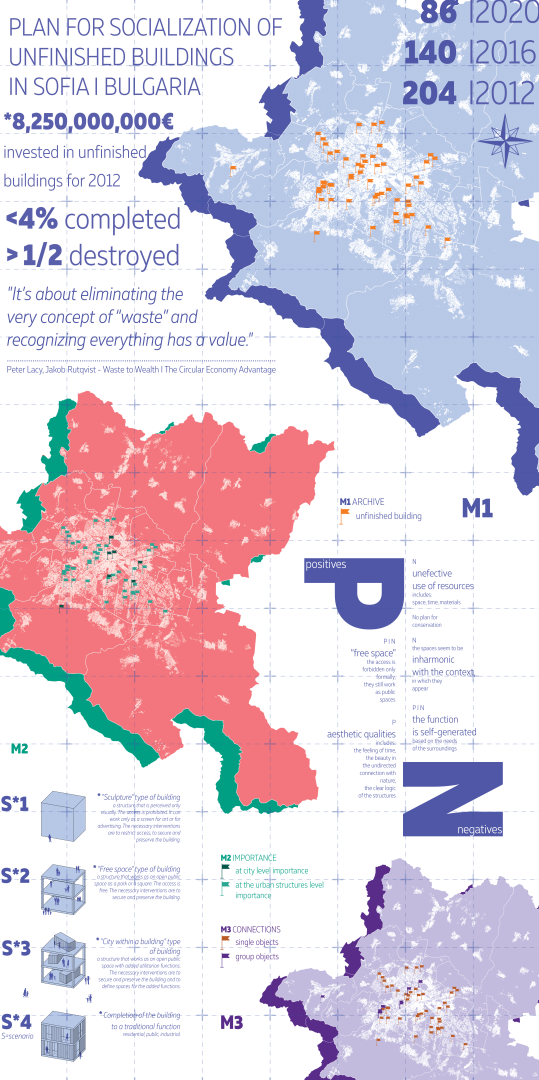
The research includes two stages. First one - the development of a database with information about all unfinished buildings in a given area - Sofia, the capital of Bulgaria. Second one - implementing an adaptive general plan that consists of a number of scenarios for their functioning. This plan would be based on various criteria like constructive serviceability of the structures, type of ownership, access, etc. These scenarios are sequential, low-budget and develop one after the other without losing any raw material.
Scenarios:
S1 * "Sculpture" type of building - a structure that is perceived only visually. It is suitable for cases when the access is prohibited. The structure can work only as a screen, for example for art or for advertising. The necessary interventions are to restrict access, to secure and preserve the building.
S2 * "Free space" type of building - a structure that works as an open public space for example as a park or a square. It is suitable for cases when the access is free. The necessary interventions are to secure and preserve the building.
S3 * "City within a building" type of building - a structure that works as an open public space with added utilitarian functions. The necessary interventions are to secure and preserve the building and to define spaces for the added functions.
S4 * Completion of the building to a traditional function - residential, public, industrial.
Key objectives for sustainability
The most serious issue associated with these structures is the underutilization of resources - space, time, materials. The following statistic shows how this problem is still present - according to Sofia Municipality as of 2012 the number of unfinished buildings was over 200, while the funds invested in them are estimated at 8 billion Euro / for comparison, the gross domestic product of Bulgaria for 2012 is 9 billion Euro /. Three years later, the number of unfinished construction sites dropped to 140, and by 2020 it is less than 80. The figure is falling rapidly, not because these buildings are being completed, but because they are being demolished. Based on the growing problem, the project raises the question of the potential of such spaces and tries to discover the opportunities they can offer. The idea refers to the studies of Peter Lacy and Jakob Rutqvist and the principles of circular economy for the optimal use of resources. The point is to eliminate the idea of "waste" and to realize that everything has value. A similar model applied in architecture would guarantee useful and sustainable existence of the buildings even in the cases, when they have remained unfinished.
Key objectives for aesthetics and quality
The unfinished sites within Sofia are very different from one another. They are in different stages of completion, have different constructions, stylistic features and designated functions. However, they share common values and problems. Each of them can be defined as a form of free space in which there is no strictly directed function, and the function is generated by the needs of the environment. Sometimes these places turn into playgrounds, into spaces for recreation or art. But more often this versatility brings a number of negatives. It is also the main reason for mass vandalism. With the wide frame set by the scenarios and the minimal physical intervention in the early stages the project aims to keep this feeling of a free space and at the same time to revive these sites. The activation of the place will reduce the negatives and improve the quality of experience.
Key objectives for inclusion
The plan consists of four different scenarios each having a specific role to include these unfinished sites in their surroundings. The first scenario considers unfinished buildings as part of the urban landscape, which can influence the environment with their visual presence. For one reason or another the access is prohibited - whether because of structural failure or at the request of the owner or the investor. They do not function as a space, but can be useful as an exhibition area - as a screen for projections, for art or for advertising. The following scenarios consider the cases in which access is free. Their spaces can accommodate a number of functions that would be defined by the investment interest, the needs of the environment and the capacity of the site. Second scenario considers possible functions that require minimal intervention. The unfinished buildings can be turned into playgrounds, meeting places for locals, areas for outdoor events or recreation etc. Third scenario sees the upgrading of functions with increasing investment interest. In parallel with the listed opportunities so far, small commercial sites can be added to the site, temporary markets or private events can be organized. The final scenario takes into account the familiar possibility of completing the structure. Purpose for each of the listed options is to create symbiosis between the building and its environment.
Innovative character
In its essence, the project draws on global tendencies affecting unfinished buildings, trying to define them and consider them as a phenomenon in architecture. Those structures are most often non-contextual. Their existence in this form is not foreseen or expected. They are not adjustable to utilitarian functions and however undirected some of them still find ways to adapt to the environment. Based on that research and an assessment of the complex characteristics, condition and potential of this specific resource a plan for socialization is developed. The four scenarios have a wide range of use, they set directions for development without specifying and oblige, that makes them universally applicable to the whole spectrum of problem situations. The project focuses on the adaptation and socialization not only as a solution for the unfinished buildings but also as a thing that should be implied in the design process. The research follows the concept that architecture is not always a final product, so it should not be seen as static, rather than as adaptive in each stage of its development.