Like a Phoenix from its ashes
Basic information
Project Title
Full project title
Category
Project Description
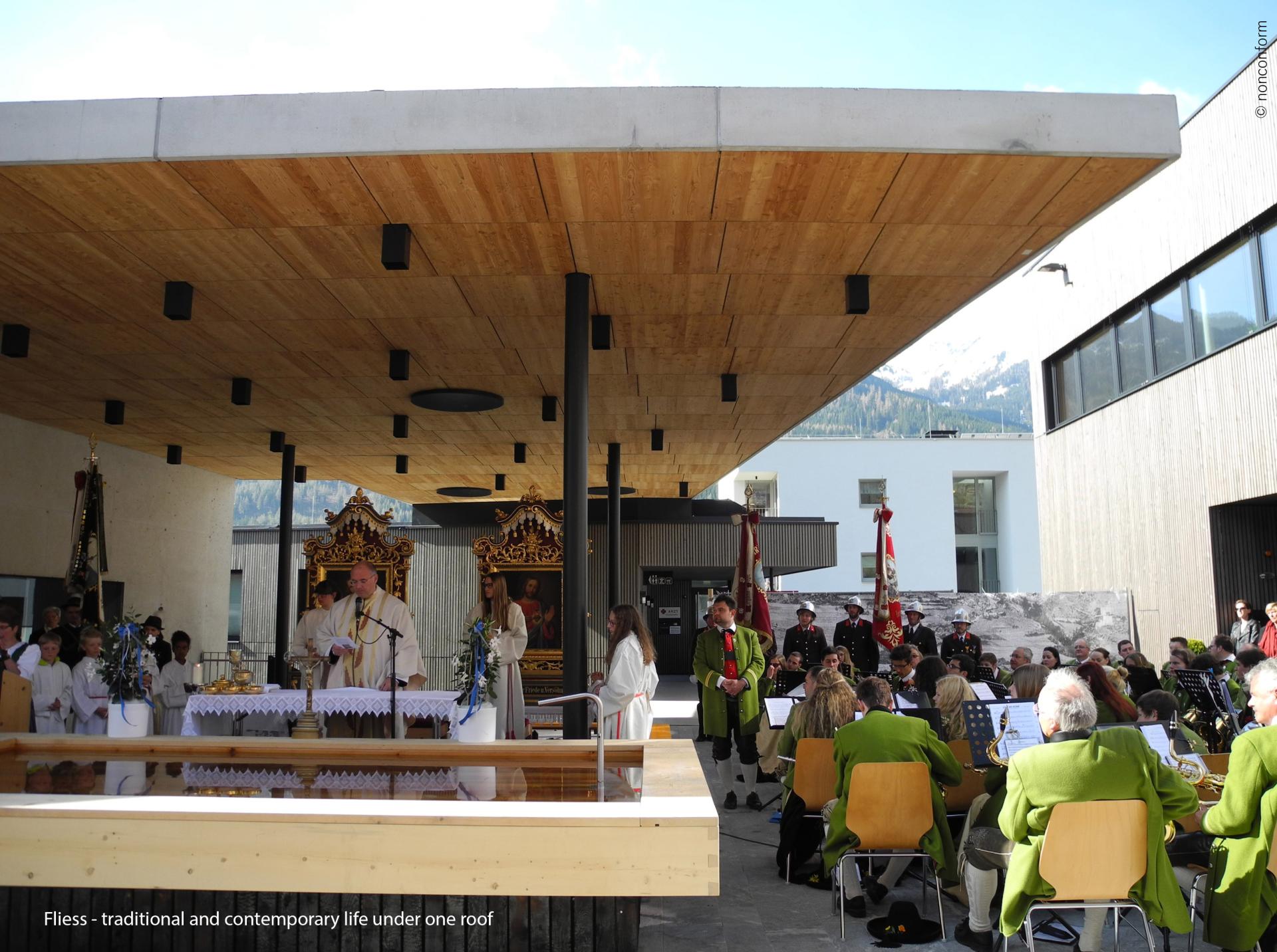
“Finally, we are meeting again in the central square – and not only in the cemetery”, said an old woman at the opening ceremony. For many years the small Austrian village seemed to be slowly dying. More and more disused buildings were emerging in the centre and to satisfy their daily needs its ageing inhabitants had no alternative but to drive to other places. An innovative combination of an architectural competition with a participatory process brought the empty, voiceless place back to life.
Project Region
EU Programme or fund
Description of the project
Summary
Fließ is a picturesque place in the Austrian mountains. The municipality consists of about 3000 inhabitants spread around 75 hamlets. For many years its population was decreasing and ageing and more and more spaces in its very centre were abandoned; the “donut effect” was eroding its heart.
For the old as for the young, and for the village alike, the future looked dire. When unable to drive anymore and if no carer could take them to the market, doctor, hairdresser or the church, the old residents had no other choice but to relocate to a nursing home in another village. The young had no reason to return after their studies, as neither jobs nor affordable housing was provided.
Having bought disused properties, the local administration involved nonconform and initiated a process meant to regenerate the centre and make it again a place for the daily and social needs of the community. This took the form of a pilot project innovatively integrating an architectural competition with a process of community involvement.
Firstly, five architectural practices were selected for the relevance of their portfolio. These then all took part, together with all interested people from the community, in a nonconform ideenwerkstatt. This participatory process spanned over three days and defined the project brief in more detail. Thirdly, having met the community and learned about their real needs and desires, the architectural practices submitted each an architectural concept. Finally, the winner project was chosen by a jury with the involvement of the community.
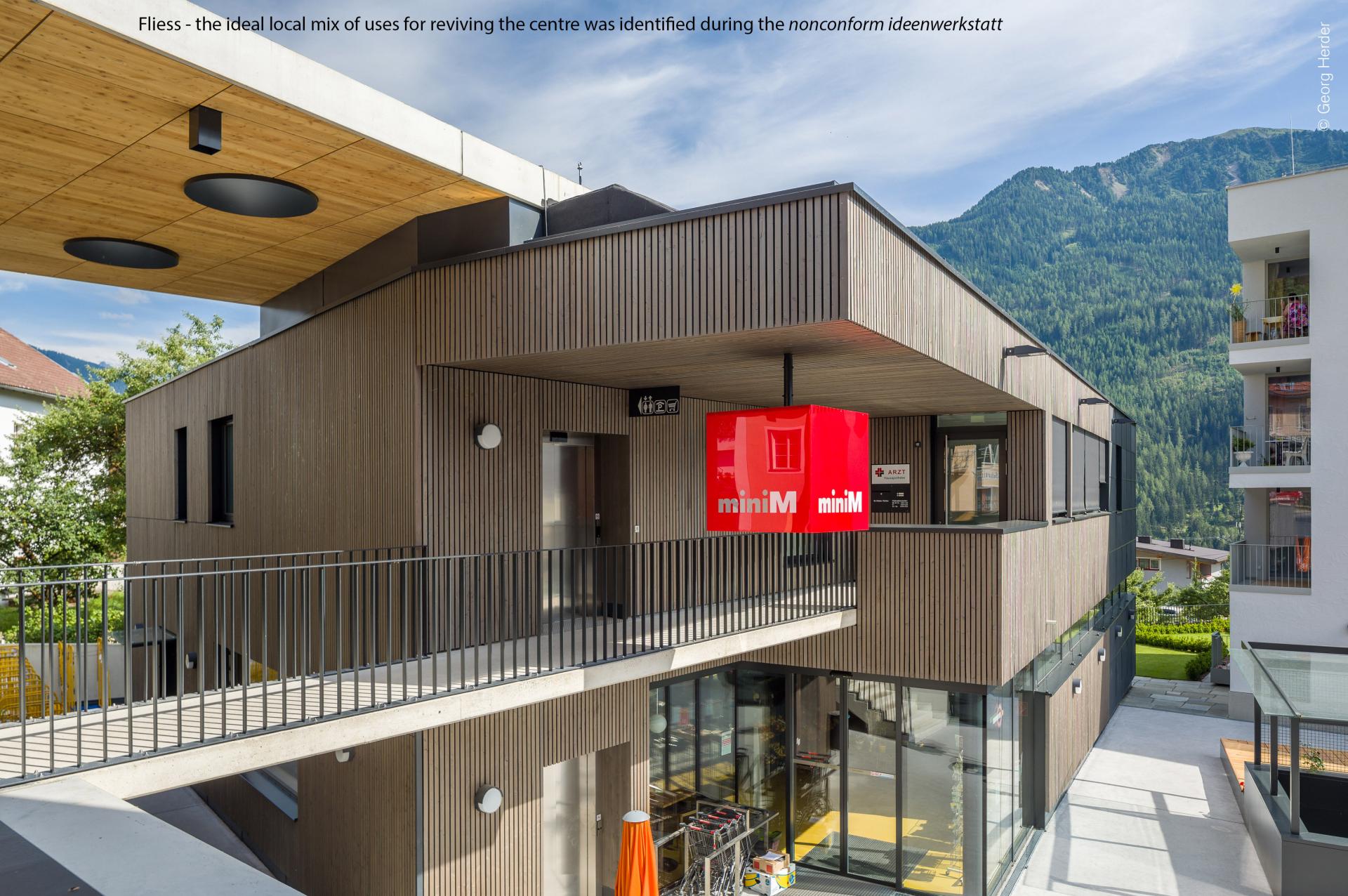
As a result, the new buildings with minimarket, bistro, administration, medical centre, hairdresser etc. and the public space between them, are now ensuring that the inhabitants´ needs are met and that the community can come together, be it for events or for the occasional coffee in the sun. The buildings also provide affordable, starter apartments for the young, assisted living for the old, and a space for social exchange.
Key objectives for sustainability
The project’s sustainability objectives were: to regenerate the centre and avoid developing green land outside the village, to use local resources by way of materials, techniques, workers and professionals, to optimize and reduce building space, to encourage sustainable behaviours (e.g. using public transport), to create jobs and livable spaces for the community that are economically viable.
These objectives were achieved by concentrating the mixed-use development in the centre, using locally sourced materials (timber and stone) and local artisans for building it. Through the participatory process spatial synergies could be identified and the built area considerably reduced. By having shared centralized spaces, in particular, the storage volume could be reduced to half and the underground parking by a fifth. Complementary uses benefitting one other were located accordingly. For instance, the bistro with its self-service tables was moved from near the local administration to next to the supermarket with the option to place tables in the square and animate the public space. An alternative to car use was made possible by improving the local public transport and placing a bus station right by the renewed centre.
As all members of the community could take part in the decision the new uses were paired to the specific needs, naturally supporting their long-term economic viability. The new apartments were rapidly occupied by new residents further supporting the regeneration of the centre.
Last but not least, the open participatory process created a sense of empowerment and belonging in the community and kicked-started a new way to live their village. The renewed centre is now a community meeting place responding to social sustainability needs by increasing the social cohesion and the quality of life.
Key objectives for aesthetics and quality
High quality experience and aesthetics, as well as bringing an important contribution to the identity of the place and its inhabitants, were of high priority for the community´s project.
Achieving these objectives was ensured through both the two-stages architectural competition, as well as by involving the public in part of the jury process. The goal was to select the best project, one which would through a contemporary architectural language, materiality and scale harmoniously integrate in the local traditional context.
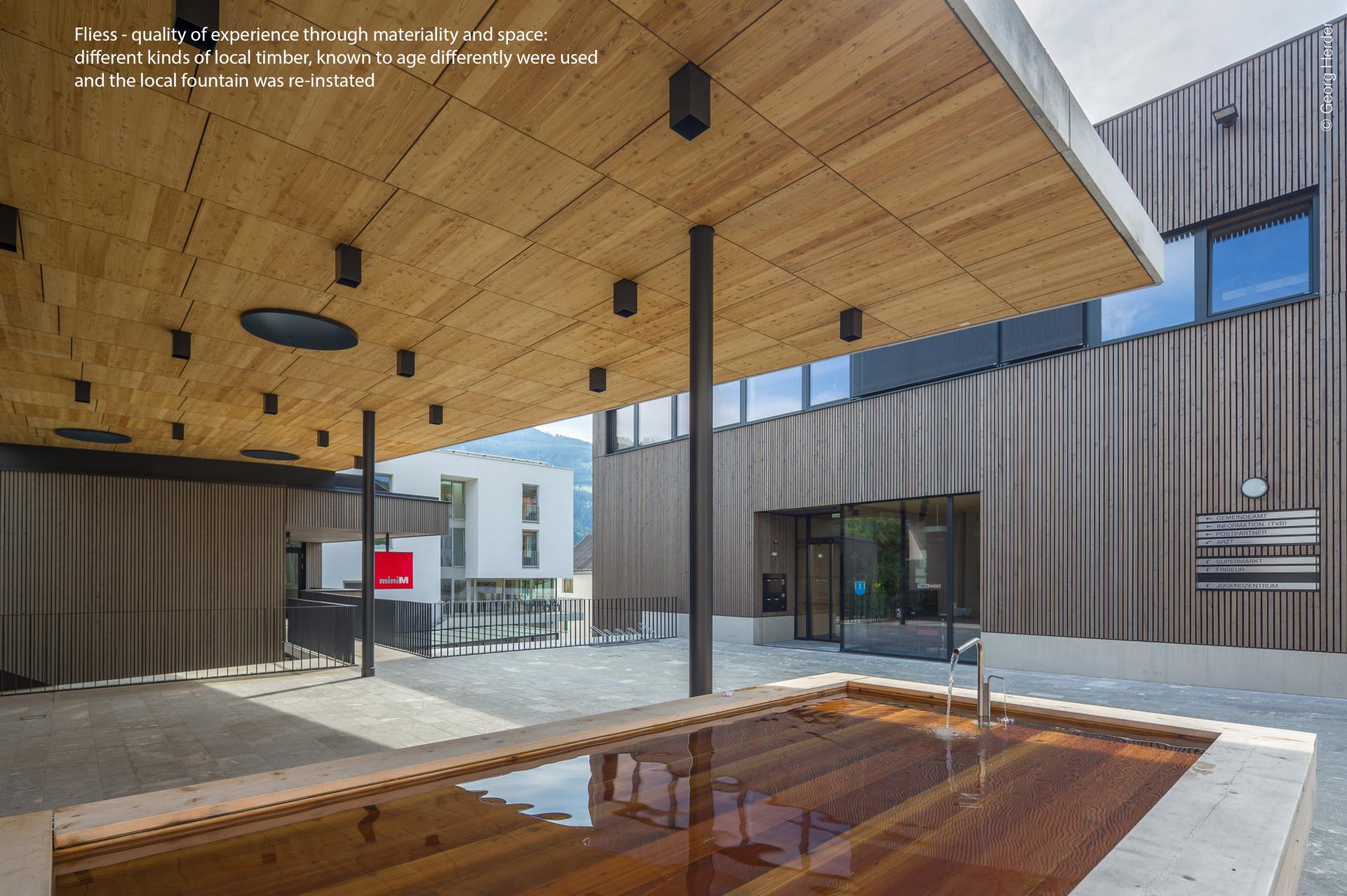
The realized architecture and open space, by Architect Rainer Köberl, provide a high quality experience through materiality, human scale and the associated sensorial experiences. Materials specific to the area, such as stone or different kinds of timber were used. These are known to be aging beautifully and create a warm atmosphere – and ensured the buildings are well integrated in the existing built environment.
The water fountain, an all-important element for the village squares throughout history, is with its sounds and reflections a place to play and interact, just as well as one to refresh oneself and meditate.
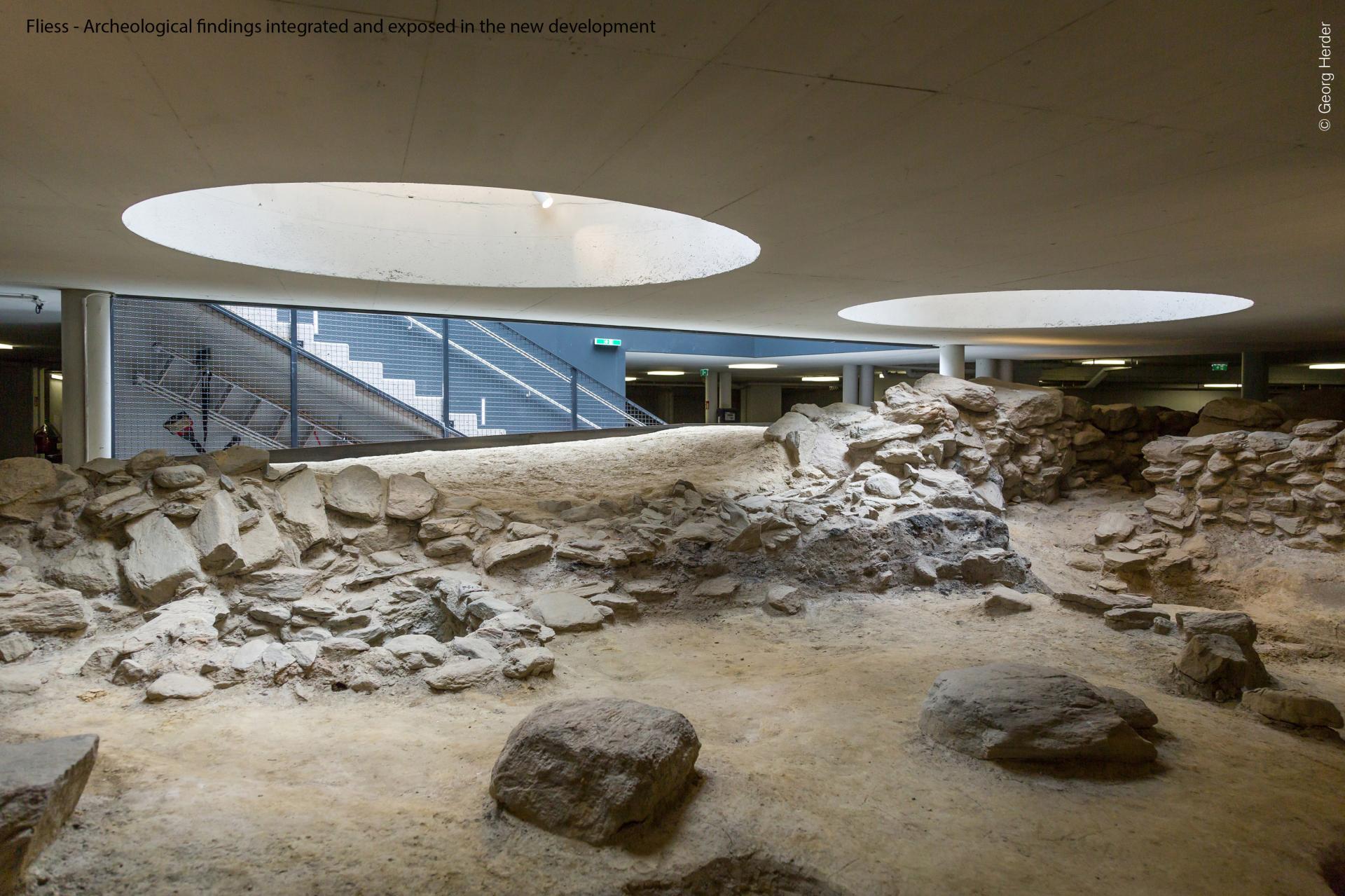
The archeological findings that emerged during the building site were carefully integrated and exposed in the development, giving a sense of past, history and identity.
Key objectives for inclusion
In terms of inclusion, the whole process aimed to give everyone a voice, from young to old, in establishing the brief as well as in selecting the winning project. This objective was achieved by actively involving the different categories in the community through diverse and specialized participatory formats (see section on participation below).
In terms of affordability and inclusion, offering starter as well as assisted living apartments created new possibilities for the young and the old alike. Moreover, through the community spaces created, the chance was given for intergenerational exchange and support.
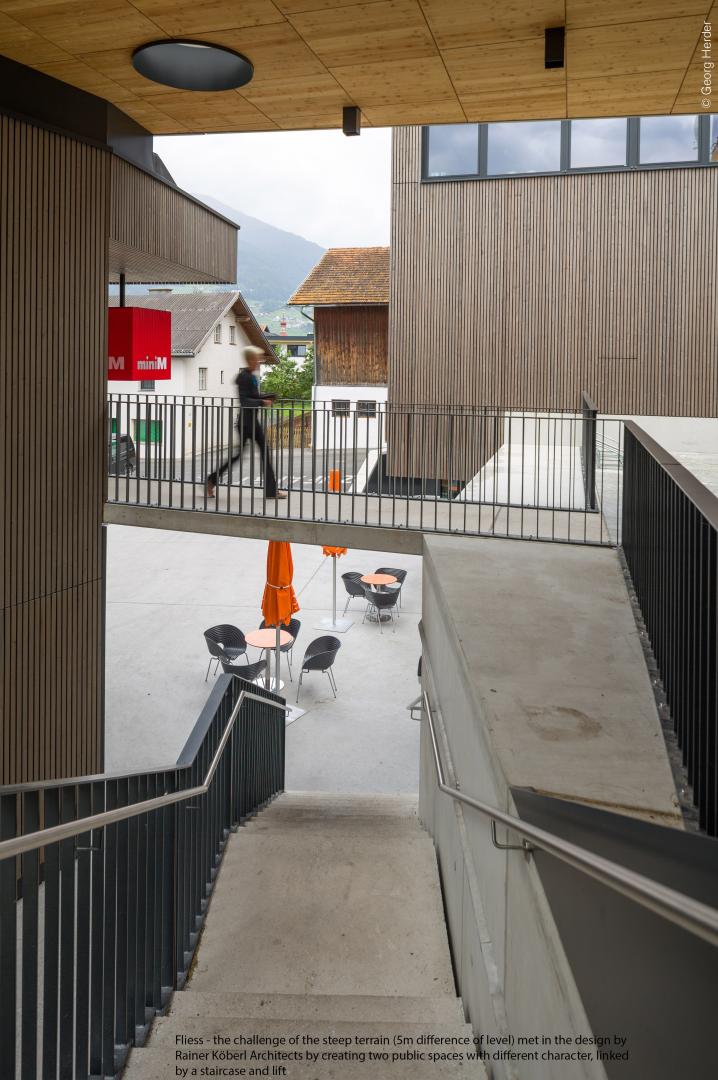
Accessibility was improved through placing the development at the heart of the village and ensuring a functional bus connection. The proposal selected offers an integrated, wheelchair friendly solution in spite of the 5m level difference by dividing the open space in two sections: one covered, marking the entrance from the street, with fountain and bus station, and a contained little square at the level of the shop and bistro. The two levels are connected by a lift and a staircase.
Results in relation to category
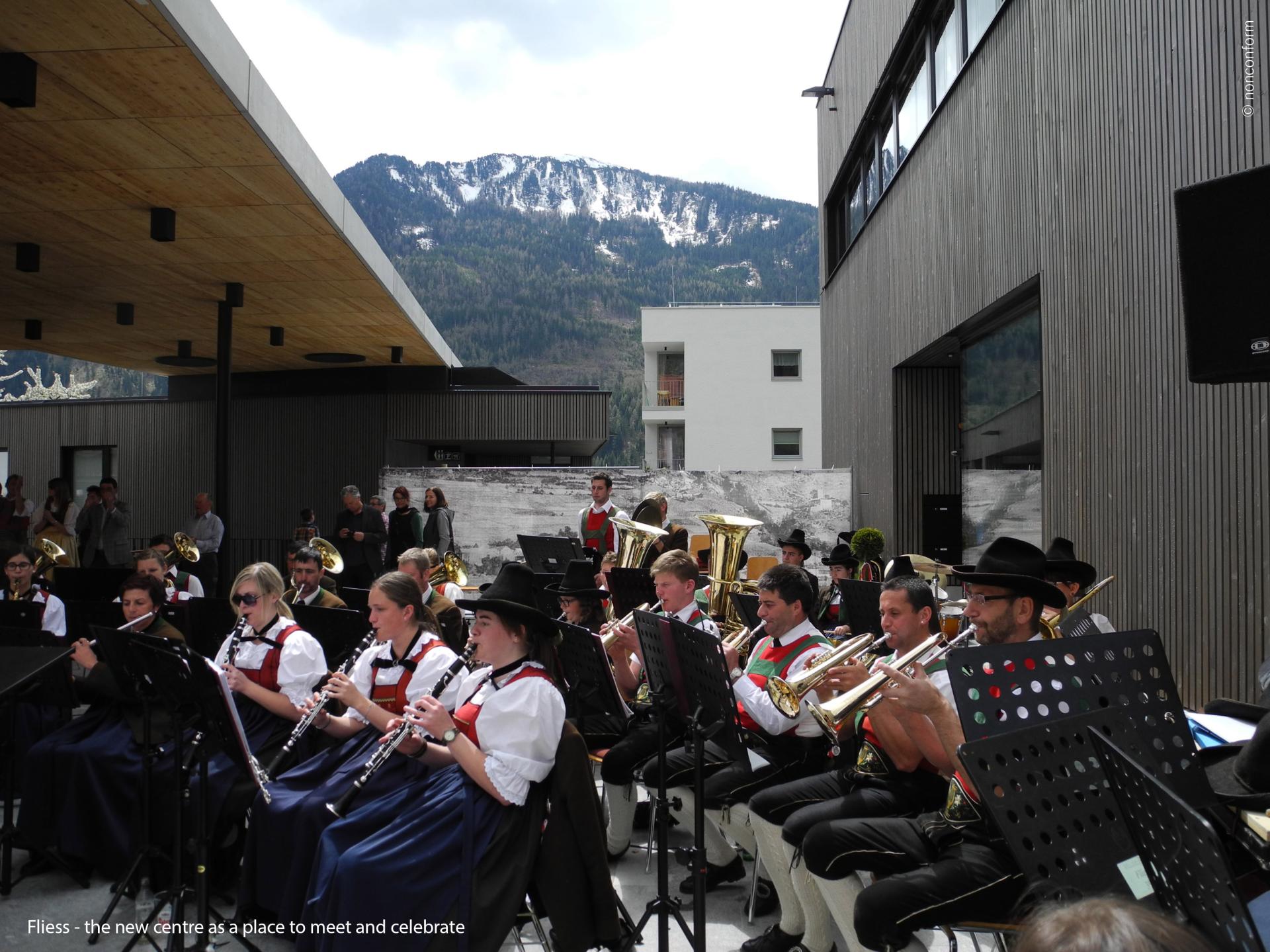
As a result of the compact development the centre is again a place for the community: for the occasional encounter, for coming together and celebrating or simply for satisfying the daily needs. The mixed uses, such as supermarket, medical centre, local administration centre with events room and a space for youngsters as well as the high quality of the development create not only new working spaces but also contribute substantially to improving the quality of life.
Due to the innovative participatory format, a new dynamic emerged - the dialogue tools empowered and gave voice to the community and triggered other new projects, such as new residential projects inside the municipality’s boundaries, the restauration of the local museum, the organization of an open-air classroom for the school children and others.
“The number of inhabitants in Fließ grew again and there is demand for properties and apartments even from people from outside, that are interested to move to Fließ!”, said Sonja Bettel in 2016, just one year after the project was inaugurated. At this event Fließ received the Landluft Baukulturgemeinde-Preis. In the same year, the project also received the award of the European Village Renewal Initiative.
How Citizens benefit
In the three intense days of the nonconform ideenwerkstatt, through various participatory formats, everyone interested from the local community could explore and discuss ideas together with the architects. In the ideenbüro, a pop-up office that nonconform opened for the three days inside the school, people could simply walk in, gather information about the project, write their ideas on ideenzettel that were afterwards exposed on a wall and discuss with the nonconform team and the architects the project. Further on, a Spurensuche group visit to the site was meant to gain fresh views through perspective exchanges and through the invaluable information shared by locals. During several events and workshops, in a relaxed and productive atmosphere ideas were exchanged, needs were identified, relevant themes for the project emerged and scenarios were developed and discussed.
To reach younger generations, an online competition on a dedicated website was launched. School children were involved through specialized workshops and presented their ideas in the form of a theatre play.
Then, during the actual selection process, apart from the typical jury sessions with closed doors, there was a dedicated part where the community could express their preferences. Therefore, the decision was informed by the position of the locals, met less opposition and increased the likelihood of its implementation.
Last but not least, at the end of the selection process all projects were presented to the community and the jury explained the advantages of the winning solution. This was done in a festive atmosphere, where all the community was invited to take part, and which created momentum for the stages to follow.
A clear impact of such participatory processes is also that through involvement solutions emerge that match the local specific needs. Moreover, people identify with the project facilitating its implementation and ensuring its long-term viability.
Innovative character
The project was innovative for the particular way in which it combined an architectural competition with a thorough participatory process.
Usually, if the community is at all involved, this happens only at the very beginning of the project, in the so-called “Stage 0” when the brief is being defined. After that, particularly for bigger projects, a competition is organized where the most suitable project is selected by a jury of experts and political actors. From then onwards the project is usually in the hands of the architecture team and then the developer. The community is involved again only when the project is finished and goes into use. This has a negative impact on the sense of identification and ownership and useful information and nuances can get lost in the hand over.
The process used in Fließ ensures not only the quality targeted through architectural competitions but also the continuity of the involvement and feedback. This format is bridging the world of experts with the one of lay persons - extending therefore the perspectives of each, generating more innovative ideas and reaching better solutions overall.