Rethinking Urban Design
Basic information
Project Title
Full project title
Category
Project Description
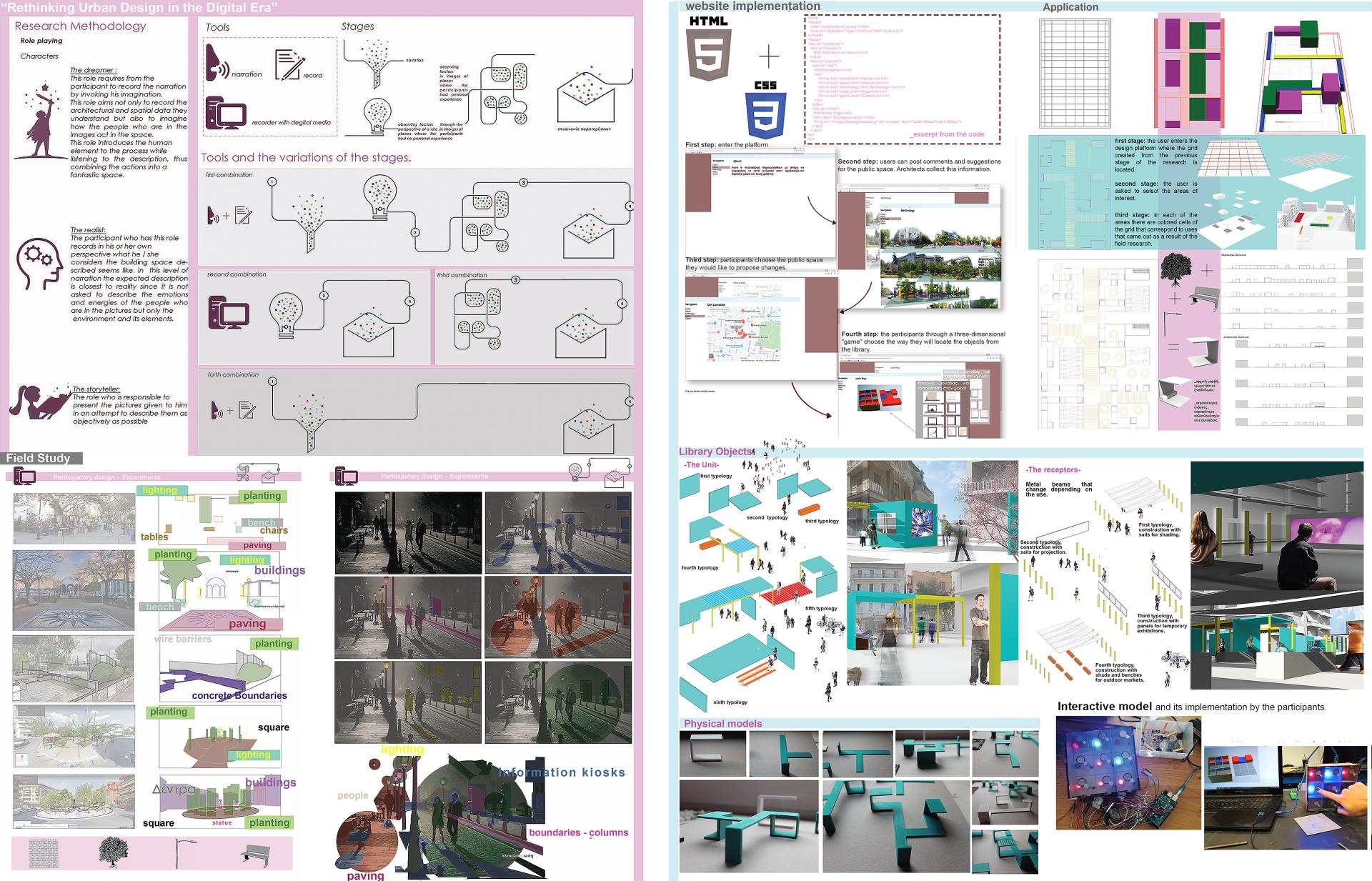
The project “Rethinking urban design in the digital era”, takes into consideration the theoretical framework regarding new technologies and their impact in everyday life. The main goal is to create a holistic design framework that guarantees the successful combination of all aspects of everyday life, in order to produce an informative, useful, and symbolically rich outcome. It aims at empowering people through bridging the digital gap, allowing them to become “makers” of the collective spaces.
Project Region
EU Programme or fund
Description of the project
Summary
The project “Rethinking Urban Design in the Digital Era” explores the introduction of new technologies as media for modulating public space.The main goal is to reimagine the urban fabric through a novel design framework that utilizes digital technologies.This framework will empower citizens by bridging the digital gap and giving them the means in order to become modulators of the collective space.The methodology on which this framework is based is gaming and narrative as tools of participatory design.The expected result is to encourage a wider level of participation in the redefinition of the sense of urban space through the creative use of digital media.Thus a bridge between virtual and physical collective space is facilitated, leading to informative, useful and symbolically rich outcomes.
Key objectives for sustainability
The project reflects sustainability on two levels.On one hand, the utilization of gaming and narration as tools allows participants to interact, cooperate and create in a virtual environment, reducing the costs usually involved in participatory design processes.On the other hand, the present proposal utilizes the Maker Space model as an open, collaborative platform where citizens are able to design, test and manufacture their ideas in a sustainable manner, promoting cyclical economic models.. The first stages of this project were implemented in the Athens Municipal Maker Space, which is a state-of-the-art open laboratory, the first municipal facility of its kind in Greece, equipped with innovative design and fabrication technologies. It is important to note that the Maker Space is part of a holistic approach regarding the osmosis of design, technology, education and culture, open to all citizens, cultivating a platform for facilitating the organic integration of new technologies and practices in everyday life.
Key objectives for aesthetics and quality
“Rethinking urban design in the digital era” promotes innovative planning and design of urban public space, focusing more on how the process is conceived and implemented, rather than the design outcome. The guiding principle of the design strategy is the creation of fertile conditions for revitalizing public space. Collaborative design processes are understood as a factor and multiplier of vitality that encompasses multiple aspects of the project: materials, forms and use. The objective is to include user input in the design of public space. In this way it differs from the traditional top down approaches about urban design that usually do not take such considerations into account. Moreover through the platform this project can be conceived as a medium for citizens to express their aesthetic regarding public space. As a result,the expected outcome is the transformation of the aesthetics and the quality of experience of urban space through the regenerative force produced by the synergic action of these design elements. This research suggests a strategy, which assumes creative interaction within a context and the gradual rise of responsibility for places by users and discreetly guided by architects. All this must be conceived as one seamless process. In this perspective the construction, implementation and maintenance of a project become foundational steps within the process itself defined by two phases: transforming “archetypal” objects of the existing library, provided by the architect, and fabricating these unique spatial variations in Maker Spaces.
Key objectives for inclusion
One of the main considerations in the development of the online design platform is the inclusion of individuals and social groups that are usually excluded from relevant discussions regarding the reshaping of public space.This is facilitated through the game-like structure that democratizes participation, regardless of gender, race, economic status, technological literacy and so forth.In the context of the proposed online design platform, everyone will have access to easy to use digital design tools and frameworks in order to propose their own vision for the urban environment.Furthermore, the platform provides a forum, a “digital agora” in which participants will be able to discuss, exchange opinions and cooperate with others, overcoming the usual barriers that hamper communication.In this way, they can share their ideas regarding the reimagining of public space, which is the common space we all share.. This can lead to organic, bottom up solutions that evolve as a result of social participation, rather than imposed as an external, top down solution.Moreover, the utilization of Simulated (Virtual or Augmented) environments allows participants to visualize and interact with their proposals in an experiential, hands-on manner.Through the aggregation of the factors mentioned above, it is expected that the project will facilitate the communication between the various stakeholders of public space as well as empowering citizens to imagine, design and fabricate a new urban environment.
Innovative character
The present project was awarded in 2020 in the State of the Art Catalogue that collects and analyses 30 best-practice case studies, offering a clear panorama of the emerging methodologies and strategies for the public space co-design through games and digital technologies. This research proposes a methodology for the cross-disciplinary study and analysis of complex urban realities, with the use of advanced digital tools for the creation and development of a “digital twin” of the city. This twin acts as a plateau for research and collaboration that represents and visualizes users’ behaviour in space as well as their proposals on how these spaces can be transformed. The objective of this research is a digital participatory design platform, which enables the evaluation of alternative planning scenarios and design interventions in the context of the management plan of open public spaces that used to be popular within the urban fabric of European cities, but are now forgotten or in limbo due to political, economic, or social pressures. It does so through this phygital approach to create bridges and crossovers between the virtual and the physical world,in order to invite citizens to better understand the impact of their proposal.