Fabricademy,Textile & Technology Academy
Basic information
Project Title
Full project title
Category
Project Description
Cutting edge, hands-on educational program combining sustainability, industry 4.0 and wearable technology for future textile narratives.Demystifying technology by interweaving traditional craftsmanship with advanced prototyping tools, biobased materials, software & fabrication techniques.A combined three months of skills modules & three months of personal project development with mentorship.Join any of the 45 locations to connect local expertise & tutorials with online best practices
Project Region
EU Programme or fund
Description of the project
Summary
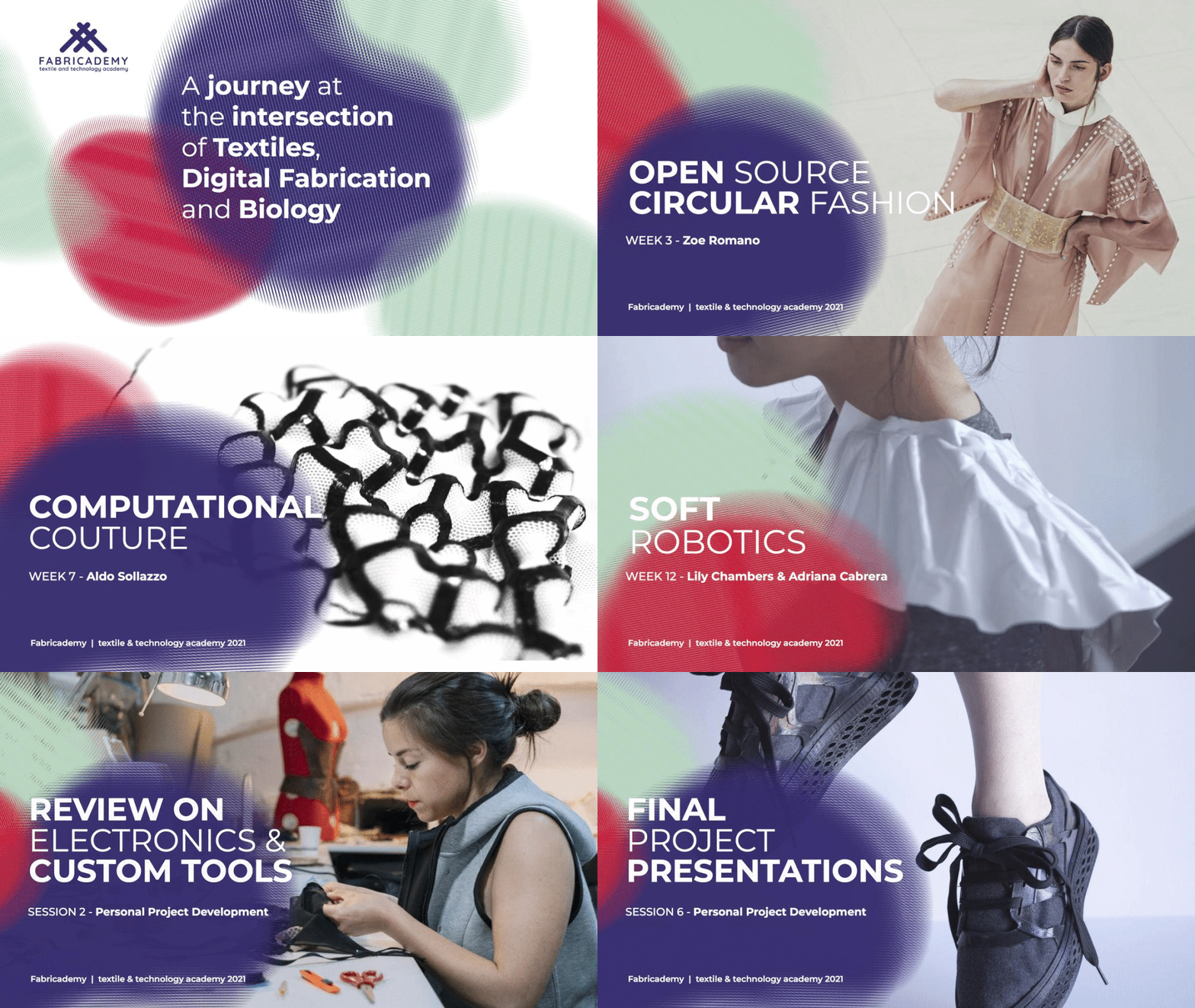
Fabricademy is a transdisciplinary, distributed educational program at the intersection of textiles, digital fabrication and biology
Maker education, hybrid learning and open source knowledge are combined to tackle sustainability issues in the textile and clothing sectors and beyond, through a hybrid approach that enables a gender-balanced digital transformation. Bringing together international experts and labs to create a networked effort for change in education. Rethinking new models of education, through modular & versatile formats, targeted to all types of learners.
Initiated by Anastasia Pistofidou, Cecilia Raspanti and Fiore Basile in 2016, bringing together international experts to create a networked effort for change in education. It's a program from the network for the networks, supported by labs and organisations in Europe that promote collaborative making, peer to peer research and distributed manufacturing, through a replicable model developed around a common infrastructure, rigorous documentation and open values.
The program explores the interrelation of human-technology-environment through the notions of embodiment, materiality, ecodesign, biodesign, performance, smart textiles and digital fabrication. Fabricademy's mission is to (re)shape and (re)define the implications and applications of technology in the T&C sectors, fashion and the upcoming wearable market. It offers a broad overview of the state of the art of the emerging technologies and builds on “learning by doing” methodologies, tackling themes like personal fabrication, distributed manufacturing, industry 4.0, wearable technology, biofabrication, assistive technologies and sustainability.
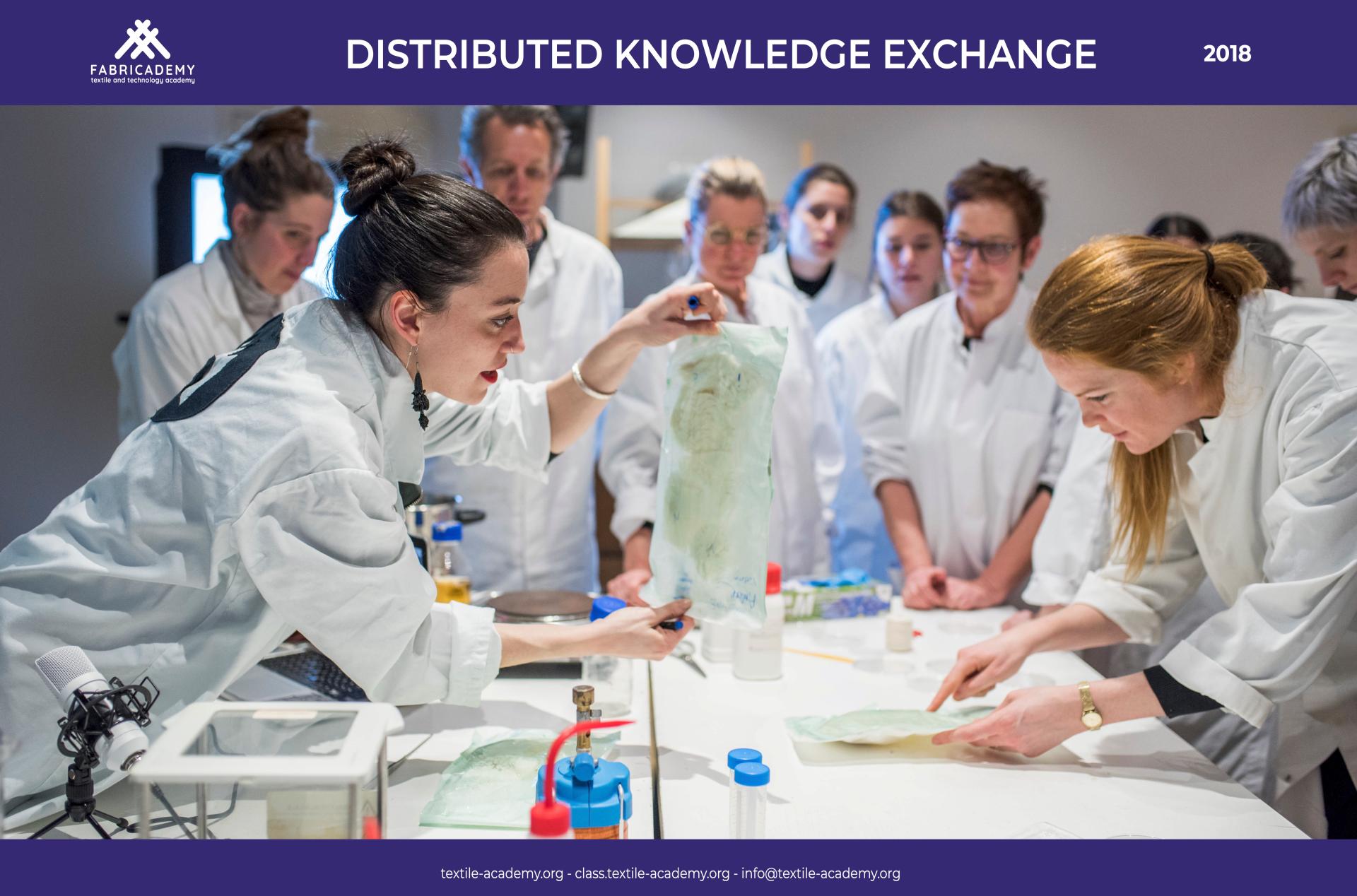
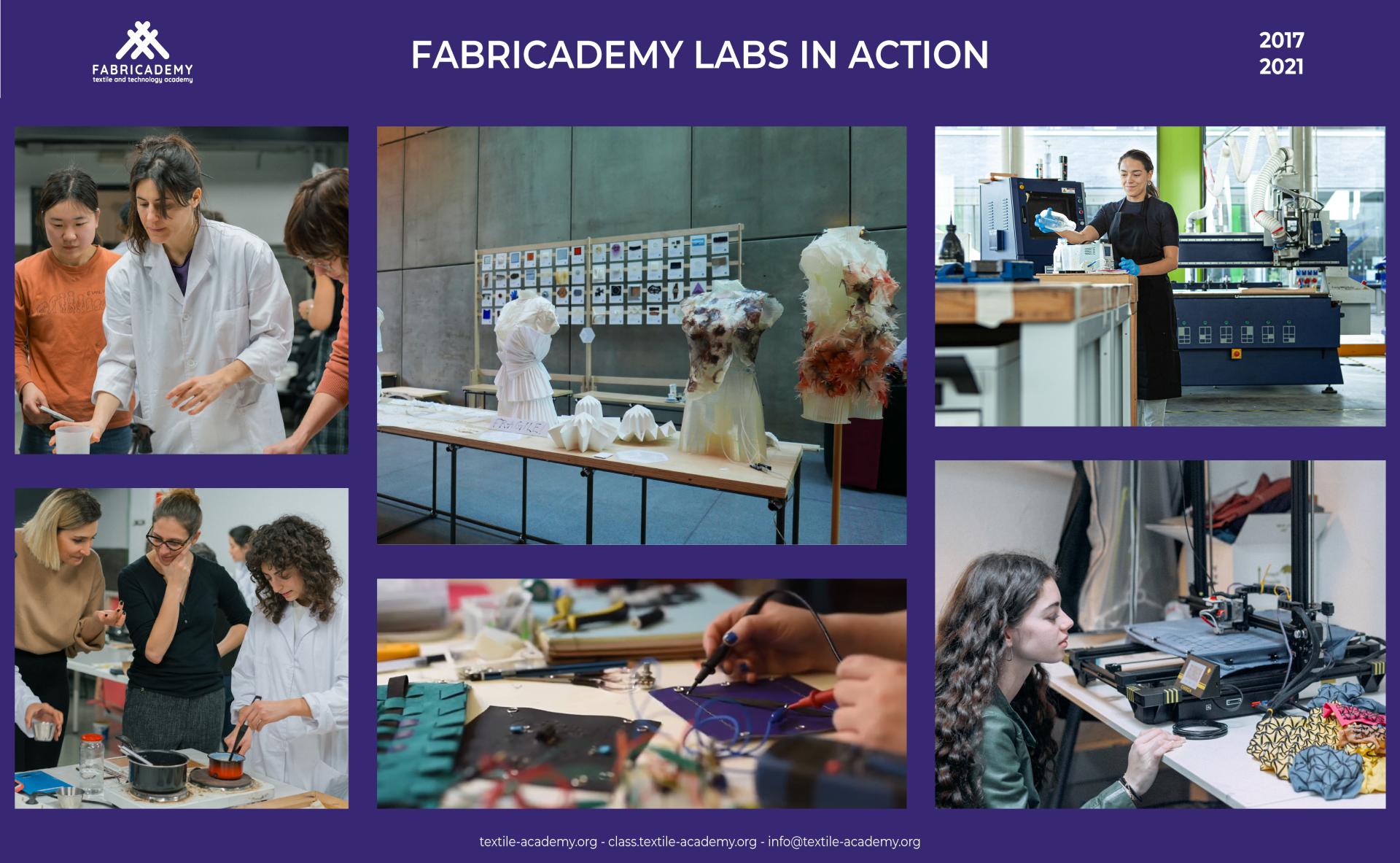
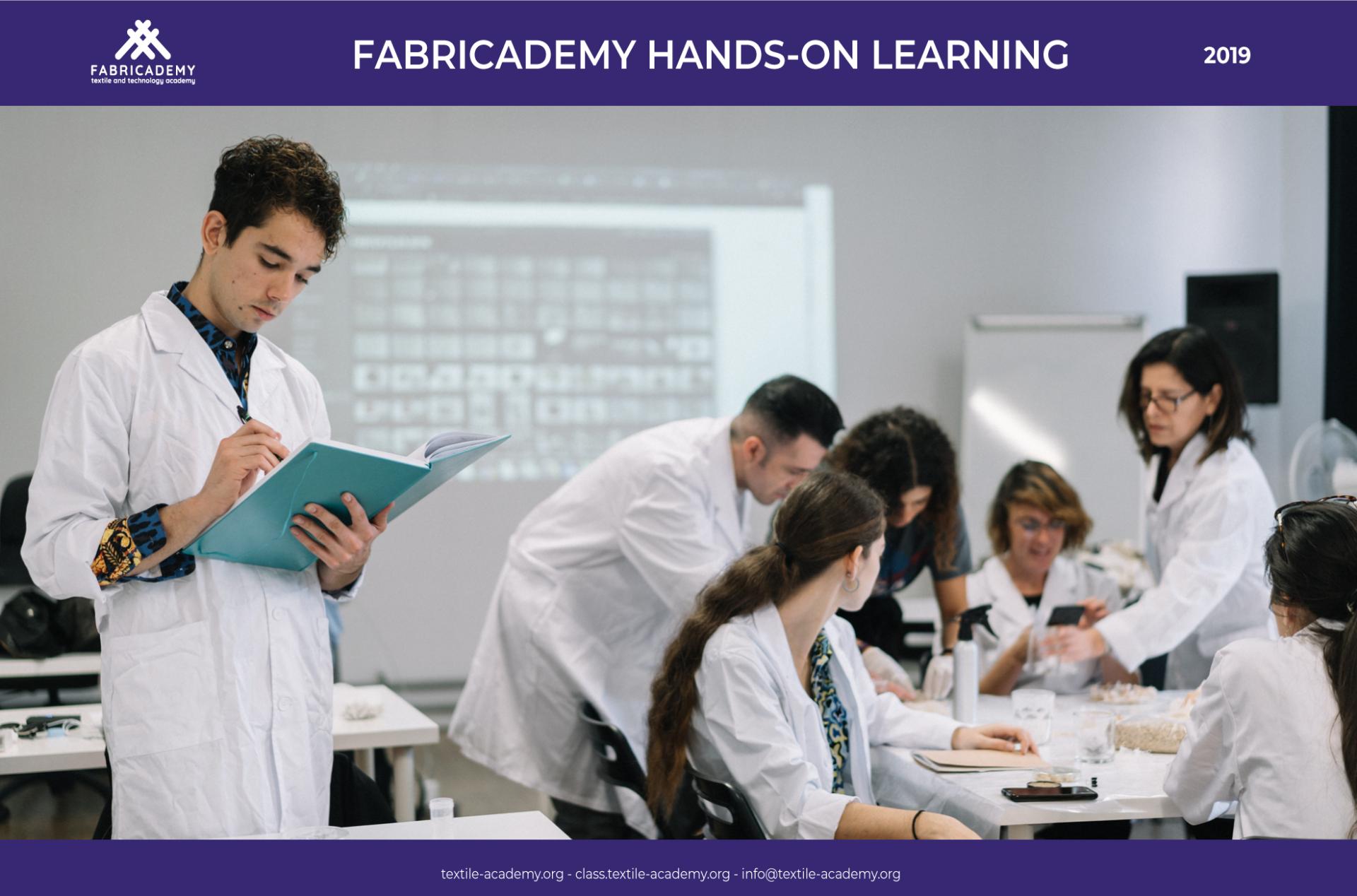
Through a series of hands-on intensive masterclasses and an individual in-depth applied project the participants focus on the development of innovative solutions that explore and implement more viable, sustainable and fair alternative systems of today.
Key objectives for sustainability
Sustainability is a transversal value throughout Fabricademy, from the ecosystem of participating labs and their local opportunities; to the skills and mindset taught within the program itself. The fields of textiles, clothing and design are constantly and actively looking for opportunities to transition towards more sustainable practices. Fabricademy believes that the way forward is to create open knowledge learning networks that enable and support sustainable research worldwide.
Fabricademy’s ¨raison d’etre¨ is to train and empower the next generation of eco-pioneers that can assist the textile and clothing sector to transition towards circular, regenerative systems, products, experiences with open innovation.
At an ecosystemic level — sustainability is embodied in viability — where the methodology and distributed character presented in transferability ensure that practices are impacted beyond the program itself, nurturing local sustainable networks and alliances.
Biobased solutions and material innovation are developed under the topics of ¨Biochromes¨ and ¨Biofabricating Materials¨, where design though materials plays a substantial role both in proposing alternative resources and in closing the loop. Participants explore principles of microbiology for the T&C sectors, implement growing techniques like bacterial dyes, mycelium and bacterial cellulose leathers. Material making is core to Fabricademy, bringing awareness into the energy and resources needed to fabricate anything; unrolling strategies of ¨design for circularity¨ & following the current technological material innovation advances and entrepreneurial opportunities in this emerging field.
Participants explore digital open source circular fashion, zero waste pattern making, modular and customizable garments. They practice agile ¨file to factory¨ workflows, learn 2D design, laser cutting and alternative business models based on digital distributed micro-manufacturing.
Key objectives for aesthetics and quality
¨If technology is omnipresent, craftsmanship is an emergency¨
With the expansion of the maker movement - access to digital fabrication is blooming, while open microbiology practices support the uprising of open-biolabs. Fabricademy leverages these two to train pioneers with hybrid profiles that combine science and creativity, crafts and technology. This mutual literacy of disciplines reveals unique aesthetics which inform the concepts of neo-craftswoman, untangled tech & eco-futuristic lifestyle.
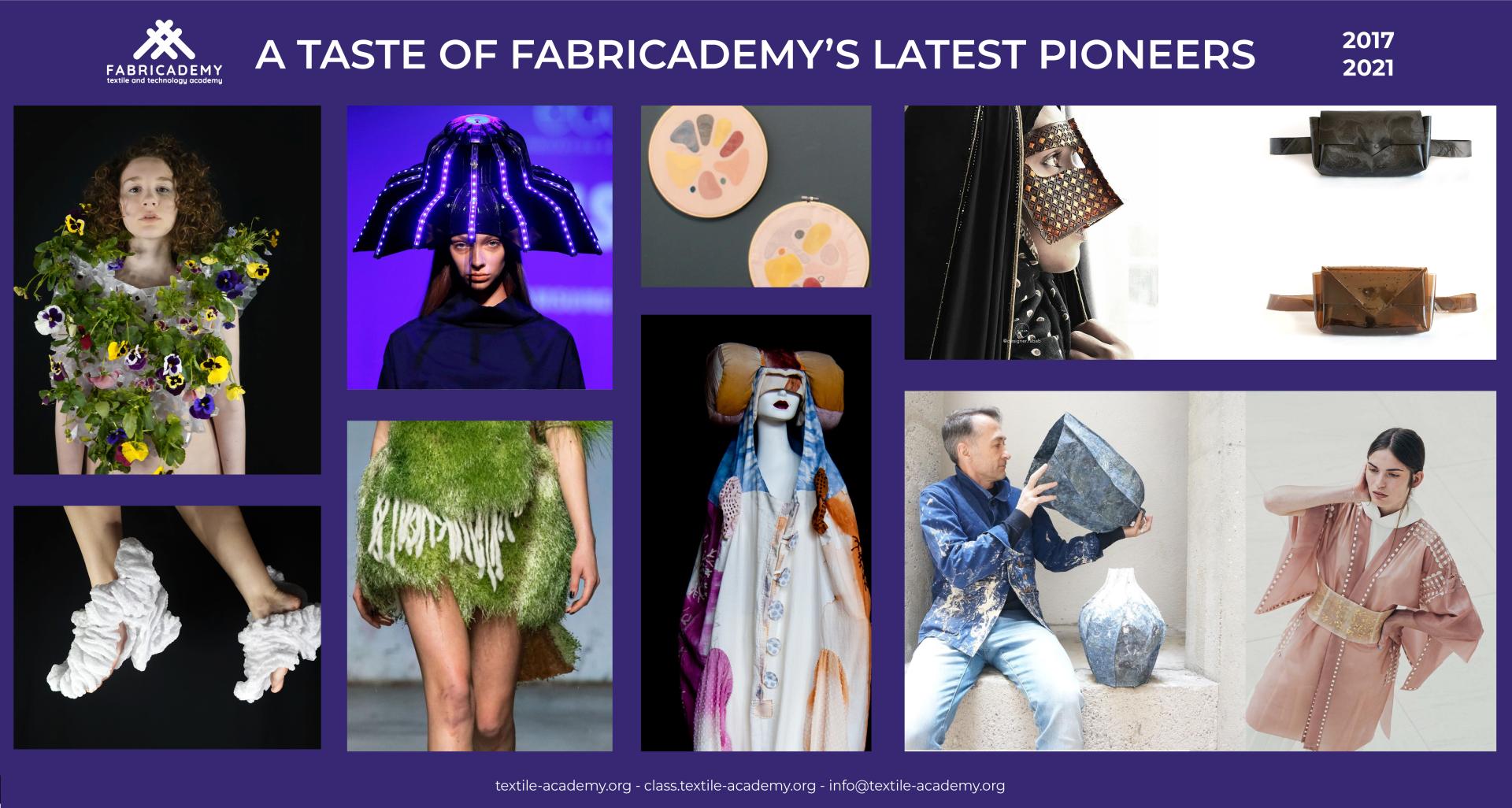
Digital transformations such as advanced manufacturing, microbiology & craftstech introduce a combined visual language that awakens highly personal aesthetics, reflecting the participant's identity. Parametric design, 3Dprinting, crafting biomaterials, bacterial dyeing are enabling design through frugal systems - the result is an aesthetic driven by sustainability, constrained by manufacturing processes and defined by technological potentials. This eco-futurist narrative develops in symbiosis with nature, where waste is a resource.
The open-source nature of the program reflects an untangled aesthetic, which looks into the black box of technology. Untangled aesthetics are expressed with examples such as hand embroidered conductive threads and electronic components that combine craft, engineering and programming.Circular design shifts the stereotypes of “form follows function” to “form follows matter”, where the notion of matter ranges from local cultures, resources and embedded energy to molecular structure, geometrical performance & lifecycle analysis. ¨Form follows matter¨, implies that design solutions propose the agent of time as a core parameter of the design process. The program explores historical crafts techniques and places them under the lens of technology to transform & rescue them, creating a neo-crafts aesthetic, ranging from natural dyeing, pigment/paper making, leather molding, to metallic embroidered circuits & lasercut garments.
Key objectives for inclusion
There are no passengers on Spaceship Earth, only co-pilots” Bucky Fuller
Inclusion is fundamental in Fabricademy: participants, lecturers and involved experts all believe that change is only possible when opportunities and technologies are more evenly distributed and accessible to create shared ownership, foster collaborations and make social impact.A melting pot of cultures: bringing together diverse nationalities, a broad range of ages (17-65+) and backgrounds, to learn from each other globally, while acting and making locally. Initiated within the fablab network with a goal to break the stereotypes that technology is manmade, bringing gender equality and creating a more comfortable entry point for tech explorations by women.Fabricademy offers a ¨bespoke¨ format of participation in the program, for broadening and facilitating access of knowledge to different groups of participants with individual needs, fostering inclusion by opening the target group to anyone from any discipline. From recently graduated students to professionals, academics, artists or entrepreneurs, participants choose single modules, thematic packages, partial or full program, according to their occupation and finances. The program is free and openly accessible for anyone to follow if they wish to do it on their own, with 350 online videos lectures, tutorials and enlightening talks.Fabricademy costs vary from country to country according to the reality of education and life costs. Local Labs define the local cost, promoting access and allowing adaptations. Many participants (20%) have gained scholarships to attend the program.
Finally within the program's content, the topic of inclusion is key, generating more than 20% of final project proposals oriented towards design for people with disabilities, assistive technologies, fabrication for care, design for the elderly population and soft robotics. In a nutshell, fabricademy is about distributing and making viable the needed ecosystem for change.
Results in relation to category
“If you want to go fast, go alone. If you want to go far, go together” – African proverb
Fabricademy is a program that grew from a network to impact and bring together a multiplicity of networks and communities world wide.
Schools / Universities, local labs, their communities and connected industries, citizens and policy makers have supported and embraced the Fabricademy program and model, creating a networked momentum towards change.
Schools and Universities have adopted and implemented the Fabricademy curriculum into their program selection and in specific cases, including local accreditations of it.
Local Labs have grown and expanded their reach and impact, by utilizing the Fabricademy body of knowledge in projects.
Policy Makers have supported the implementation of value driven networked actions in further projects and research to analyse its potential.
FabLab network and Academany have expanded their reach and impact to completely new fields and communities.
Fabricademy participants:
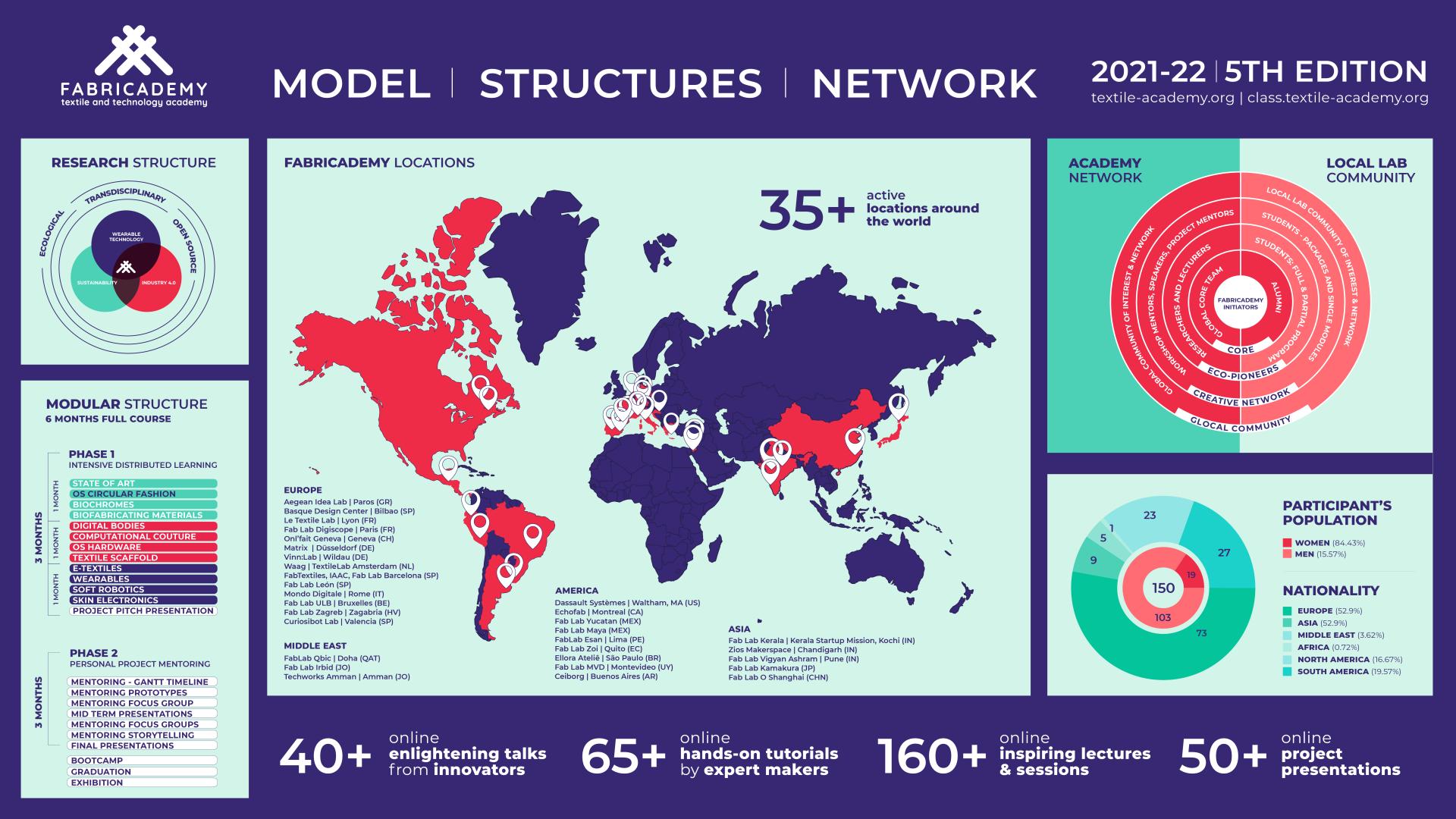
- ±150 participants attended
- 30 scholarships
- 116 women & 29 men attended
- ages ranging from 17 to 60 years old
- 35 different nationalities, accessing the program in 45 different locations
- 120000+ € in funding received by participants in awards for their Fabricademy projects
- 10+ have been employed in labs as local instructors
- 5+ entrepreneurs
- 5+ work in Textile and Clothing Industries
Fabricademy global:
- Global team of 23 people
- 60+ creative experts involved across 4 years
- 35+ active locations across the globe in 2021, 45 locations habilitated to run the program
- 10 Universities (ex. ULB/Belgium, ESAN/PE), 16 fab labs/makerspaces, 5 organisations (eg: IaaC/ES, Waag /NL), 3 ateliers, 1 design center & 1 corporation
- Knowledge coming together from at least 10 different distinct fields
- 2000+ hours of online video material of lectures, learning tutorials and enlightening talks
- 37K views on online video materials, accessed in 150 countries worldwide.
How Citizens benefit
The future is already here—it’s just not very evenly distributed yet. William Gibson ¨We are here to help distribute it Mr. Gibson¨
Fabricademy is a program that gives citizens the tools, knowledge & methodology to be the drivers of innovation themselves. The value driven network of makers & researchers actively involved in the program, has the common scope of democratising access to knowledge & demystifying technology, breaking down complex information into accessible elements that are easily understood by citizen makers that want to change their opportunities & environment.Citizens joining the program or accessing our online open source repositories, are empowered & start their transition from consumers to prosumers, tackling their own needs by themselves. Fabricademy labs are currently working on further adapting the curriculum to a broader age range of citizens, from young girls to women innovators. They create opportunities to enrich the shared knowledge of the Fabricademy network, while creating new local gateways for citizens fostering social inclusion through exhibitions, bootcamps & workshops. Working in local contexts, creates opportunities for knowledge exchange & needs identification, revealing how the program can evolve to better meet the local community needs.Citizen engagement projects in Labs range from upskill artisans of indigenous tribes of Peru, to engage with local restaurants, design with food waste in Barcelona as a circular district demonstratorWithin the program, participants are drivers for innovation tackling real problems and implementing their projects starting from local value chains and the geographical cultural context.By training the eco-pioneers of tomorrow, we accelerate the creation and access to products designed from a fair and sustainable value perspective, that matches the needs and desires of civil society in finding more eco-friendly alternatives & nurture environmental behavioral changes.
Innovative character
Rather than thinking in a ¨technology driven¨ education and society, we promote a ¨technology enabled¨one.
Fabricademy is a grassroots academy - not a traditional institution, but a networked distributed effort to innovate the Textile and Fashion education, creating an enabling future-proof model with the interests of people and our planet in mind.Maker education, hybrid learning and open knowledge are combined to tackle sustainability issues in the T/C sectors, through a multidisciplinary practice that empowers a gender-balanced digital transformation towards nature based, technology enabled design.With a Fully distributed approach, the value proposition is in people being empowered to transform their global & local practices.We believe people are the main actors of change. We believe that code is culture, and only when tech, knowledge & open environments are accessible: change happens. A Dynamic program, in constant evolution, where teaching comes with research, technology is constantly evolving, and the program keeps adapting with our participants.Fabricademy follows agile and innovative teaching methodologies, such as the instructional framework of gradual release of responsibility, by alternating between Lectures, Hands-on demonstrations, collective making, self-exploration, personal application, documentation and finally sharing a reviewing with the community.Participants are evaluated through a double peer review system, by mentors & active members of the academy network via an online custom evaluation platform.We want to challenge the mindset of T&C studies that promote competition & authorship, shifting from the ¨star¨designer to co-creators embracing open knowledge for a better collective future. Participants are self-empowered to produce for their needs, and their prototypes get closer to being fulfilling products, embracing all perceptions, learning throughout the process and looking into the beauty of unexpected outcomes.