VAL DE SCARPE - EDUCATION CENTER
Basic information
Project Title
Full project title
Category
Project Description
The Education Center of Val du Scarpe is a first step — and the first part — of a multipurpose facility that will eventually offer sports and educational activities within this Val de Scarpe district. In the spirit of mutualization and educative continuity, the project follows a strategy that articulates the different facilities – a nursery center ; daycare; an elementary school; a gymnasium and a community center – all around different layers that outline the shape of the site.
Project Region
EU Programme or fund
Description of the project
Summary
The Education Center of Val du Scarpe is a first step — and the first part — of a multipurpose facility that will eventually offer sports and educational activities within this Val de Scarpe district.In the spirit of mutualization and educative continuity, the project follows a strategy that articulates the different facilities – a nursery center ; daycare; an elementary school; a gymnasium and a community center – all around different layers that outline the shape of the site, towards the river.
The complex is drawn along a north-south axis and is comprised of rooms and spaces whose purposes, themselves, organize and hierarchize the school’s various functions. Depending upon these functions, the further toward the interior of the complex these rooms and spaces are located (therefore, the further from the street), the calmer the atmosphere will be, until reaching —at the core of the complex— exterior spaces that are sheltered and protected.
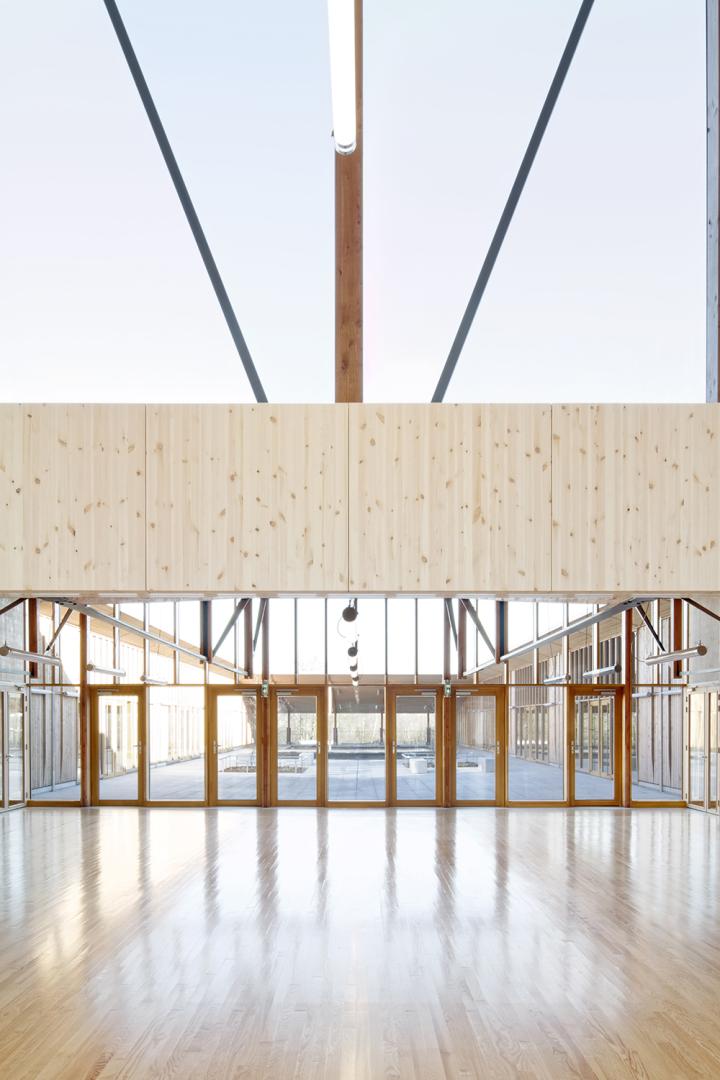
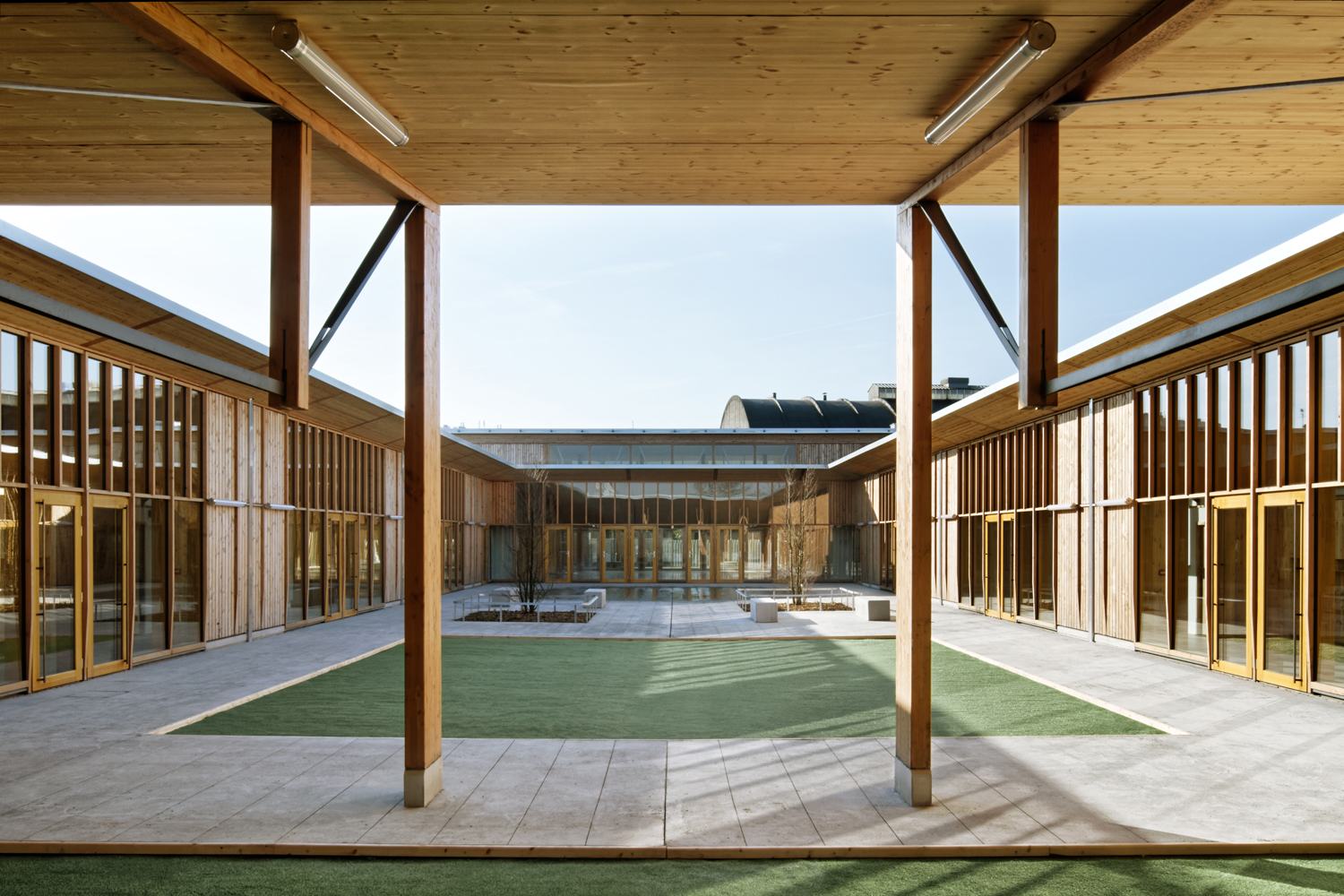
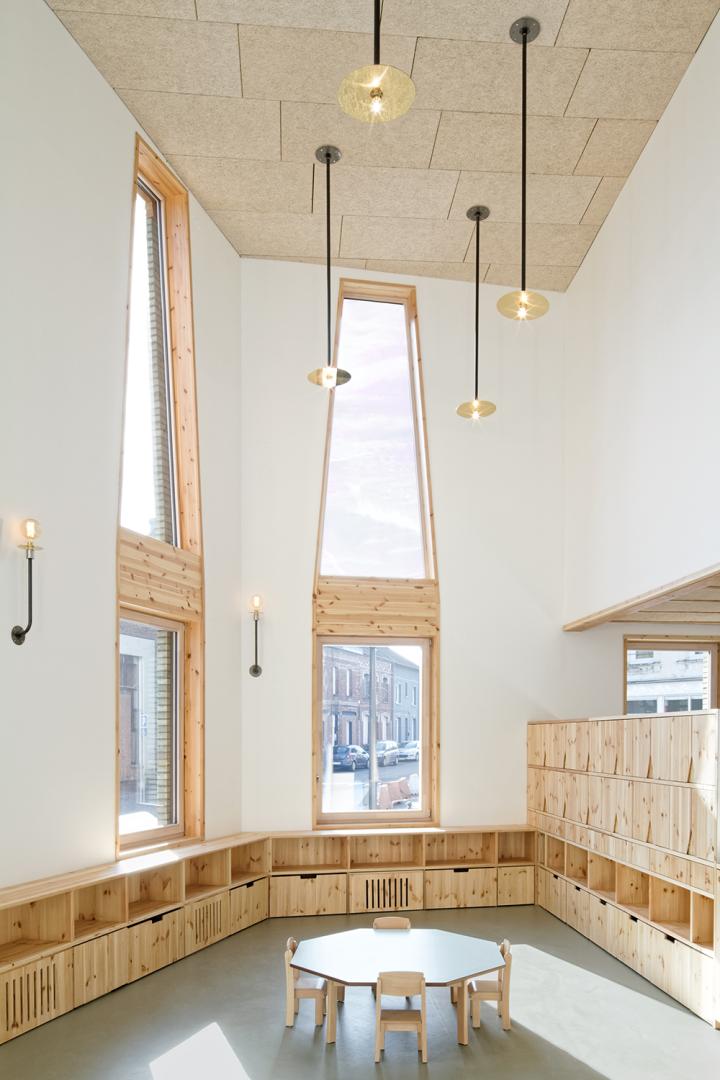
The Education Center is composed of two large and functional wings that are articulated around a covered atrium, as well as two reception desks and a large psychomotricity room. A roof in the shape of an “inverted compluvium” at the center of the premises, harbors classrooms around the school yard. This roof also covers part of the school yard, a space to meet and play. Serviced by two big galleries, the classrooms are opened to both the west and the east, and are enriched by shared educational gardens. Alongside the structuring axis, a perception of depths made possible by the transparency of layers of glass is created in the rooms and spaces —towards the sky and in the interior and exterior of the facility.
Key objectives for sustainability
To propose a familiar and contemporary architectural writing :The educational pole opening its doors for the start of the scool year in 2018, we choose the wooden prefabrication to optimize the duration of the construction work, while qualifying internal atmospheres of the project. However, on the outsides, the project leans on a second register made up of brick-built walls just like the nearby constructions. The choice of this ancestral technique on the territory and the green, singular color, asserts the symbolic and institutional character of the equipment in its environment.
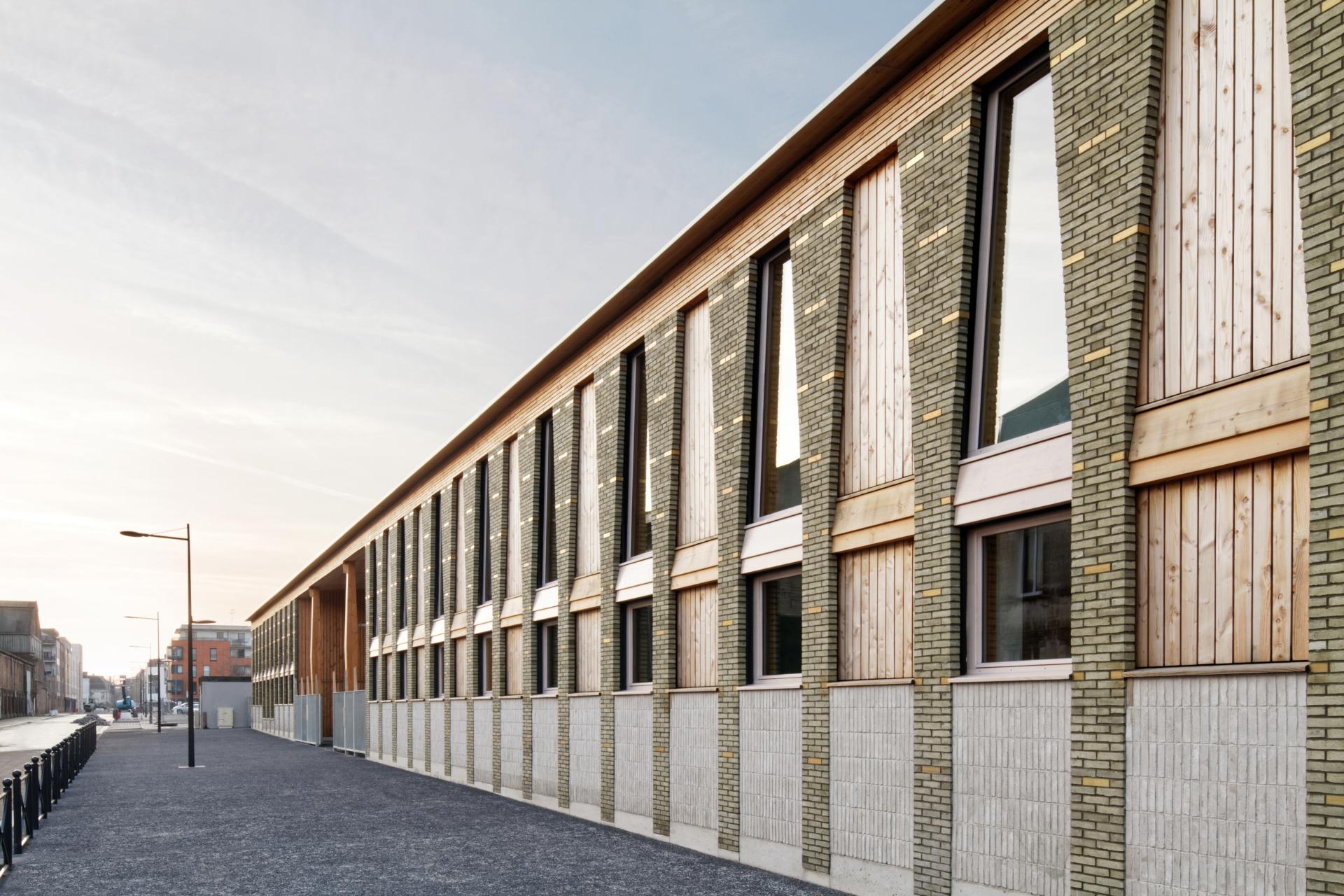
In order to comply with environmental objectives and very ambitious delivery deadlines, the project follows a strategy that relies on a principle of prefabricated wood structures and several inverted trusses. The warm expressivity of the wood is reaffirmed in the courtyards and in the interior space, while on the streets, a cladding made of green bricks with touches of brass denotes this singular architectural scripture addressed to the city. This “lace” surrounds the wooden building, and creates a series of vertical frames responding to the facing factory.
Key objectives for aesthetics and quality
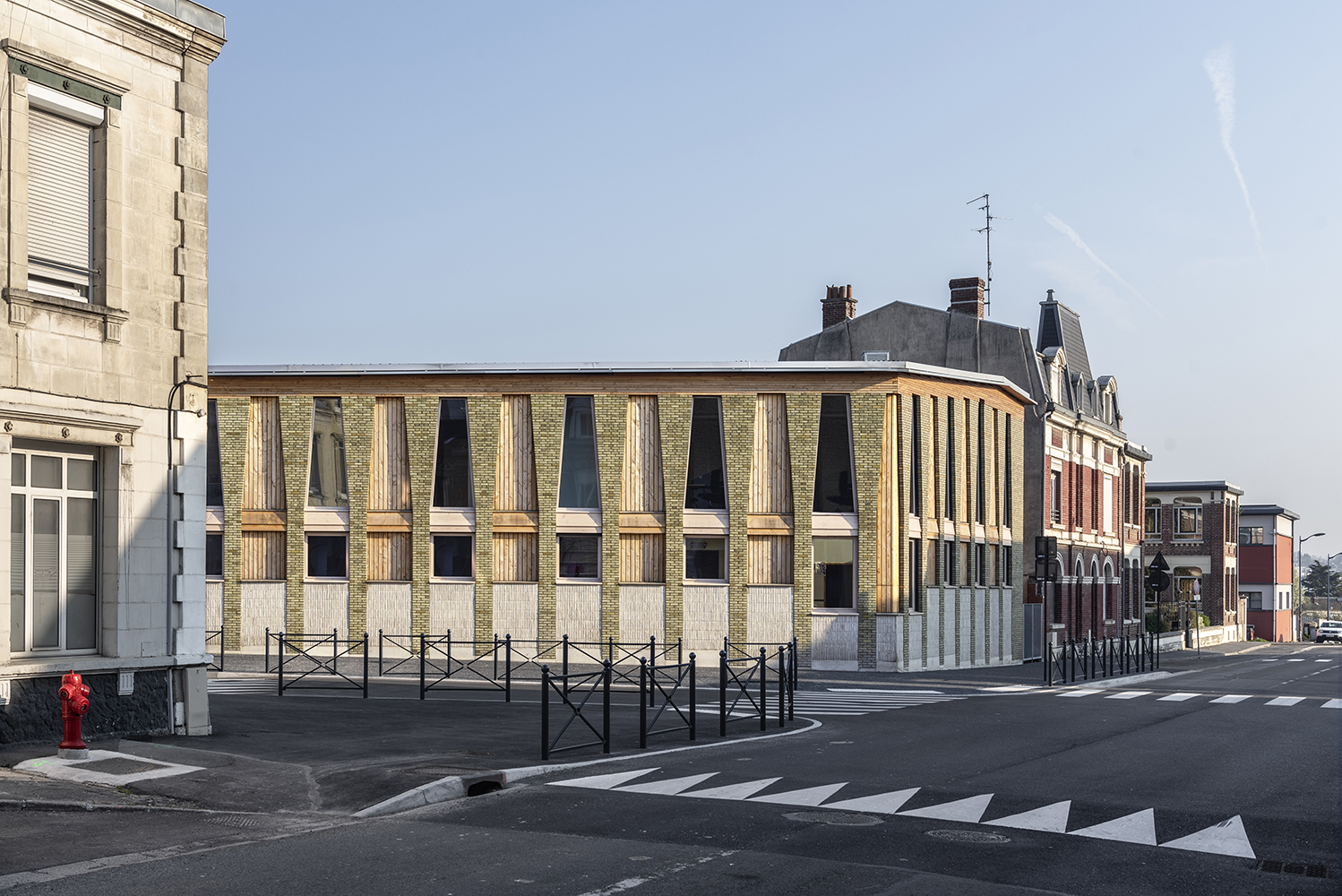
In a gently sloping plot, the project organizes the main functions of the program along an open north-south axis between the town on one side and the landscape of the Val de Scarpe on the other. From rue Jean Bodel to the north, the covered forecourt, the motor skills room, the nursery school courtyard and the courtyard overlooking the landscape of the Val de Scarpe follow one another. This transparency is a way of making the organization of spaces immediately readable for parents, children and teachers and of projecting the idea of a place open to residents of the neighborhood. It is quite spectacular to note that, by this device, the foliage of the Scarpe riparian forest appears in the central perspective of the school and that from the entrance square, projecting this natural landscape in the street, in the city. The other functions are organized around this axis, forming two main volumes. At the rear, an inverted pluvium frame around the playground separates the classrooms in two side wings. Galleries, used as collective educational spaces, act as a physical and symbolic buffer between the courtyard, a space for play and the classroom, a place for learning. The sloping roof opening the facades on the side of the galleries and the glass units arranged above the locker room furniture allow light to enter in complete privacy from the gallery, allowing the classrooms to benefit from light sources on two crossing sides. , East and West. On the other side, the edges of the plot are separated from the neighboring rear by a brick fence wall leaving very neat little educational gardens that extend the classes outside. In addition to the regulated figure of the building on the courtyard, a second body ensures adaptation to the complex geometry of the plot. Winding around the corner of the main streets, it protects the small courtyard of the nursery inside and creates a built-in corner, the district's figurehead, twin of the neighboring red-brick house.
Key objectives for inclusion
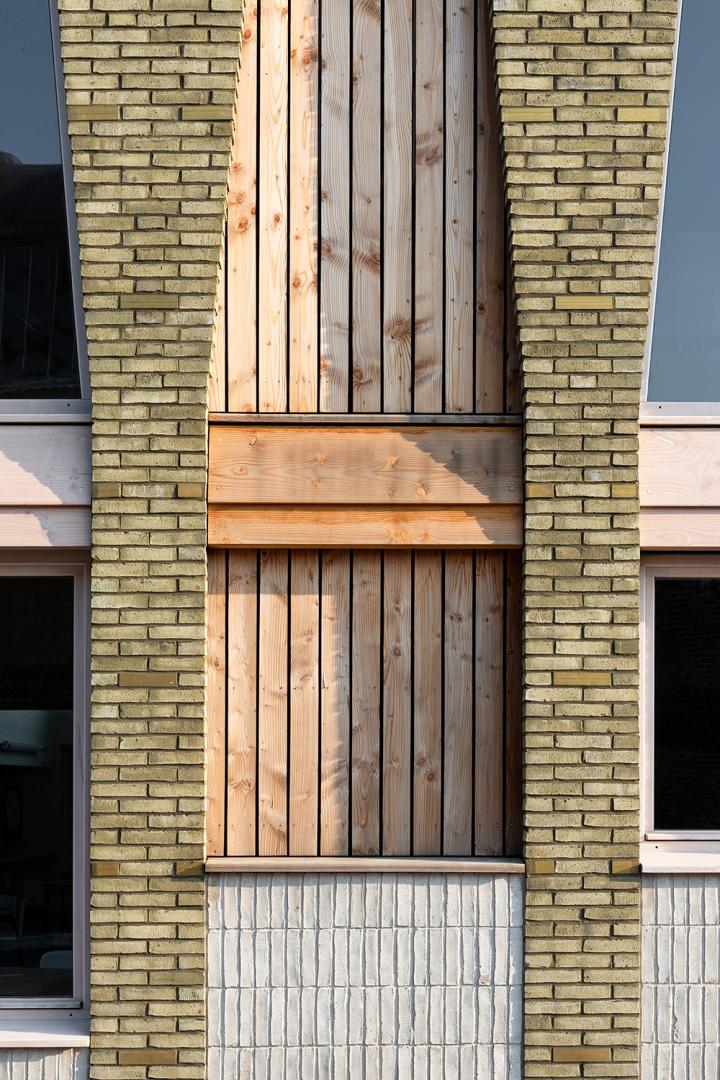
The presence of a wooden structure in a city and a brick district raises questions, risking an effect of rupture, of brutal singularity. In addition, the facade of a gigantic red brick factory with characteristic industrial architecture faces the program on rue Jean Bodel, installing a monumental scale in a predominantly residential and domestic district. For these two reasons, the peripheral facades, built with timber frame walls, are covered with a brick skin. This second layer is a self-supporting device, designed like a lace on a body, revealing in its voids, coverings and joinery in wood. It assumes its preciousness in a design and intricate pattern of green, white terracotta bricks and brass like a precious fabric, woven with golden threads. On the main entrance facades of the establishment and forming the corner of the two streets, the lace creates a double reading. At the neighborhood level, it is the idea of a succession of massive brick piles in response to the buttresses of the factory facing it. On a domestic scale, when we approach, we perceive the ambivalence of the skin. We read the different layers of the facade, we understand that the piles are reversed forming the pattern of a suspended fabric rather than that of pillars placed on the ground. On the sides, against the neighboring plots, the brick skin becomes a fence putting the facades of each class at a distance and letting the educational gardens appear in the thick of it. It is this ambiguity between the idea of an industrial repetitive structure and a decorative motif that allows the project to be the landmark that this district in reconversion needed while leaving a form of discretion, like s' he had always been there.
Results in relation to category
If the construction of equipment mainly in wood for the structure and interior coatings met the environmental and calendar objectives of the program, the the presence of a wooden structure in a city and a brick district raised questions. It seemed to be able to set up an effect of rupture, of brutal singularity. In addition, the facade of a gigantic red brick factory with characteristic industrial architecture faces the program on the street Jean Bodel, installing a monumental scale in a predominantly residential area and domesticated. For these two reasons, the peripheral facades, built in timber frame walls, are covered with a skin of green bricks. This second layer is an apparatus self-supporting, drawn like a lace on a body, revealing in its voids, coverings and joinery of wood. She assumes her preciousness in a design and pattern complex of green, white terracotta bricks and brass like a precious fabric, woven with threads golden.
On the main entrance facades of the establishment and forming the corner of the two streets, the lace installs a double reading. At the level of the district, it is the idea of a succession of piles massive brick in response to the factory buttresses opposite it. At the domestic level, when we approach, we perceive the ambivalence of the skin. We read the different layers of the facade indicating that the bricks are supported on a wooden facade, it is understood that the piles are inverted forming the pattern of a hanging fabric rather than that of pillars resting on the ground. On the sides, against the neighboring plots, the brick skin becomes a fence putting the facades of each class and allowing the educational gardens to appear thickly. It is this ambiguity between the idea of an industrial repetitive structure and a decorative motif that allows the project to be the landmark that this reconversion district needed while sparing a form of discretion, as if he had always been there.
How Citizens benefit
- To look for a just balance between " opening on the district " and " intimacy for the child ":
The project settles a hierarchy of the functions, from north to south, from the public area towards the internal calm courtyards. Some entities of the program such as the covered square, the motricity room or the refectory, offer new equipments to the district while guaranteeing the intimacy for places of teaching.
The volumetry of the project also answers this will. In front of the big brick-built facade of the factory, along the street Jean Bodel, a first body, built on two levels in front of street, asserts the institutional side of the operation. On the contrary on the back, the classes of the ground floor get organized around a big protected courtyard, a central space for meetings and games. It leaves on the plot side, room for educational gardens, separated from the neighborhood by an enclosing wall which protects the intimacy of the classes. The principle of distribution, by two glazed galleries facing itself, confers a big legibility on the space, in particular for the children. They are places for exchanges, work, exhibitions, in the service of evolutionary pedagogies.
Innovative character
The social context is that of a school where 37 languages are spoken by parents this school year and a program that will welcome young parents in the early childhood part precarious situation. If the project assumes the role of driving force in the development of the district by reconversion, its status as a landmark in the urban landscape, as a public institution, it takes care to remain a welcoming place for families. This is all the more difficult to assume that national injunctions encourage the transformation of schools and nurseries into enclosures protected from hypothetical external aggressions.