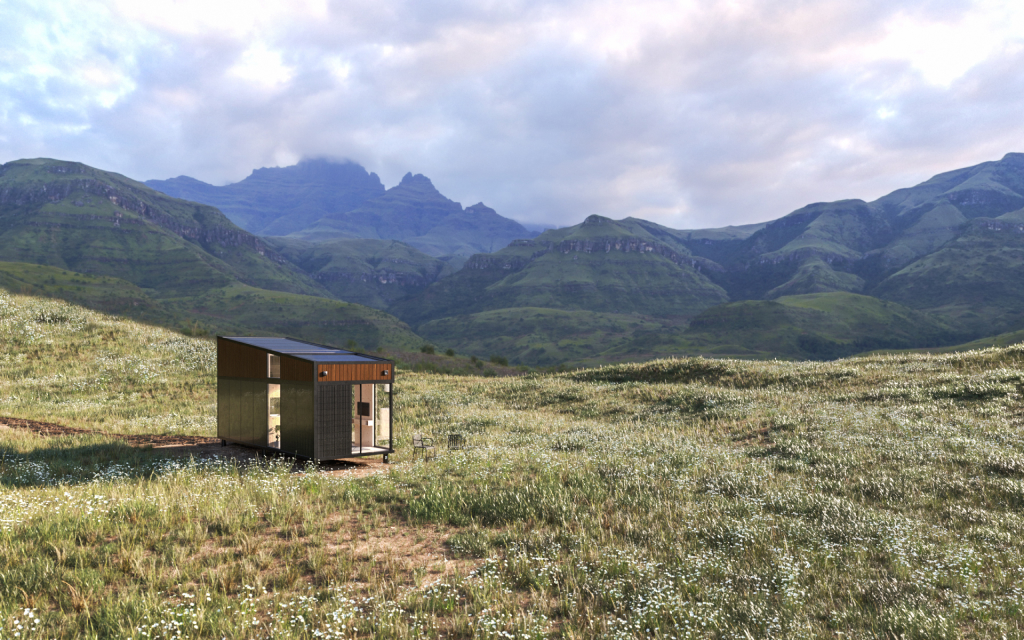
Hoummi, your mobile friendly home
Basic information
Project Title
Full project title
Category
Project Description
mobile homes, autonomous and modular, built with sustainable and recyclable materials.
Project Region
EU Programme or fund
Description of the project
Summary
mobile homes, autonomous and modular, built with sustainable and recyclable materials.
Key objectives for sustainability
One of the peculiarities of our concept is that each module is fully autonomous (off grid) from the networks for water and energy. For water, a 1000-liter recovery tank, coupled with an advanced filtration system, is integrated in each module and we are working on making the process more efficient by developing a water reuse loop system (for the shower in particular) as well as a water recovery system by atmospheric condensation so that the house can be autonomous all year round.
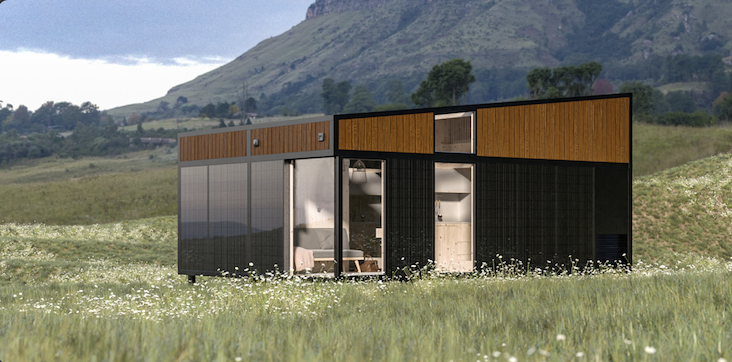
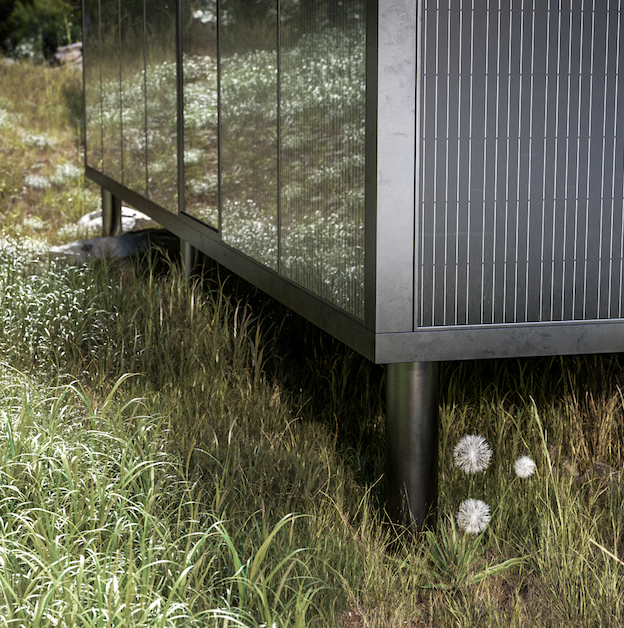
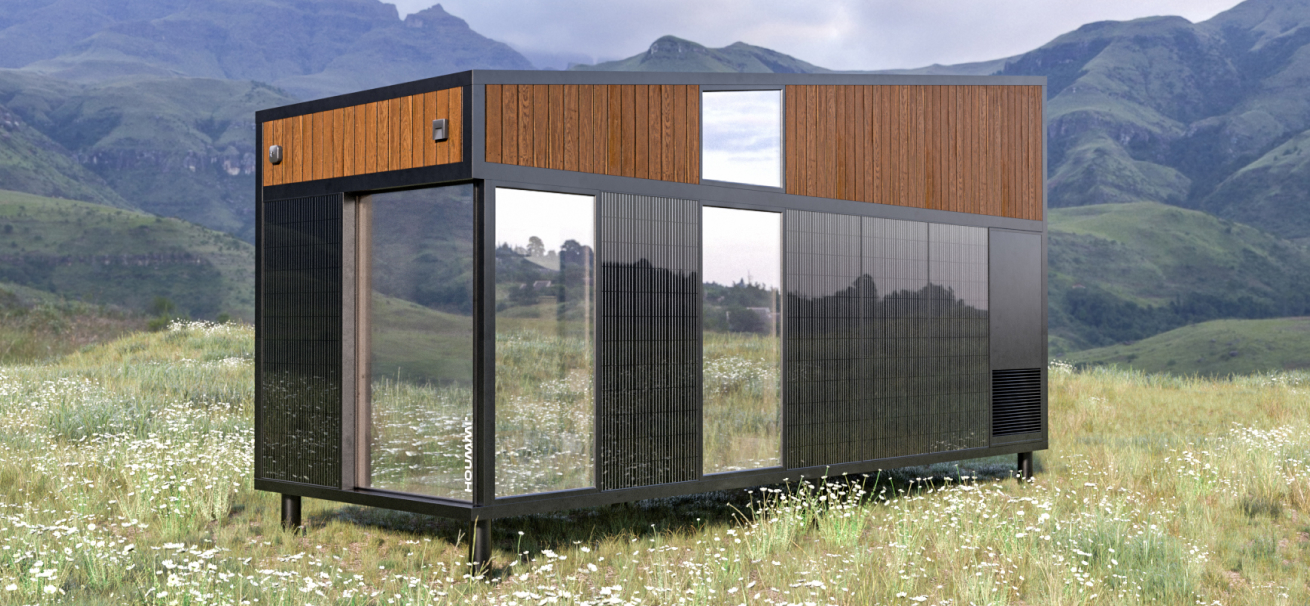
For the electricity, we decided to cover the majority of the external surfaces (except outside windows) with photovoltaic cells, which makes it possible to position the house without taking the orientation into account.
We have worked a lot on the structural resistance and durability of the selected materials and although today it is difficult to estimate the lifespan of our constructions, it is certain that our modules can last several decades. Moreover, each component that constitutes the house is simplified as much as possible to limit the number of spare parts and the replacement of deteriorated parts is meant to be as simple and accessible as possible and can be done directly by the resident.
The materials used are: wood for the sides, steel and recycled fiberglass for the structure, cork for the finishing touches, glass for the openings and the protection of the photovoltaic cells, and aluminium for part of the finishing touches.
As we do not use concrete for the foundations, we have established a partnership with a company that develops steel foundation screws that leave no trace on the ground once the house is removed except for a hole of 10cm in diameter and 1m50 deep. There are 6 screws per module.
Key objectives for aesthetics and quality
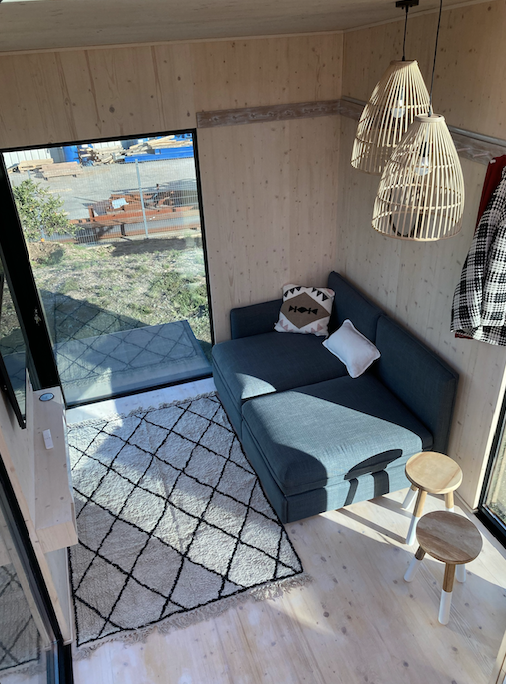
When one thinks of a micro-space, one sometimes imagines a dimly lit environment with small furniture and equipment. We have taken the opposite approach. Instead of integrating a small door, small windows, a small sofa... we are working on very bright spaces with large openings (more than 12m2 of glass surface per module) as well as a layout which is as optimal and spacious as possible.
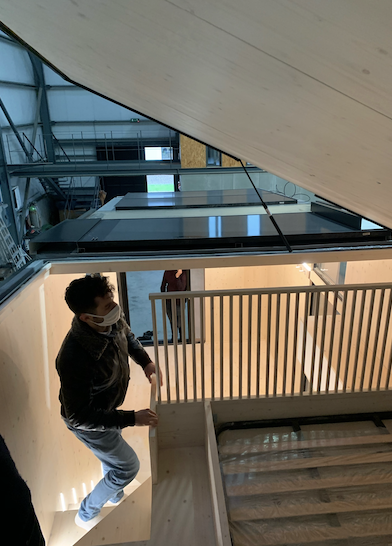
We also thought a lot about what would make the experience of having a small space unique and have therefore integrated, for example, a sunroof by the mezzanine so you can sleep under the stars.
The design is of fundamental brick from a development, which combines the functional part with the visual aesthetics, and it contributes to the adoption of the product by the user. We integrated this at the beginning of the reflection process and creation of the Hoummi concept.
And, because tastes and colors are not reserved for the designer but are unique to each individual, the Hoummi concept incorporates a great deal of flexibility in the customization of coverings and functional integrations, according to the desires and needs of the purchasers.
The technical basis of the Hoummi concept is complex and its understanding requires the mastery of certain notions. Making this technological base accessible while making simplicity of use and quality of experience the main goal of progression is the best way for us to deliver maximum value to the main beneficiary of our solution: the resident.
Key objectives for inclusion
We also aim to develop the Hoummi concept in different contexts of inclusive housing. We are currently working on projects in collaboration with local authorities, social housing organizations and student housing providers. Our aim is to implement the first grouped housing programs for students and people with serious social integration problems by 2022.
Social housing organizations have identified major advantages in the Hoummi concept, such as the agility of deployment (having the possibility of setting up small villages of Hoummi homes in only few weeks), modularity (making it possible to invest in empty spaces in towns and residual land), the reversibility of our constructions and the interchangeability of all the parts, the recycling (the possibility of renovating the interior panels easily), the elimination of water and energy charges for the inhabitants, the notion of education in resilient housing made possible by the pedagogical character of the embedded home automation.
Moreover, by its very nature, the Hoummi concept makes it possible to evolve towards more inclusive ways of living in eco-resilient mode, on shared premises where certain services are shared and where neighborhood solidarity is cultivated.
We plan to conduct experiments on eco-resilient habitats in conjunction with local partner communities and associations, and to model, in order to better duplicate redesigned living spaces which are more in line with the issues (densification of urban space, low-carbon construction, non-artificialization, energy and water autonomy, etc.) and aspirations of our time (a place to live that makes sense, which promotes local solidarity, etc.).
Innovative character
The Hoummi concept is innovating on different levels: on a technical and technological level, but also on a configuration of modalities level which makes evolution of the home possible. Another level is the difference in ways in which the home can be used (see previous question).
First of all, we offer a concept of "house seed", which means the home is a reversible and evolving workspace with surfaces which increase (or decrease) in an organic way, according to the resident’s needs. Our eco-system allows the interconnection of modules, horizontally and vertically, like a set of Lego.
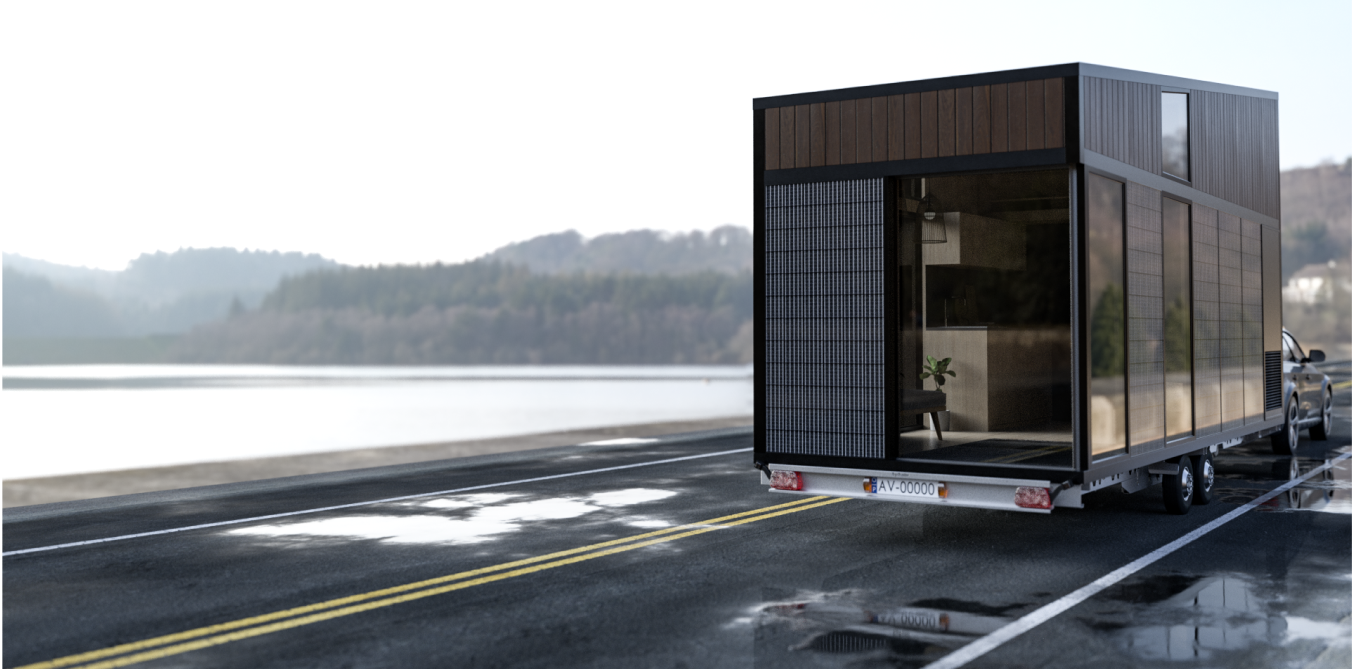
Our technical developments also allow us to innovate by proposing a mobile micro-home, but with a removable rolling chassis (the house can be detached from the trailer).
A notable technological innovation for the designs of buildings and living spaces is reaching full autonomy during any season and from anywhere in Europe. This means being autonomous when it comes to energy (domestic needs and recharging of soft mobility, and eventually electric vehicles), when it comes to hydraulics (having an integrated management of the water cycle) and waste treatment.
It should be noted that we are in the process of developing, in partnership with a laboratory of the University of Porto (INEGI), a very innovative system of toilets operating in a totally autonomous way.
The concept is innovative because it allows you to easily personalize your home (on a standard basis of 80%), in the same way that you can configure your car and select a set of interior systems and functionalities that best meet your needs and aspirations.
Finally, in terms of design and living comfort, the innovative character of our concept offers a unique style (such as the arch of light or the sunroof), in terms of fittings, functionalities and atmosphere.