Bauhaus Campus Weimar
Basic information
Project Title
Full project title
Category
Project Description
The redesign of the open spaces of the Bauhaus University is a project in landscape architecture. In the context of the UNESCO World Heritage and following the tradition of the Bauhaus stage, the existing spatial interventions of the site were transformed into atmospheric and spatially effective ‘open-air theatres’. The result is a series of separate, clearly legible – through simultaneous interaction – multifaceted landscape spaces that embody both modernity and the past.
Project Region
EU Programme or fund
Which funds
Other Funds
The transformation of the open space at the Van-de-Velde-Bau to today’s Bauhaus Campus was financially supported with a grant of 450 000 € by the Federal Insitute for Research on Building, Urban Affairs and Spatial Development and it’s programme Bundesprogramm nationale Projekte des Städtebaus. Based on the results of the planning competition the outdoor facilities of the Weimar Bauhaus University main building received a qualified redesign, appropriate to an UNESCO World Heritage Site. In preparation for the Bauhaus anniversary in 2019 an attractive public space was created at the place where Bauhaus was founded.
Description of the project
Summary
The open space of the Bauhaus-Universität Weimar originally consisted of several unconnected, designed areas, which over time have developed into a uniform educational institution, earning it a place on the World Heritage List. The heart of the campus today is found between the Van-de-Velde and main buildings, a location originally home to the School of Arts and Crafts, and where Walter Gropius would later found the Bauhaus movement in 1919.
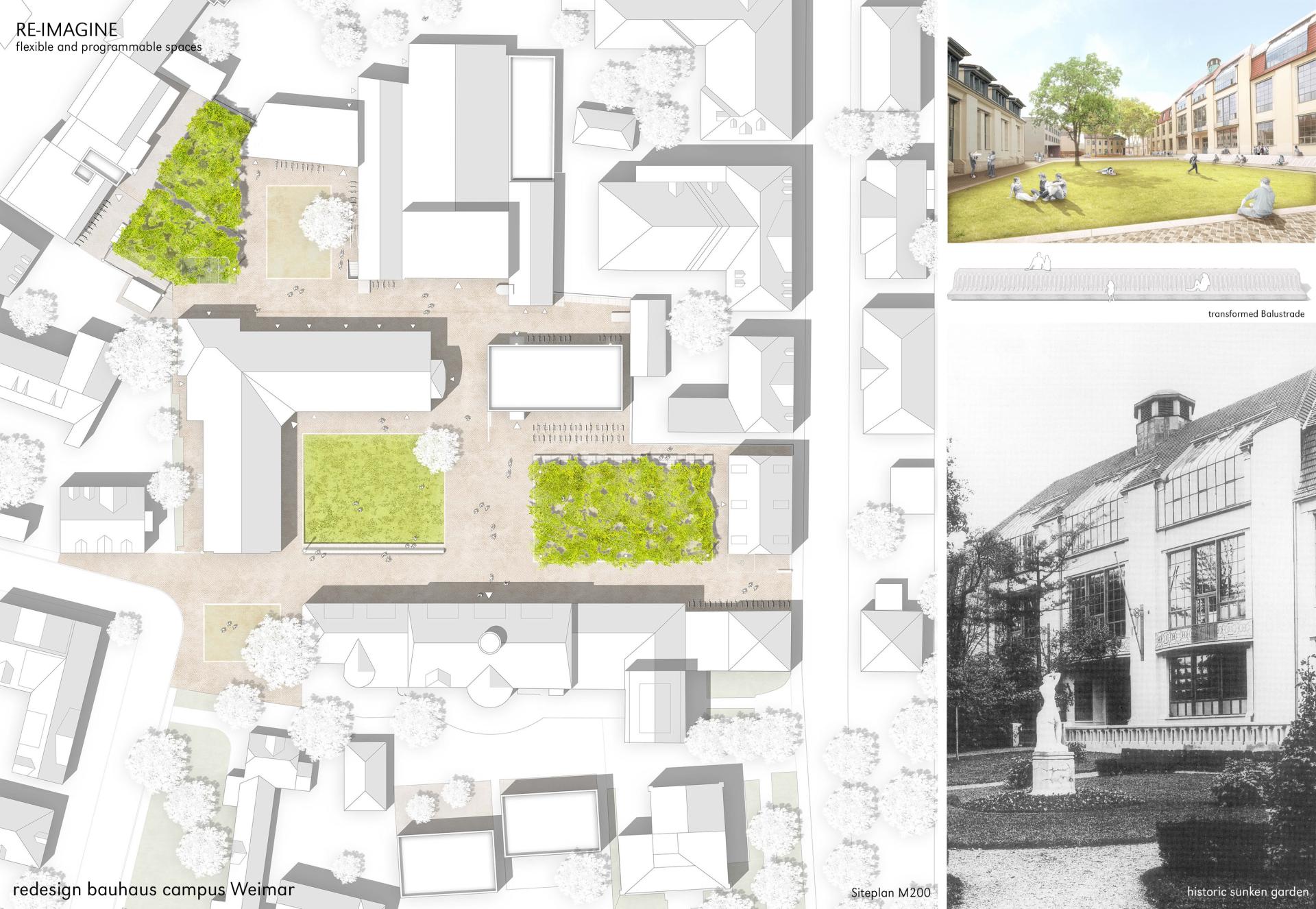
With only a few black-and-white photographs of Van-de-Velde's original formal garden remaining, the design and its elements have been almost completely lost to time.
The site restoration could not simply be a literal reconstruction of the original design. Rather, it demanded that the spaces create not only a harmonious dialogue with the adjacent buildings, but also meet flexible usage requirements of a lively university, and respond to expectations of numerous outside visitors to the historical campus.
Following the tradition of the Bauhaus stage, the existing spatial interventions of the site were transformed into atmospheric and spatially effective ‘open-air theatres’. The result is a series of separate, clearly legible – through simultaneous interaction – multifaceted landscape spaces that embody both modernity and the past. These spaces, or ‘stages’, are created through combining meaning, interpretation and experience, all of which draw from the potential of the place.
To further enhance the landscape as a stage, such a covering was chosen to thematically bind all which lies between the building facades. The inclusive surface brings continuity and generosity, while establishing connection to outer areas. The design principles used are based on the abstraction of the essential, therefore, the materials are processed with respect to the style that Walter Gropius made eternally significant to the architectural world.
Key objectives for sustainability
In its implementation the desgin of the campus is not only multicoded but addresses as well issues of sustainability.
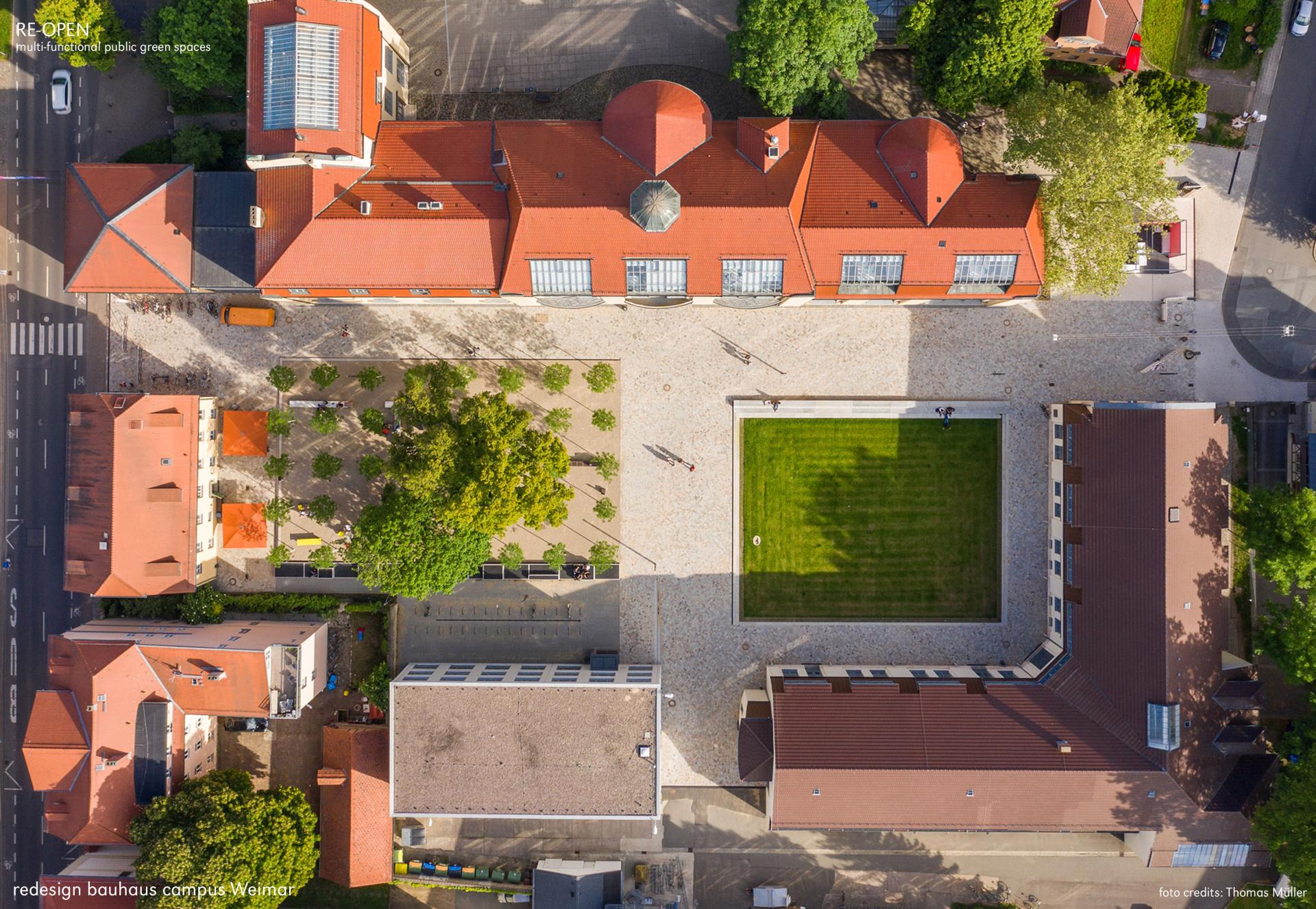
By realizing the campus meadow as a sunken garden a historical reference is established and additionally the on-site water drainage is organized. The campus meadow has been lowered to the level of the Van-de-Velde-Winkelbau and hence reaches the tiered position of the formerly enclosed Jugendstil garden. At the same time the sunken garden is a method to retain rainwater in the event of heavy rain and to reduce mixed water overflows into the sewerage system. As a multifunctional area the campus meadow is lowered, creating an area protected from the wind which favors a gentle microclimate.
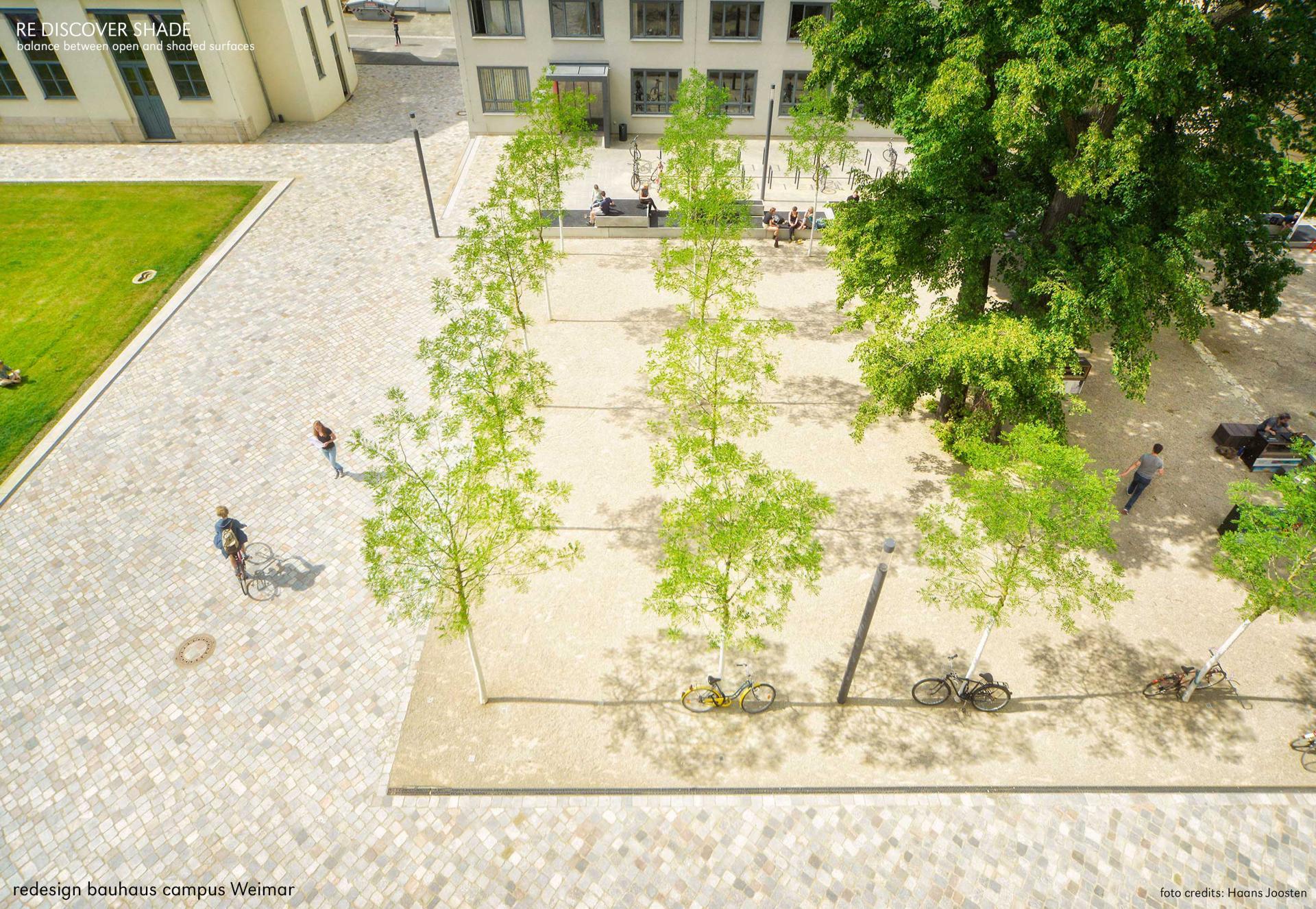
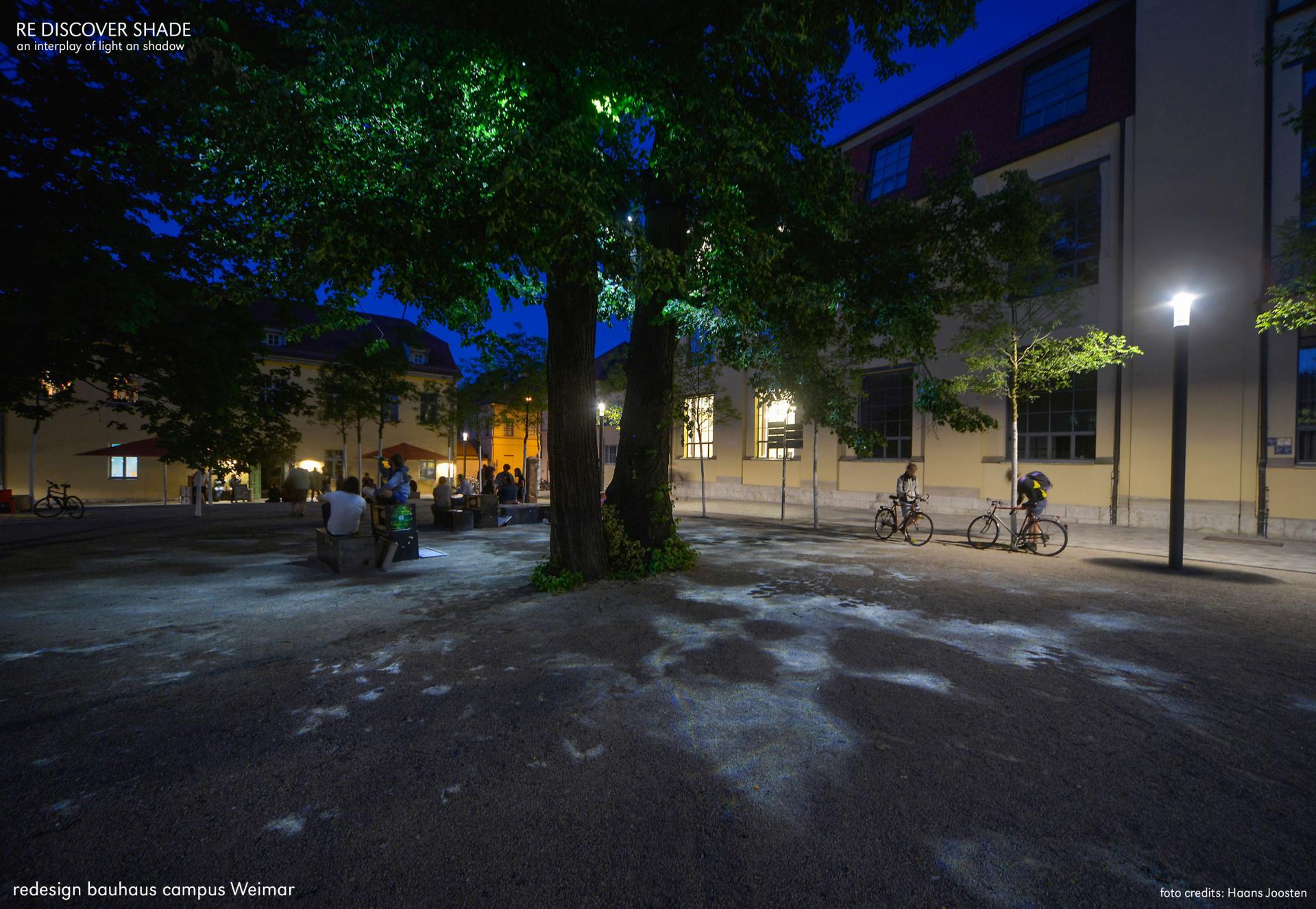
The newly created tree hall in front of the Studierendenhaus is made of high-pitched sugar maple (Acer saccarinum) and serves as a climate hall. An existing two-stemmed linden tree and a maple tree are supplemented by 31 trees in a grid of 4.5 metres. The grid provided allows versatile, individual and simultaneous use of the water-bound path surface. Prospectively, due to the evaporation process in summer, the high – branched and translucent tree tops will offer a pleasantly fresh and shady place to stay.
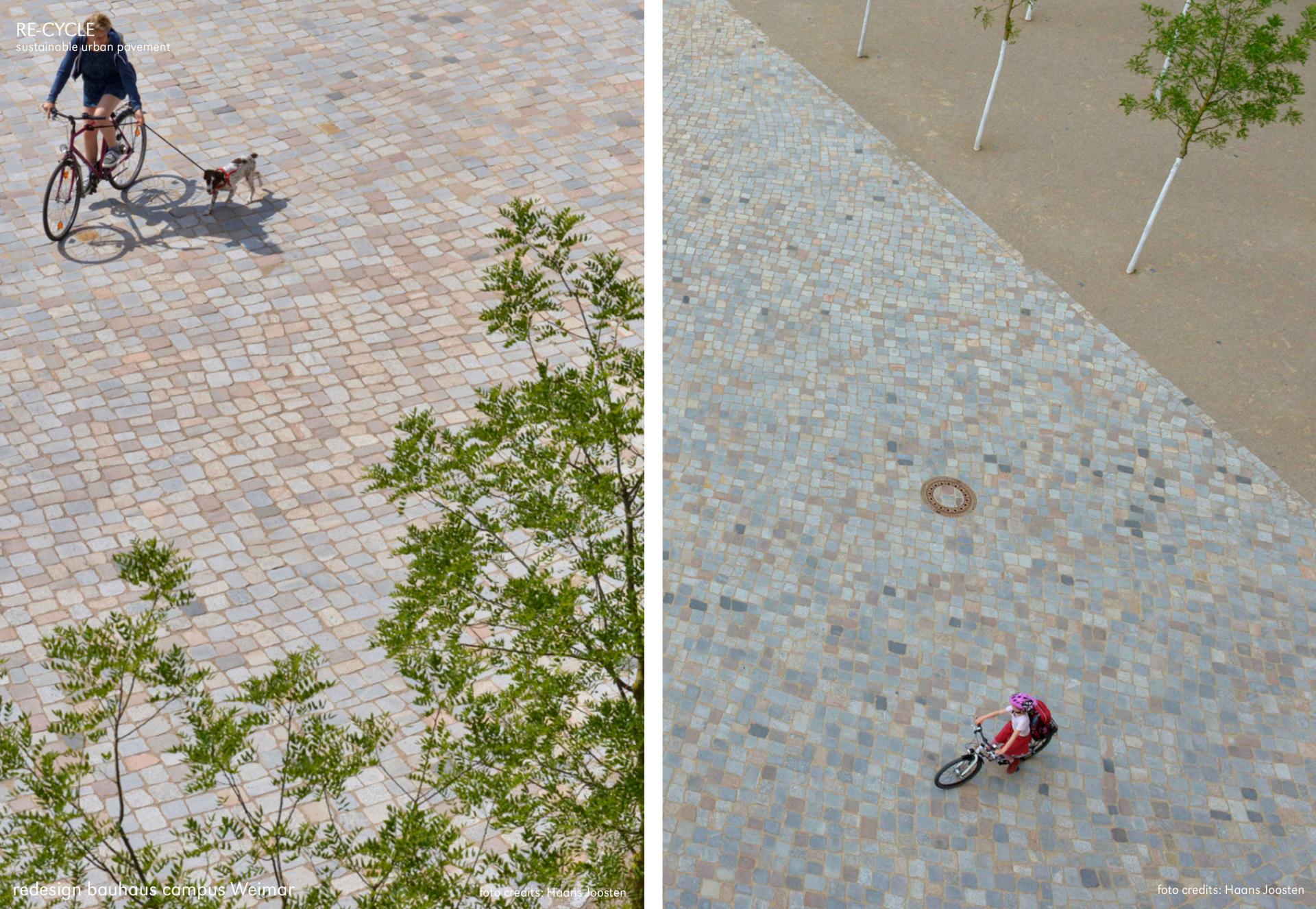
In accordance with the historical significance of the campus and its outdoor area, which is also used as a universal public space by numerous visitors, most of the paths are paved with reclaimed granite paving which is laid in the passe style. The reused granite pavement was previously secured in this area. In extension of the main access road to the campus it was installed in accordance with the requirements of monument protection law and gets an authentic revival as recycled material.
Key objectives for aesthetics and quality
The tree stage: A concept embodying a plantation of trees as a single living unit, represents an attempt to strengthen the way in which one experiences the space. The design of the small entrance square refers to this, as does that of the campus meadow against the backdrop of the Van-de-Velde buildings. The simple, and in turn multifunctional campus meadow serves as a stage for a myriad of events, installations and informal exchange. Also the design principles used are based on the abstraction of the essential, therefore, the materials are processed with respect to the style that Walter Gropius made eternally significant to the architectural world.
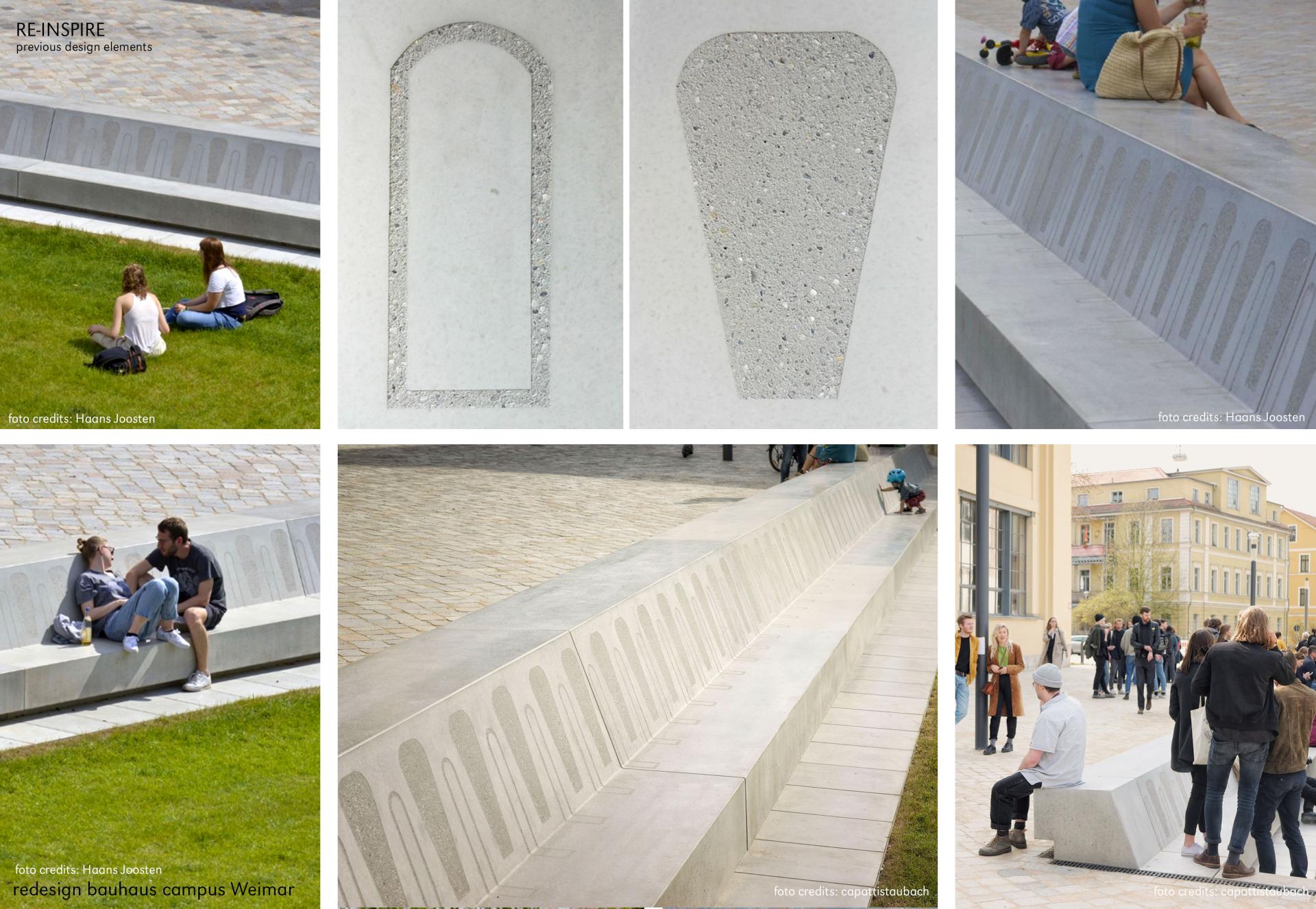
The balustrade bench: In the past a balustrade fenced off the private sunken garden from the public space. The balustrade got lost but is reinterpreted in its limiting function. Designed as a seating element that can be used from two sides – practical and beautiful at the same time – it invites you to linger on different levels of the site. In reminiscence of the artisanal design the balustrade bench as a historical quotation is productively developed into the present. To consciously bring to mind the local identity for the future the former pattern of the enclosure is embossed into the concrete bench in an abstract manner. These handcrafted inlays and stone carvings tie in with the tradition of the place. This creates a kind of „mapping“ for tourists and an everyday business card for the university.
The cube bench: A seating combination which closes the tree hall to the north – consists of longer and shorter concrete elements stacked next to and on top of one another. It is also inspired by the places history. Like the pavements the bench, with characteristics of quadratic and rectangular shapes by Rudolf Lutz, combines aesthetics and usability as a sculptural element.
Key objectives for inclusion
We see inclusion in a figurative sense. On the one hand the redesign of the outdoor facilities implements the well-known and recognized rules of inclusion in the form of accessibility, shared spaces for pedestrians and cyclists and an easy-to-understand, intuitive route guidance, supplemented by orientation signs for visitors of the campus as well as for users of the city’s guidance system.
On the other hand there is a need of inclusion for the different user groups which use the site from diverging perspectives. It needs an open design which allows a large variety of options to experience the place. The cautious design in this central location pays respect and appreciation for the existing, is not in competition but seeks dialogue. Characteristic fragments of the location are picked up and transferred to a productive present. It is about everyone’s participation in this world heritage of humanity.
Results in relation to category
The Van-de-Velde building, with its characteristic window panes merging into the roof, holds immense iconic value, since it’s completion until today.
The site restoration could not simply be a literal reconstruction of the original design. Rather, it demanded that the space create not only a harmonious dialogue with the adjacent buildings, but also meet flexible usage requirements of a lively university, and respond to expectations of numerous outside visitors to the historical campus.
Following the tradition of the Bauhaus stage, the existing spatial interventions of the site were transformed into atmospheric and spatially effective ‘open-air theatres’. The result is a series of separate, clearly legible – through simultaneous interaction – multifaceted landscape spaces that embody both modernity and the past. These spaces, or ‘stages’, are created through combining meaning, interpretation and experience, all of which draw from the potential of the place.
To further enhance the landscape as a stage, such a covering was chosen to thematically bind all which lies between the building facades. The inclusive surface brings continuity and generosity, while establishing connection to outer areas. The design principles used are based on the abstraction of the essential, therefore, the materials are processed with respect to the style that Walter Gropius made eternally significant to the architectural world.
How Citizens benefit
The exterior space to be redesigned had to meet different requirements: to create an appropriate dialogue with the context, to satisfy the flexible usage requirements of a contemporary, lively university and to respond to the expectations of the numerous external visitors to the historical ensemble.
In the context of the project’s realization, the student body as an essential user group of the new campus received special attention. Regular coordination rounds with the student representatives in the run-up to the construction work ensured that the diverse user requirements were appropriately integrated. During the construction work, weekly open consultation hours were offered for the transparent exchange of information.
In contrast to the student requirements the interests of external visitors are less focused on everyday university life than on the authenticity of the location. The existing convergences, breaks and scars of time shall remain visible but should be presented more consciously and clearly to reveal the dimensions of contemporary history.
Using the example of the balustrade bench the interface between functionality and historicity can be clearly understood. As a symbolic bridge element it points back to the original shape of the place and at the same time serves contemporary everyday demands as modern seating furniture.
Innovative character
The innovative character of the project appears in the different levels of reuse both materially and historically. We decided on purpose to maintain the ideas, designs and materials of the historic space and to transfer it into the present, fulfilling contemporary demands of sustainibilty in reducing the carbon footprint. In this way it is possible to experience the project from different metaphoric angles.