W10 - Homes for all
Basic information
Project Title
Full project title
Category
Project Description
W10 – homes for all
Inclusion starts from home, a place to feel cosy and safe.
W10 -project matches many needs. It provides a block of social housing flats for anyone to apply, services based on Housing First for ex-homeless tenants living in the house or in scattered housing around the city, flats for emergency situations and a community centre to benefit the whole neighbourhood.
W10 is a product of cooperation. Now the house is a home base for many kinds of activities.
Project Region
EU Programme or fund
Description of the project
Summary
The key objective of W 10 project was to create sustainable solutions to homelessness and to tackle the lack of affordable social housing in the city of Järvenpää. This was done by building a new social housing facility and buying scattered housing for the homeless. Support services are based on the Housing First principle.
Besides good quality rental housing the project combines several special features:
- cooperation between the city, Y-Foundation and the Helsinki Deaconess Institute
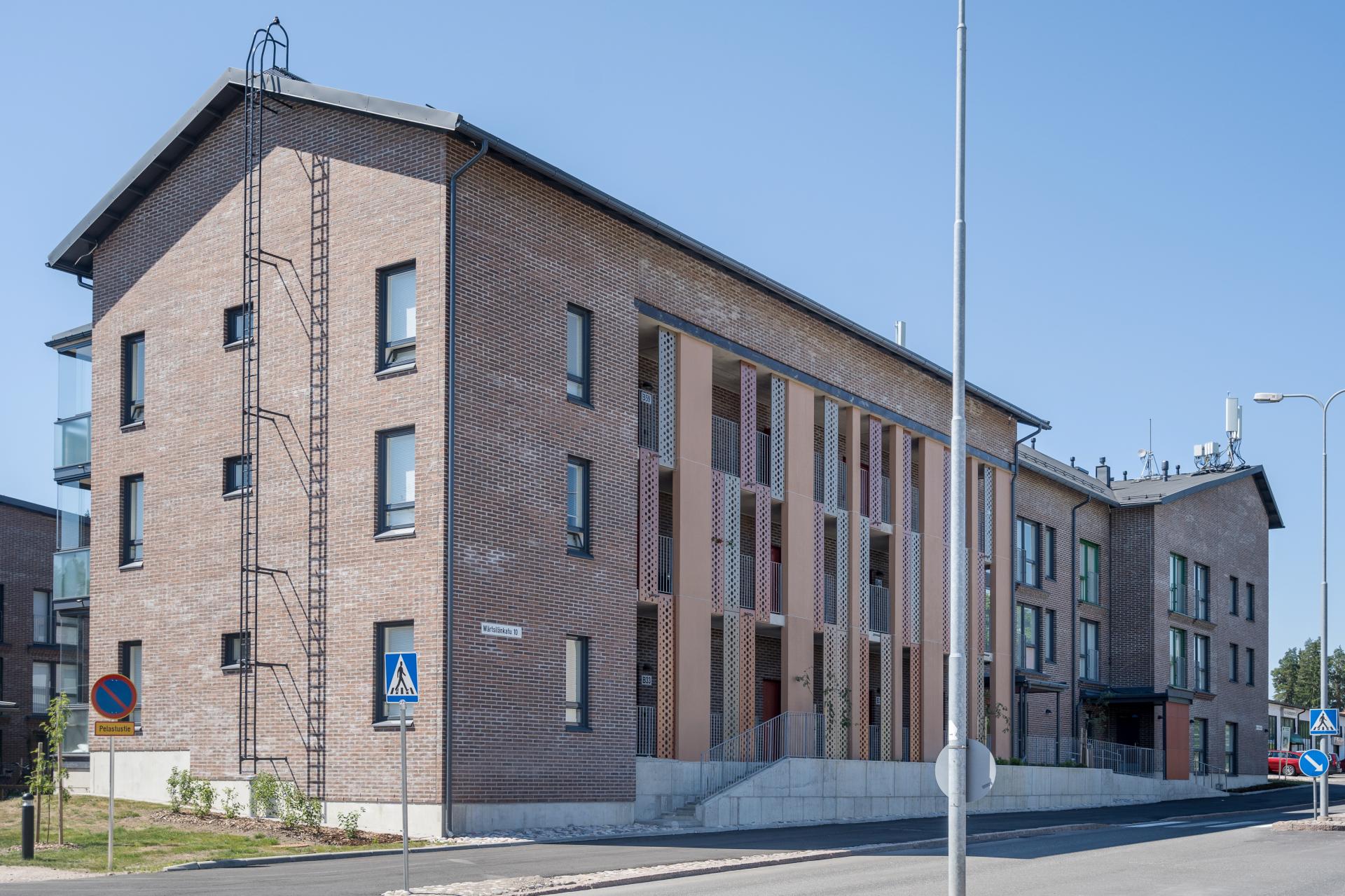
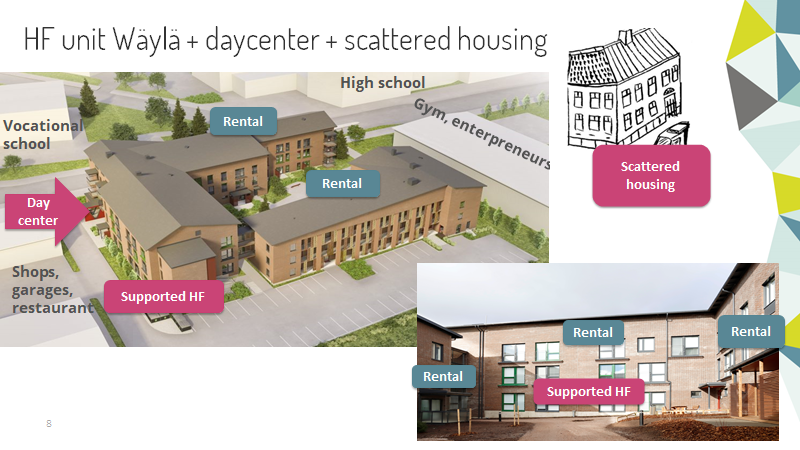
- 36 permanent, scattered housing for the homeless both in the premises and in individual flats around the city. 4 flats are for crisis situations. (pic.1&2).
- a support team of four including a social worker, a nurse and practical nurses
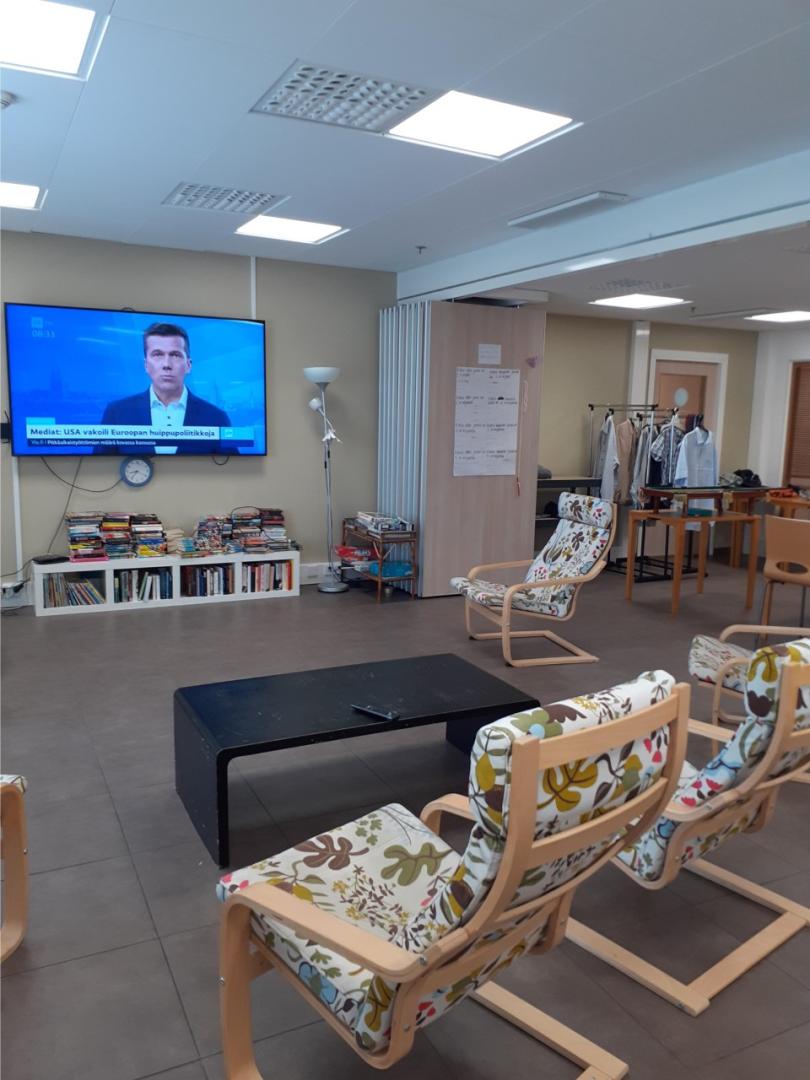
- a community center open for volunteers, peers and the public
- active neighborhood work
- low threshold activities
- participation in paid work is enabled by the Uuras employment activities in Y-Foundation
- a learning environment for vocational studies
The initiative to establish a new kind of housing and service facility was made by the city on Järvenpää. The city sold the plot to Y-Foundation which took care of planning and building the facility and buying scattered housing around the city. The city also chose the service provider Hoiva which is a social enterprise owned by the Helsinki Deaconess Institute.
The block of flats is located near the city center. Public services are easy to reach and there are excellent facilities for exercise in the neighborhood: a gym, a football pitch, an indoor swimming pool, and an indoor ice rink.
Housing First is the underlying philosophy in homeless services Finland and the approach is becoming more and more popular all over Europe. In many countries finding affordable housing is a major obstacle in the work. The core principle is that a homeless person is offered a permanent home and support services when needed. It is important, however, to create pathways to inclusion and empowerment as well.
Key objectives for sustainability
Y-Foundation’s mission is to ensure that everyone has a home. (https://ysaatio.fi/en/home). The strategy follows the UN Developmental Goals, which guide world’s development efforts until 2030. EU has adopted a resolution to eradicate homelessness in Europe by 2030.
The W10 -project manifests this aim to create a fair society where no-one is left behind. The objective is economic and social well-being of the tenants. This is met by providing affordable housing, supporting tenants with special needs, and enabling pathways to inclusion and community integration. The basic premise in eradicating homelessness is a permanent rental contract. A home is a prerequisite to dignified life and a basis for recovery from homelessness. Tailored support and activities provide pathways to social inclusion. The open access community center invites tenants as well as people from the surrounding community to join in activities that enhance interaction and social cohesion.
An empowering community enables also environmental sustainability. The community center uses waste food offered by local grocery stores. The tenants are aware of environmental issues and develop recycling. This is financially supported by Y-Foundation. In the long run perhaps the most important target is the activation of all tenants and the local community in sustainability issues. Being environmentally conscious is more difficult if one struggles with livelihood or is threatened by homelessness.
Sustainable building materials, insulation and taking care of maintenance are of course important qualities in the building itself. After W10 was built, Y-Foundation has established carbon neutral construction targets. The next project will be carbon neutral from the very beginning.
Key objectives for aesthetics and quality
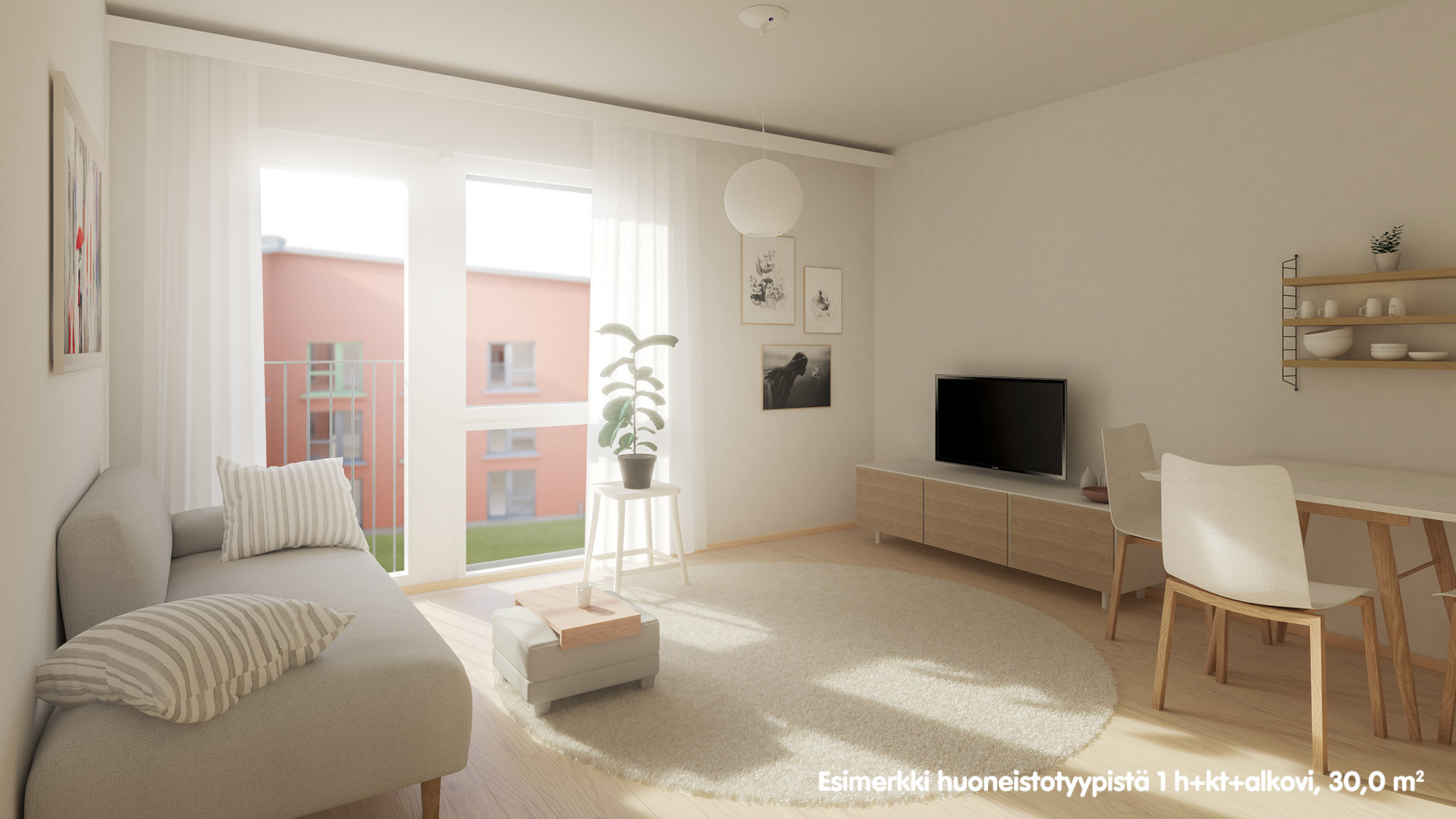
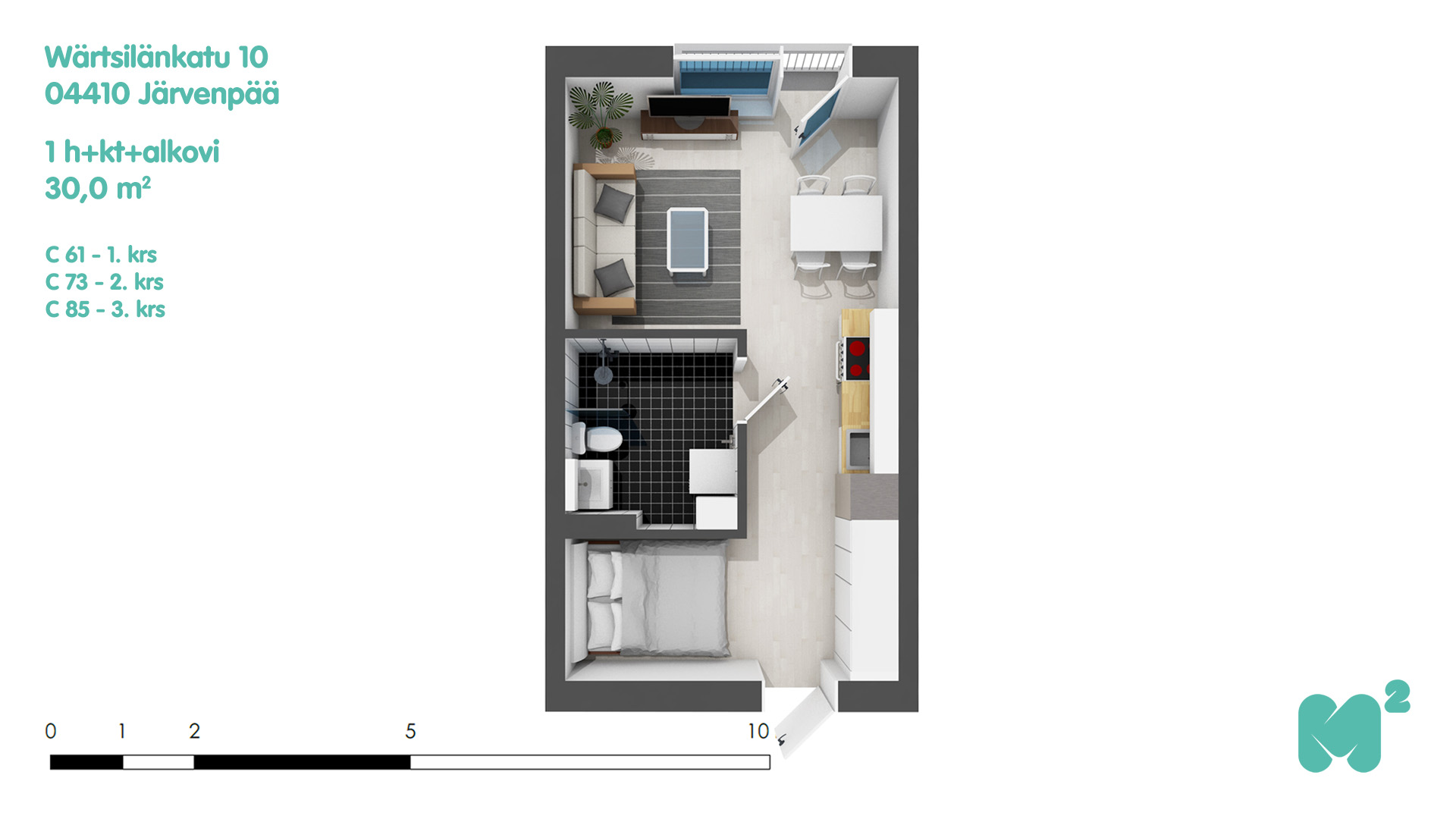
In W10 aesthetics means equal access to high quality living conditions for all. In practice this means that living is based on normal, permanent rental contracts, with the exception of the flats for emergency housing. Also, people with lived experience of homelessness and people in midst of a crisis live in similar good-quality apartments (pictures 3 & 4) situated in the same housing block. The flats follow the comparatively high constructions standards in Finland and are equipped in the same way. This equality of aesthetics is an essential factor in fostering the idea of human dignity and social inclusion. The tenant is entitled to live in aesthetically pleasant surroundings, regardless of one’s life trajectory or life situation.
The equality of aesthetics is crucial also in promoting ontological security, a safe home for those who otherwise would be in a vulnerable position in our society. People experiencing homelessness, substance abuse and mental problems are often living in unsecure and unstable surroundings and conditions, which do not meet the normal standards of living in the society. Thus, along with the permanent rental contract, the experience of living in similar aesthetic surroundings as others is a strong message favoring social inclusion. In this regard aesthetics has a deep impact on existential security and lived experience.
Key objectives for inclusion
The main objective is to provide normal flats in normal neighborhoods for people who otherwise are not able to afford them or who do not have the required social skills to live there. This is in accordance with the normalcy principle in Housing First, which implies that everyone can live in normal housing with adequate support if needed. The idea is to tackle segregation and strengthen inclusion. W10 is situated near the city center and it consists of normal apartments. Some individuals who have experienced homelessness live in satellite flats which are studios bought from the private housing stock. These flats are scattered in different areas in Järvenpää. This is made possible by offering support services.
The community center is an open place for citizens in Järvenpää to meet and interact with each other. Thus it enables inclusion and promotes social cohesion. The center brings together organisations like the nearby vocational school Keuda and a collaborative network focusing on creating communality through waste food (Yhdessä katettu - Served together). In the center the clients can take part in making and delivering food as well as join in the activities organized by the students in practical nursing and catering.
Inclusion is enabled also by building pathways to education and employment. The communal center consists of a variety of participatory activities. Firstly, all clients can take part in planning and implementing the activities. Secondly, the possibility to take part in low-threshold work activities enables tenants to practice and acquire social and other life skills in cleaning, neighborhood work, cooking etc. Active coaching is provided in a secure setting to encourage empowerment. The third option is Winssi -project organized by the city of Järvenpää. It offers rehabilitative work to its clients. Fourthly, the Uuras employment project hosted by Y-Foundation employs tenants for example to clean the premises of W10.
Results in relation to category
The W10 facility consists of 107 apartments and a community center. 67 affordable rental flats, 20 flats with support and 4 flats for crisis situations are situated in the new W10 building. The community center is part of the same housing block. Another 16 apartments are scattered around the city. Also, the product includes a support team delivering 24/7 support to 36 tenants living in W10 and scattered housing. The team runs the community center, too. The support team consists of a nurse, a social worker and practical nurses.
There are tenants living in all W10 flats, so this goal has been reached. 67 individuals or families needing affordable homes have permanent rental flats near the city center. As tenants of a non-profit housing provider they can rely on good management and maintenance in the real estate. The landlord follows the law on residential leases and provides housing advice services to all its tenants to help with potential rent arrears or other problems. In case of unemployment it is also possible to participate in the employment project and earn money to pay the rent.
A remarkable achievement is that also 36 homeless people have been housed in a sustainable way and there is both professional support as well as meaningful activities available in the premises.
Housing has had a major impact on the lives of the tenants. Affordable housing and good living conditions diminished the risk of ending up homeless again. For the former homeless acquiring a home is often a turning point in life. Exiting the adversities of temporary and uncertain living conditions makes changes in lifestyle as well as treatment of mental and substance issues possible.
The tenants in supported housing fill in a questionnaire on their well-being annually. In 2020 83% of the tenants experienced engagement in their lives, 67% were less lonely than earlier, 75% felt that they have moved forward in their lives and 55% reported improvement in self-esteem.
How Citizens benefit
The W10 project was designed by professionals responsible for the implementation: the city, the service provider and Y-Foundation. The service provider is known for its innovative practices and developing Housing First together with the clients. That´s why the main idea was to create spaces to enable participation in the community.
In W10 the tenants, 36 of whom have been homeless or under the threat of homelessness, have found permanent homes. Individually this has meant more security and better possibilities to make choices in one’s life. Housing homeless people increases security also on the community level as people settle down and receive the support they need. It can take time before a person is ready to be involved in other activity available in the facility, but it is important to know that it is possible in the future.
The community center benefits the tenants and the local community by providing a space to meet each other and work together. Interaction and open dialogue within the neighborhood decrease tensions between different groups. Prejudices towards marginalized individuals tend to dispel when people interact in person. The idea is to facilitate interaction and establish agency through engaging clients themselves to plan and to conduct the activities of the center.
There are many ways how the civil society can be involved in the project. Active neighborhood work is another form of engaging with different actors in the community. This is accomplished by regular meetings with the neighbors and keeping the environment tidy. The network delivering waste food joins local entrepreneurs, NGOs, tenants, clients of the community center and vocational students in activities that reduce the amount of wasted food. For the future practical nurses, the supported housing and the community center provide a learning environment.
Some of these activities have been affected by the pandemic but they are ready to continue as soon
Innovative character
The innovative character of W10 is based on adapting the principles of Housing First to eradicate homelessness and combining different kinds of housing solutions together with a participatory community center. Together they form a functional whole.
With adequate and individualized support also people with complex needs like mental and substance abuse problems can live in the same buildings and neighborhoods as anyone else. Following this principle of normalcy empowers those who live in W10. It also forms a sustainable ground for active engagement in the community and fosters community integration.
Normal long-term rental contracts are made with every tenant to create sustainable living conditions. This is the main innovation in Housing First: ending homelessness by providing a permanent home instead of living in temporary hostels, night shelters or sleeping rough. Sustainability is strengthened also by flexible housing and service options as the tenants can move between different kinds of housing solutions depending on their need for support. More intense (24h) support is available in the W10 while lighter support is supplied to tenants in scattered housing in the city. The innovation here lies in combining levels of support and the empowering activities in the community center to form a seamless continuum of choices and support. Low-threshold activities encourage inclusion, while pathways to employment offer more structured steps towards integration.