Takeda
Basic information
Project Title
Full project title
Category
Project Description
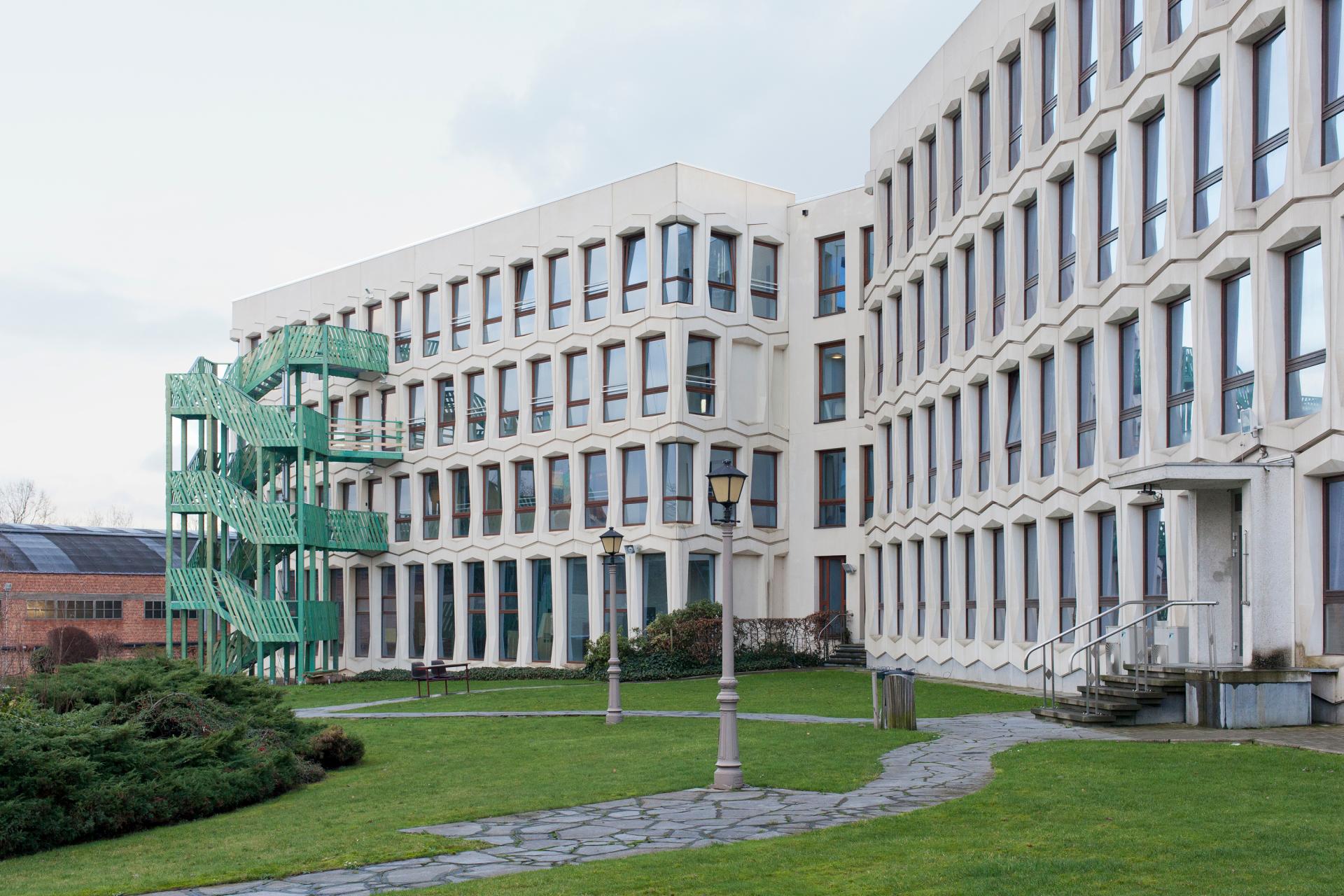
reconversion of an office building into a school, Brussels
Project Region
EU Programme or fund
Description of the project
Summary
A SCHOOL IN MOVEMENT
A school project is built step by step. In the case of the future school that will occupy the site of Takeda, it is also the reality of the building that step by step will evolve over the years. This first phase of transformation is temporary. However, it must anticipate a future site and removals during the evolution of the building(s). The project therefore reflects the character of transformation, evolution and dynamic equilibrium, which is also the objective of any form of teaching.
Like its pedagogy, the building seeks to be appropriable by students and teachers. The project proposes a series of one-off interventions that are mainly independent of one another. This elemental approach allows the project to evolve serenely in the shortest time possible. Indeed, in dialogue with project owners, the elements can easily be modified, replaced, abandoned without the project as a whole suffering the consequences. This method allows to control the costs and to simply manage the site.
Key objectives for sustainability
TARGETED MEASURES
5 major interventions
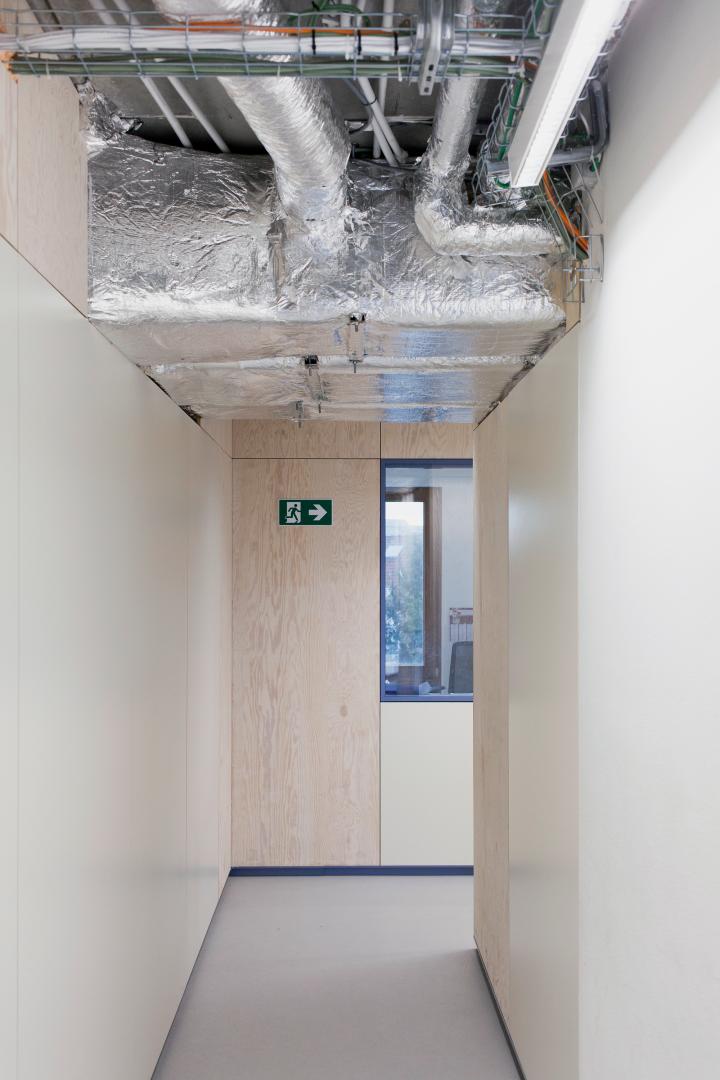
1. interior
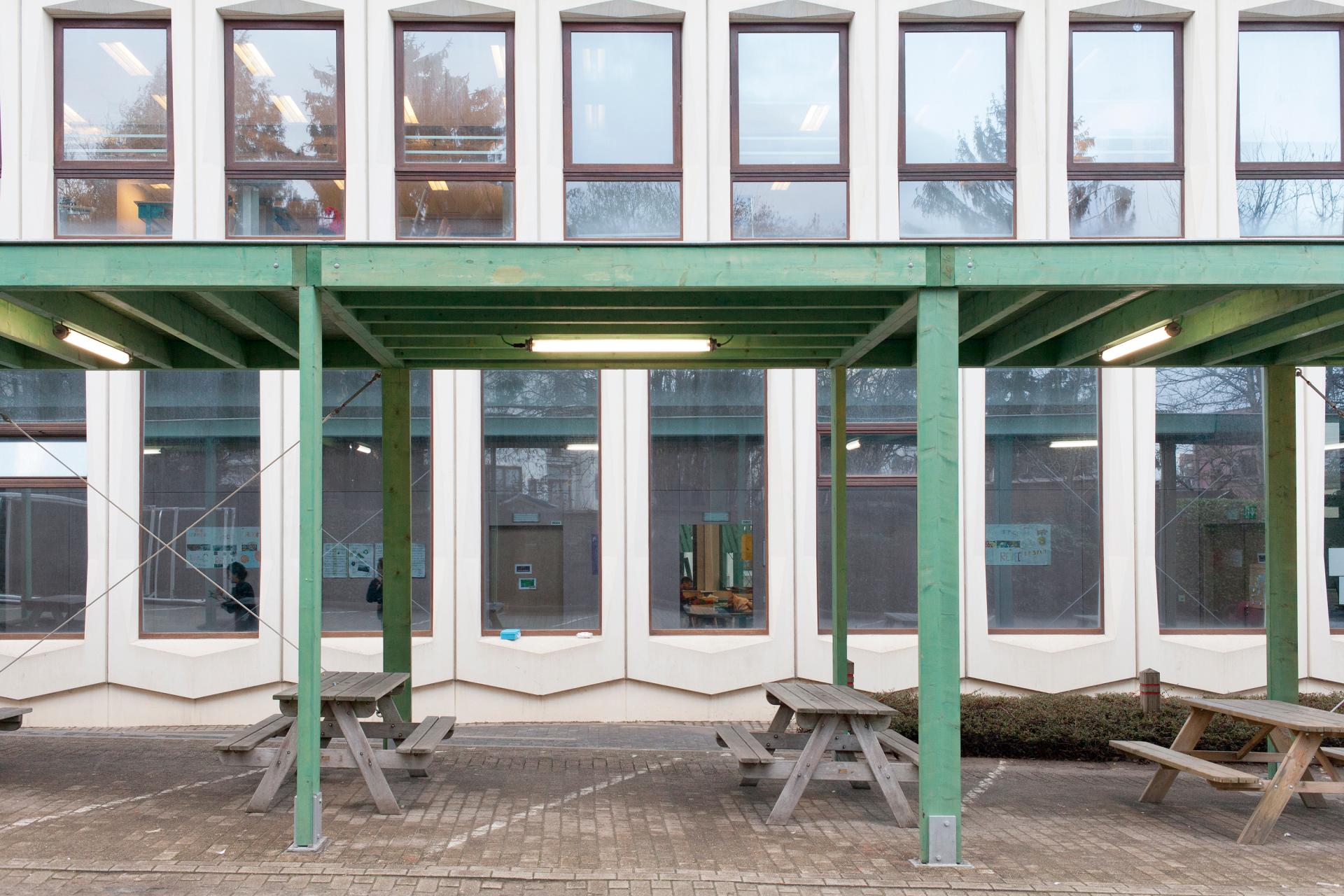
2. new entrance
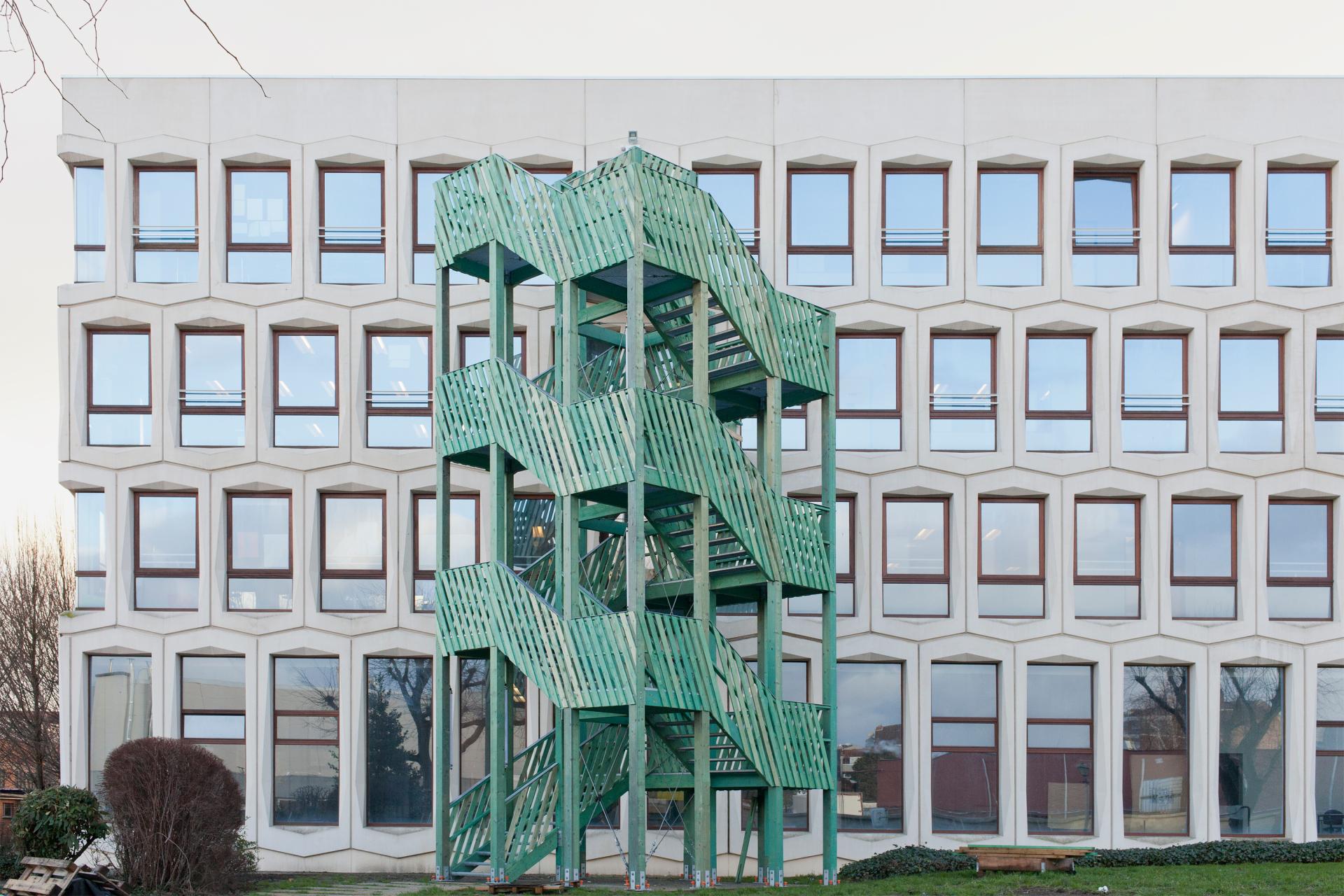
3. emergency stairs
4. outdoor facilities
5. sanitary facilities
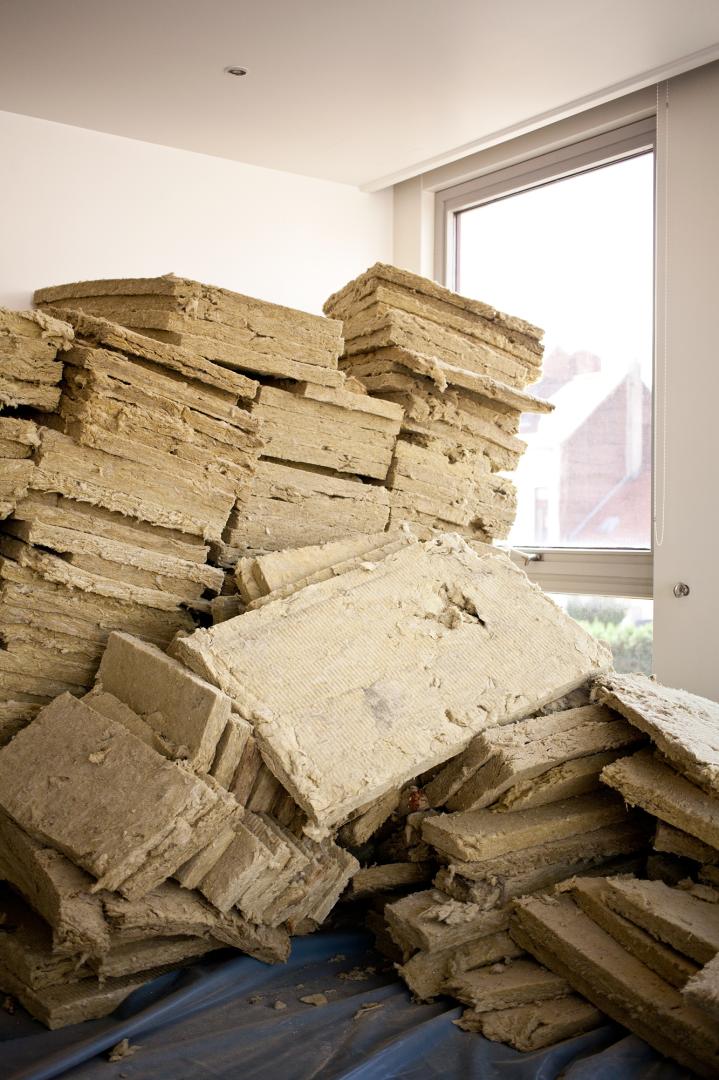
All interventions are designed with a view to flexibility and sustainability (in the broad sense of the term). Emphasis will be placed on the retrieval of existing elements from offices and the possible re-use of temporary construction elements. The idea is that the school can seize and reinvent with these elements of construction once the final project is built.
Key objectives for aesthetics and quality
THE EXISTING, FEEDSTOCK BANK
Two principles guide interior design
1. Class dimensions
2. Re-use of office building components
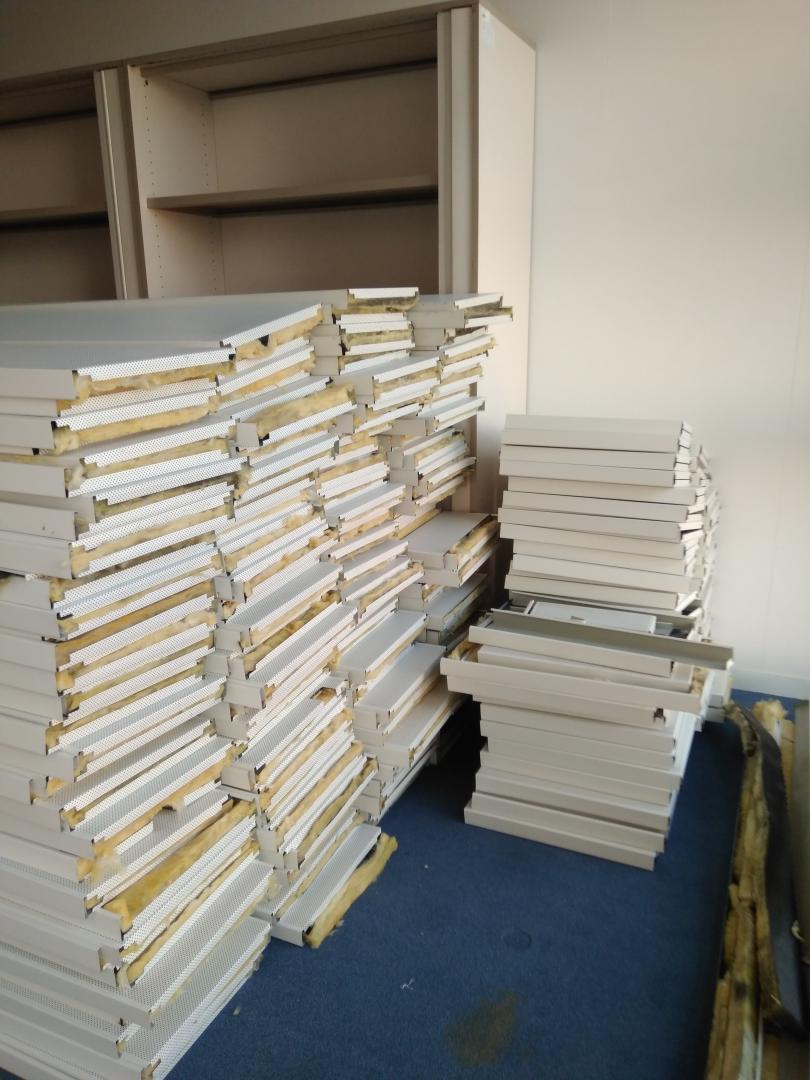
The plan favours classes of an ideal size in the configuration of the existing building. This will enable the second phase to recover the improvements made by optimizing them. The building has a simple and modular partitioning system. This system is disassembled and reassembled to realize the classes. In order to compensate for the missing elements, multiplex panels are made. These panels give a new identity to the building and also allow signage by colouring or through stencil prints. The existing carpets are replaced by lino or an equivalent coating and the ceilings are as far as possible suppressed to increase the ceiling height. A series of false ceiling elements are retained for acoustics in the classrooms. A guardrail is added to the opening windows to comply with current standards and the existing sunshades are also preserved to protect the south facades from glare.
Key objectives for inclusion
THE NEW ELEMENT, SOURCING TO BE
It is moved directly into the east wing of the project in order to ensure the smooth running of a site on the site and in the west wing of the building. A large reusable playground serves as an entrance device and clearly shows the change of use of the building. It is proposed to carry out this device in the first phase so as not to have to carry out work on the facades once the school is in operation. In the final phase, the awning can be reused, moved to serve as a playground or dismantled and rebuilt in another form.
A simple structure consisting of a wooden pole and perforated galvanized steel stairs. It creates a new identity in motion for the school. It allows a new access to the classes from the playground. The staircase is designed as a wooden tower around which a staircase winds up. The staircase can be extended in the 2018-2019 phase.
Results in relation to category
The Takeda project was mostly a challenge faced to the regulations of public market. It was an opportunity for the office to work on a method to develop circularity in public adjudications. This happens through many ways : a first phase of careful survey of all the panels available, the making of an inventory, a project and a partition of rooms according to panels available, and in the last phase, the making of graphic documents attached to the execution files before publications for adjudications
How Citizens benefit
RELOCALISATION
We noticed in the construction site that an interesting side effect of circularity is that economical means are distributed differently.
Instead of buying manufactured materials and paying for their transportation, often over quite large distances, a circular approach invests much more in local work force : the careful dismantling, conditioning and reuse of materials is time consuming.
This means that a circular project engaging in re-use and in maintaining constructions on site will not be significantly cheaper. But the money is invested directly in the development of local know-how and in the local economy.
Innovative character
TO DISMANTLE, TO BE DISMANTLED
The Takeda office building has undeniable qualities, and the office has tried to push this to its absolute limits: the building seems to contain all the keys necessary for its transformation; a timeless shell, in a modular plateau structure. Lightweight partitions that can be dismantled and used.
Consequently, the new constructions must perpetuate this logic, a logic that is the essence of the project, right from its sketch. This starts with a precise and detailed inventory of reusable materials, to then develop a design that is fundamentally linked to the available raw materials.
Likewise, the new shell (entrance and staircase) is built with a local wooden structure, which is deliberately to be dismantled in the future, in view of the ambitions of the school organisation.