duplex appartments and spa/hammam
Basic information
Project Title
Full project title
Category
Project Description
Located in Castro Marim, Portugal, one of the poorest regions of Europe and most
affected by climate change, the project is the result of a dialogue between innovative
technologies and traditional methods, guided by sustainability and reduction of CO2 emissions.
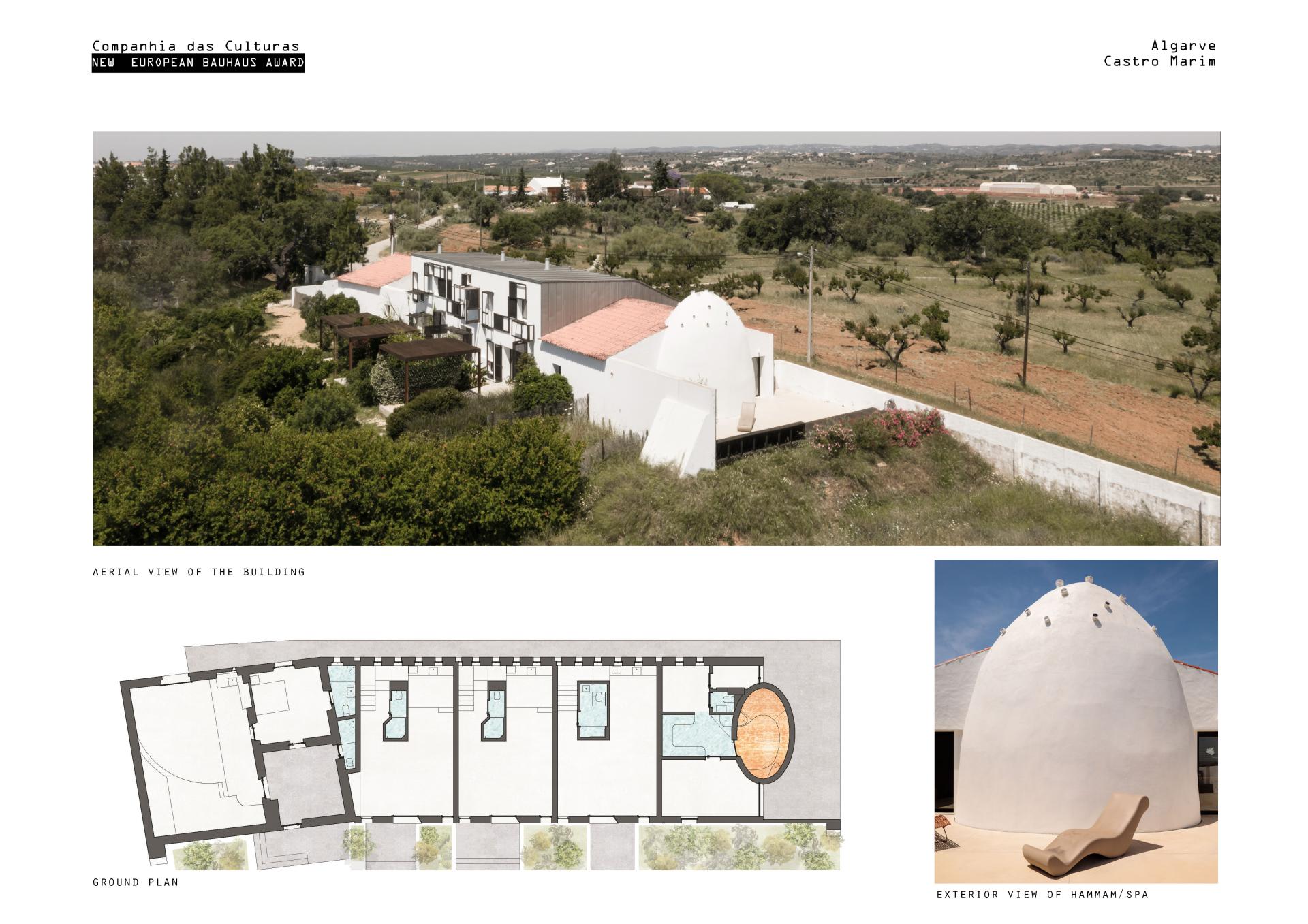
Built upon the ruin of a former agricultural facility, it has today several housing units for artists
residencies, guest house and a spa/hammam for locals and visitors.
Project Region
EU Programme or fund
Which funds
Other Funds
PRODER nr 020000905341 amount of 198000€ payments completed in 2014
artists residencies, guest house and spa/hammam is part of eco design hotel Companhia das Culturas.
Description of the project
Summary
The project is located in the south of Portugal in Castro Marin one of the poorest regions in Europe. It received EU funds of 198 000€ to raise a new building over a footprint of a ruin (former agricultural facility) located inside the existing village. The project has housing units, for artists residencies and guest house and spa/hammam for locals and visitors. The organization of new spaces was made according to a challenging dialogue between innovative technologies and traditional methods, oriented by a sustainable strategy.
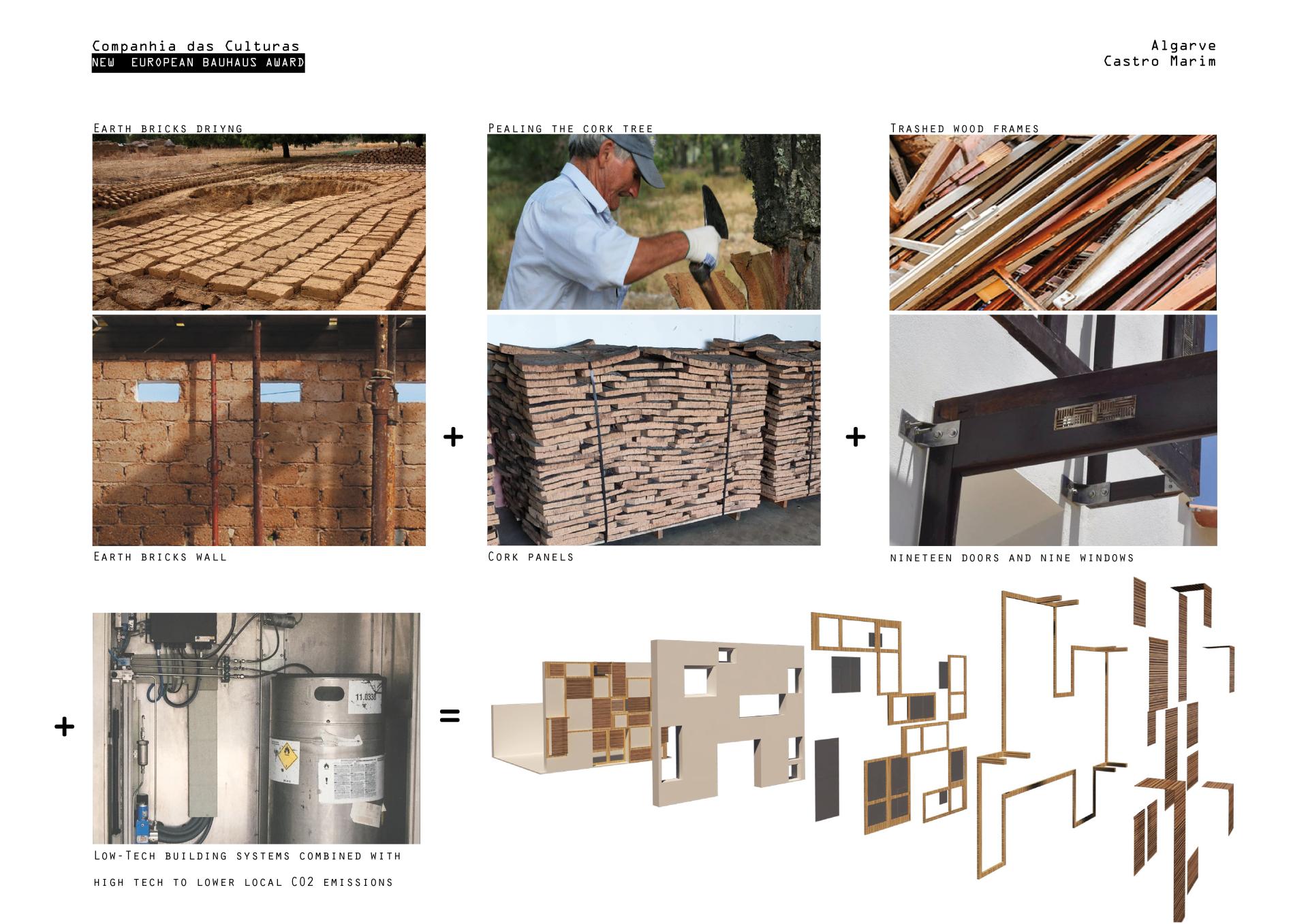
Innovative technologies were included from early stage of the project. Consultants on solar panels, heated surfaces, water cisterns, efficient insulation, shading systems, humidity filters have contributed to seek a high level of environmental quality. In parallel to high tech solutions, traditional methods were integrated in the design. The central argument is that energy efficiency and sustainability have been tested for centuries in local dwellings, thus local good practices contain solutions that were integrated in the design, such as, earth bricks, cross ventilation, external shades, and the use of cork in the building.
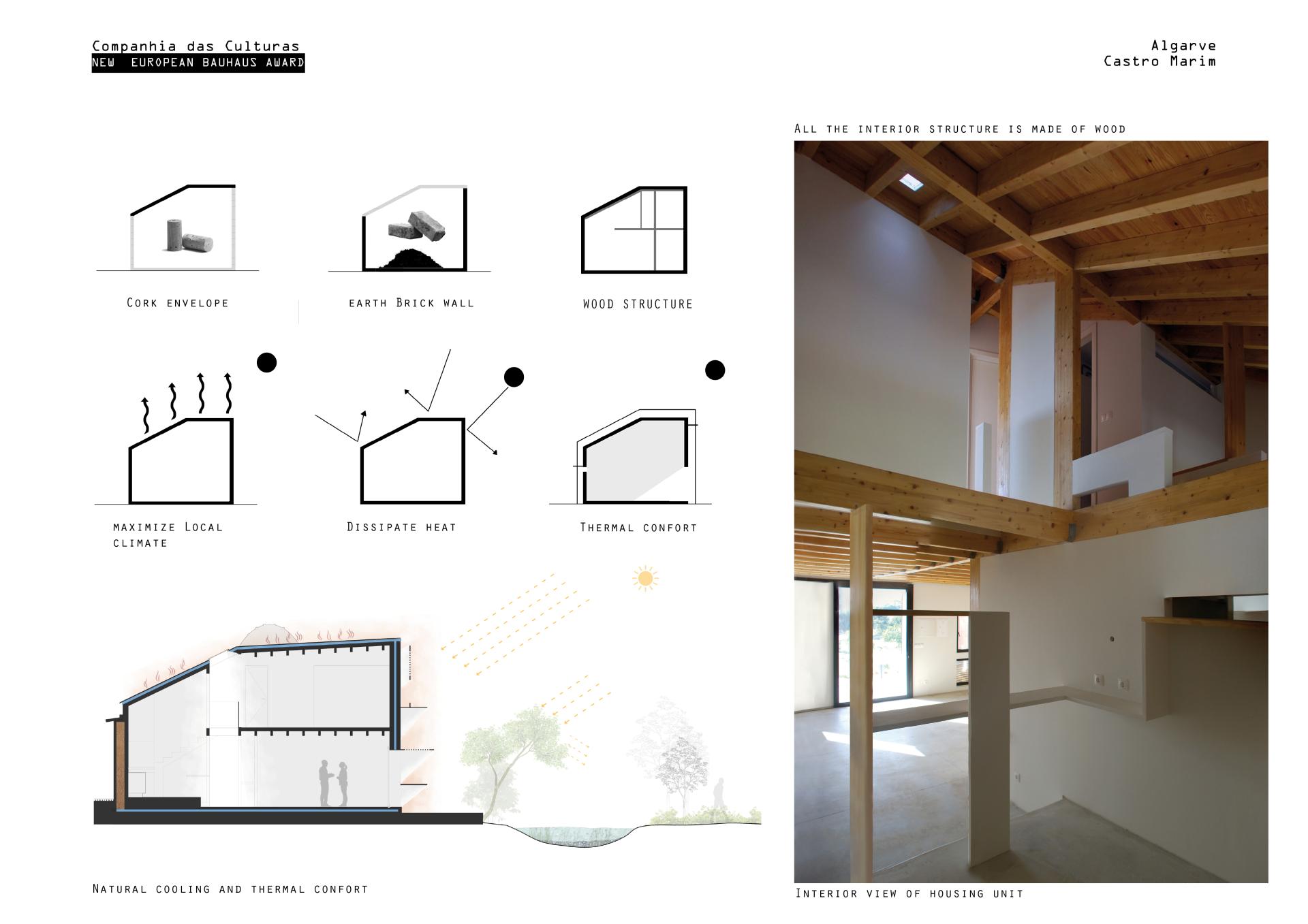
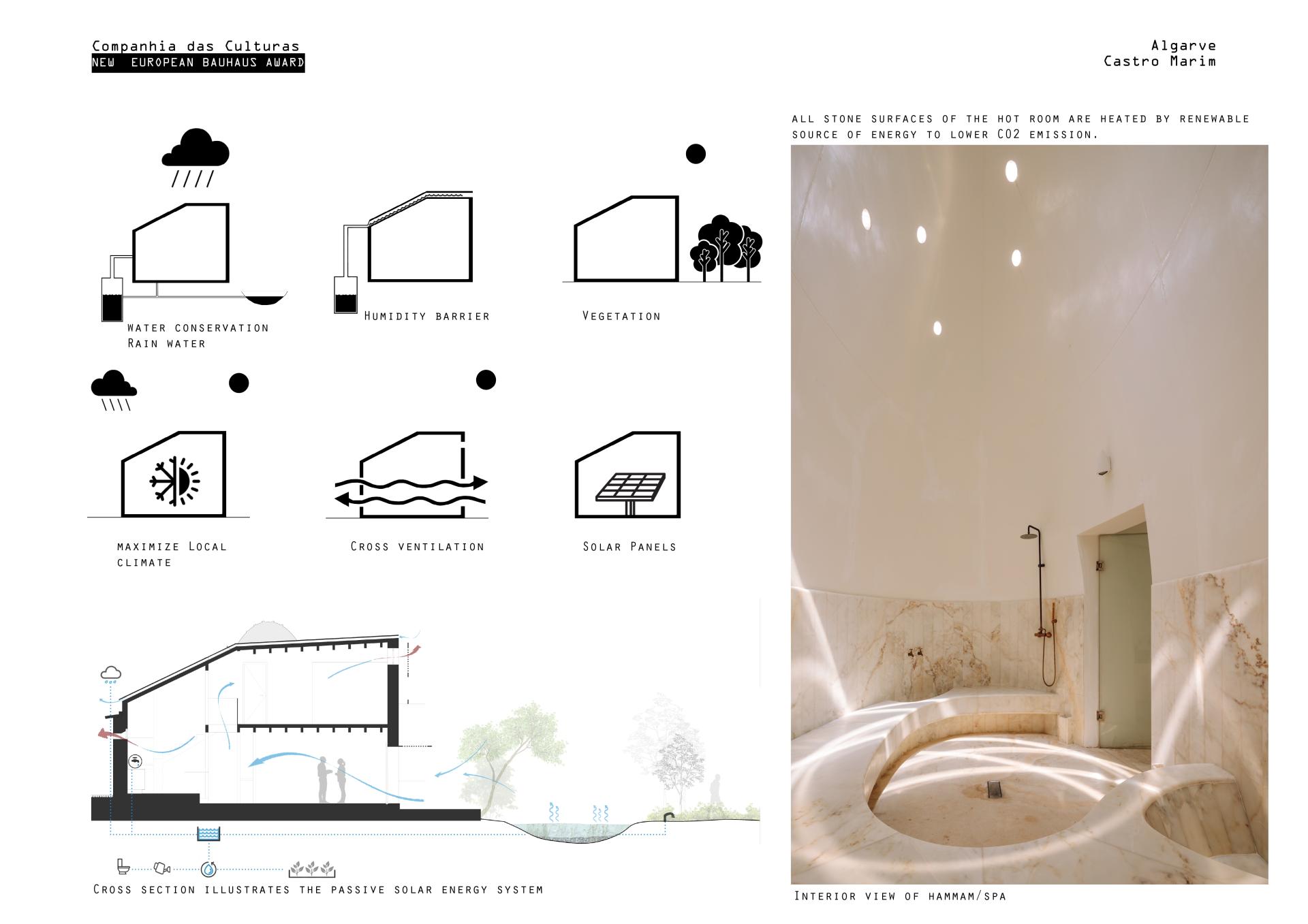
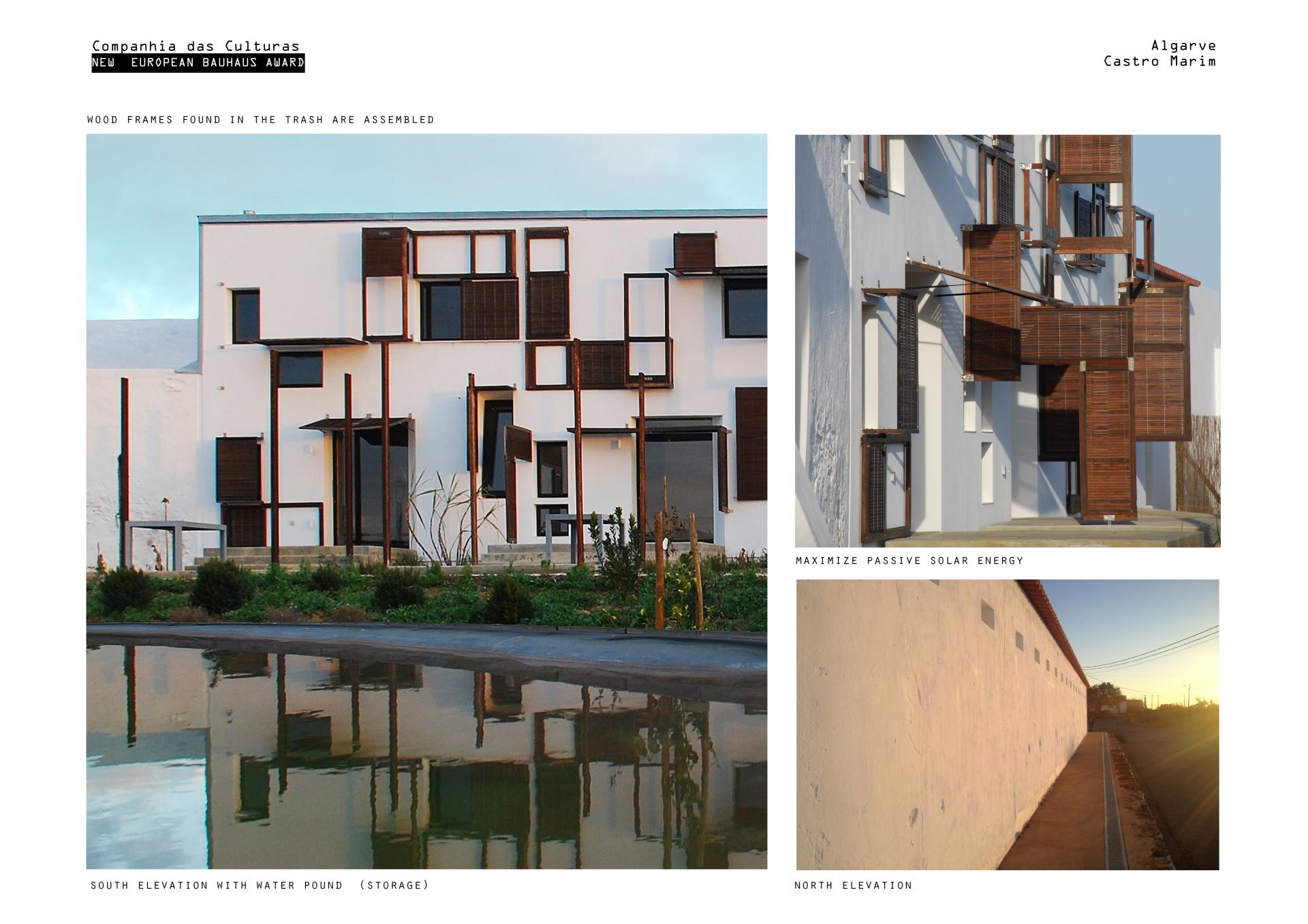
Each elevation was designed to reach an optimal performance for the climatic conditions throughout the year. Rainwater is collected to feed the lake of nearly 150m3 recycling an estimated 30.000 liters per year that are used to water the vegetation along the south elevation. The transpiration of the leaves lowers the temperature by an average of 5º degrees Celsius. The passive way to lower CO2 emissions and protect biodiversity while enhancing the parameters of comfort is also used inside the building. The aim is to dissipate heat, keep the temperature stable, protect the inside from extreme light and maximize the use of passive solar energy. The combination of the three R's policies, reuse, reduce and recycle were integrated at several levels of design.
Key objectives for sustainability
The integration of the 3R's reuse, recycle, reduce, and have driven the development of the project. Reuse existing earth bricks found on site over the footprint of the ruin. Recycle existing hard wood frames of excellent quality brought from the tropical forest and found in the trash nearby. Reduce CO2 emissions sustained by three principles. First, the use of local materials to avoid transportation. Then, the building is implemented over the footprint accepting the existing topography to avoid movements and transportation of land to damp. And lastly, design elevations respond efficiently to both the demands of the warm season and the cold months of the winter.
Reusing construction material in a surface of 364m2 earth bricks enhance the thermal inertia of the building. The use of cork panels on the roof and south elevation, a surface of 542m2 enhances the insulation of the building.
To reduce the ecologic footprint updated technologies are integrated, namely solar heating panels and radiant surfaces combined with the use of cork panels, guarantee excellent performances in the thermal control of the building. The collection of rainwater and gray water from the shower to feed the lake is another contribution for the sustainability of the project. The garden cools down the environment along the warmest elevation of the building.
Recycled wood frames on the south elevation are assembled to maximize the benefits of solar passive energy thus reducing the consumption of energy during the four seasons of the year.
The listed strategies are combined to achieve a high level of 3R's. It is through their combination that a high level of sustainability is achieved.
Key objectives for aesthetics and quality
The main objective was to build a new facility, mixing traditional knowledge and innovative design without imposing a rupture with the local context. The combination of design and constructive solutions have contributed to the integration in the local community.
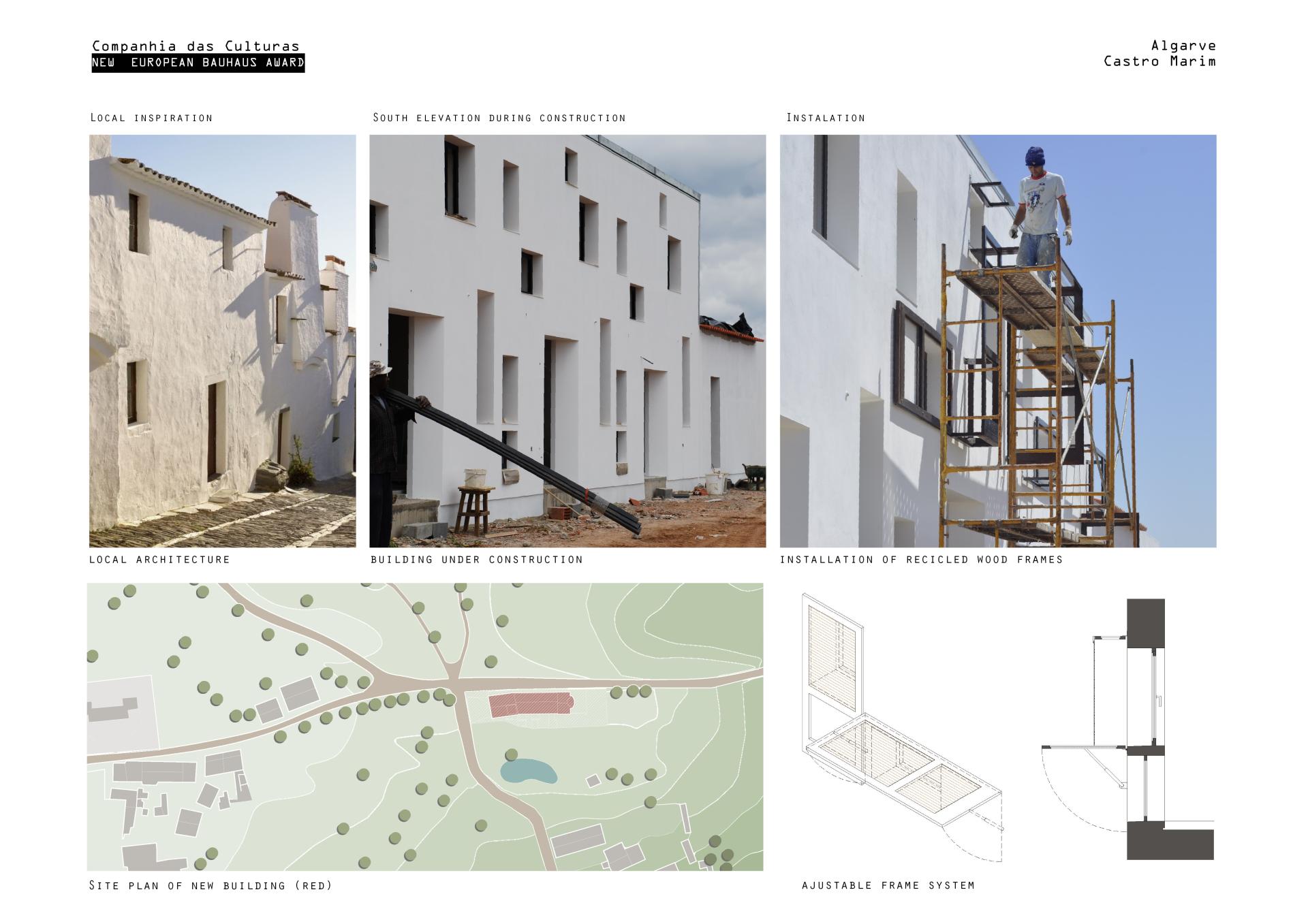
The identity of the site is a result of the local landscape, local typologies, the adequate scale, and the spatial experience of the built environment. Local buildings do not use stones around the openings (doors and windows), they are described as plain architecture, mainly whitewashed, and adapt to the local climatic conditions. There are exterior shadings that occasionally protect from the summer extreme heat.
The strategy of mixing traditional and innovative systems results from the use of traditional building materials, earth bricks built on site, cork panels extracted from the cork trees in the region and wood frames trashed by local constructers. Innovative systems include solar panels, ecologic cistern, water filter control, LED light and heated surfaces.
Several media highlight the "charm" of the building which emerge from the dialogue with local context. Most of the recent buildings in the region privilege a discourse of power imposing a rupture with local exiting buildings. On the other hand, the project offers a fragment of perfection, touching the consciousness that feed the memory of local community. Those are the main reasons for meeting the key objectives of a traditionally rooted and innovative architecture.
Key objectives for inclusion
The new building offers a traditional hammam/spa open for the local community and visitors, short term housing units for seasonal visitors and artists residencies throughout the year.
The design of a new hammam/spa in this particular region and in this specific period of time, the 21st century, is a statement at two levels: historic and geographic. The new building establishes a relation to a long-lost practice. It opens a new perception where local culture is seen not just within its present context but also related to ancient traditions.
The whole project including the housing units preserves the existing spatial structure of local plain architecture where each housing unit holds direct access to the outside, without sharing enclosed circulation spaces. This solution has proved to be successful during times of pandemic and brought great value as it immediately adapted to the requirements brought by COVID-19.
Local community is dominated by low income groups, among them there is a high rate living on welfare, families of single mothers and citizens that were born outside the EU. The project promoter hires four women in full time, another four employees in full time for half of the year a total of nine women and one man. The majority are citizens from outside the EU. Three external collaborators cooperate occasionally. There has been a growing interaction between locals workers and visitors. The activity remained during the breakdown of the pandemic. For now, it is outstanding the inclusiveness that the project brought to the village, to the women and to the local producers.
Results in relation to category
It is hard to select just one category because the project touches various aspects that are not exclusive to one single category.
The project presents a philosophy of a concept that stands as a testimony of previous generations to remind as how precarious buildings are when facing the strength of natural forces. The project intends to respect that statement and enhance the feeling of the ancestors that continuously face the precariousness of life, just like our generation.
The integration of the 3R's reuse, recycle, reduce, has been interpreted differently by each cultural environment but there’s no doubt about the quality of an architectural solution that is subtle and low-profile. The EU funds applied in this remote region brought it to the front page of several media. The project has been published both nationally and internationally by high standard media, invited to be presented in relevant cultural events, EU meetings and academic publications. The project continues to have an excellent impact in the local community and region, attracting a large number of users and tenants.
The high level of energy efficiency succeeds to reduce CO2 emissions, the circular use of water, use of, passive solar system and renewable sources of energy, present a reference to structure the next design of buildings for the region.
How Citizens benefit
The project changed the perception of the local community that did not see any interest in abandoned agriculture facilities and buildings. The region is dominated by low-income groups with low self esteem therefore the project is playing a key role to raise their pride for their region and local architecture. The widespread media visibility of the project continues to have an impact among the local community and the local municipality. It brings a shift in the discussion for future developments and the opportunity to regenerate former abandoned agricultural infrastructures. The project has boosted the self-esteem of the local community that share the perception of its value.
The eight employees, mainly women and immigrants are integrated in the community. The guest house, resident artists and spa/hammam are consuming local bio agriculture contributing to the promotion of local producers.
Innovative character
1- The combination between innovative technologies and traditional methods to reach sustainable strategies. The integration of high-tech solutions and low-tech methods open new opportunities for innovative design.
2- Designing building systems that combine global solutions (solar heating panels and radiant surfaces) and local solutions (earth bricks and cork).
3- Ecologic strategies, recycled rainwater and gray water from the showers feed the lake that water the plants. The new vegetation located outside benefits from the water collected in the building to enhance a process of symbiosis, useful to cool down the temperature, save energy and boost the green infrastructures, enhancing biodiversity.
4- Inclusiveness of the local community, the curved dome illuminates through small circular openings, provides on the inside a unique narrative about the secular identity of the place. It creates an innovative spatial experience of an updated traditional bath, a cultural inheritance discarded for five centuries.
5- Shading system built with recycled wood frames of 19 doors and 9 windows reused and placed along the south elevation for solar protection. The design is the result of a close collaboration with thermal engineer who contributes to reach a high level of performance. The frames found in the trash are brought to life with a meaningful statement about the need to recycle and protect the natural environment in a playful and positive way.
6- The combination of several strategies reduces carbon emissions and contribute towards a carbon neutral performance. Earth brick walls provide thermal mass, local cork is harvested for insulation. Oriented to the south, the artists residencies are warmed by the sun in the winter while ventilation and shade couple with thermal mass for coolness in the warm months of the summer.