De Nieuwe Stad / The New City
Basic information
Project Title
Full project title
Category
Project Description
A different mindset to urban development: that’s what makes De Nieuwe Stad (‘the new city’) a game-changer. The project proves that public programs can be safely placed into the hands of the private sector. Not shying away from complex issues and taking a tabula scripta (building upon the existing) instead of a tabula rasa (starting afresh) approach. While many urban professionals try to avoid restrictive conditions and complexities, Schipper Bosch moves forward by incorporating them.
Project Region
EU Programme or fund
Description of the project
Summary
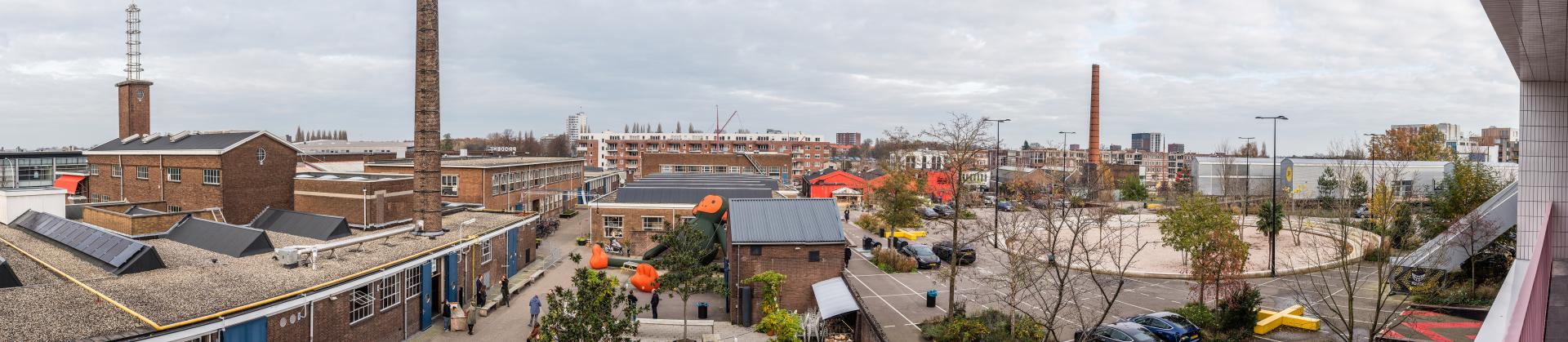
The city of Amersfoort is known as one of the Netherlands’ biggest urban regeneration projects. Bulldozers erased a substantial part of the old city fabric and replaced it with new generic developments. The old Prodent toothpaste factory, which was designed by architect Philippe Anne Warners in the unique style of Amsterdam School and manufactured toothpaste as recently as 2012, remained standing even though much of the surrounding area was demolished.
In 2013, the Schipper Bosch family took ownership. Having purchased it directly from Unilever, Schipper Bosch aimed to have the Prodent factory become the catalyst for a bottom-up redevelopment of the entire area incorporating the dreams and ideas of its residents. In an era where the generic city was gaining ground across the board, De Nieuwe Stad became a field lab for the urban development of tomorrow.
It reminds us of how cities had once been made, based on the belief that if anything they were a dynamic hub for people, trade, manufacturing, food, energy and ideas. The area aims to attain permanent temporariness, i.e. anything can be transformed into something else at any time.
Public commissioning entities are simply not geared to such aims, or to abandoning the orthodox approach. And this is where Schipper Bosch has filled a void in that it acquired the facility from the private sector, and purchased its public space from Amersfoort council. It remains in full control of the entire project, an prerequisite to successfully achieving its ambitions, which even included the area being fitted with its own power grid. By doing so, the project illustrates at which crossroads contemporary urban planning finds itself and how taking a tabula scripta (building upon the existing) rather than a tabula rasa (starting afresh) approach can enrich city-making and innovation on multiple levels.
Key objectives for sustainability
At De Nieuwe Stad we try and utilise existing construction as best we can on our developments. That doesn’t mean we won’t take down a run-down factory hall, and replace it with a newbuild, if that is the better option. We take our time in developing a comprehensive and detailed vision and will not shy away from leaving a site or property abandoned until the right time arrives for implementing that vision. Sustainability is an intrinsic component to this. We are not afraid to test and make mistakes as we strive to move forward. In our case, practice and improvements do indeed make perfect.
All aspects of our planning strategy focusses on people. Where we’re currently at in terms of climate change, developing new habits and products can help create a positive change. One of these areas is nutrition, where we’ve introduced more regional produce into the Amersfoort food chain through our regional produce supermarket, Het Lokaal. We try and team up with third parties, like Het Lokaal, to encourage them to subscribe to our own quality ambitions, with them, in turn, feeling part of our community.
De Nieuwe Stad is also a place where pioneering efforts are made in search of sustainable solutions creating positive changes for people and their environment. The decision to immediately begin experimenting with the ideas tabled, has laid the basis for us to become self-sufficient. We have put in our own heating network fed by a bioenergy installation as temporary step in the right direction. And we also accommodate sustainable mobility, with the park boasting a charging square and a car-share programme as well as being bike-friendly.
Key objectives for aesthetics and quality
One of the areas quality features is its industrial character. Teaming up with urban development architects, ZUS, and the project’s stakeholders we labelled the strategy ‘industrial poetry’ and it is one we are going to keep. Also every bit as important is that it is one of the main characteristics new developments will have to incorporate. Every other project on the site will use true materials; any new material will create a sophisticated dialogue with the existing structures, embracing authenticity and visual interconnection.
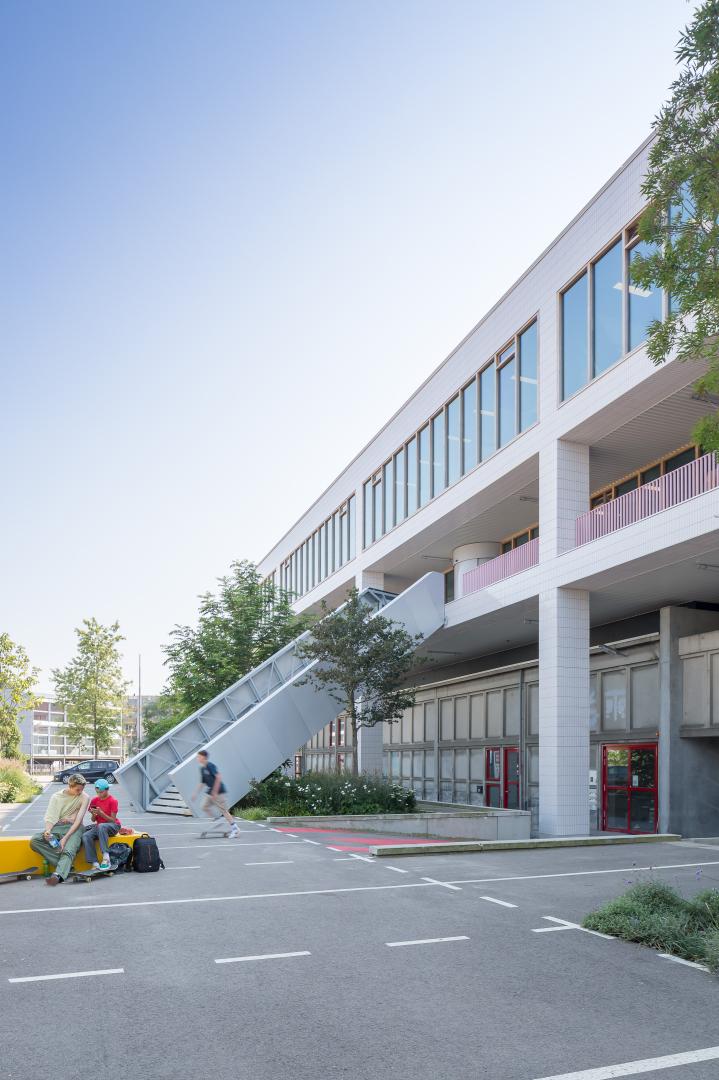
The area receives constant upgrades and even improves neighbouring urban development errors that are made in the past. Het Platform, newbuild property, is an excellent example. This building was built over an existing warehouse and was designed in a style reminiscent of the Italian Superstudio architects of the 1970s who proved highly influential in European urban planning architecture.Its glazed white exterior tiling allows the building to interact with its surroundings, something the bold red exterior of the Hogeschool Utrecht building directly behind it fails to do. Its bright white inserts are, of course, also a nod to former tenants, Prodent toothpaste manufacturers.
We were also quick to act on the opportunities that presented itself. Brainchild of Belgian architects, Robbrecht and Daem, De Paviljoens, was designed for the 1992 edition of the Documenta Kassel fair, and had been bound for the scrapheap, before finding a new home at De Nieuwe Stad. Its buildings were initially put in at the edge of then barren parking lot area, so as to lay claim’ to the area in a spatial sense. Circular in a sustainable sense, their shape also reflects the shape of the silo-like building which had previously adorned this site. Planning permission was rather craftily attained by as the buildings were put in with temporary permanence enjoyed pursuant to a ‘parking permit’. Instantly they were loved and nowadays regarded as substantial part of the area.
Key objectives for inclusion
Cities have a social function and we want to contribute to this sense of community by creating both a strong social fabric and a bustling part of town. We do this by facilitating joint activities, encouraging interaction and offering the right physical framework.
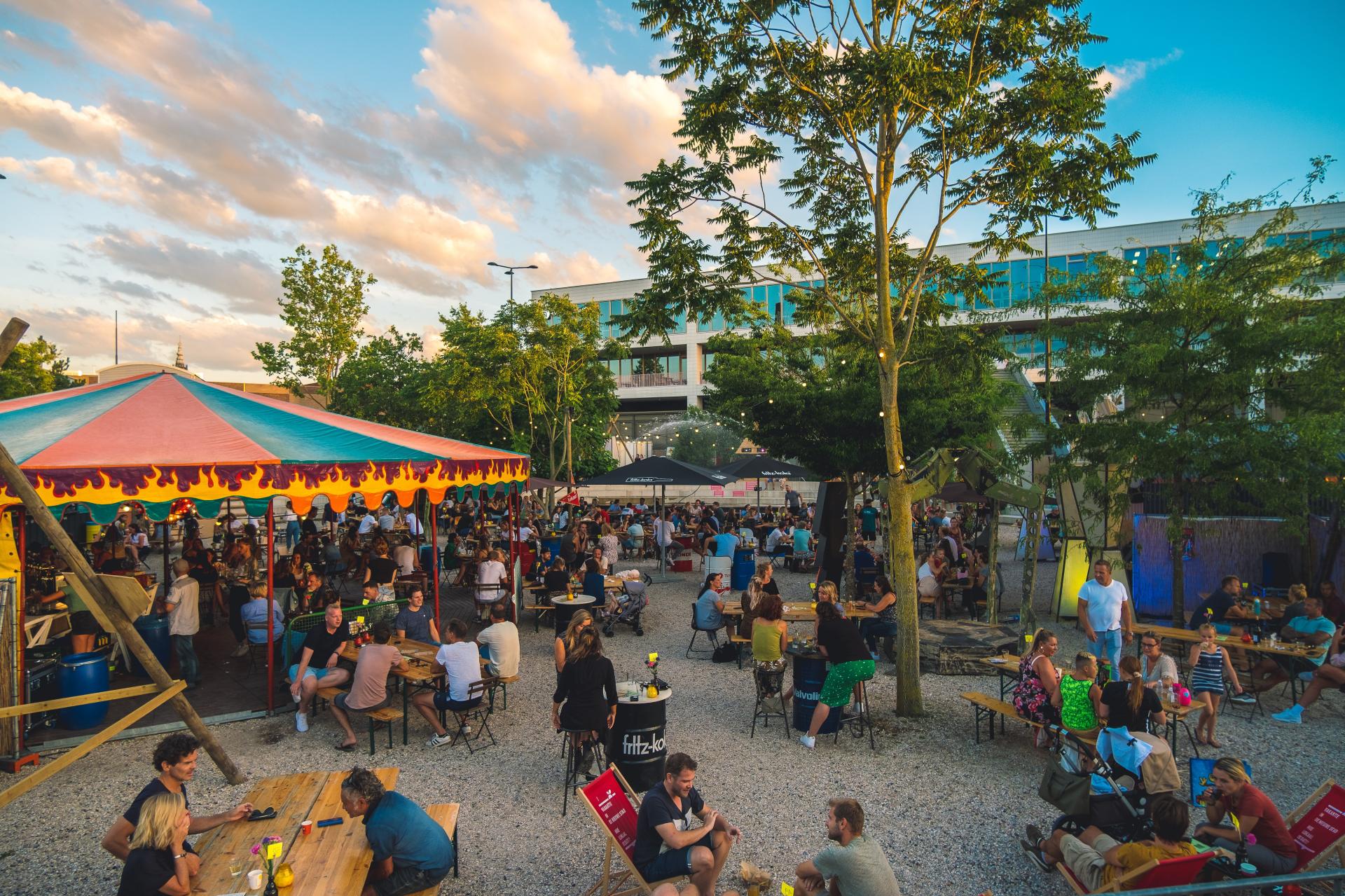
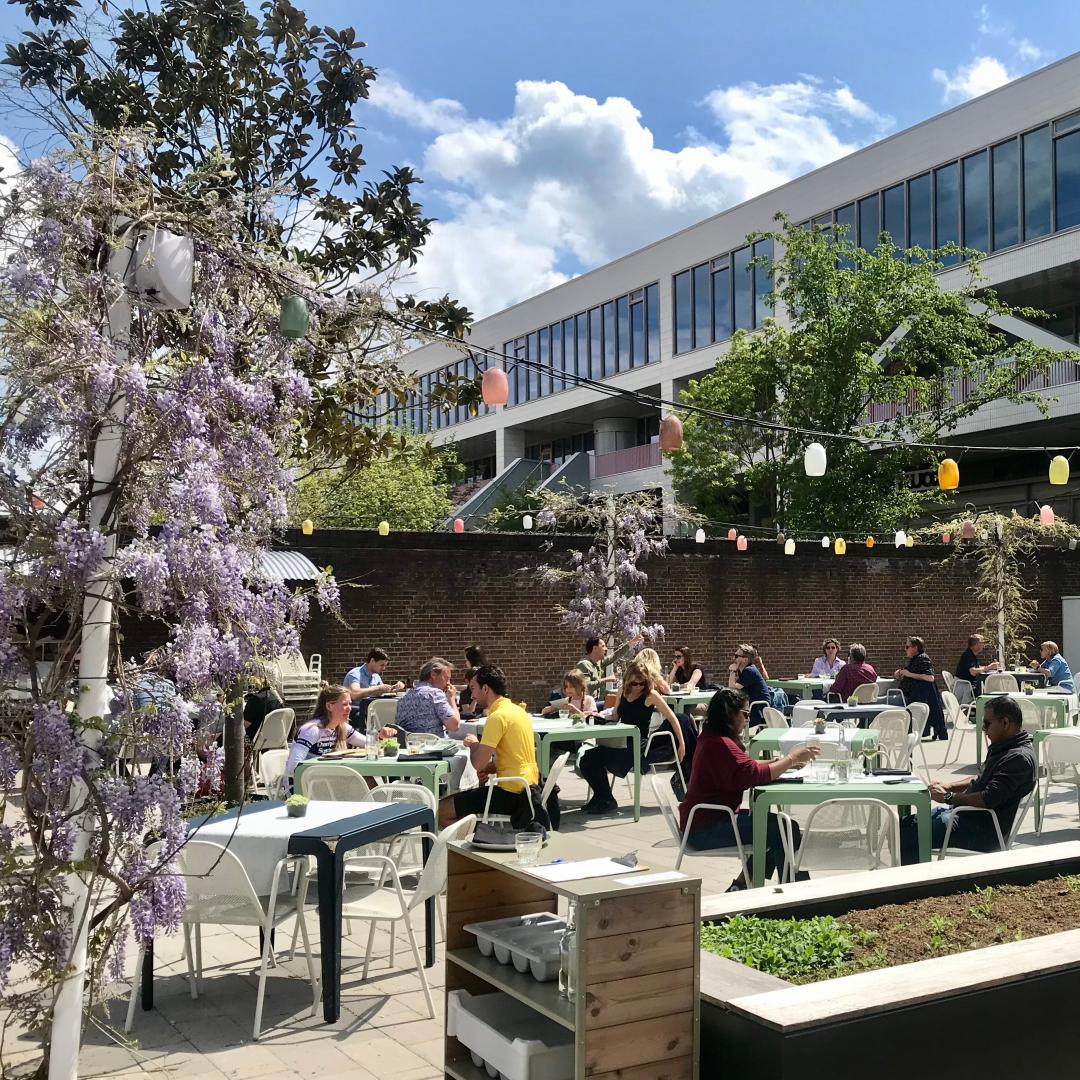
We enable those social connections by removing the physical barriers to them, e.g. by opening up a passage through a former storage shed in the wall between the old toothpaste factory and the parking lot, which also allowed us to reveal its original Polonceau trusses. But there are more factors contributing to this. The Hoog Vuur bar & restaurant was put in to act as a ‘living room’ for the entire area, but the site also boasts a wide street layout, and a multifunctional main square.
De Nieuwe Stad does the opposite of creating single-use buildings because they only make for more monofuctional communities. It’s mission is to connect anything and everyone, to boost the unexpected meeting and collaboration between businesses. The common denominator of the site’s facilities is its shared functions, an attorney will go and get his haircut from one of the pupils at the hairdressers academy, and even a large consulting firm like TwynstraGudde does not have its own restaurant, opting to make use of local bars and restaurants instead. This allows for interconnections to be made between different groups.This didn’t stayed unnoticed, as the project gained global notoriety when it made renowned German industry magazine, Domus, referencing De Nieuwe Stad as an example of inclusive development, juxtaposing Apple and Google’s closed campuses.
Rather than getting in other’s way, De Nieuwe Stad’s residents complement each other. And by remaining active on-site as a property developer and investor, we’re able to actively direct this process. This is what we’ll also be doing in the ‘The Next Face’ project, which will see housing added for all income levels as well as boast shared functions in its pu
Results in relation to category
There’s quite a bit of history to where De Nieuwe Stad is located. In 1832 it was an estate outside the fortified walls of Amersfoort and had been dubbed the Oliemolenkwartier [Eng: Oil Mill Quarter], for the oil mill which stood there from 1765 up to 1940. Its proximity to the Eem river later saw it serve as an industrial estate, an era which came to an end with the closing of the Prodent toothpaste factory in 2011. With such a long history, many generations have worked (and lived) in the area or the factory as such.
Adding new relevance to this area could only be done by engaging the residents, new interested parties and ideas within the area. This can only be brought about by continuously revisiting the reasons why we build a certain way and how we treat sustainability, inclusivity and diversity. By taking up an editorial role whilst keeping clear ambitions, we ensure to only allow new buildings and construction that yield quality.
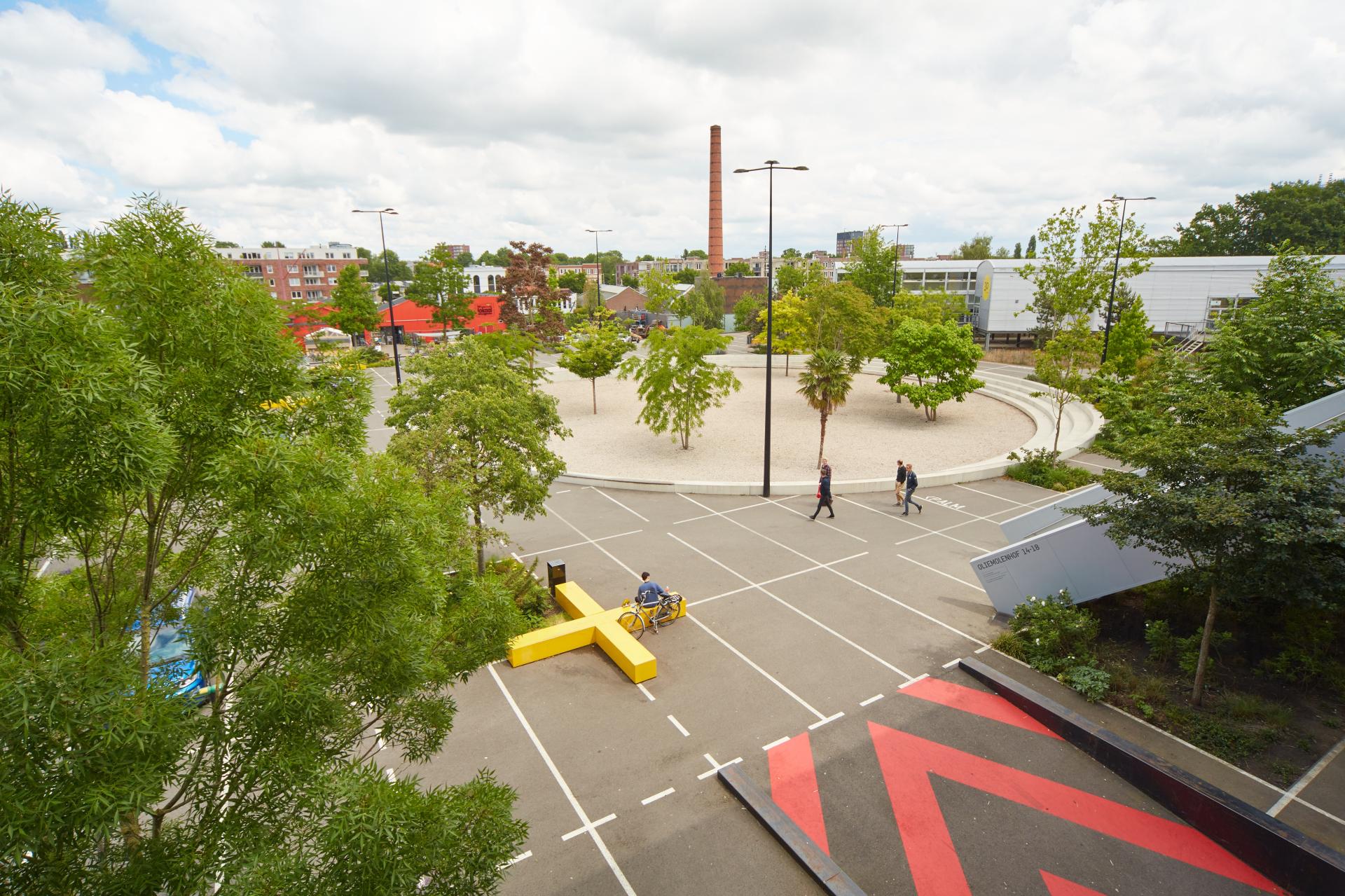
Additionally, we’ve also moved to take up the community management component and have full control of the public area. This allows you to go beyond making mere functional choices and opt to put in aesthetically sound bright yellow seating crosses instead of having to put in the mandatory council park benches. It also allows you to move at your own pace and experiment as you see fit as well as make all the mistakes that come with that. It’s a celebration of city making.
The area has since attracted a plethora of users and has consequently attracted a diverse crowd. It’s events function attracts anywhere from (young) music lovers to corporate conference visitors, and from cycling enthusiasts to culinary adepts. The project now crystallizes out as true European project. We teamed up with architects from the UK, Holland, Portugal, Norway, France and Belgium as we strive to realise the ambitions to connect young and old, history and contemporary.
How Citizens benefit
Looking at a site in its entirety doesn’t make its (re)development any easier. It tends to make the choices one has to make both bigger and more complex which ultimately adds pressure. We reached out to Rotterdam urban development architects, ZUS, to join us and Amersfoort council in drafting an dynamic urban planning ambition. This saw us arrive at a strategy not constructing a masterplan but defining several pillars and principles to warrant De Nieuwe Stad becoming a success from an urban planning, economical, and a cultural perspective; whatever the future may bring.
This strategy, a manifest, perhaps, containing our ambitions stipulated that the area was to become a city within a city, with its own rules and freedoms, a place that would be able to accommodate both temporary as well as permanent development projects – much like any regular city would.
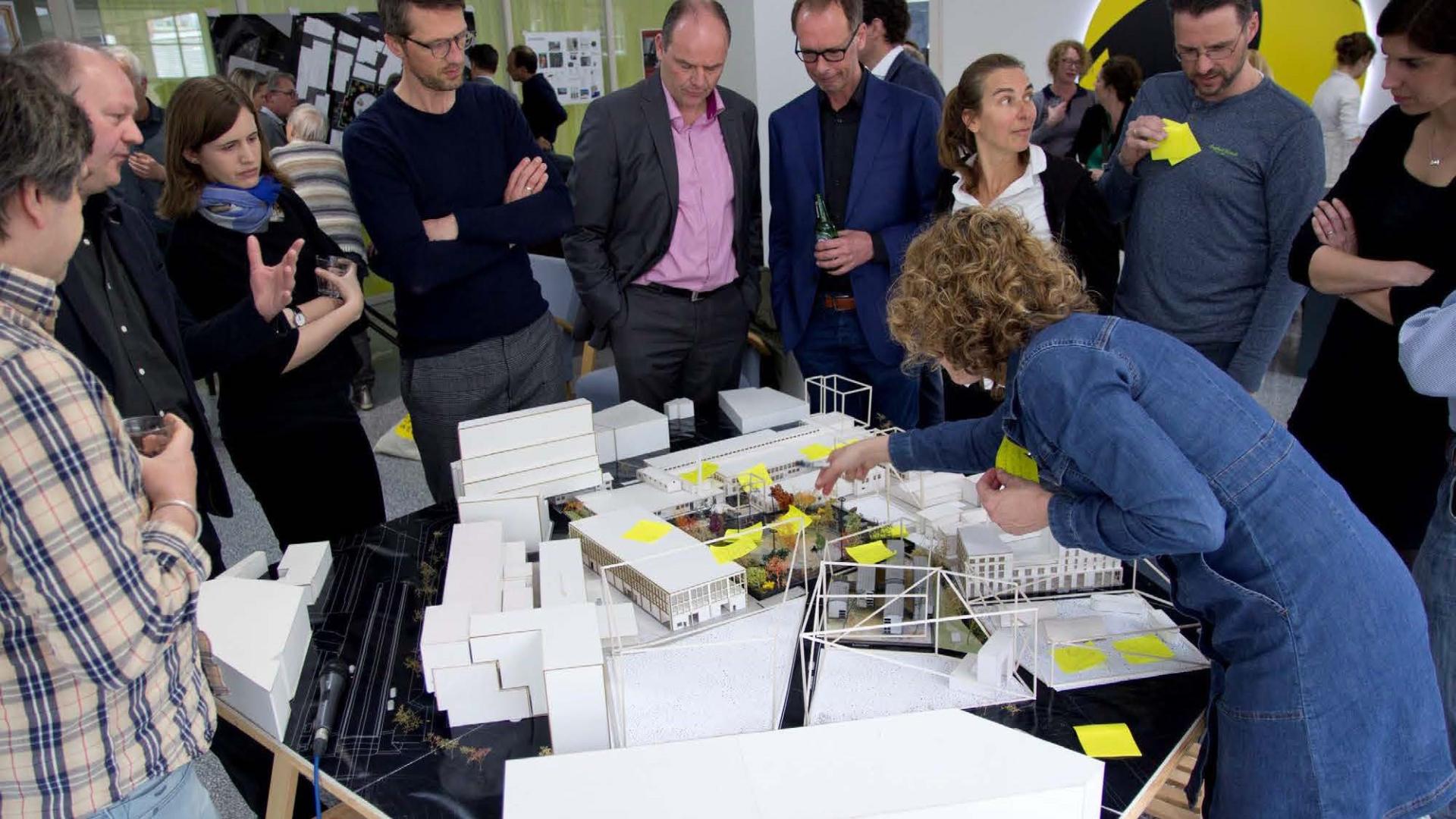
The collective interest – as well as those of the other land owners, the incumbent tenants and the city of Amersfoort as a whole - was to come first in all of those developments. The area’s users would be offered the chance to offer their input on the plan’s pillars and principles during what would become known as pizza sessions. The area’s residents, i.e. the people and the businesses it houses, would, and still do, make the area into what it is today.
One of the brainchilds of these sessions is the Oliemolenhof square. A thorough analysis of the area combined with user input saw it decided that the parking lot be transformed into a multifunctional arena boasting twenty car charging stations, which could, for example, also provide power to visiting food trucks. With no traffic lanes or other directional indicators, the square acts as a shared space for cyclists, pedestrians and vehicles. This has deregulated this public space in a rather pleasant way, and in doing so, it has come to symbolise the idea behind De Nieuwe Stad: coordination and collaboration.
Innovative character
Every item would be met with the same question: “Do we really need to do it that way?” “Why house a school in one single building and not spread across various locations? Why does office space need to be stacked into the heavens? Why not go bungalow style?” It’s questions like these that are the catalyst to innovation. It’s made De Nieuwe Stad the perfect place for experimenting with the urban development principles of the future. And it has also taught us that no progress can also constitute progress, as one of the manufacturing halls we couldn’t find a purpose for and which had been left abandoned has since found one as an events venue, hosting the presentation of the newest model of Seat and the country’s most sustainable bank’s Annual General Meeting.
Not taking the building itself as the starting point for our thinking process, De Nieuwe Stad encourages us to dare to think along themes. One of those is how mobility is changing and this has seen us take a flexible approach to the number of parking spaces the site would have to accommodate, i.e. not adhering to a set norm, but rather carefully monitoring how many are really needed. And the design of the new parking garage we’ll be putting in to accompany the newly-planned housing already allows for decks to quickly be transformed into housing units, should they prove needed.
There’s a ton of experimenting going on at De Nieuwe Stad on some of the latest clever technological solution, e.g. a car charging square and a power grid loop. We also employ an innovative take on how our properties are used. Our tenant TwynstraGudde, for example, rents more workstations and conference rooms on Friday, their busiest day, than they do the rest of the week, when they simply book any extra ones as and when needed. This in turn also allows us to open up any remaining office space to flexible third-party users. A solution as efficient as it is sustainable. In continuously reinventing itself De Nieuwe Stad is gaining identity.