Fluke
Basic information
Project Title
Full project title
Category
Project Description
Fluke is a student project that asks the question: what if there were more fun, inclusive ,and playful ways to participate within the building of our cities? By incorporating a playful participatory placemaking process, we test out novel approaches to co-creation of public space in practice using more playful tactics. To us, the days of sitting in long and boring urban planning meetings by municipalities must change if our communities are to because we imagine a world where work can be play!
Project Region
EU Programme or fund
Description of the project
Summary
Fluke (adjective): An unlikely chance occurrence, especially a surprising piece of luck.
Fluke is a project born between two students who, by a fluke, decided to populate a similar surface of the earth, at a similar point in time; Nicole to study Integrated Product Design and Tatiana to study Sustainable Urban Planning in Stockholm, Sweden. With Tatiana interested in co-created public spaces and Nicole in co-design processes, we created Fluke as a way to put all the critical theories we learned in university and were eager the test in our masters thesis.
Fluke aims to give space for community places to grow, for and by the communities. Inspired by Creative Europe Trust in Play Initiative, we formed Fluke in order to explore how play, co-creation, and digital tools can come together to nourish a community and give resources to it during a turning point in modern history. We incorporate the right mix of temporary urbanist interventions, open-source urbanism, and participatory ways of operating to give everyone the chance to participate in the building of our community. Using an approach based on co-creation, we hoped to make tools and practices that transferred the creative power to citizens, and engaged them in different ways than they were used to — what better way to do this than play?
In a fluke occurrence, we met one of the founders of Blivande, where they showed us a new digital tool developed for their participatory and decentralized community, the Plato platform. The platform looked exactly what we were looking for so we did what we knew best— testing it out in our own community. Using our community of Lappis as a starting point, the largest student housing accommodation in all of Sweden where over 2,500 diverse and multicultural students and families live, we are exploring how we can use both physical and digital spaces to encourage positive exchanges of ideas, conversation, synergies, and yes, even disagreements.
Key objectives for sustainability
Fluke explores how co-design and decentralizing decision-making processes at the community scale can enable local solutions to global problems. For many citizens looking to make an impact in their city, the scale that much of urban development happens on leaves little avenue for participation— or let’s face it… is plain boring.
By working with those at Blivande to test out their newly developed Plato tool, we are exploring the possibilities of decentralization, self-sufficiency, and co-creation at the community scale. Local solutions start with an engaged and empowered community, and Fluke’s interdisciplinary approach looks to use play as a mechanism to enable more fruitful discussion and cooperation, at the same time as building the feeling of community belonging and increased agency over the communal spaces.
Fluke likes to operate using mostly found objects, using the plentiful trash rooms in our student accommodation to our advantage to build our pop-up interventions. The trash of other Lappis residents become our treasures as we look to subvert and recreate new functions for spaces— you could say cardboard has become a staple in our work. If we can’t find what we need to make our interventions reality, we use many of the shared and communal spaces already present within Lappis, like community workshop or the Kostnix, the non-commercial ‘free’ store located in Lappis.
We want to kick-start a cultural shift from a consumption-based society towards a culture where we work together to produce places for people to meet, to be social, and co-create together. The context we live in is prime for co-creation— bachelors, masters, and even PhD students from all over the world come to study and live in Sweden to learn how to incorporate sustainability into their mindsets. Overall, Fluke looks to create a space for co-creation by enabling people the opportunity to meet, to learn from one another, and give them the tools to make their dreams for their community a reality.
Key objectives for aesthetics and quality
By utilizing concepts of iteration, prototyping and trigger materials from product design into the world of urban planning, Fluke incorporates experimentation to explore how people actually want to engage. In the design of the Fluke process, a common visual and verbal language has been developed to help facilitate communication with residents. By making use of easy-to-access materials and an informal language, this innovative approach looks to make engagement of all kinds a norm within the planning process. Our primary focus at the moment is to use wood as a later-stage building material, which can be easily manipulated and aesthetically changed through paint to fit its context and purpose. On top of this, being physically present in public space allows us to delve into co-creation activities alongside residents. This has proven to effectively allow people to get involved in the project and understand the context in which it is being developed.
We believe that people should have the power to transform both the aesthetics of space, along with the functions and meanings attributed to them. For this reason this project goes against the more traditional urban planning and design approaches, focusing instead on giving full creative power to residents through tools that we have handcrafted to fit the context in which they are used, allowing residents to reimagine and reinvent places at their own desires. Fluke's intention is to make participation feel comfortable and open to anyone by applying a clear and approachable language, material elements that are familiar, and community-building activities.
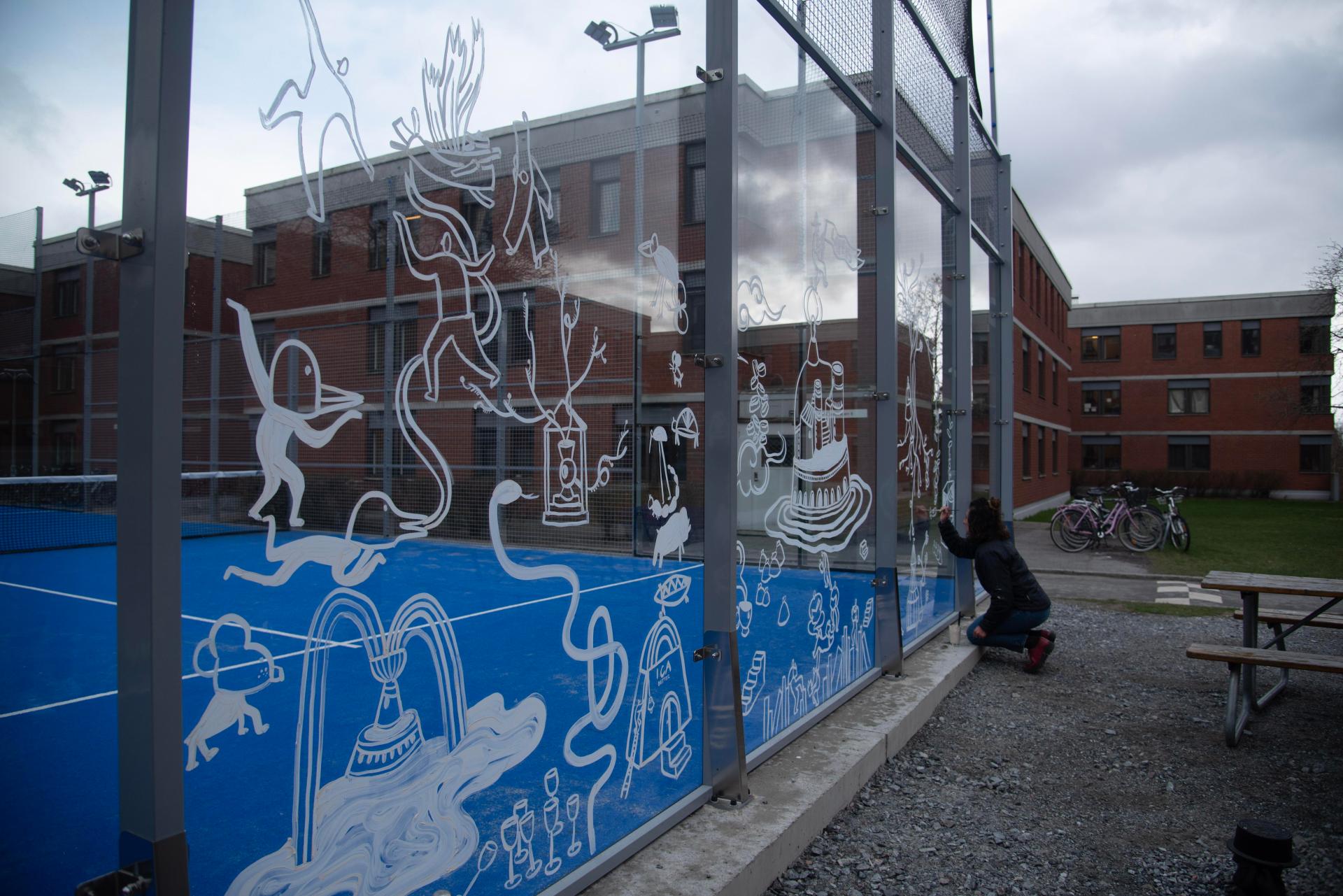
To help bridge our work with both technology and art, we have been collaborating with different artists to allow the collective inputs and findings to be expressed in different manners. In a project titled In memoriam/In futurum, we are co-creating a zine for the “Experimental Field”, an ongoing exhibition at Accelerator, an art gallery in Stockholm.
Key objectives for inclusion
Fluke looks to bring all types of people into the placemaking process, by creating different grammars that residents are able to participate and co-create in a way they feel at home. Since February 2021, we have engaged with this way of thinking to have over 250 members of the community participate throughout different stages. We believe building trust with the community is one of the most important aspects in community building and play, so all of our efforts have incorporated pop-up and interventions in public space at the street level.
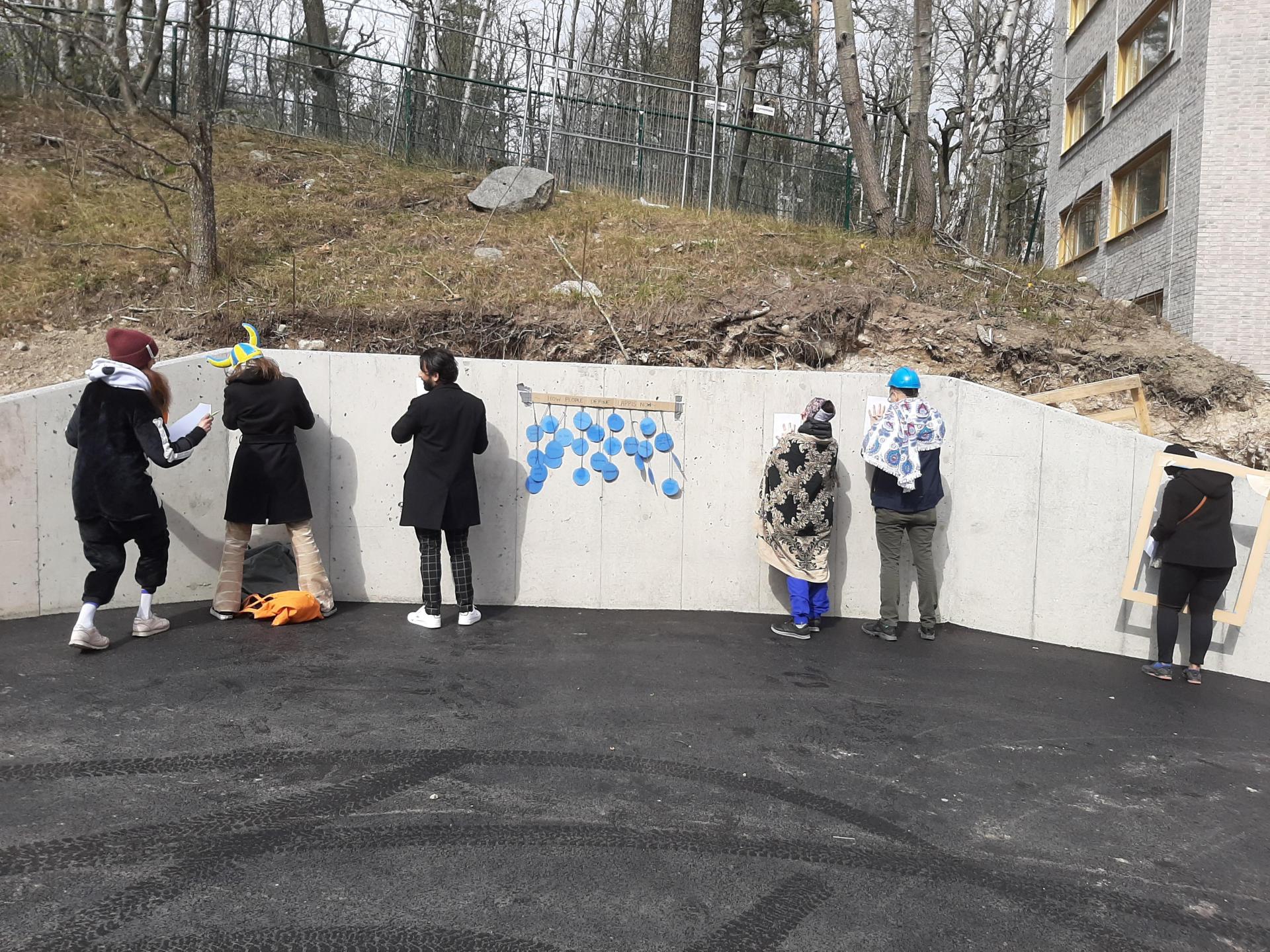
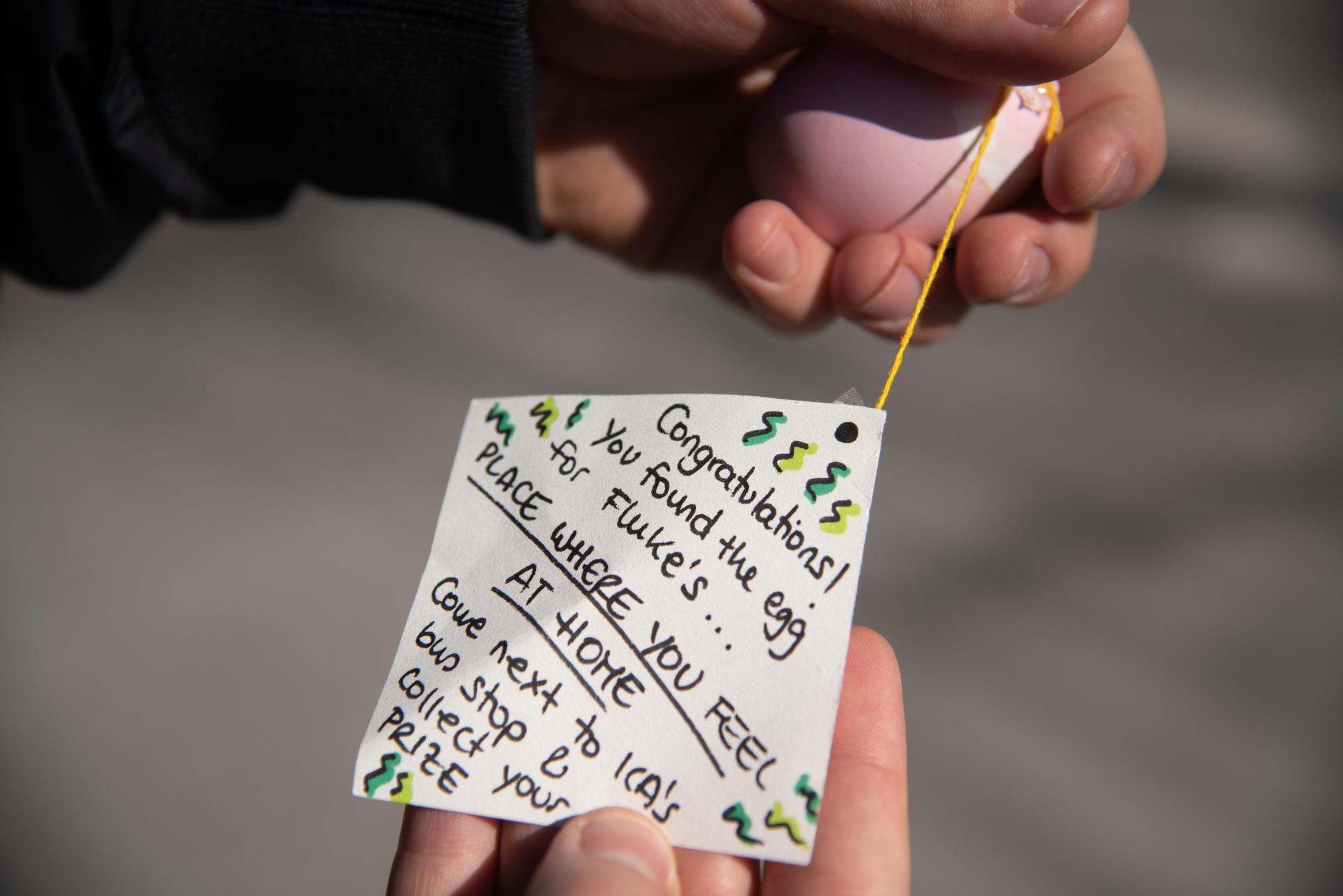
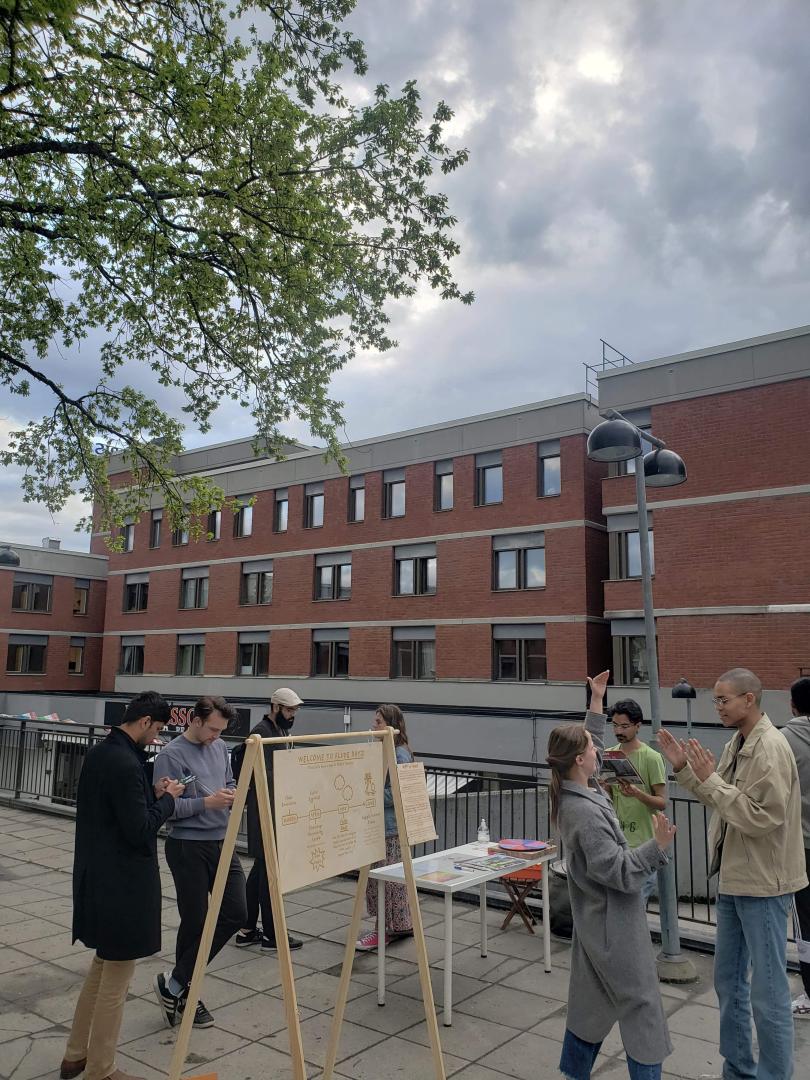
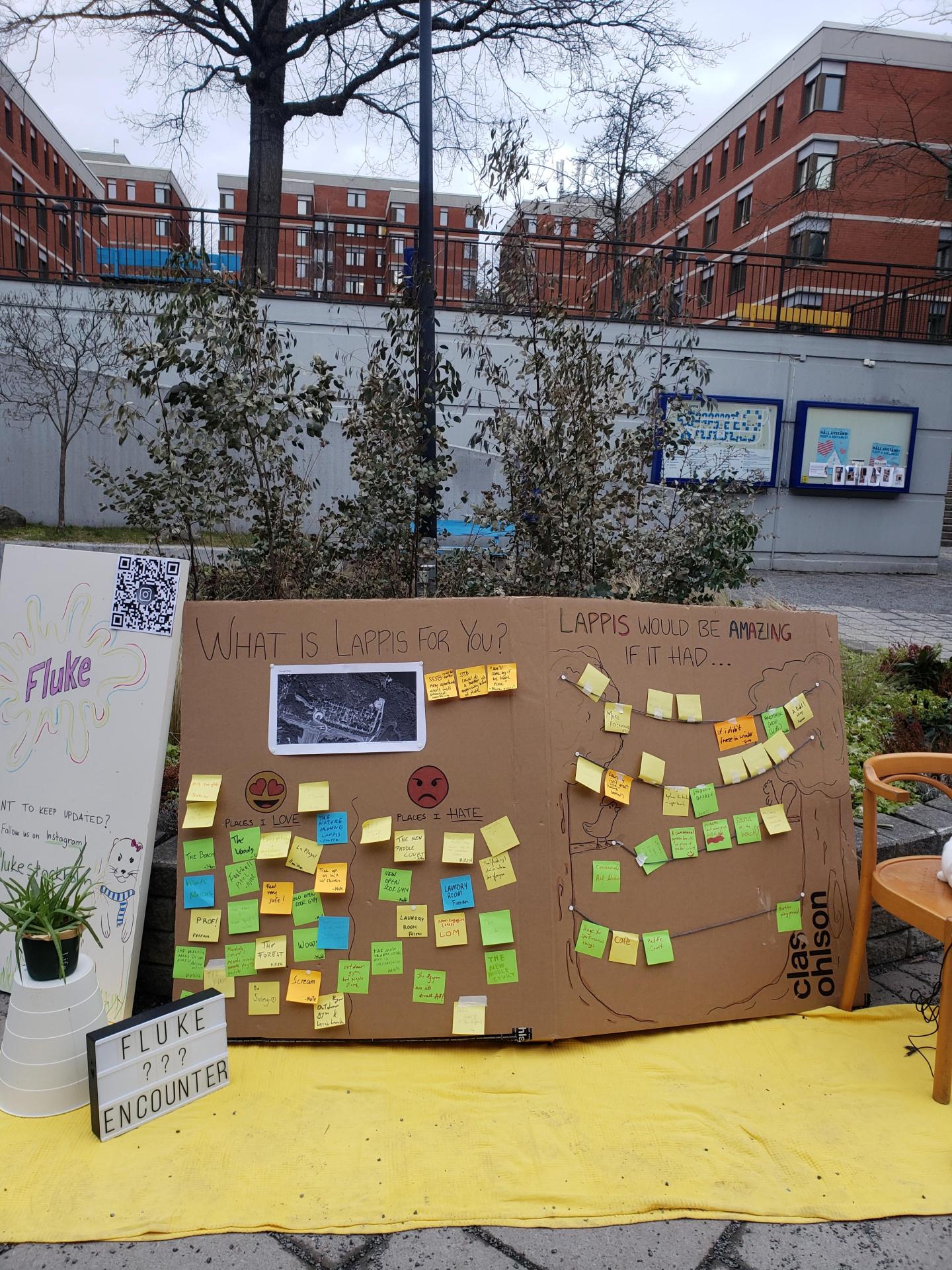
Through our placemaking process, we first started by engaging stakeholders with our weekly and random ‘Fluke Encounters’. Here, we brought some carpets, plants, cardboard, and sticky notes to the center square, where we asked a variety of questions about the residents, their conception of community, and their thoughts about Lappis. From here, we developed a fun and playful place analysis using an Easter Egg Hunt using a digital map.
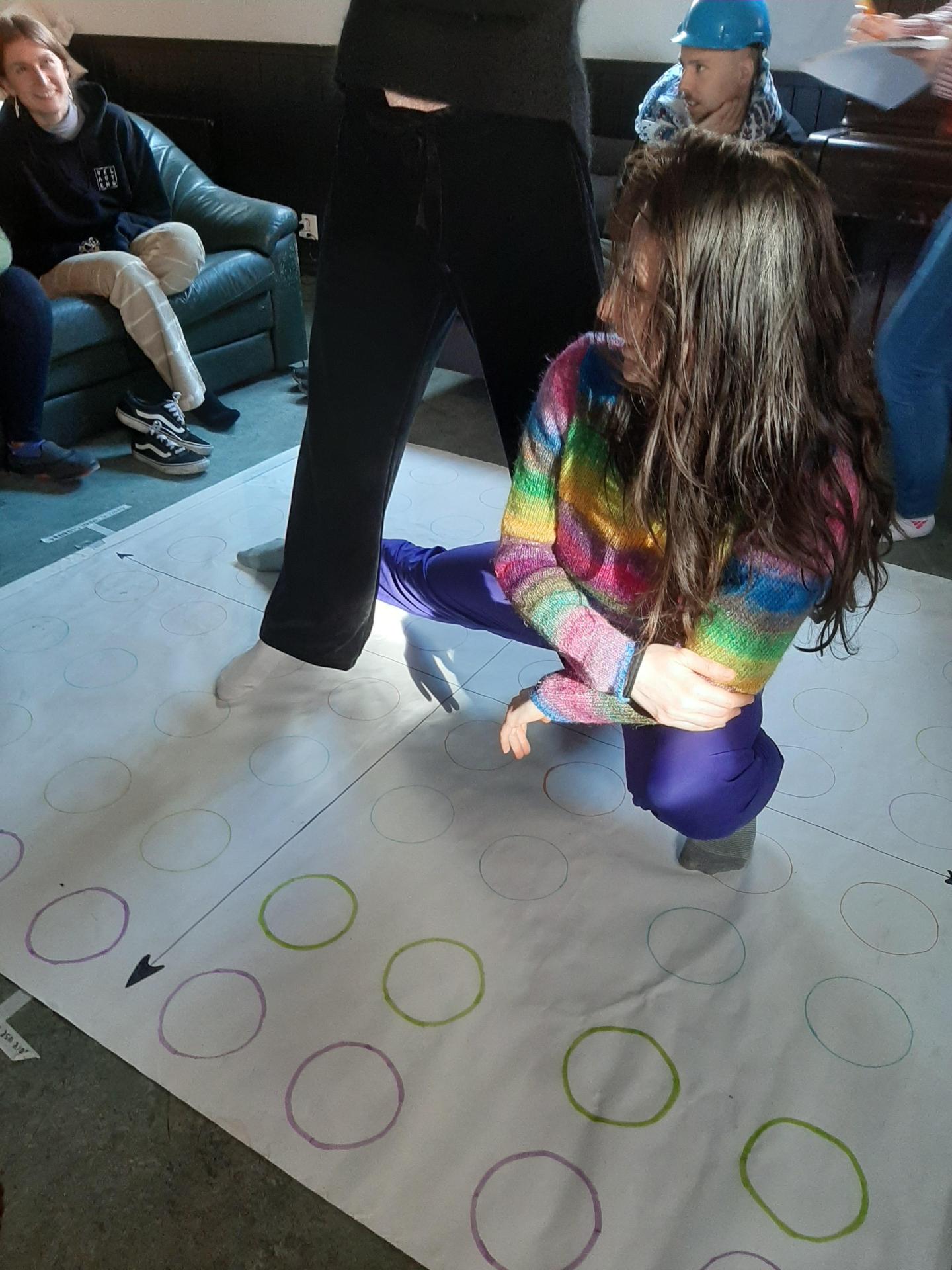
Next, we held a co-creation Flukeshop, a playful workshop where 6 different Lappis residents came together to co-create a vision for Lappis. Here, we used a play-walk to visit some of places from the Egg Hunt, ‘find’ information from the Fluke Encounters, and play together to imagine what a better Lappis could look like! Lastly, we held our Fluke Dayz encounter where anyone could come, spin the space wheel, and go reimagine these spaces. We currently have over 30 different submissions from groups of residents on the Plato platform, and now are collectively funding the dreams we want to turn into reality.
The approach we have taken has also been affordable (to say the least). Using the trash and recycling rooms for most of our materials, we argue that placemaking doesn’t need to be flashy or expensive— it just needs people and a strong mission to create better spaces. We believe that by taking such an affordable route, any community organizers can use a similar approach to co-create!
Innovative character
As a society, we’ve mixed up the idea that community development must be all work, and no play. Fluke looks to bring innovation to placemaking by interweaving play into the placemaking process and make it easy for all types of people to participate in the development of our public spaces.. The world of urban game design is exploding, but we believe these games need to be connected to larger processes so residents and participants can see changes happen within their communities. We incorporate this thinking through the lens of product design and urban theory, picking and choosing concepts from each which best suit our context.
Fluke is looking to innovate on all fronts of the placemaking process, by exploring news concepts and tools that work in practice at every step of the process— from engagement, place analysis, visioning, and prototyping. We hope that play of all types can help foster participation in co-creating places for the community, through all levels of the ladder of participation. Not everyone wants to participate in the same manner, and that’s okay. Fluke innovates how urban planners and community activists ask residents to participate and co-create together.
In addition, through the project Fluke has established a collaboration with Blivande - a creative hub in Stockholm - for whom we’ve been testing out their newly developed participatory tool called Plato (PLAcemaking + TOol). Plato is a digital tool that allows democratic decision-making, and Fluke has incorporated it to assist in this transformational process at the neighborhood level, using it in the final stages of the process to gather ideas from residents on reinventions of spaces, to afterwards democratically decide which ones to materialize.