Building upon fragility
Basic information
Project Title
Full project title
Category
Project Description
This project critically engages Porto di Mare, an urban border of Milan, characterized by phenomena of social and environmental fragility, e.g. social segregation, disused infrastructure, unauthorized buildings, and soil pollution. In this scenario, emerges the circular economy concept, a sustainable design instrument, with a focus on how architecture can answer climate change issues and develop a sustainable circular and social approach to rethink the fragile areas within the urban scenario.
Project Region
EU Programme or fund
Description of the project
Summary
This project aims to propose a possible re-definition of the urban border starting from the need of the municipality to regenerate the peri-urban areas in the city. These areas are often characterized by marginalization combined with diffused phenomena of fragility. This research is focused on the proposal of a specific and site-located intervention, which can be adapted and displayed as a framework for future development within other similar areas. In this sense, the architectural project can be thought of as a resilient project, conceived not only of responding to the current needs of the place and the city but also of configuring itself as an adaptive framework, capable of facing climate, environmental, economic and social changes.
Starting from a first phase of analysis, focused on morpho-typological aspects and parallelly on-site surveys, we had the opportunity to interact with the local community through interviews to understand some dynamics in a more structured way. In addition, some associations, already active in the local area, were contacted to start establishing a fruitful dialogue concerning future project proposals.
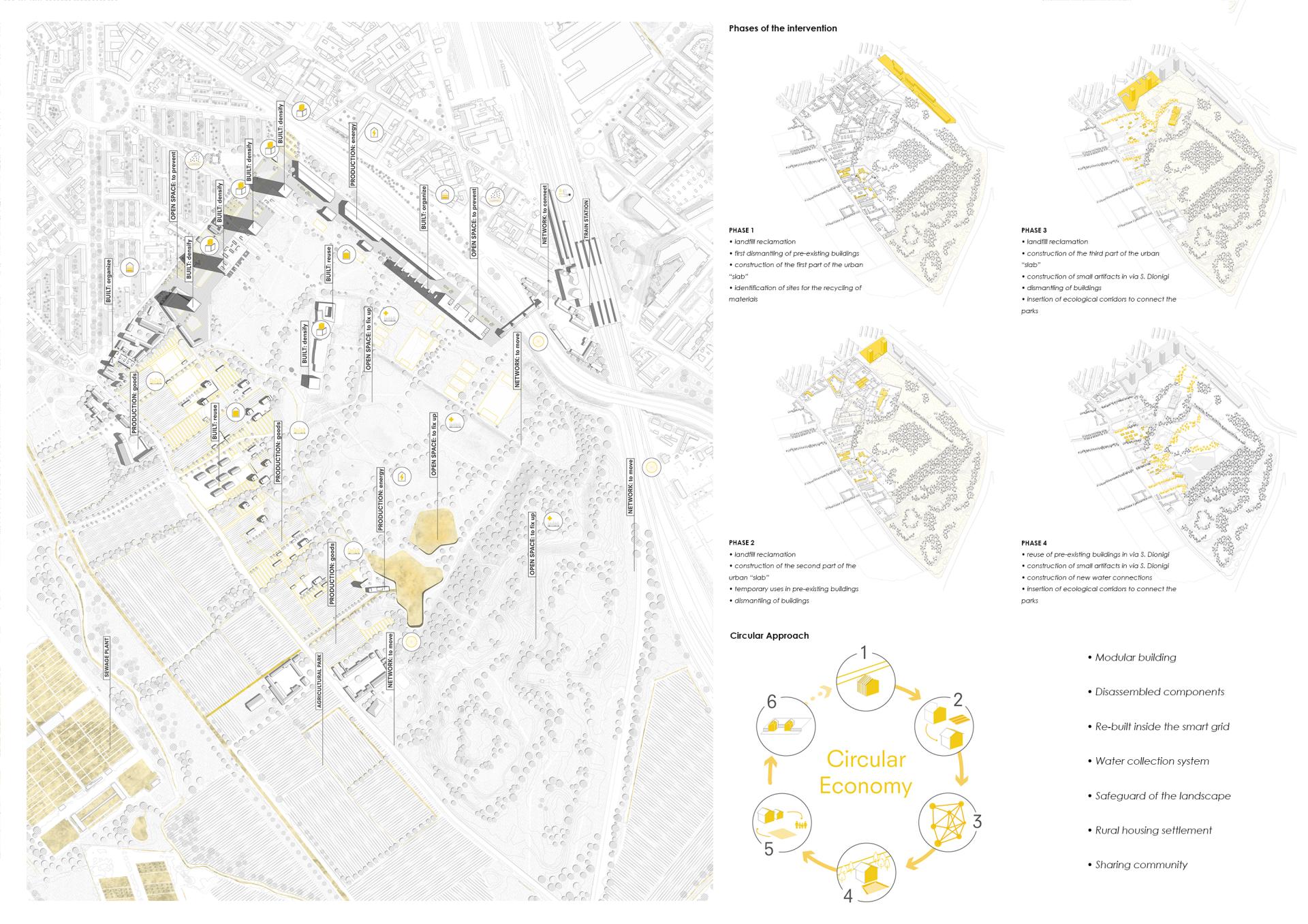
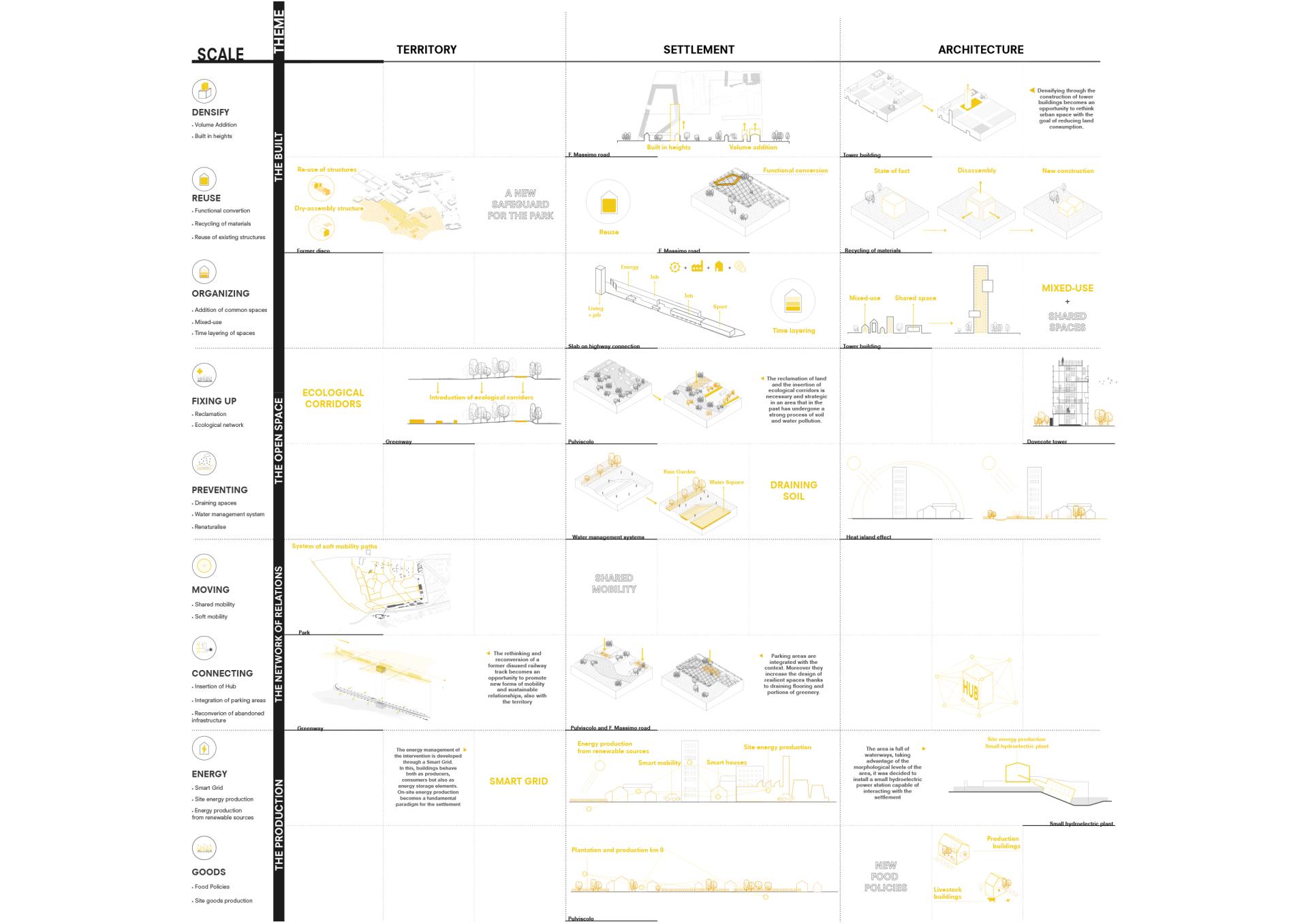
We revised the "Ciam grid", intersecting the scales of intervention with the topics of the city of the future. It aims to define a set of operations concerning social and environmental resilience, following circular economy paradigms: reduce, reuse, recycle. These are assumed as fundamentals for the definition of the masterplan, developed through temporal phases.
The urban design strategy collects design actions, displayed through some design focus, aimed at a sustainable growth, reducing soil consumption and converting previously used land in public spaces for social cohesion.
In conclusion, the analyzed project focused on the questions of how architecture can answer climate change issues, and how a sustainable circular approach can be developed to rethink the fragile areas within the urban scenario.
Key objectives for sustainability
The project looks towards a deeper meaning in developing a controlled process capable of responding to the urgent issues we are facing. Among others emerge the environmental, climatic, social and economic crisis, in which ‘sustainability’ is not seen as a result but as the processes associated with it.
Specifically, a key driver in this perspective can be the circular point of view. The concept of circularity, indeed, has its most profound meaning in the question of time. Precisely how a product can be reused in future development even applied to the product's waste. The strategy is developed through temporal steps, starting from the reclamation of the soil, followed by the identification of buildings that can be reused, and finally becoming a local productive area for slow food associations, until the identification of future implementation.
The matrix that we have developed by intersecting scales (Territory, Settlement, Architecture) with the themes related to the city of the future (built environment, mobility, open spaces, production), is configured as a cornerstone of sustainable thinking within the project. We have researched the possible interrelationships between environmental, social and economic sustainability within the area's design process.
The themes are:
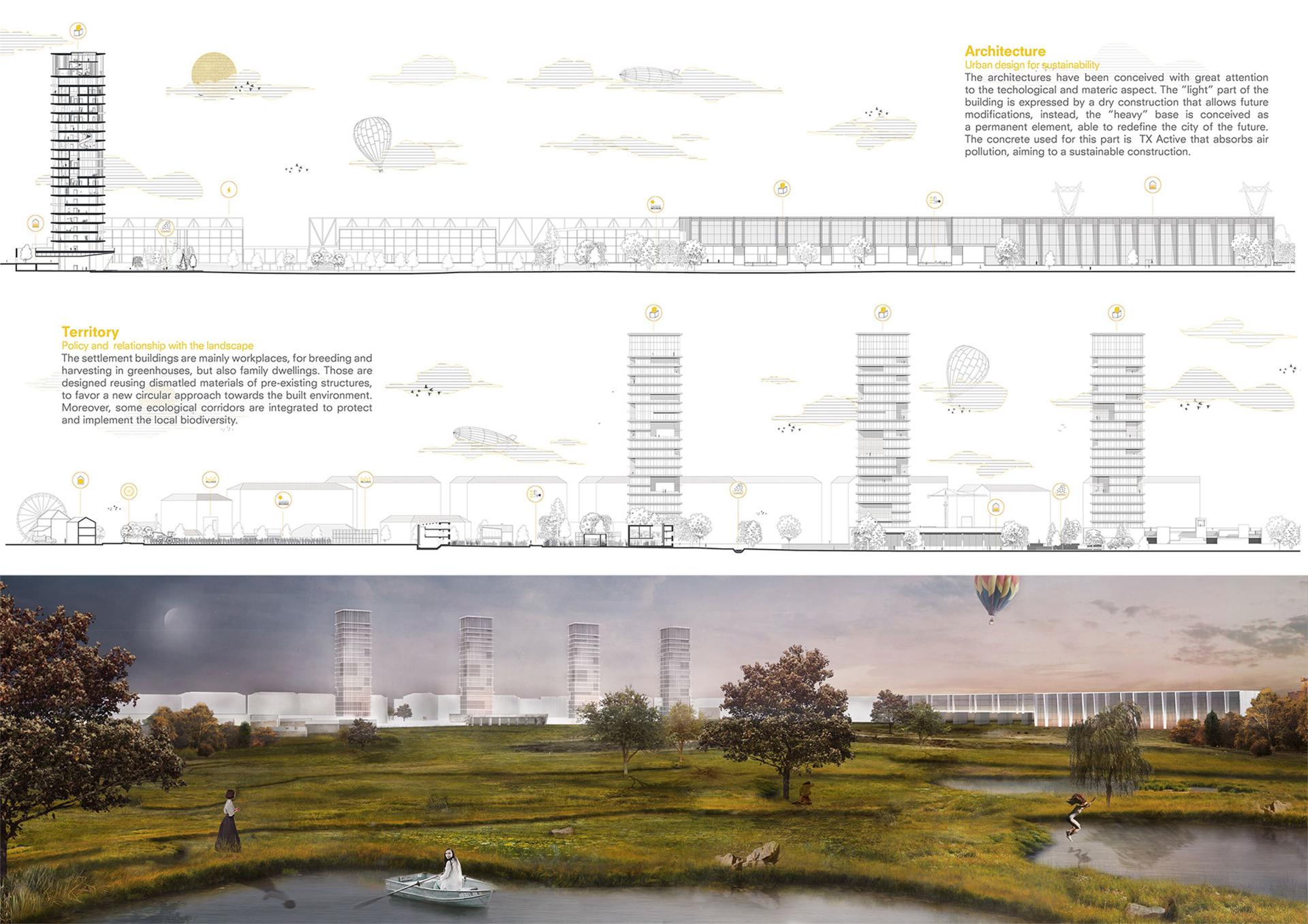
•The reduction of soil consumption: the settlement buildings are designed reusing dismantled materials of pre-existing structures/adaptive reuse of buildings for new purposes.
•The architectural and technological aspects should allow further modification within the project i.e. dry construction.
•The reconversion of an abandoned railway into a greenway interacts with the territory, defining a new relation between citizens and landscape.
•Architectural declination of the new food policies in a periurban scenario.
•The local and sustainable production intersecting both the physical and the social dimension.
•The protection and implementation of biodiversity and the reclamation of polluted soil.
Key objectives for aesthetics and quality
The aesthetic and experiential aspect played a significant role in spatial design. We proposed a regenerative process that improves housing standards and the quality of public spaces. Still, we wanted to give new meaning and re-weave a series of socio-spatial relationships between inhabitants and context through architecture.
In this sense, the central elements of the design were light-matter and water (in the past, Porto di Mare was intended to become a large harbour for Milan). We designed the buildings by identifying some hard cores made out of concrete, which define more intimate spaces. Here, light and matter play a crucial role in creating reflective spaces, "rooted" to the ground and the context. In contrast to this heavy base, we have designed lighter structures on the upper levels, where dry construction techniques suggest a reversibility logic and the possible recycling and reuse of materials. We, therefore, opted for hybrid technology, in which the base, heavy and fixed, counteracted a light and removable portion that dialogues more with the element of the light and the air, creating a strong visual relation with the landscape and nature.
One main factor addressed this choice: "What is the city of the future we want to build?". In this sense, the idea of designing buildings that can be wholly dismantled represents an ephemeral idea of architecture, which opposes the authors' view where architecture can still build new solid parts of the city, with the concept of stratification and rooting.
Key objectives for inclusion
The issue of social inclusion was crucial in planning the regeneration of this area. There are severe phenomena of social degradation, marginalization, illegality, which strongly influence the management and way of living of these spaces. The project, therefore, investigates the notion of social resilience by examining multiple aspects. The first is the concept of the rooting of a community to the context. In this sense, the goal is to build a self-reliant community, which can take care of the site again, restoring a sense of identity and contributing to reducing the current degradation. This first point was developed through inclusive planning of the local community, starting from their needs and their possible involvement in implementing some portions of the project and production initiatives. We hypothesized some local production chains, starting from the notions of circular economy, through the recovery of materials and their reuse.
The second theme is that of the development of mixed-use buildings. This is fundamental for bringing social benefits and resilience. The challenge was to understand and hypothesise which possible uses of the spaces could occur during the whole day to make this neighbourhood attractive and active, avoiding the unwanted effect of a new dormitory area. Work, housing, local production, and sharing spaces were hypothesised, looking towards the site's future development with the Milan-Cortina 2026 Olympics.
Innovative character
The innovative aspect of this project is the construction of an intervention matrix interweaving the scales of the project (Territory, Settlement, Architecture) and the themes related to the circular economy, resilience and sustainable development (Built environment, mobility, open spaces, production). The potential of the grid is to display a possible inter-scalar logic of operations, repeatable in similar contexts.
The "Territory" deals with the regeneration of a disused railway through the reactivation of a local network. This linear system interacts with the territory by connecting with some relevant nodes, converging on Rogoredo station, a new hub between the urban and the rural, crucial for the future city. This intervention defines a new relationship between citizens and landscape, preserving it while giving new value through the integration of ecological corridors and the promotion of biodiversity.
The "Settlement" declines urban design with the new food policies. In relationship with food processing and advertising, the local production chain becomes a vital factor in reactivating the city's metabolism. These food policies are integrated with the project to face the current food emergency. The strategy is declined through temporal phases starting from the reclamation of the land, followed by identifying buildings that could be reused and areas to stock recycled materials derived from the selective demolition; the aim is to define a sustainable ecosystemic intervention.
The "Architecture" deals with two different projects assuming the paradigms of resilience and circular economy, considered a chance to redefine sustainable growth. Resilience is intended in its social connotation by creating shared spaces and public spaces for social cohesion.
In conclusion, the three scales analyzed focus on how architecture can answer climate change issues and develop a sustainable circular approach to rethink fragile areas.