Playing to hide a school in the nature
Basic information
Project Title
Full project title
Category
Project Description
Imagine Montessori School is a reference eco-school internationally renowned for its ability to amalgamate its Montessori pedagogy from 1 to 18 years with its sustainability approach and entrepreneurship spirit as its dorsal spine.
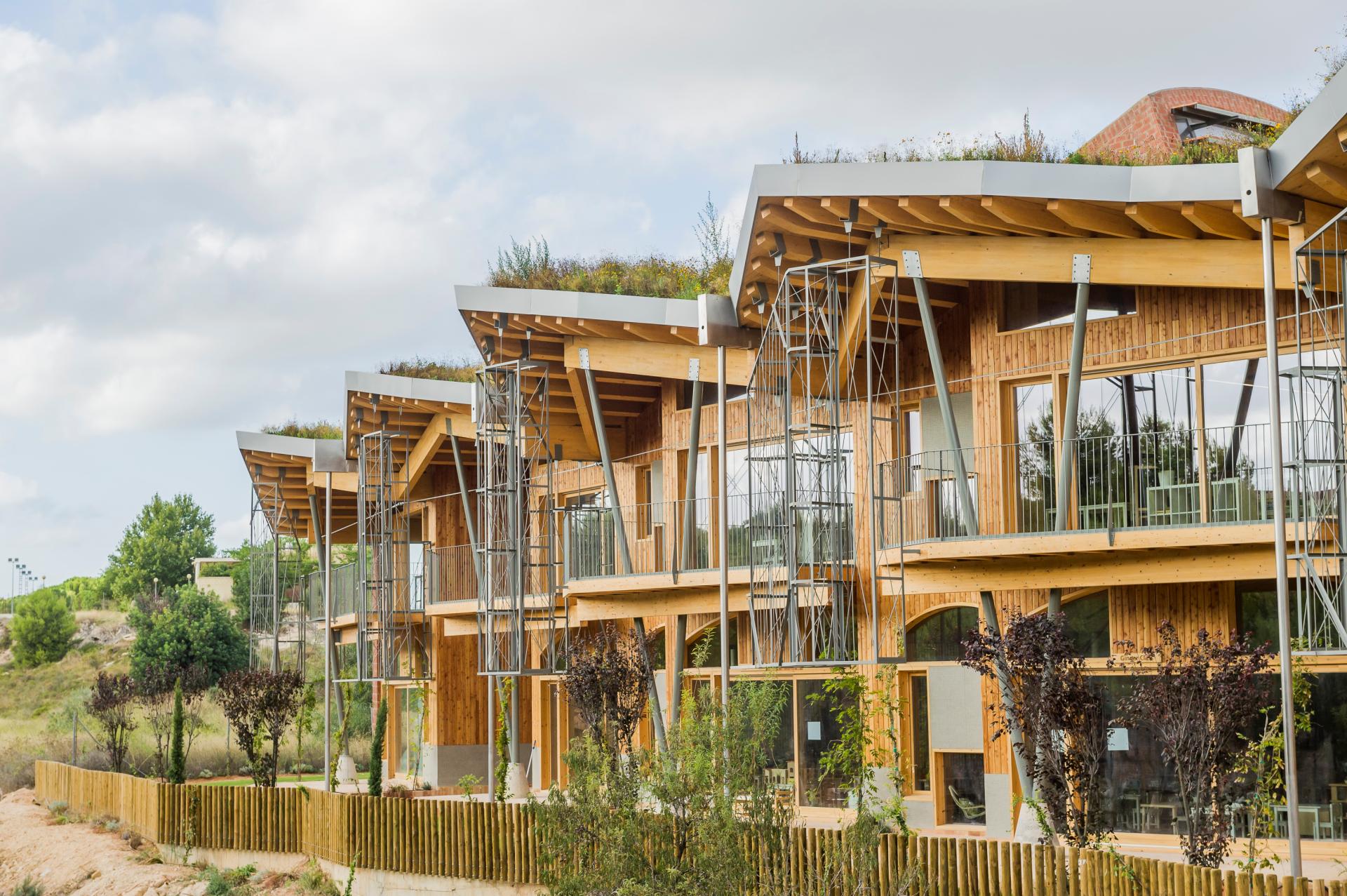
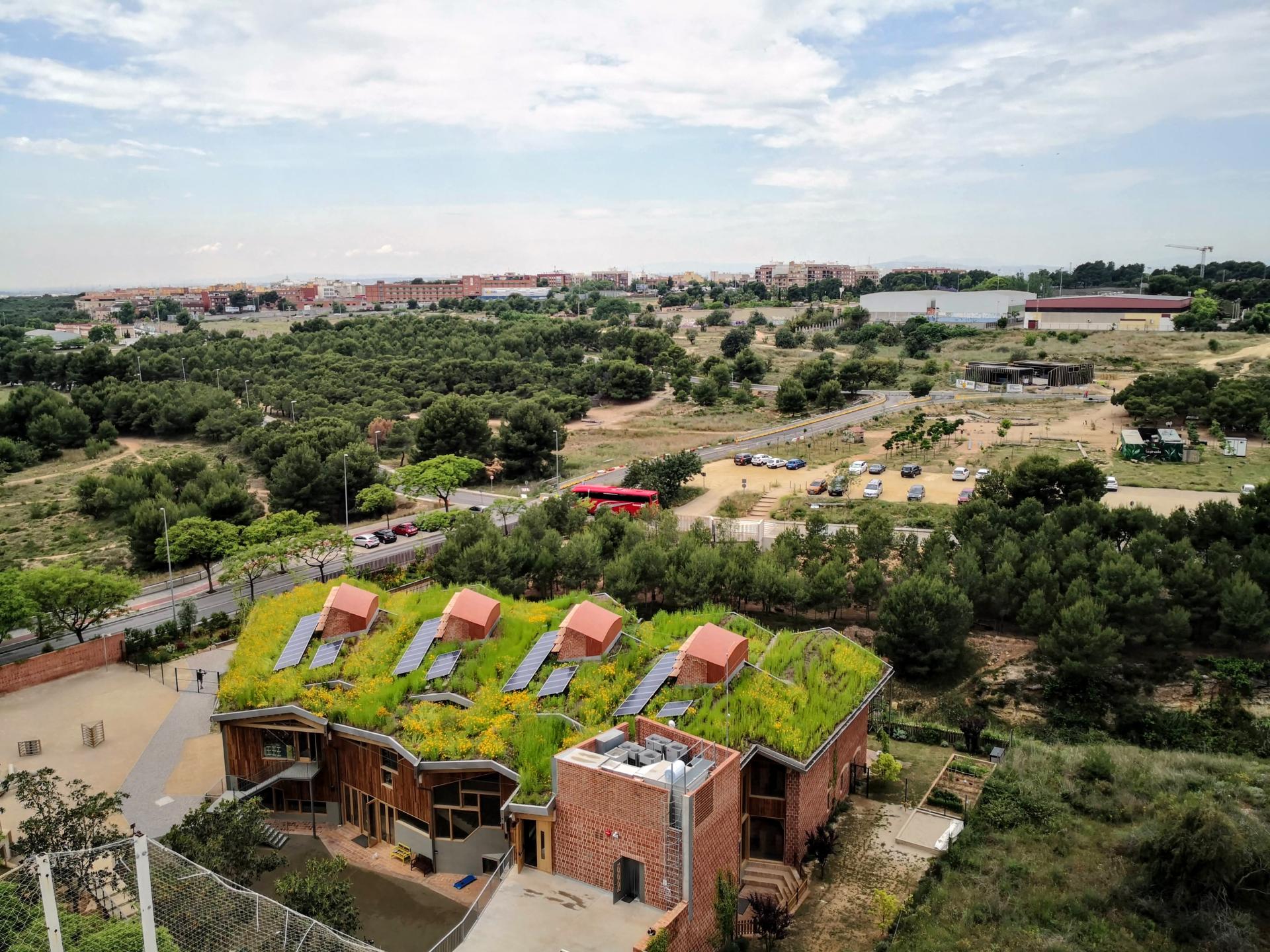
The design blurs the limits of the school, integrating indoor and outdoor areas, mixing green roof with the land around, creating an ecosystem around promoting local biodiversity, creating spaces for children and families to share time and experiences.
Project Region
EU Programme or fund
Description of the project
Summary
According to the report by Schools for Health, the school building affects the health and performance of the student. By the time a student graduates from school, they will have spent more than 15,000 hours there, second only to the home in terms of time spent indoors.
With this in mind, we have created an environment in which the ideal conditions are created to benefit the students well-being while contributing to their cognitive, physiological, social and emotional development.
Imagine is the first all-through school in the European Union to achieve a double sustainability certification (Breeam Excellent and Green four leaves). These guarantee that the design, construction and daily use of the building is carried out under the most demanding sustainability criteria, reducing energy consumption by 45% compared to a conventional building of similar use. It also recognises a 21% reduction in water consumption and a 47% reduction in CO2 emissions (equivalent to the annual CO2 absorption by a forest of 150 trees), improving the air quality and wellness of the building.
Imagine is located in a beautiful and virgin landscape of more than +1,000,000 m2 with more than 3,000 pine trees.
The school is designed to interact respectfully with the natural environment, with a perfect aesthetical integration and a carefully designed engineering to minimise the CO2 emissions, natural ventilation, avoiding the use of heating and cooling, creating hollows in the roof for bird and bugs nesting.
The local biodiversity is boosted by our +1,000m2 green roof, full of local flowers and plant species that contributes to the local ecosystem and serves as a stop for the birds migrating toward “La Albufera” (a widely known natural park area to the south of Valencia).
Key objectives for sustainability
Our sustainability model is structured in 3 pillars:
- Building design principles
- Energy consumption: The design minimizes the use of energy throughout its useful life. To check the effectiveness of the enclosures, Blower Door tests have been carried out, which aim to detect unwanted air leaks.
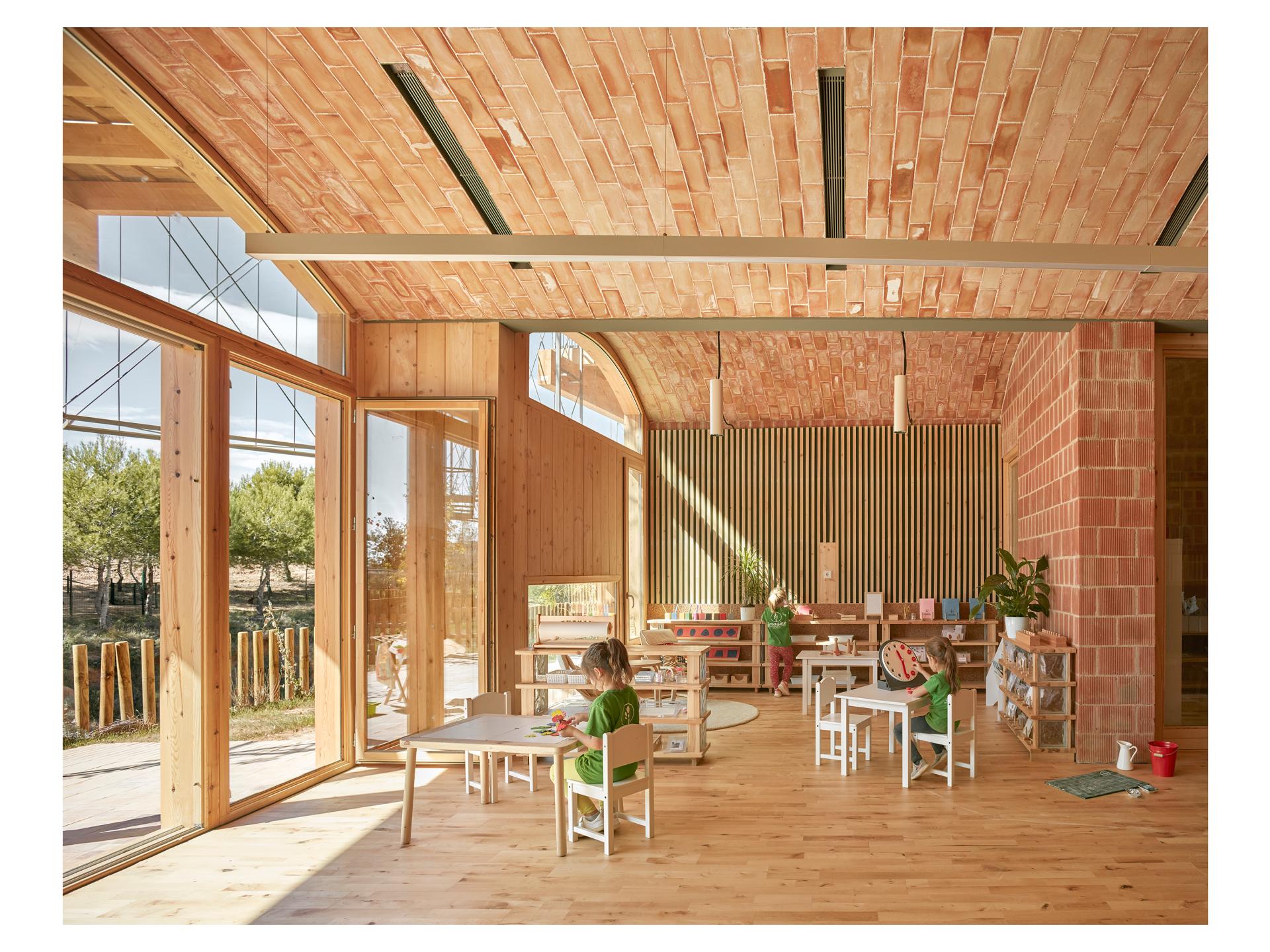
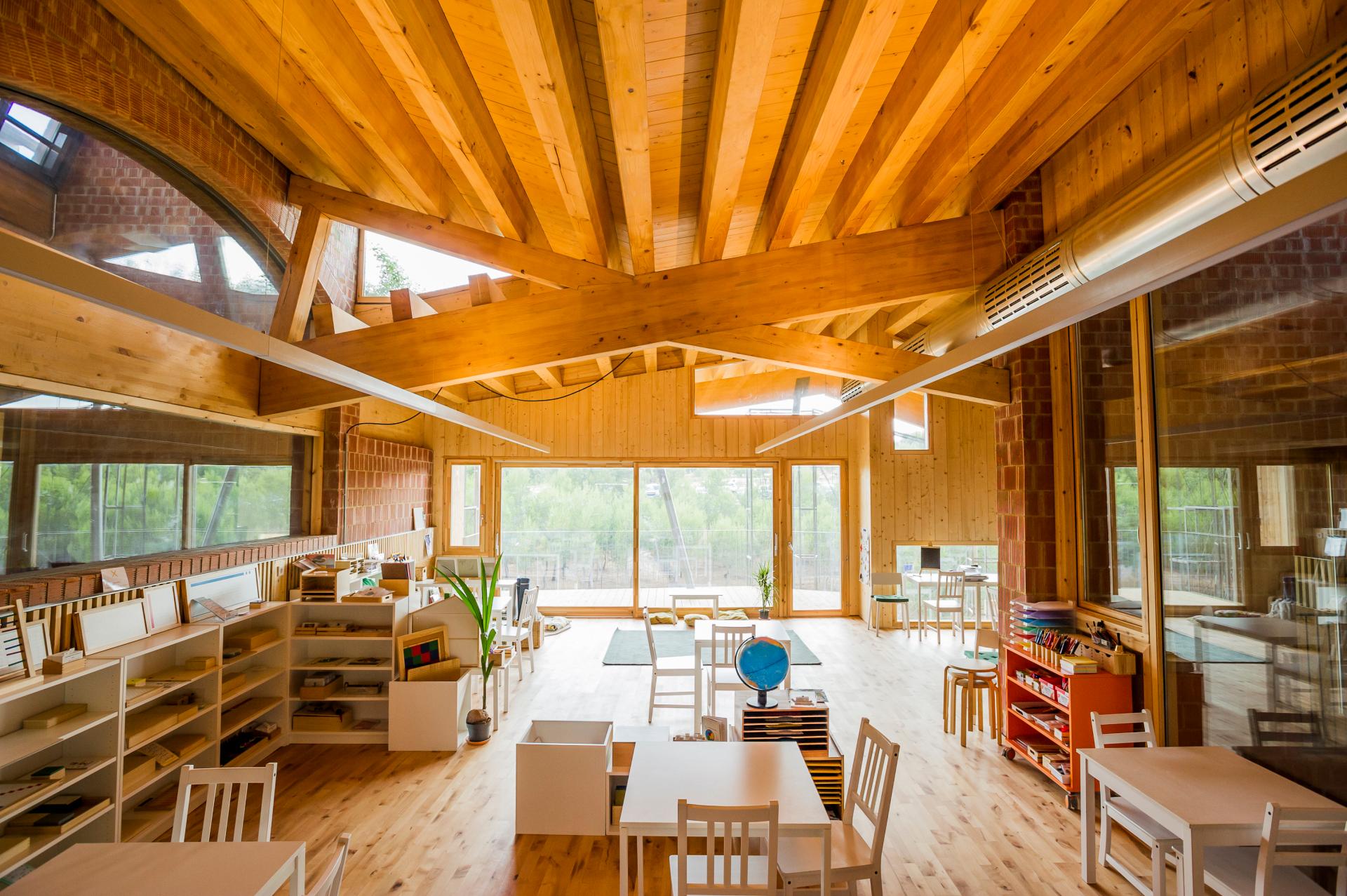
- Selection of the materials: The building materials used in the construction of the Imagine Montessori School were chosen partly for their environmentally friendly qualities. We have avoided using materials such as steel and concrete as much as possible because of their high carbon footprint, instead we focused on materials such as wood and baked clay.
- Wood: All facade and roof coverings have been made with one of the most sustainable materials available: wood. We have sourced wood from sustainably managed forests, which of course absorbs CO2, requires little energy to handle and can be 100% recycled. Most of the facades are made up of wooden frames covered by wooden panels.
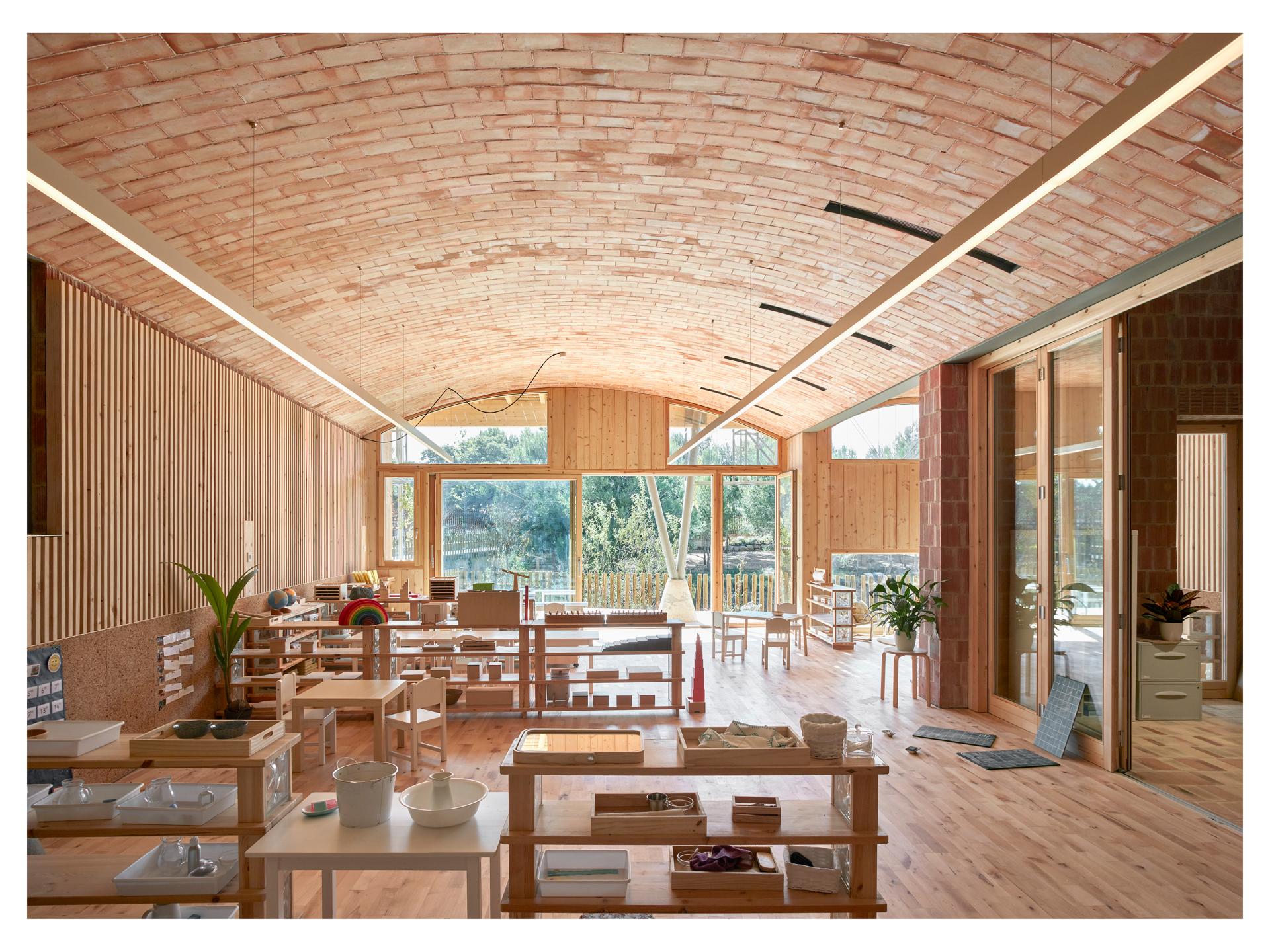
- Baked Clay: The main structure of the building has been made with load bearing brick walls and solid brick Catalan vaults. This is a simple local construction technique, based on the use of ceramic brick and whose shape optimises its structural function and avoids the use of cement, thus significantly reducing the building’s carbon footprint.
- Operations design principles
- Energy generation and Green/Renewable energy: The energy consumed derives from the photovoltaic installation that partially supplies itself. The rest of the energy supplied comes 100% from renewable energies.
- Water consumption: The building has been designed to minimise water consumption, which is why it has been equipped with low-consumption plumbing installations. Additionally, any rainwater that falls on the roof or on the surrounding area is collected in a large buried container and then used to irrigate the garden areas.
Key objectives for aesthetics and quality
- Aesthetics
- Integration with the nature:
- Design principles: A building born from a concept of authenticity; honouring the materials and processes used while respecting the location in which it has been built. Outside, the project is inspired by Nature: earth, air, water, light along with the many plants and animals.
- Green roof: The roof of the school has been transformed into a beautiful green area that blends in with the landscape, providing a habitat for the local flora and fauna. The benefits of this include improving urban climate, reducing pollution, increasing water retention, noise reduction, energy saving, and extending the life of the building.
- Beauty of every space:
- All the spaces in our schools have been designed as prepared environments that promote the learning and development of our students. The exterior and interior spaces are open plan.
- Integration with the nature:
- Quality of experience: In the nature experience
- “La Pinada Fun”:
- As part of the group, we count with the collaboration of “La Pinada Fun” just beside the school, as a continuity of the social life of the school community and extended to any other families willing to join in a relaxed atmosphere.
- It offers soft drinks and something to eat, everything in line with a healthy living style and real fooding movement.
- Forest school
- The school has a forest within the school premises where children can play freely among all the infrastructure developed by our maintenance team, which design and build our own furniture and playing areas.
- Gardening
- The school gardening promotes sensibilization at an early stage and becomes more structured work at the age of 12 when students run their own business growing vegetables and food and they sell it internally to school families.
- “La Pinada Fun”:
Key objectives for inclusion
- Social inclusion: Promoting work for people at risk (risk of social exclusion, or people with disabilities).
- On Payroll: At Imagine we directly offer opportunities to disabled people or to people at risk of social exclusion. We have staff on payroll with these situations.
- Sub-contracting: When contracting services (gardening, kitchen...) we include a clause for the subcontractor to include this profile as a mandatory % of their workforce.
- Partner Associations: We also directly collaborate with a local association of people at risk of exclusion called “Asociación La Coma” with the majority of members of gipsy ethnia.
- Creating awareness of groups at risk.
- Educational inclusion:
- Educational inclusion is a concept of pedagogy and considers that the school should include all individuals in the learning process, despite their condition, origin, race, religion or gender, etc.
- Diversity is a positive value within the school community. We understand our differences and despite our characteristics (physical, psychological, social and cultural) children have the right to receive a quality education.
- We contribute by creating a multicultural environment (+40 nationalities), and valuing diversity.
- Diversity and inclusion:
- At school we value diversity as a lever to enrich our community culture, fostering gender equality and diversity and also valuing differences on religion, race, origin or sexual orientation.
- At Imagine we count with more than 40 nationalities among our community including our LGBT community, and our 2 main annual celebrations are “International Day” that is the result of a month's preparation of all families bringing their home countries culture and the “Family day” in all the different ways a family could be today.
Results in relation to category
We have achieved several impacts on the media since we opened the school in Sep-2016 due to the innovative approach of our School. Top architect magazines as well as national and local newspapers wrote relevant articles. Here you have a selection of them:
- Architect magazines:
- The architectural review - Play (May-2021)
- Metalocus – Escuela sostenible al borde de la ciudad colegio Imagine Montessori (Feb-2021)
- Conarquitectura – Colegio Imagine Montessori School (Feb-2021)
- Espacios para la Infancia – Revista Sequences Bois (Jan-2021)
- Arquitectura y Empresa - Arquitectura Escolar Bioclimática (Oct-2019)
- Construible - Inauguran la escuela sostenible Imagine Montessori en Paterna que contará con un ahorro energético del 70%
- National press
- Los métodos que tratan de romper los moldes – ABC (feb-2020)
- Levante - Montessori inaugura en Paterna el colegio más sostenible de España
- El Mundo - Abre sus puertas el Imagine Montessori School La Pinada
- ABC - Imagine Montessori School La Pinada inaugura su nuevo colegio en Paterna
- Economía3 - Montessori inaugura su nuevo centro educativo sostenible en Paterna
- El Meridiano - Imagine Montessori School La Pinada, nuevo colegio en Paterna
- 7TeleValencia - Paterna tiene el colegio más sostenible de España
- La Canyada te guía - El nuevo centro educativo Montessori School La Pinada abre sus puertas en Valterna
- Valencia International - Imagine Montessori School La Pinada has inaugurated its new school in Paterna
- Prizes
How Citizens benefit
All parties involved during the conception of the School and currently are involved as follows:
- Users:
- Involvement: Participation of all types of school users in the design phase (families, teachers, cooks, cleaning, administrative staff…)
- Impact: Every single area of the school was designed considering the daily operations.
- Neighbourhood:
- Involvement: During the construction phase, as part of our sustainability certification process, we have contacted all neighbors in the area offering a contact person in case any concern/issue arises during that phase. We have also organised a meeting with all the neighbours willing to participate (+80) to explain the mobility plan associated with the new school operations.
- Impact: high satisfaction and onboarding of all parties, even when raising concerns, we showed them on how the traffic flow would flow (simulated analysis based on a drone flight video and extrapolating with new population in the area).
- Education community:
- Involvement: As a pioneer education system, we collaborate with different universities and training centres.
- Impact: contributing to spread this methodology and way of understanding how sustainability, concept of beauty, hands-on learning and academic excellence can live together to take the most of the learning experience.
- Architects and construction:
- Involvement: We also collaborate with the architectural and construction community in collaboration with the Universidad Politécnica de Valencia.
- Impact: to showcase how powerful the construction systems we are using are, to achieve sustainability impact combining easy to access technology and traditional building concepts.
- Sustainability conscious community:
- Involvement: we continuously launch initiatives involving the extended community of the school, related to sustainability such as awareness initiatives.
- Impact: social awareness.
Innovative character
These are the main innovative levers we have used to redesign the traditional design and construction approach:
- Reduce steel and cement used for construction
- Why?: The building materials used in the construction of the Imagine Montessori School were chosen partly for their environmentally friendly qualities. We have avoided using materials such as steel and concrete as much as possible because of their high carbon footprint, instead we focused on materials such as wood and baked clay.
- Wood: All facade and roof coverings have been made with one of the most sustainable materials available: wood. We have sourced wood from sustainably managed forests, which of course absorbs CO2, requires little energy to handle and can be 100% recycled. Most of the facades are made up of wooden frames covered by wooden panels.
- Baked Clay: The main structure of the building has been made with load bearing brick walls and solid brick Catalan vaults. This is a simple local construction technique, based on the use of ceramic brick and whose shape optimises its structural function and avoids the use of cement, thus significantly reducing the building’s carbon footprint.
- Combine with state of the art technology:
- Monitor: Capture key information from all different patterns of use and consumption and analyse it through Power BI (Business Intelligence).
- Automate: apply logical reasoning through specific meassures (CO2 levels, light intensity, water consumption, potential water leaks...) to improve wellness and consumption and to care the environment.
- Machine learning and big data: Based on all data capture, manage the date to conclude data inter-related to continue improving our key variables (maximise wellness, minimise use of resources, etc).
- Apply a solid standard to deploy and sustain our sustainability model:
- First School in the European Union with the double sustainability certificate: Breeam Excellent and Green 4 leaves.