Agritecture
Basic information
Project Title
Full project title
Category
Project Description
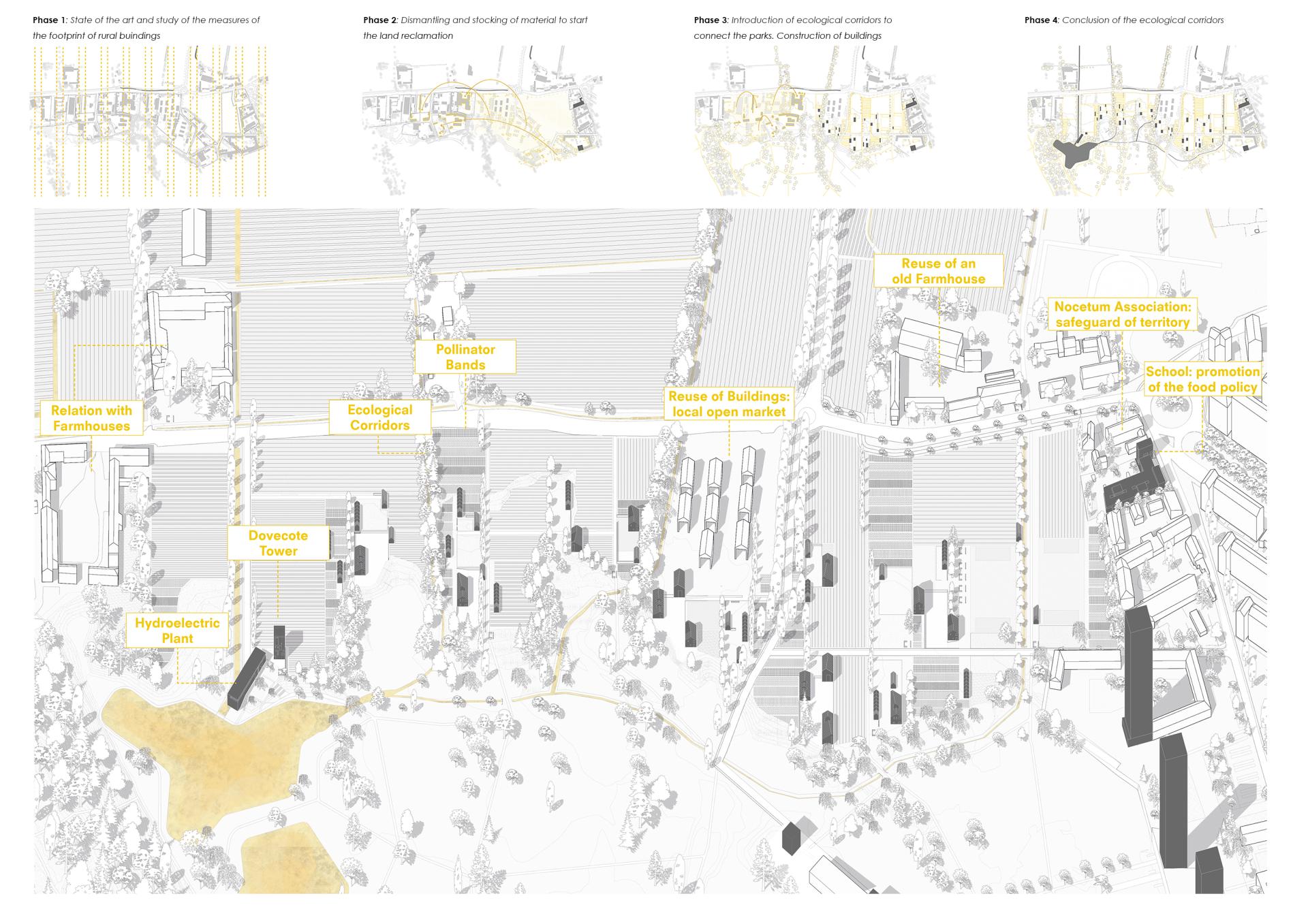
The project is part of a wider masterplan in Porto di Mare and is located above the polluted industrial settlement between two main parks and the open countryside. Here we promoted a strategy aimed at creating a resilient landscape to preserve the agricultural vocation of the site. At the same time, it wants to catalyse and activate Milan's food policy. Great attention was given to the natural capital, preserving the local biodiversity by integrating small artefacts and ecological corridors.
Project Region
EU Programme or fund
Description of the project
Summary
The project area runs for 1.5 km and is located on a former polluted industrial settlement, between two main Milanese parks and the open countryside. It is here promoted a strategy aimed to create a resilient landscape to preserve the agricultural vocation of the site. At the same time, it wants to catalyse the reclamation of the soil to activate and promote the food policy of Milan.
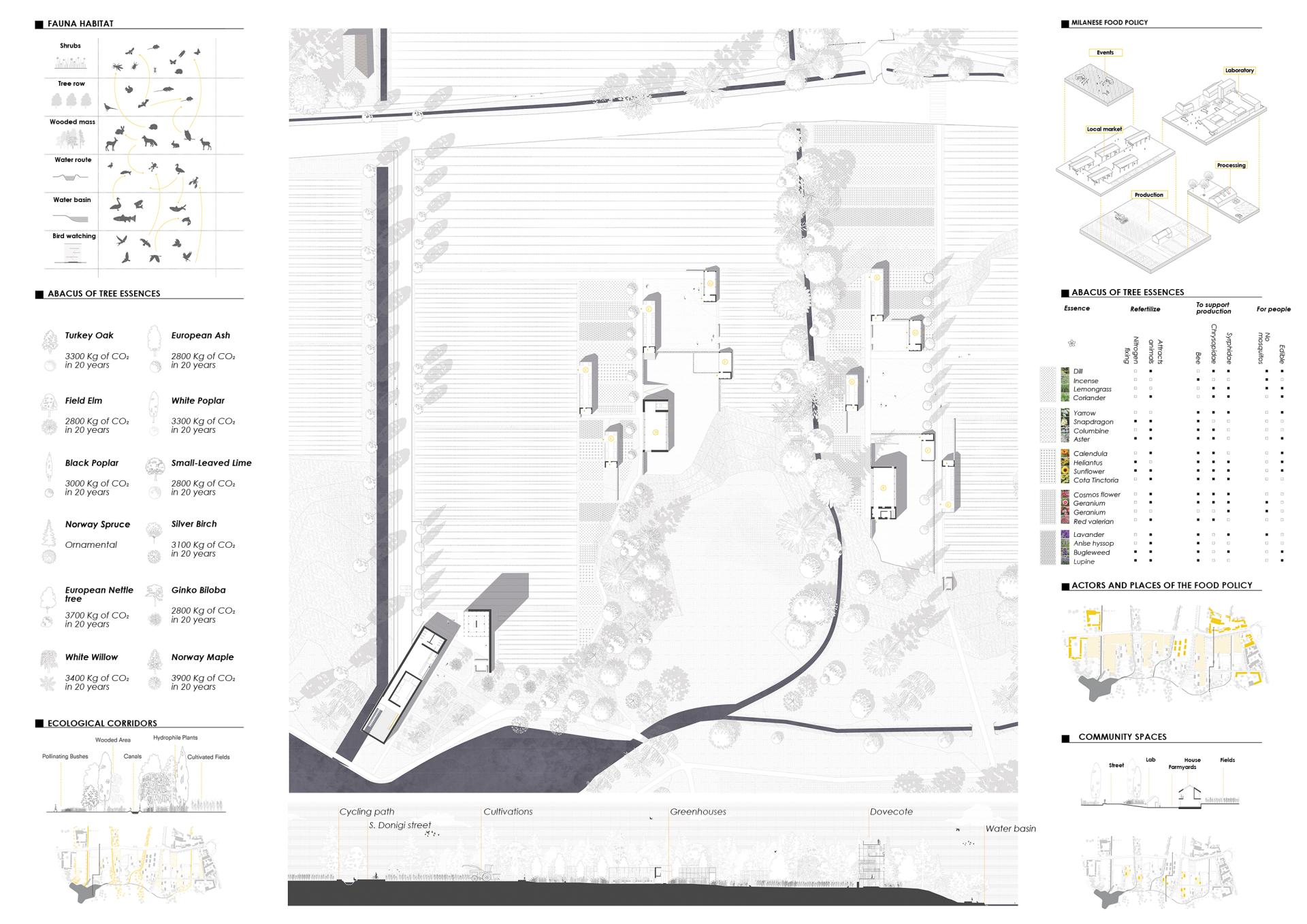
The first action is the disposition of a new design of the area, providing ecological corridors between the two parks. In this sense, it is suggested to be part of an abacus of trees and flowers (pollinator bands) useful to reclaim the environment, but also for the faunistic repopulation. The settlement buildings are mainly workplaces, for breeding and harvesting in greenhouses, but also family dwellings. These ones are designed reusing dismantled materials and conceived following a process of mimesis of traditional buildings elements, such as the pitched roof or the use of bricks, but also with a modern design of the cascine barnyard (typical farmstead in the northern part of Italy): a semi-public space among the buildings, defined by lowering the ground level.
At the beginning and at the end of the area are located two public functions. The first one is a small hydroelectric power plant to produce local energy and a dovecote tower to implement the ecological corridors. At the end of the area is located a kindergarten, where the food policy could be promoted; connected to the local association network.
Key objectives for sustainability
The current polluted industrial area, set at the southern margin of Milan, requires a reflection on the design action and a vision of the future for this area. The necessity of dismantling the majority of these industries set up the urgency of imagining some key objectives that could highlight the sustainable transition of this territory.
Following the reclamation and rehabilitation of the area, the project aims to design a landscape with a clear agricultural vocation, in relation to the surrounding agricultural parks. Furthermore, by applying a dispersion strategy, the percentage of draining, agricultural and open spaces is clearly higher than the previous industrial settlement, highlighting the aim to reduce the land occupation.
Moreover, sustainability is also related to the method and instruments to be used for this regeneration. The project wanted to investigate how the usage of Nature-based solutions could impact the reclamation of a polluted territory, blend with new peri-urban settlement and increase the biodiversity of the area.
The final scope is then of territorial repair, which is assumed systematizing the areas with the context, reactivating social dynamics and the metabolic cycles, producing coexistence practices and care of the peri-urban space by the inhabitants.
Key objectives for aesthetics and quality
The project shows how the implementation of ecological corridors and the renaturalization of former industrial areas could generate a new landscape between the countryside and the city. Designing with nature-based solutions also goes in the direction of increasing the presence of local fauna, such as birdlife and pollinating insects. The regeneration of this territory promotes a renewed biodiversity at the margin of the city, where the experience of space relates with a new sensoriality of nature. In this perspective, the project aims to define a new ecosystem, in which the landscape blends natural elements with the built environment. The nature-based solutions, such as the implementation of ecological corridors, seems to outline an emerging aesthetic, connected to the concept of the “Tiers Paysage”, defining a connection between regeneration processes and environmental urgencies. The role of nature becomes not only a technical solution but reflects upon a new landscape between rurality and urbanity, making the user and the environment closer.
Moreover, buildings contribute to the general aesthetic of the place, using local materials such as bricks, reused wood, etc., and are framed as instruments to reinforce some ecological connection and to preserve and regulate the life of the new landscape itself.
Finally, the regenerated landscape is connected with the agricultural aesthetic that was fragmented and polluted by the abusive industries in the second half of the XX century, revealing a new coexistence between human and nature.
Key objectives for inclusion
As another periphery, the project area is subject to social and economical depression. Because of this reason, the regeneration project aims not only to reclaim soils but also to implement new spaces to attract people and foster social inclusion.
To do so, we imagined building a new local productive community that can host start-up and young entrepreneurs with the aim of innovating local food production. With this, the introduction of urban farming is connected with the close Cascina Nocetum, a local rural community that works toward the social inclusion of migrants and fragile people. Thus, inclusiveness is framed as an action among people and spaces, aimed at having cultural and social needs at the core of the project.
Moreover, to combine socio-ecological actions in approaches that increase the ecosystem potential of the project, the design of the new building clusters always define an internal common space, where it is possible to host a variety of shared functions.
This renewed self-reliant community, which can take care of the site again, reducing the current degradation and restoring a sense of identity.
Innovative character
The intervention is based on the vision that the project could be a tool to regenerate a polluted marginal area. The combination of circular economy strategies and nature-based solutions hints alchemy that open to the possibility to repair and sustain the new neighbourhoods, relating to the theme of regeneration as a growing and adaptive instrument, anchoring the project in its specific urban landscape, intimately entangled with the community process among the site.
Furthermore, the project represents a possibility to increase the local production of agricultural, fruit and vegetable goods. The strategy derived from the desire to get closer to the food policy of the city of Milan, which represents one of the policies of Expo 2015, and is a supporting tool for city government, promoted in synergy by the Municipality of Milan and the Cariplo Foundation. The scope is to make the Milanese food system more sustainable, starting with the protection of Milanese agricultural production, and promoting educational events and workshops in schools.
In this sense, Agritecture foresees and re-elaborates these aspects linked to the city food policy, from production to on-site sales, up to the close relationship with schools and other city services.
The theme of food policies, directly links with the contemporary discussion of the themes of resilience and the circular economy, providing not only the design of new living spaces but also to the study of possible short chains between the spaces of production, processing, resale and consumption of products.
Finally, the Nature-based solutions applied in this masterplan are not framed as technical solutions, rather as a systemic approach to increase local biodiversity and reinforce the ecosystem of the peri-urban Milanese area between rural and urban spaces.