TERRA FLUIDA - HYBRID NATURECULTURES
Basic information
Project Title
Full project title
Category
Project Description
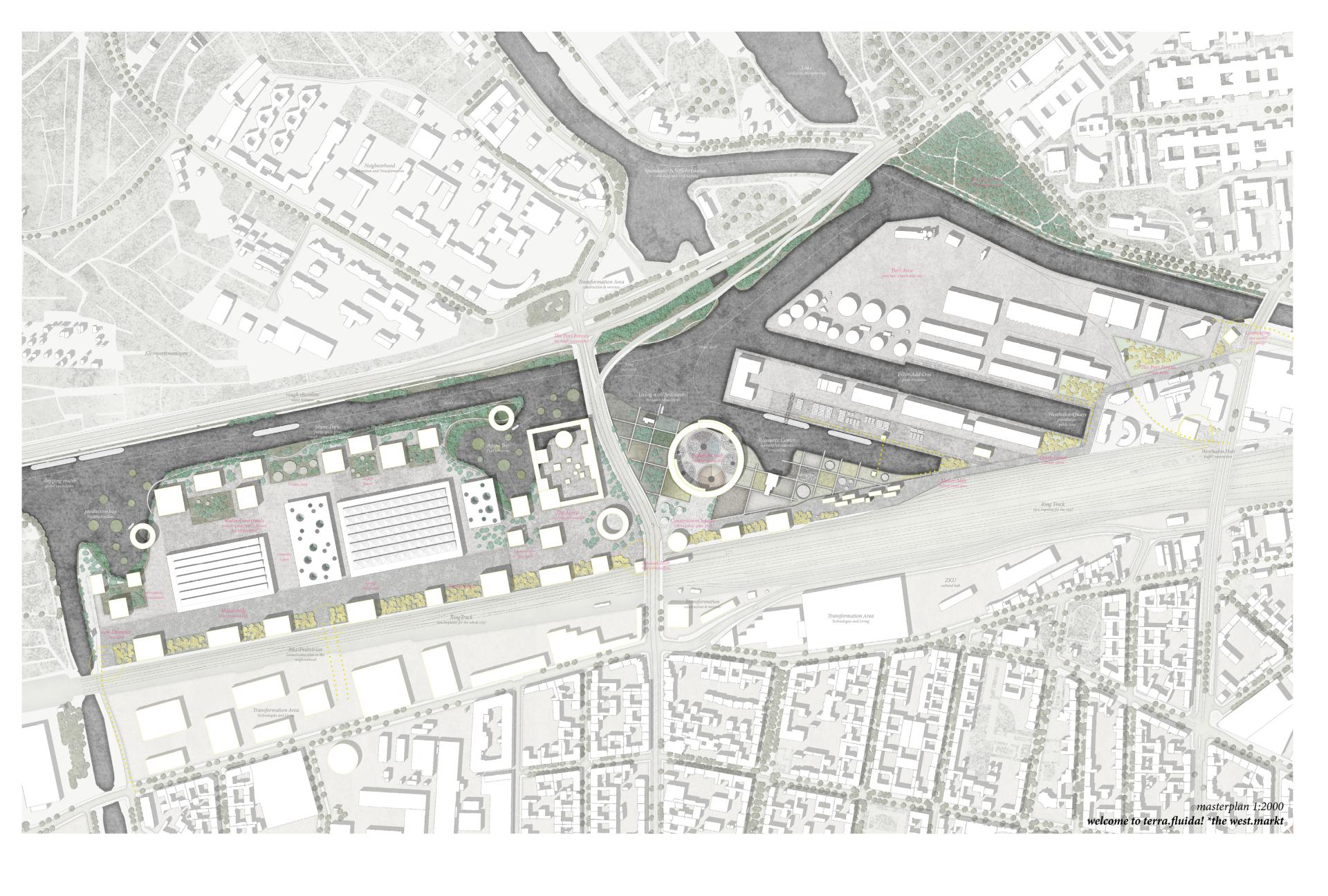
Welcome to Terra Fluida, a vision for the radical transformation of the wholesale market and city harbour in Berlin. Currently isolated and divided, a strategy is developed to transform the area into an hybrid and circular productive district. The vision reinterprets the overlapping layers of infrastructures, ecologies and geology by formulating new spatial and aesthetic concepts of hybrid naturecultures, which result in typologies for a porous and adaptive city which celebrates its metabolism!
Project Region
EU Programme or fund
Description of the project
Summary
The vision shows, how the vast and isolated industrial enclave of the wholesale market and the city harbour in Berlin can be transformed over the next 20+ years into a hybrid and circularly interconnected city district, where interwoven naturecultures at the intersection of infrastructural, ecological and material processes will create a strong backbone of dynamic spatial sequences and hybrid infrastructures.
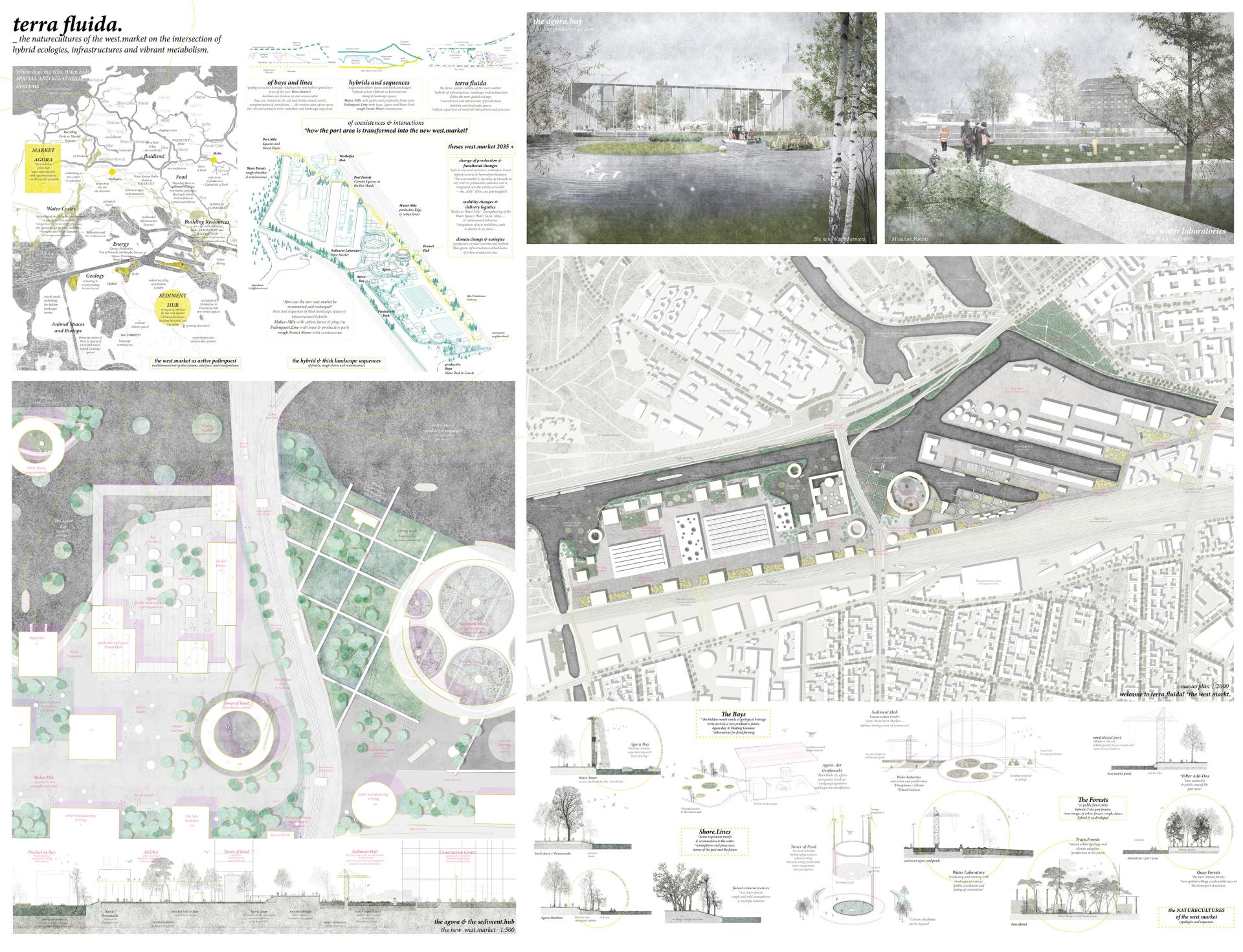
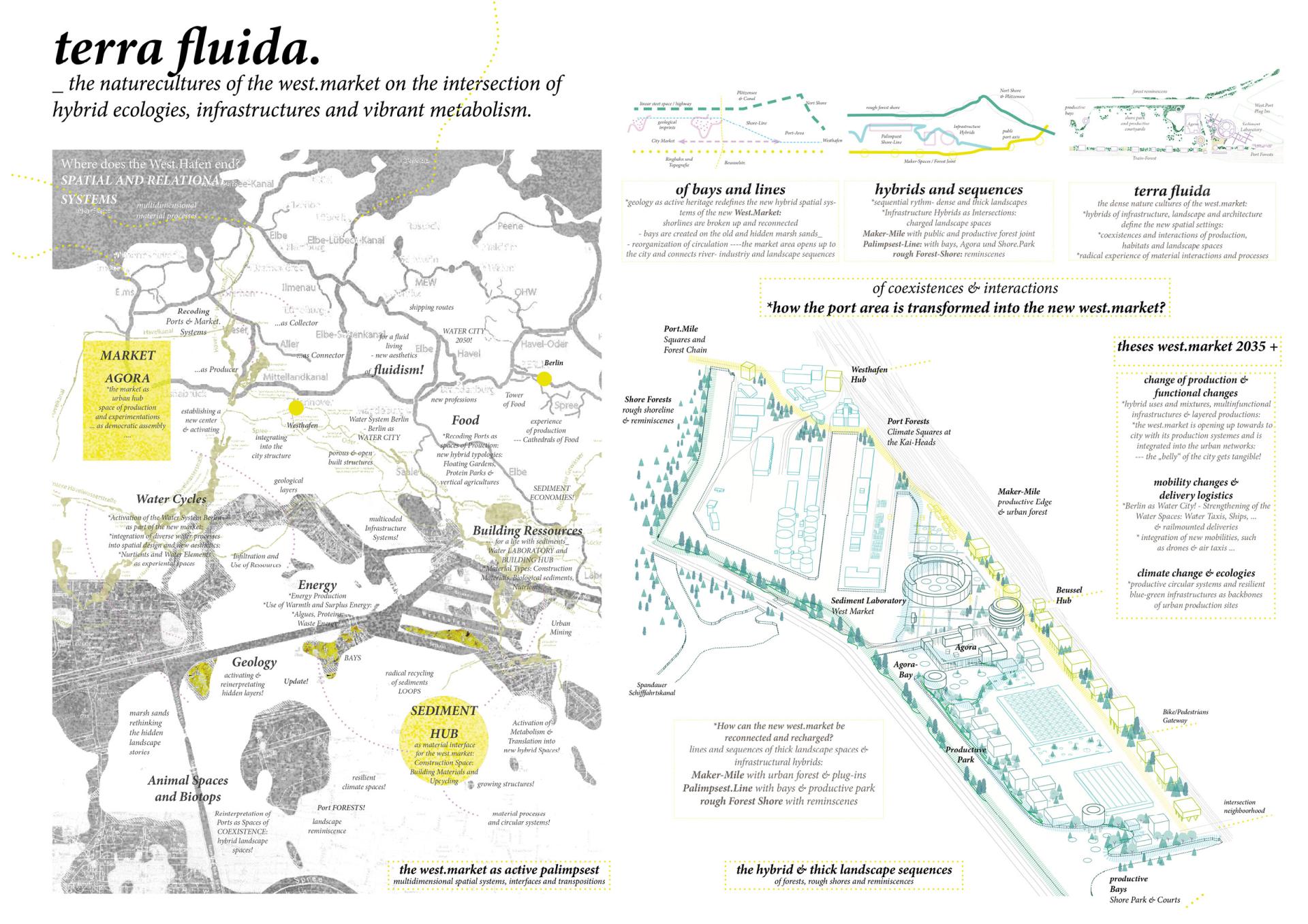
Terra Fluida is celebrating the diverse metabolic processes of Berlin instead of hiding them away, making thus tangible the hybrid links between material flows, geological traces and ecological processes on different (deep) time and spatial scales. Terra fluida is showing how, in times of climate change and pressing urban challenges such as droughts, heavy cloudbursts, lack of biodiversity or shortage of housing, production areas can be developed towards more inclusive, adaptable and porous situations, which provide habitats for humans, as well as for non-humans. The new West.Market will be reprogrammed and intertwined with its surroundings by a set of strong atmospheric typologies of hybrid city-natures along three identified sequential lines:
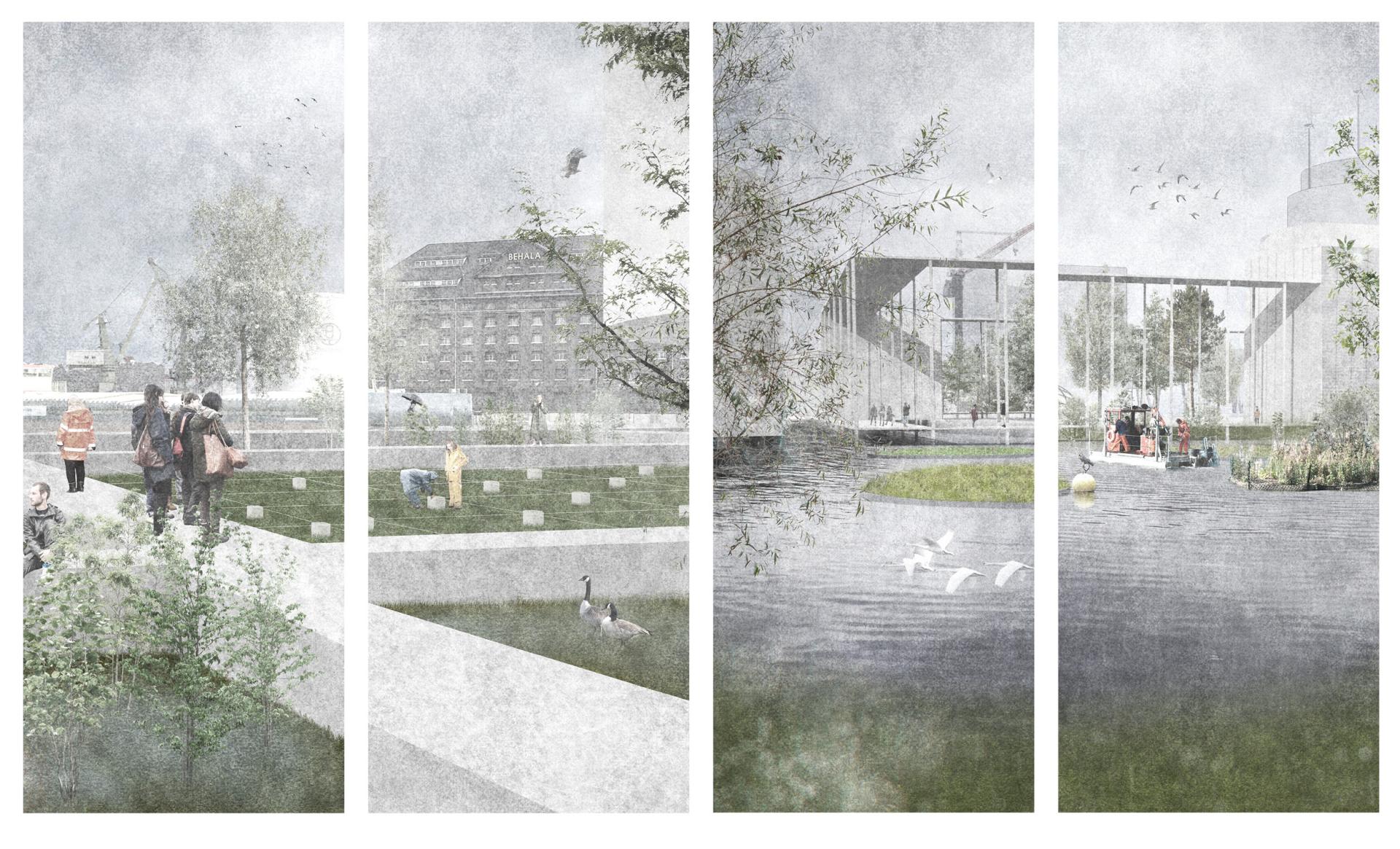
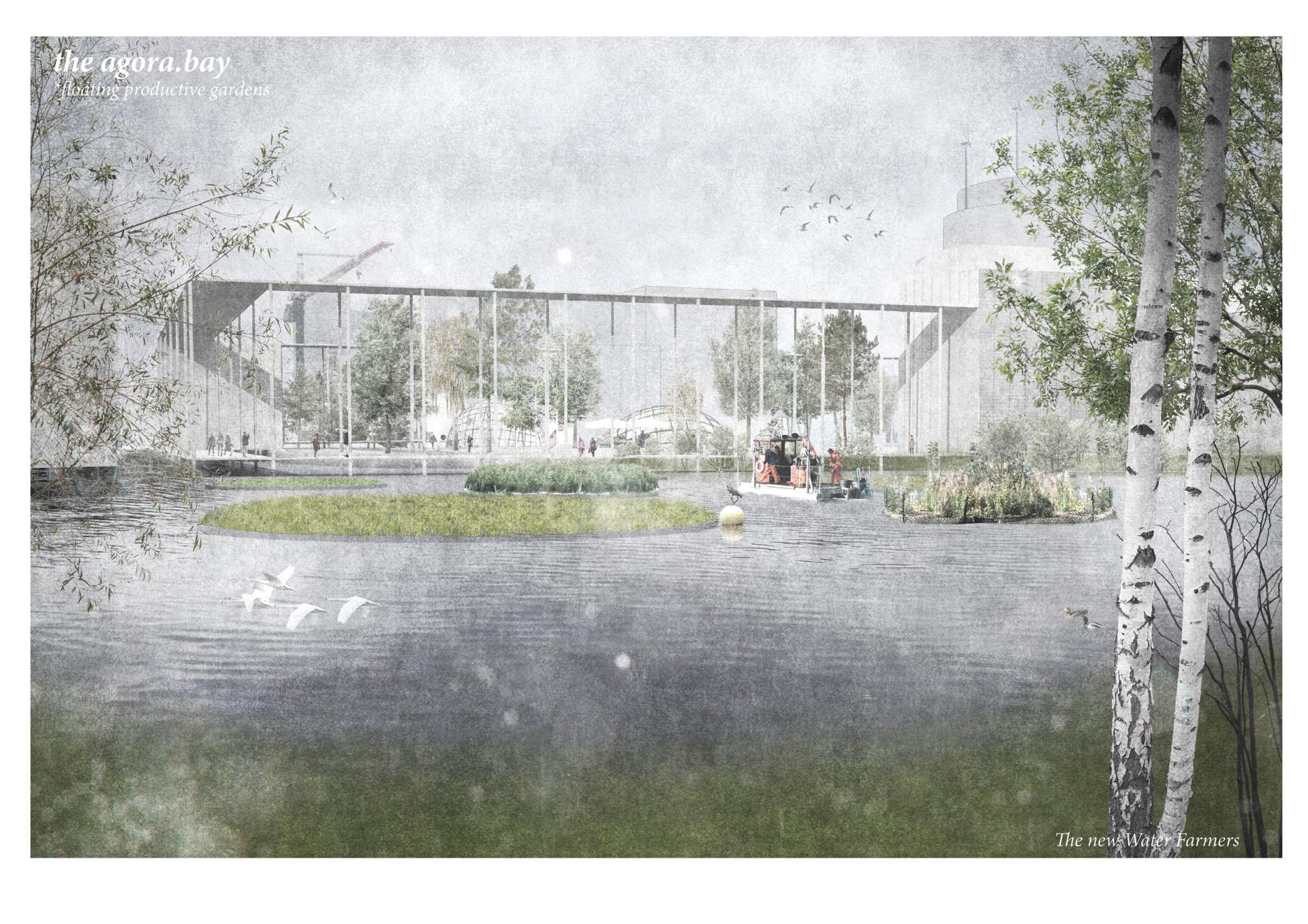
The hidden geological structure of Berlin and its former marshsands is re-interpreted as the Palimpsest-Line: the existing shoreline will be re-dynamized and developed towards two productive bays, where hybrid infrastructures, such as the democratic Agora and the metabolic heart, the Sediment Hub with its water laboratories, are located, and where new metabolic practices are being tested, re-interpreting geology for a productive future.
Along the rail-tracks, the Maker-Mile is evolving: It connects the wholesale market with the port area and is designed as an innovative and creative mixed-use zone, where maker spaces and housing merge with linear urban climate forests. Together with the rough shoreline, the developed naturecultures demonstrate a strategy for an interwoven and inclusive city in the anthropocene!
Key objectives for sustainability
RADICAL CIRCULARITY: Terra Fluida is based on a circular concept, by making tangible the different components and the aesthetic realm of urban metabolism. Urban mining is consequently translated into hybrid structures, with the goal of a zero-waste district, which reuses all its building materials, waste and by-products. The different metabolic systems, such as water, building materials/sediments, energy, waste and food are treated in a circular manner and are spatially and materially interconnected.
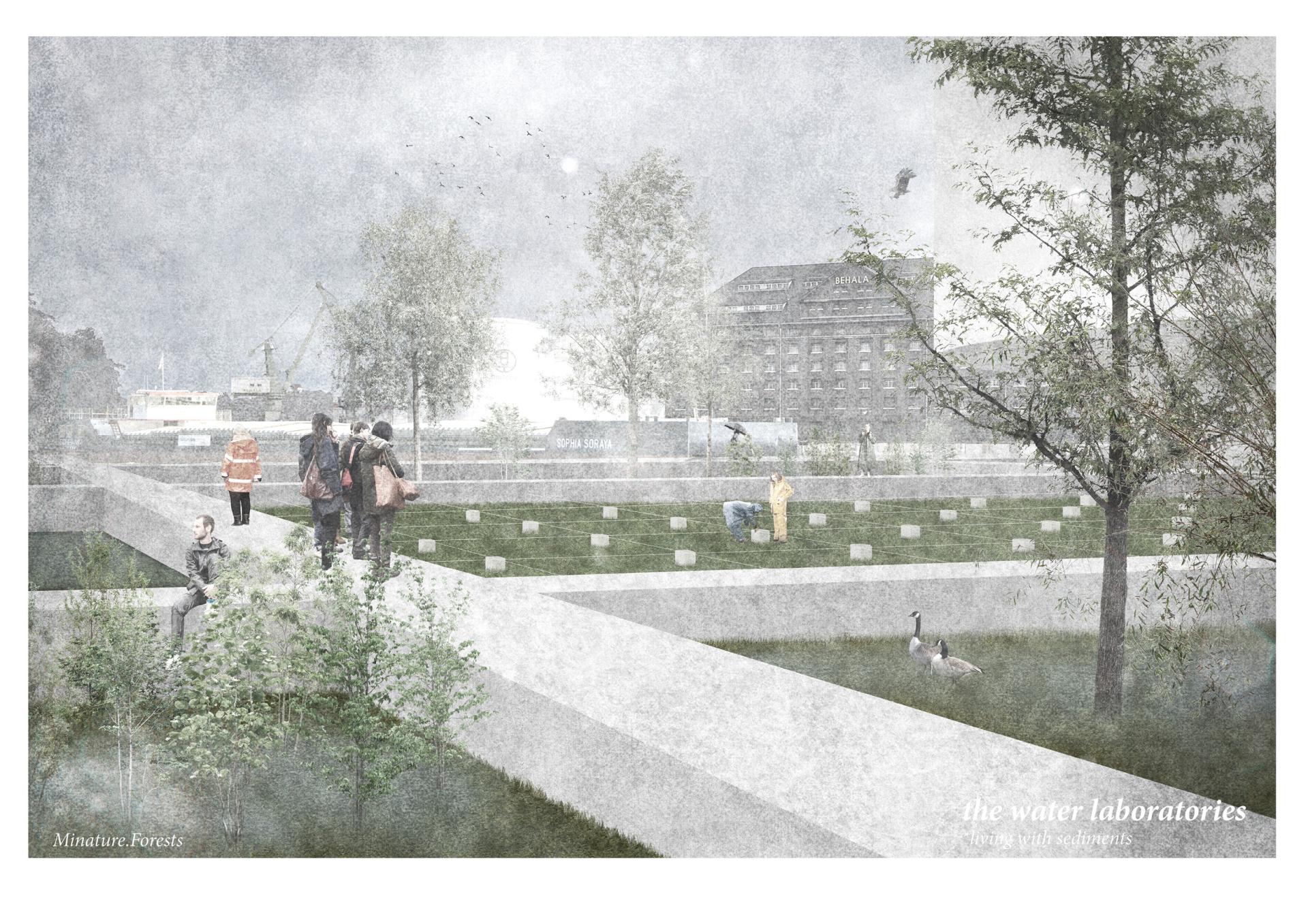
PRODUCTIVE GEOLOGY: Water is the core element for the design: Along the palimpsest.shoreline, productive bays with floating gardens evolve on the hidden marshsands. In those bays, waterfarms create new and innovative ways to provide the city with food. Together with the new food parlament, the Agora and the hybrid Tower of Food, where food and energy production is organized and displayed vertically, a sustainable approach towards local food production and research is established. The metabolic heart of the new west.market is the Sediment-Hub, a multilayered recycling center and water laboratory, where people can experience on-site the circular production system of the West-Market: the radical treatment and upcycling of the different sediment types, nutrients or building materials. A new type of public interaction is created by walkways and staircases around the pools and pourings to feel and see the new spatial aesthetics of urban metabolism.
COOLING SPINE: To tackle the challenges of climate change, the new west.market.district is regarded as breathing and cooling spine in the city structure: Climate sensitive planning tools and ecological processes are adapted to create cooling and breathing spaces, such as the urban forest joint along the rail tracks, climate groves at the port quays, or hybrid blue-green uses for rooftop spaces for production of energy, add-ons for animalhabitats or climate machines for diverse microclimates in the different public spaces.
Key objectives for aesthetics and quality
BEYOND NATURE: Goal of the Project is to explore the alternative and often overseen aesthetics of urban metabolism and to translate them into hybrid urban naturecultures, where contemporary and romanticized images of nature are challenged and being tested. The vision reinterprets the overlapping layers of materials and sediments, infrastructures, ecologies and geologies and formulates new spatial and aesthetic concepts of hybrid naturecultures at the intersection of infrastructures, material processes and how they mutually define each other.
HYBRID AESTHETICS: The project is actively engaging in the question, on how we can feel, see, sense and experience those diverse urban metabolic processes of cities (regions), which are actively linked through different (deep) time layers of material and geological imprints and spatial scales, such as the multidimensionality of the water system. A set of strong atmospheric, site-shaping spaces and hybrid architectures is evolving by proposing new and radical ways of living and experiencing together with material flows, ecological processes and infrastructural spaces. A renewed repertoire of hybrid aesthetical categories is evolving around the notions of roughness, fluidity, terrestrial and planetary interconnectedness.
TANGIBLE METABOLISM: Terra Fluida wants to advocate towards a new approach of city planning/landscape architecture, where sediments and material flows not only remain "the unconcealed", but rather be seen as attractive dynamic and adaptable space builders which define the contemporary parameters for urban planning: Spatially, programmatically and resilient, making production and the urban metabolism tangible for everyone, while at the same time providing a valuable habitat for both man and nature. Terra fluida is a strategy for a porous, inclusive and adaptable European city in the anthropocene!
Key objectives for inclusion
INCLUSIVE METABOLISM: Our project asks how isolated urban production areas and the underlying metabolism and processes can be reinterpreted and re-thought as integral parts of city territories and as dynamic spaces, where the metabolic interdependencies get tangible and translated into adaptive spatial structures, that are open to the public with a diverse range of public space to meet, negotiate and co-produce important metabolic topics of today's cities.
The concept of Terra Fluida is based on an inclusive approach towards society and community-building which goes far beyond its spatial framework. The area will not only be physically fully accessible and barrier-free, but also act as a hub for active participation, where local stakeholders, the municipality and private companies can exploit synergies in co-producing an open-ended and adaptive urban neighborhood.
FOOD DEMOCRACY: Being inspired by the ancient agora, people can gather, discuss and participate in the future agora, the democratic center of the West.market. Together with Tower of Food, it opens up spaces for debates on urban food production, participation and solidarity. Sharing knowledge about urban food production, recycling methods and degradation processes are key principles for the inclusivity of the new West.market. Furthermore, aspects, such as environmental and nature education and new urban practices, such as water farming or vertical agriculture can be tested and lived.
MULTISPECIES APPROACH: The strategy for the new west.market is explicitly directed towards human AND non-human needs and thus reflects a multispecies approach for an inclusive city structure. The design solutions show hybrid ways of integrating and overlapping habitats and important biotope structures with infrastructural and architectural elements and functions and thus create a co-evolution of built structures and the environment.
Innovative character
SHIFTING PRACTICE: Terra Fluida develops radical alternatives to current methodological approaches and design practices in landscape architecture/city planning. Instead of categorizing the urban metabolism and its spatial presence as something disconnected, abstract or intangible, we search the answers for an holistic (design) approach by engaging the multidimensional spaces of sediment, food, water and waste systems and by integrating its manifold facettes and spaces into a new design language, a design paradigma, which is based on a renewed concept of nature and city in the anthropocene and its intertwined challenges, overlaying geological, infrastructural and ecological structures and processes - in search for a HYBRID CITY: We search the answers in the hybrids, at the intersection of disciplines, at the edges of the discourse.
We are creating NATURECULTURES: new typologies between infrastructures and ecologies, between humans and non-humans, between deep-time and future technologies, between architecture and nature, between beautiful and rough, the terrestrial and the planetary. Preparing for the upcoming challenges of climate change and the the post-covid-era requires a consequent retrofitting of our city territories and a hybrid design attitude: Nature is dead. Long live Naturecultures! Let´s act!